

Bali Myna (Leucopsar rothschildi) at Lowry Park Zoo by Lee
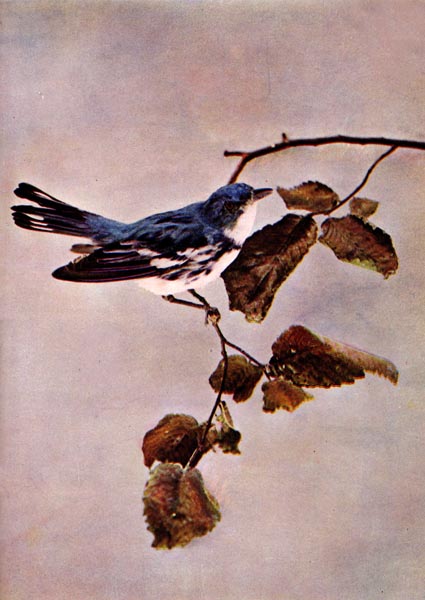
Cerulean Warbler (Setophaga cerulea) – Birds Illustrated by Color Photography

HIS beautiful little sky-blue feathered creature is well named Azure Warbler, or again White-throated Blue Warbler, and is the most abundant of the genus here.
It is a bird of the wood, everywhere associated with the beautiful tall forests of the more northern counties of western New York, sometimes found in the open woods of pasture-lands, and quite partial to hardwood trees. In its flitting motion in search of insect-prey, and in the jerking curves of its more prolonged flight, as also in its structure, it is a genuine Wood Warbler and keeps for the most part to what Thoreau calls the “upper story” of its sylvan domain.
All Warblers, it has been said, depend upon their markings rather than song for their identity, which renders the majority of the tribe of greater interest to the scientist than to the novice. Until you have named four or five of the commonest species as landmarks, you will be considerably confused.
Audubon described the song of the Cerulean Warbler as “extremely sweet and mellow,” whereas it is a modest little strain, says Chapman, or trill, divided into syllables like zee, zee, zee, ze-ee-ee-eep, or according to another observer, rheet, rheet, rheet, rheet, ridi, idi, e-e-e-e-ee; beginning with several soft warbling notes and ending in a rather prolonged but quite musical squeak. The latter and more rapid part of the strain, which is given in the upward slide, approaches an insect quality of tone which is more or less peculiar to all true Warblers, a song so common as to be a universal characteristic of our tall forests.
It is not strange that the nest of this species has been so seldom discovered, even where the bird is very abundant during the breeding season. It is built in the higher horizontal branches of forest trees, always out some distance from the trunk, and ranging from twenty to fifty feet above the ground. One described by Dr. Brewer, found in Ontario, near Niagara Falls, was built in a large oak tree at the height of fifty or more feet from the ground. It was placed horizontally on the upper surface of a slender limb between two small twigs; and the branch on which it was thus saddled was only an inch and a half in thickness, being nine feet from the trunk of the tree. The abandoned home was secured with great difficulty.
The nest is a rather slender fabric, somewhat similar to the nest of the Redstart, and quite small for the bird, consisting chiefly of a strong rim firmly woven of strips of fine bark, stems of grasses, and pine needles, bound round with flaxen fibres of plants and wool. Around the base a few bits of hornets’ nests, mosses, and lichens are loosely fastened. The nest within is furnished with fine stems and needles, the flooring very thin and slight.
The bird is shy when started from the nest, and has a sharp chipping alarm-note common to the family.
The Cerulean Warbler is found in the Eastern States, but is more numerous west of the Allegheny mountains, and throughout the heavily wooded districts of the Mississippi valley. In winter it migrates to Central America and Cuba. The Warblers are of unfailing interest to the lover of bird life. Apart from the beauty of the birds themselves, with their perpetually contrasting colors among the green leaves, their pretty ways furnish to the silent watcher an ever changing spectacle of the innocent life in the tree-tops.
Summary:
CERULEAN WARBLER—Dendræca caerulea. Other names: “Azure Warbler;” “White-throated Blue Warbler.”
Range—Mississippi valley as far north as Minnesota, and eastward as far as Lockport, N. Y. (Davison.) Winters in the tropics.
Nest—Of fine grasses bound with spider’s silk, lined with strips of bark and with a few lichens attached to its upper surface, in a tree, twenty-five to fifty feet from the ground. (Chapman.)
Eggs—Four, creamy-white, thickly covered with rather heavy blotches of reddish brown.

Cerulean Warbler (Dendroica cerulea) ©WikC
Lee’s Addition:
The birds of heaven dwell by them; they give forth their voice from among the branches. (Psalms 104:12 Darby)
The Lord has given us another neat little bird to observe. The color reminds us of the blue sky above. The Cerulean Warblers are part of the Parulidae – New World Warblers Family.
“Adult males have pale cerulean blue upperparts and white underparts with a black necklace across the breast; they also have black streaks on the back and flanks. Females and immature birds have greyer or greenish upperparts, a pale stripe over the eye, and no streaking on the back and no necklace. All of these birds, regardless of their age, have wing bars and a thin pointed bill. A small wood warbler of about 4 inches (11.5 cm) in length, with long pointed wings, short tail, and long under tail coverts. Males have blue upper parts and white below with black streaking on back and upper tail coverts. Females are bluish-green to olive-green above with white under parts and a white or yellowish eyebrow stripe. Both sexes have 2 white wing bars and white tail spots. Juveniles are similar to female with brownish/gray upper parts, white under parts and a pale crown stripe. The cerulean warbler is often found high in the canopy of mature forests.
Their breeding habitats are mature deciduous forests in eastern North America. They migrate to spend the boreal winter in forested mountain areas in South America. The cerulean warbler is an early migrant and arrives on breeding grounds up to 2 weeks before other wood warbler migrants. Males arrive one week before females and pairs form as soon as females arrive. Age of first breeding is one year. Both sexes participate in nest site selection but construction is carried out by the female who may take up to a week to construct the nest.
They forage actively high in trees, sometimes catching insects in flight. These birds mainly eat insects. Their nests are cup-shaped, and are placed on a horizontal branch high in a hardwood tree. The song is a buzzed zray zray zray zray zeeee. The call is a slurred chip.
Song by Tayler Brooks – xeno-canto.org
The Cerulean Warbler is the fastest declining neotropical migrant songbird. Among the many threats they face, their wintering habitat in the northern Andes is dwindling rapidly. Cerulean Warblers depend on shade coffee plantations during the winter. In fragmented forest areas, this bird is vulnerable to nest parasitism by the Brown-headed Cowbird. This bird’s numbers are declining faster than any other warbler species in the USA; its population in 2006 was less than one-fifth of what it was 40 years before.
The Cerulean Warbler has been recorded as a vagrant to Iceland.” (Wikipedia and NY DEC with editing)

Cerulean Warbler (Dendroica cerulea) at nest ©L Walkinshaw
*
Birds Illustrated by Color Photography – Revisited
The above article is an article in the monthly serial for October 1897 “designed to promote Knowledge of Bird-Live.” These include Color Photography, as they call them, today they are drawings. There are at least three Volumes that have been digitized by Project Gutenberg.
To see the whole series of – Birds Illustrated by Color Photography – Revisited
*
(Information from Wikipedia and other internet sources)
Next Article – The Yellow-billed Tropic Bird
The Previous Article – The Wild Turkey
*
Links:
*

The Wild Turkey
From Col. Fred. Kaempfer.
Copyrighted by Nature Study Pub. Co., 1897, Chicago.

T has been observed that when the Turkey makes its appearance on table all conversation should for the moment be suspended. That it is eaten in silence on some occasions may be inferred from the following anecdote: A certain judge of Avignon, famous for his love of the glorious bird, which the American people have wisely selected for the celebration of Thanksgiving Day, said to a friend: “We have just been dining on a superb Turkey. It was excellent. Stuffed with truffles to the very throat—tender, delicate, filled with perfume! We left nothing but the bones!” “How many were there of you?” asked his friend. “Two,” replied the judge, “the Turkey—and myself!” The reason, no doubt, why this brilliant bird, which so much resembles the domestic Turkey, is now almost extinct. It was formerly a resident of New England, and is still found to some extent as far north-west as the Missouri River and south-west as Texas. In Ohio it was formerly an abundant resident. Dr. Kirtland (1850) mentions the time when Wild Turkeys were more common than tame ones are now.
The nests of this bird are very difficult to discover, as they are made on the ground, midst tall, thick weeds or tangled briars. The female will not leave the nest until almost trodden upon. It is stated that when the eggs are once touched, she will abandon her nest.
The Turkey became known to Europeans almost immediately upon the discovery of America by the Spaniards in 1518, and it is probable that it is distinctively an American bird. In its wild state, its plumage, as in the case of the Honduras Turkey, grows more lustrous and magnificent as the family extends southward.
The “Gobblers,” as the males are called, associate in parties of ten to one hundred, seeking their food apart from the females, which wander singly with their young or in troops with other hens and their families, sometimes to the number of seventy or eighty. They travel on foot, unless disturbed by the hunter or a river compels them to take wing. It is said that when about to cross a river, they select a high eminence from which to start, that their flight may be more sure, and in such a position they sometimes remain for a day or more, as if in consultation. On such occasions the males gobble vociferously, strutting about pompously as if to animate their companions. At the signal note of their leader, they wing their way to the opposite shore.
The Wild Turkey feeds on many kinds of berries, fruits, and grasses. Beetles, tadpoles, young frogs, and lizards are sometimes found in its crop. When the Turkeys reach their destination, they disperse in flocks, devouring the mast as they proceed.
Pairing time begins in March. The sexes roost apart, but at no great distance, so that when the female utters a call, every male within hearing responds, rolling note after note in rapid succession, in a voice resembling that of the tame Turkey when he hears any unusual noise. Where the Turkeys are numerous, the woods from one end to the other, sometimes for many miles, resound with these voices of wooing.
The specimen of the Wild Turkey presented in this number of Birds is of extraordinary size and beauty, and has been much admired. The day is not far distant when a living specimen of this noble bird will be sought for in vain in the United States.
WILD TURKEY—Meleagris gallopava.
Range—Eastern United States from Pennsylvania southward to Florida, west to Wisconsin, the Indian Territory and Texas.
Nest—On the ground, at the base of a bush or tree.
Eggs—Ten to fourteen, pale cream buff, finely and evenly speckled with grayish brown.

Wild Turkey (Meleagris gallopavo) by Lee at LPZoo
Lee’s Addition:
Of all clean birds you may eat. (Deuteronomy 14:11 AMP)
The Wild Turkey (Meleagris gallopavo) is native to North America and is the heaviest member of the diverse Galliformes and are in the Phasianidae – Pheasants, Fowl & Allies Family. It is the same species as the domestic turkey, which was originally derived from a southern Mexican subspecies of Wild Turkey (not the related Ocellated Turkey). Although native to North America, the Wild Turkey got its name due to the trade routes in place. During the 16th Century, the major trade route from the Americas and Asia required the goods to go to Constantinople in Turkey before being sent to Britain. The British at the time therefore, associated the Wild Turkey with the country Turkey and the name stuck.
Adult wild turkeys have long reddish-yellow to grayish-green legs. The body feathers are generally blackish and dark brown overall with a coppery sheen that becomes more complex in adult males. Adult males, called toms or gobblers, have a large, featherless, reddish head, red throat, and red wattles on the throat and neck. The head has fleshy growths called caruncles. Juvenile males are called jakes, the difference between an adult male and a juvenile is that the jake has a very short beard and his tail fan has longer feathers in the middle. The adult male’s tail fan will be all the same length. When males are excited, a fleshy flap on the bill expands, and this, the wattles and the bare skin of the head and neck all become engorged with blood, almost concealing the eyes and bill. The long fleshy object over a male’s beak is called a snood. When a male turkey is excited, its head turns blue; when ready to fight, it turns red. Each foot has three toes in front, with a shorter, rear-facing toe in back; males have a spur behind each of their lower legs.
Male turkeys have a long, dark, fan-shaped tail and glossy bronze wings. The male is substantially larger than the female, and his feathers have areas of red, purple, green, copper, bronze, and gold iridescence. Females, called hens, have feathers that are duller overall, in shades of brown and gray. The primary wing feathers have white bars. Turkeys have 5000 to 6000 feathers. Tail feathers are of the same length in adults, different lengths in juveniles.
Males typically have a “beard”, a tuft of coarse hair (modified feathers) growing from the center of the breast. Beards average 230 mm (9.1 in) in length. In some populations, females have a beard, usually shorter and thinner than that of the male. The adult male (or “tom”) normally weighs from 5 to 11 kg (11 to 24 lb) and measures 100–125 cm (39–49 in) in length. The adult female (or “hen”) is typically much smaller at 2.5–5.4 kg (5.5–12 lb) and is 76 to 95 cm (30 to 37 in) long. The wings are relatively small, as is typical of the galliform order, and the wingspan ranges from 1.25 to 1.44 m (4 ft 1 in to 4 ft 9 in). The bill is also relatively small. The tarsus of the Wild Turkey is quite long and sturdy. The tail is also relatively long The record-sized adult male Wild Turkey, … weighed 16.85 kg (37.1 lb). While it is usually rather lighter than the waterfowl, after the Trumpeter Swan, the turkey has the second heaviest maximum weight of any North American bird. Going on average mass, several other birds on the continent, including the American White Pelican and the very rare California Condor and Whooping Crane surpass the mean weight of turkeys.
Turkeys have many vocalizations: “gobbles,” “clucks,” “putts,” “purrs,” “yelps,” “cutts,” “whines,” “cackles,” and “kee-kees.” In early spring, male turkeys, also called gobblers or toms, gobble to announce their presence to females and competing males. The gobble can carry for up to a mile. Males also emit a low-pitched “drumming” sound; produced by the movement of air in the air sack in the chest, similar to the booming of a prairie chicken. In addition they produce a sound known as the “spit” which is a sharp expulsion of air from this air sack. Hens “yelp” to let gobblers know their location. Gobblers often yelp in the manner of females, and hens can gobble, though they rarely do so. Immature males, called jakes, often yelp.
Males Displaying:
Female Calling:
Alarm Call by several birds.
Wild turkeys prefer hardwood and mixed conifer-hardwood forests with scattered openings such as pastures, fields, orchards and seasonal marshes. Open, mature forest with a variety of interspersion of tree species appear to be preferred. In the Northeast of North America, turkeys are most profuse in hardwood timber of oak-hickory and forests of red oak, beech, cherry and white ash. Best ranges for turkeys in the Coastal Plain and Piedmont sections have an interspersion of clearings, farms, and plantations with preferred habitat along principal rivers and in cypress and tupelo swamps. Appalachian and Cumberland plateaus, birds occupy mixed forest of oaks and pines on southern and western slopes, also hickory with diverse understories. Bald cypress and sweet gum swamps of s. Florida; also hardwood of Cliftonia in north-central Florida. Lykes Fisheating Creek area of s. Florida has hardwood hammocks, glades of short grasses with isolated live oak; nesting in neighboring prairies. Original habitat here was mainly longleaf pine with turkey oak and slash pine “flatwoods,” now mainly replaced by slash pine plantations.
Wild turkeys are omnivorous, foraging on the ground or climbing shrubs and small trees to feed. They prefer eating hard mast such as acorns, nuts, and various trees, including hazel, chestnut, hickory, and pinyon pine as well as various seeds, berries such as juniper and bearberry, roots and insects. Turkeys also occasionally consume amphibians and small reptiles such as lizards and snakes. Poults have been observed eating insects, berries, and seeds. Wild turkeys often feed in cow pastures, sometimes visit back yard bird feeders, and favor croplands after harvest to scavenge seed on the ground. Turkeys are also known to eat a wide variety of grasses.
Males are polygamous, mating with as many hens as they can. Male wild turkeys display for females by puffing out their feathers, spreading out their tails and dragging their wings. This behavior is most commonly referred to as strutting. Their heads and necks are colored brilliantly with red, blue and white. The color can change with the turkey’s mood, with a solid white head and neck being the most excited. They use gobbling, drumming/booming and spitting as signs of social dominance, and to attract females. Courtship begins during the months of March and April, which is when turkeys are still flocked together in winter areas. (Wikipedia with editing)
This was taken on the Roaring Fork Drive in Gatlinburg, TN last October.
*
Birds Illustrated by Color Photography – Revisited
The above article is an article in the monthly serial for October 1897 “designed to promote Knowledge of Bird-Live.” These include Color Photography, as they call them, today they are drawings. There are at least three Volumes that have been digitized by Project Gutenberg.
To see the whole series of – Birds Illustrated by Color Photography – Revisited
*
(Information from Wikipedia and other internet sources)
Next Article – The Cerulean Warbler
The Previous Article – The Piping Belted Plover
*
Links:
*

Green Heron (Butorides virescens) by Lee
“But now ask the beasts, and they will teach you; And the birds of the air, and they will tell you; (Job 12:7 NKJV)
I have thinking about that Green Heron in the video I posted a few days ago. (Green Heron Fishing With Bread) The verse above makes me think there has to be some lessons to learn from it. These are just some of my thoughts and I am sure you can come up with some of your own.
One that comes to thought right off is that bird’s patience. Are we?
These wait all upon thee; that thou mayest give them their meat in due season. That thou givest them they gather: thou openest thine hand, they are filled with good. (Psalms 104:27-28 KJV)
The verse used on the article tells how the Lord protects and provides for His creation. Will He not provide for us also. He loves us and wants to meet our needs, just as was provided for this Heron.
Look at the birds of the air, for they neither sow nor reap nor gather into barns; yet your heavenly Father feeds them. Are you not of more value than they? (Matthew 6:26 NKJV)
Another lesson is that the bird is doing something that we wouldn’t think it could do. You wonder where it learned that behavior. For us, the Lord wants us to do something, and if we are willing, we are amazed at what we can do. Things we would never think we had the capacity to do He helps us perform..
Jesus said unto him, If thou canst believe, all things are possible to him that believeth. (Mark 9:23 KJV)
I can do all things through Christ which strengtheneth me. (Philippians 4:13 KJV)
He (the heron) has a goal in mind and isn’t going to give up even though it takes several attempts to accomplish his goal. The Lord tells us to become “fishers of men” and we need to keep trying and not give up. Even when our “bread” is down to hardly anything and you think you might as well give up, you try one more time.
So then neither is he that planteth any thing, neither he that watereth; but God that giveth the increase. Now he that planteth and he that watereth are one: and every man shall receive his own reward according to his own labour. (1 Corinthians 3:7-8 KJV)
On a more light side, I am not so sure that the Heron wasn’t bordering on “gluttony.” Did you see that last part where it is swallowing the fish. Looks like it almost “bit of more than it could chew.”
But put ye on the Lord Jesus Christ, and make not provision for the flesh, to fulfil the lusts thereof. (Romans 13:14 KJV)
These are but a few and if you have some, leave a comment and share them with us.
*
Thanks to MrBeemBom for taking the video and sharing it on YouTube.
*

Little Blue Heron at Lake Hollingsworth
Lev 11:19 And the stork, the heron after her kind, and the lapwing, and the bat.
You will enjoy watching this Green Heron fishing with bread. The video speaks for itself.
Look at the birds of the air, for they neither sow nor reap nor gather into barns; yet your heavenly Father feeds them. Are you not of more value than they? (Matthew 6:26 NKJV)

Bleeding-Heart Pigeon ©WikiC
And God remembered Noah, and every living thing, and all the cattle that was with him in the ark: and God made a wind to pass over the earth, and the waters asswaged; (Genesis 8:1 KJV)

Bleeding-Heart Pigeon ©WikiC
And God remembered Noah, and every living thing, and all the cattle that was with him in the ark: and God made a wind to pass over the earth, and the waters asswaged; (Genesis 8:1 KJV)
Today, here in the United States, is Memorial Day. A day when we remember those who have given their all in the service of our country. We honor those who we can no longer thank. As this is being written, they are laying a wreath at the tomb of the unknown soldier at Arlington National Cemetary.
My father was one of those who passed away as a result of his being in the trenches in WW I. He suffered for several years from the effects of the “mustard gas” that was sprayed on them. It is good for us to remember things and honor events.
Yesterday, in the morning service, the event of the 12 stones being taken for the Jordon River by the Israelites for a memorial was taught. That was a memorial to remind them of the way the LORD protected them and made a way for them to cross over the Jordon. It is good to remember things and honor events.
And Joshua said unto them, Pass over before the ark of the LORD your God into the midst of Jordan, and take ye up every man of you a stone upon his shoulder, according unto the number of the tribes of the children of Israel: That this may be a sign among you, that when your children ask their fathers in time to come, saying, What mean ye by these stones? Then ye shall answer them, That the waters of Jordan were cut off before the ark of the covenant of the LORD; when it passed over Jordan, the waters of Jordan were cut off: and these stones shall be for a memorial unto the children of Israel for ever. (Joshua 4:5-7 KJV)

Mourning Dove (Zenaida macroura) by Quy Tran
Our Scripture above is where the God remembered those He was protecting from the flood that were aboard the ark. He did not forget them. In time, the waters went down and they were able to leave the ark.
And it came to pass in the six hundred and first year, in the first month, the first day of the month, that the waters were dried up from the earth; and Noah removed the covering of the ark and looked, and indeed the surface of the ground was dry. And in the second month, on the twenty-seventh day of the month, the earth was dried. Then God spoke to Noah, saying, “Go out of the ark, you and your wife, and your sons and your sons’ wives with you. Bring out with you every living thing of all flesh that is with you: birds and cattle and every creeping thing that creeps on the earth, so that they may abound on the earth, and be fruitful and multiply on the earth.” (Genesis 8:13-17 NKJV)
It does us good to remember what the God has done through His creation and protection during the flood. Just as He provided salvation for them from the flood, and only those in the ark were saved. Today, we have a Savior who said:
Jesus saith unto him, I am the way, the truth, and the life: no man cometh unto the Father, but by me. (John 14:6 KJV)

Bald Eagle Brings Nesting Material by Aesthetic Photos
Happy Memorial Day! Lord Bless your day as you remember.
See:
P.S. Check out this article:
‘Sarge, Will You Tell Us About God?’ – The Story of God’s Miraculous Protection of an Entire U. S. Marine Unit, From A Walk In The Word
*

The Belted Piping Plover
From col. F. M. Woodruff. Copyrighted by Nature Study Pub. Co., 1897, Chicago.
The Belted Piping Plover
From col. F. M. Woodruff. Copyrighted by Nature Study Pub. Co., 1897, Chicago.
N the Missouri river region and in contiguous parts of the interior of the United States, the Belted Piping Plover is a common summer resident, and is found along the shores of the great lakes, breeding on the flat, pebbly beach between the sand dunes and shore. It is the second of the ring-necked Plovers, and arrives in April in scattering flocks, which separate into pairs a month later. It strays at times into the interior, and has been known to breed on the borders of ponds many miles from the coast. In New England, however, it seldom wanders far from the shore, and prefers sand islands near the main land for its nesting haunts. Nelson says, that some thirty pairs, which were breeding along the beach at Waukegan, within a space of two miles, successfully concealed their nests, for which he made diligent search, although the birds were continually circling about or standing at a short distance, uttering an occasional note of alarm.
These birds have a soft, low, piping note, which they utter not only upon the wing, but occasionally as they run about upon the ground, and, during the early nesting season, a peculiar, loud, prolonged, musical call, that readily attracts attention. In other respects, their habits are not noticeably differed from the Semi-palmated. (See July Birds)
Their nests are without lining, a mere depression in the sand. The eggs are usually four, light gray to creamy buff, finely and rather sparsely speckled or dotted with blackish brown and purplish gray.
The female Belted Piping Plover is similar to the male, but with the dark colors lighter and less in extent. The young have no black band in front, while the collar around the neck is ashy brown.
These interesting and valuable game birds are found associated with various beach birds and Sandpipers, and they become exceedingly fat during the latter part of the summer.
All the Plovers have a singular habit when alighting on the ground in the nesting time; they drop their wings, stand with their legs half bent, and tremble as if unable to support their bodies. In this absurd position they will stand, according to a well-known observer, for several minutes, uttering a curious sound, and then seem to balance themselves with great difficulty. This singular manœuvre is no doubt intended to produce a belief that they may be easily caught, and thus turn the attention of the egg-gatherer from the pursuit of the eggs to themselves, their eggs being recognized the world over, as a great delicacy.
The Plover utters a piping sound
While on the wing or on the ground;
All a tremble it drops its wings,
And, with legs half bent, it sings:
“My nest is near, come take the eggs,
And take me too,—I’m off my legs.”
In vain men search with eager eyes,
No nest is found, the Plover flies!
—C. C. M
Summary:
THE BELTED PIPING PLOVER.—Aegialitis meloda circumcincta.
Range—Missouri river region; occasionally eastward to the Atlantic coast.
Nest—Depression in the sand without lining.
Eggs—Four, light gray to creamy buff, finely speckled with blackish brown and purplish gray.

Piping Plover (Charadrius melodus) by J Fenton
Lee’s Addition:
Keep me as the apple of the eye, hide me under the shadow of thy wings, (Psalms 17:8 KJV)
Even though these birds make nest right out in the open, the Lord has given them the instincts and knowledge to protect themselves and their young. He does not leave them defenseless. Jim Fenton did a great job capturing these little birds. I especially like the one below. That little one is under not only the shadow of both wings, but the whole body. Aren’t we like that sometimes? We feel like we need lots of protection and love from our Savior.
Today this bird is known only as a Piping Plover and is in the Charadriidae Family of Plovers, Dotterels and Lapwings. Currently there are 67 species assigned to the family. According to What Bird, “Piping plovers will sometimes extend one foot out into wet sand and vibrate it to scare up food items, a foraging technique known as foot-trembling.” That may explain the trembling mentioned above. They also use the “feigned broken wing” like Killdeers to lure predators away from their nests.
You can listen to their call here: Piping Plover.
Wikipedia says, “The Piping Plover (Charadrius melodus) is a small sand-colored, sparrow-sized shorebird that nests and feeds along coastal sand and gravel beaches in North America. The adult has yellow-orange legs, a black band across the forehead from eye to eye, and a black ring around the neck. This chest band is usually thicker in males during the breeding season, and it’s the only reliable way to tell the sexes apart. It is difficult to see when standing still as it blends well with open, sandy beach habitats. It typically runs in short and stops.
There are 2 subspecies of Piping Plovers: the eastern population is known as Charadrius melodus melodus and the mid-west population is known as Charadrius melodus circumcinctus. The bird’s name is derived from its plaintive bell-like whistles which are often heard before the bird is visible. On average, circumcinctus is darker overall with more contrastingly dark cheeks and lores. Breeding male circumcinctus shows more extensive black on forehead and bill-base and more often shows complete breast-bands. Some overlap exists.
Their breeding habitat includes beaches or sand flats on the Atlantic coast, the shores of the Great Lakes, and in the mid-west of Canada and the United States. They nest on sandy or gravel beaches or shoals. These shorebirds forage for food on beaches, usually by sight, moving across the beaches in short bursts. Generally, Piping Plovers will forage for food around the high tide wrack zone and along the waters edge. They mainly eat insects, marine worms, and crustaceans.

Piping Plover (Charadrius melodus) by J Fenton
Piping Plovers migrate north in the summer and winters to the south on the Gulf of Mexico, the southern Atlantic coast of the United States and the Caribbean. They begin migrating north beginning in mid-March. Their breeding grounds extend from southern Newfoundland south to the northern parts of South Carolina. They begin mating and nesting on the beach in mid-April.
After a chick hatches it is able to feed within hours. The adults’ role is then to protect them from the elements by brooding them. They also alert them to any danger. Like many other species of plovers, adult Piping Plovers will often feign a “broken wing display”, drawing attention to themselves and away from the chicks when a predator may be threatening the chicks’ safety. The “broken wing display” is also used during the nesting period to distract predators from the nest.[3] A major defense mechanism in the chicks is their ability to blend in with the sand. It takes about 30 days before a chick achieves flight capability. They must be able to fly at least 50 yards before they can be considered as fledglings.
(Wikipedia with editing)
*
Birds Illustrated by Color Photography – Revisited
The above article is an article in the monthly serial for October 1897 “designed to promote Knowledge of Bird-Live.” These include Color Photography, as they call them, today they are drawings. There are at least three Volumes that have been digitized by Project Gutenberg.
To see the whole series of – Birds Illustrated by Color Photography – Revisited
*
(Information from Wikipedia and other internet sources)
Next Article – The Wild Turkey
The Previous Article – The Turnstone
Links:
Piping Plover – What Bird
Piping Plover – xeno-canto
Piping Plover – Wikipedia
Charadriidae Family of Plovers, Dotterels and Lapwings
*

The Turnstone
HIS small plover-like bird is found on the sea-coasts of nearly all countries; in America, from Greenland and Alaska to Chili and Brazil; more or less common in the interior along the shores of the Great Lakes and larger rivers.
It is generally found in company with flocks of the smaller species of Sandpipers, its boldly marked plumage contrasting with surroundings, while the Sandpipers mingle with the sands and unless revealed by some abrupt movement can hardly be seen at a little distance.
The name Turnstone has been applied to this bird on account of its curious habit of dexterously inserting its bill beneath stones and pebbles along the shore in quest of food, overturning them in search of the insects or prey of any kind which may be lurking beneath. It is found on smooth, sandy beaches, though more commonly about the base of rocky cliffs and cones. The eggs of horseshoe crabs are its particular delight.
In the nesting season the Turnstone is widely distributed throughout the northern portions of both continents, and wanders southward along the sea-coasts of all countries. In America it breeds commonly in the Barren Lands of the Arctic coasts and the Anderson River districts, on the Islands of Franklin and Liverpool bays, nesting in July. In the Hudson’s Bay country the eggs are laid in June. The nest is a hollow scratched in the earth, and is lined with bits of grass.
The Turnstone is known by various names: “Brant Bird,” “Bead-bird,” “Horse-foot-Snipe,” “Sand-runner,” “Calico-back,” “Chicaric” and “Chickling.” The two latter names have reference to its rasping notes, “Calico-back,” to the variegated plumage of the upper parts.
In summer the adults are oddly pied above with black, white, brown, and chestnut-red, but the red is totally wanting in winter. They differ from the true Plovers in the well developed hind-toe, and the strong claws, but chiefly in the more robust feet, without trace of web between the toes.
The eggs are greenish-drab in color, spotted, blotched, and dotted irregularly and thickly with yellowish and umber brown. The eggs are two or four, abruptly pyriform in shape.
Summary:
TURNSTONE.—Arenaria interpres. Other names: “Brant Bird,” “Calico-back,” “Bead-bird,” “Sand-runner,” “Chickling,” “Horse-foot Snipe.”
Range—Nearly cosmopolitan; nests in the Arctic regions, and in America migrates southward to Patagonia. (Chapman.)
Nest—A slight depression on the ground.
Eggs—Two or four, greenish-drab, spotted all over with brown.

Ruddy Turnstone – MacDill by Lee
Lee’s Addition:
A gift is as a precious stone in the eyes of him that hath it: whithersoever it turneth, it prospereth. (Proverbs 17:8 KJV)
Amazing! Today, Dan and I went over to Tampa and we carried our cameras along. We went to the shore and were taking photos of the birds that were having a field day just off shore. Brown Pelicans, Cormorants, and lots of Laughing Gulls and terns were diving for the fish that must have been clustered right there. Later we walked down to where the terns and gulls were landed to take more photos. While I was standing there, this one odd bird landed by me and then stayed for about a minute and was gone. Guess he couldn’t find any of his kind. At the time, I thanked the Lord for letting me see it and did not know then that it was the next bird in this series.
I didn’t recognize it until this evening while going through my photos. It was a Ruddy Turnstone! I have never seen one in breeding plumage before and thought I had gotten me a new bird, but no, seen them before.
I am thankful that the photos turned out so good. Dan showed me how to adjust my viewfinder setting properly. I have just looked through it and tried to make things out clear. I was taught to put some lines or text up in the viewfinder and adjust it so that is clear. Then the pictures will be clear when I use my program mode. Worked pretty good.
I haven’t said much lately about my eye, but it has recently gotten worse. (My camera eye) When I went to the eye doctor this week, I was told the vision has gone from 20/50 to 20/80 since my last checkup 6 weeks ago. That is one reason I haven’t been doing as many blogs as usual.
Long story short, my cataract has increased and will need to have an implant, but they can’t do it until my 6 months check up for my retina surgery. That is in June. Then if all is well, the cataract will be taken care of. In the mean time, my vision is blurry and will most likely get worse before it can be taken care of. Your prayers are appreciated that I don’t get discouraged and that I’ll get a good report in June. So far, I am thankful for what I can see. Today was an experiment for me to see if I could still get a good photo and to just enjoy watching the Lord’s amazing creations flying and having a good time “fishing.”

Ruddy Turnstone and Forster’s Tern
The Ruddy Turnstone (Arenaria interpres) is a small wading bird, one of two species of turnstone in the genus Arenaria. It is now classified in the sandpiper family Scolopacidae but was formerly sometimes placed in the plover family Charadriidae. It is a highly migratory bird, breeding in northern parts of Eurasia and North America and flying south to winter on coastlines almost worldwide. It is the only species of turnstone in much of its range and is often known simply as Turnstone. (Wikipedia)
*
Birds Illustrated by Color Photography – Revisited
The above article is an article in the monthly serial for October 1897 “designed to promote Knowledge of Bird-Live.” These include Color Photography, as they call them, today they are drawings. There are at least three Volumes that have been digitized by Project Gutenberg.
To see the whole series of – Birds Illustrated by Color Photography – Revisited
*
(Information from Wikipedia and other internet sources)
Next Article – Belted Piping Plover
The Previous Article – The American White-Fronted Goose
Links:
Ruddy Turnstone – Wikipedia
Charadriidae – Plovers Family
*


 Birds of the Bible For Kids