Vol. 2, No. 4 – The Chimney Swift

Chimney Swift of Birds Illustrated by Color Photography, 1897

Chimney Swift of Birds Illustrated by Color Photography, 1897

From col. Eugene Bliss. Copyrighted by
Nature Study Pub. Co., 1897, Chicago.

THE CHIMNEY SWIFT.

C
HIEF POKAGON, of the Pottawattamie Indians, in an article in The Osprey, writes delightfully of the Chimney Swift, and we quote a portion of it describing a peculiar habit of the bird. The chief was a youth when he made the observation, and he writes in the second person:

“As you look, you see the head of the young chief is turning slowly around, watching something high in air above the stream; you now begin to look in the same direction, catching glimpses every now and then, of the segment of a wild revolving ring of small unnumbered birds circling high above the trees. Their twittering notes and whizzing wings create a musical, but wild, continued roar. You now begin to realize he is determined to understand all about the feathered bees, as large as little birds, the village boy had seen. The circle continues to decrease in size, but increases the revolution until all the living, breathing ring swings over the stream in the field of your vision, and you begin to enquire what means all this mighty ingathering of such multitude of birds. The young chief in admiration claps his hands, leaping towards the stream. The twittering, whizzing roar continues to increase; the revolving circle fast assumes a funnel shape, moving downward until the point reaches the hollow in the stub, pouring its living mass therein until the last bird dropped out of sight. Rejoicing in wonder and admiration, the youth walks round the base of the stub, listening to the rumbling roar of fluttering wings within. Night comes on, he wraps his blanket closer about him, and lies down to rest until the coming day, that he may witness the swarming multitudes pass out in early morning. But not until the hour of midnight does he fall asleep, nor does he wake until the dawn of day, when, rising to his feet, he looks upward to the skies. One by one the stars disappear. The moon grows pale. He listens. Last night’s familiar roar rings in his ears. He now beholds swarming from out the stub the living, breathing mass, forming in funnel shape, revolving like a top, rising high in air, then sweeping outward into a wide expanding ring, until the myriads of birds are scattered wide, like leaves before the whirlwind.”

And then what do they do? Open the mouth of a swallow that has been flying, and turn out the mass of small flies and other insects that have been collected there. The number packed into its mouth is almost incredible, for when relieved from the constant pressure to which it is subjected, the black heap begins to swell and enlarge, until it attains nearly double its former size.

Chimney Swallow is the name usually applied to this Swift. The habit of frequenting chimneys is a recent one, and the substitution of this modern artificial home for hollow trees illustrates the readiness with which it adapts itself to a change in surroundings. In perching, they cling to the side of the chimney, using the spine-pointed tails for a support. They are most active early in the morning and late in the afternoon, when one may hear their rolling twitter as they course about overhead.

The question whether Chimney Swifts break off twigs for their nests with their feet is now being discussed by ornithologists. Many curious and interesting observations have been made, and the momentous question will no doubt in time be placed beyond peradventure.

Summary:

CHIMNEY SWIFT.Chætura pelagica. Other name: “Chimney Swallow.”

Range—Eastern North America; breeds from Florida to Labrador; winters in Central America.

Nest—A bracket-like basket of dead twigs glued together with saliva, attached to the wall of a chimney, generally about ten feet from the top, by the gummy secretions of the bird’s salivary glands.

Eggs—Four to six, white.


Chimney Swift (Chaetura pelagica) ©WikiC

Chimney Swift (Chaetura pelagica) ©WikiC

Lee’s Addition:

“Even the stork in the heavens Knows her appointed times; And the turtledove, the swift, and the swallow Observe the time of their coming. But My people do not know the judgment of the LORD. (Jer 8:7 NKJV)

The Chimney Swift (Chaetura pelagica) is a bird belonging to the swift family. It commonly nests in chimneys in eastern North America, and migrates in large flocks to northwestern South America for the winter. It is also one of the Bible Birds. They belong to the Apodidae – Swifts Family which has 105 species. The Apodidae is part of the  APODIFORMES Order.

This is a medium-sized swift, measuring from 4.7 to 5.9 in (12 to 15 cm) in length, with a wingspan of 11 to 12 in (27 to 30 cm) and a weight ranging from 0.60 to 1.1 oz (17 to 30 g).[15] The sexes are identical in plumage, though males average slightly heavier than females. The adult’s plumage is a dark sooty olive above and grayish brown below, with a slightly paler rump and uppertail covert feathers, and a significantly paler throat. Its upperparts are the most uniformly colored of all the Chaetura swifts, showing little contrast between back and rump. Its beak is black, as are its feet and legs. Its iris is dark brown.

The Chimney Swift’s wings are slender, curved and long, extending beyond the bird’s tail when folded. Its wingtips are pointed, which helps to decrease air turbulence (and therefore drag) during flight. In flight, it holds its wings stiffly, alternating between rapid, quivering flaps and longer glides. Its flight profile is widely described as a “cigar with wings”—a description first used by Roger Tory Peterson. Although the bird often appears to beat its wings asynchronously during flight, photographic and stroboscopic studies have shown that it beats them in unison. The illusion that it does otherwise is heightened by its very fast and highly erratic flight, with many rapid changes of direction.

The legs of the Chimney Swift, like those of all swifts, are very short. Its feet are small but strong, with very short toes that are tipped with sharp, curved claws. The toes are anisodactyl—three forward, one back—like those of most birds, but the Chimney Swift can swivel its back toe (its hallux) forward to help it get a better grip. Unlike the legs and feet of most birds, those of the Chimney Swift have no scales; instead, they are covered with smooth skin.

Its tail is short and square. All ten of its tail feathers have shafts ending in sharp, stiff points. These help the bird to prop itself against vertical surfaces.

The Chimney Swift has large, deep set eyes. These are protected by small patches of coarse, black, bristly feathers, which are located in front of each eye. The swift can change the angle of these feathers, which may help to reduce glare. It is far-sighted and, like some birds of prey, has two fovea that help to make its vision especially acute. Like most vertebrates, it is able to focus both eyes at once; however, it is also able to focus a single eye independently.

Its bill is very small, and its gape is huge, extending back below its eyes, and allowing the bird to open its mouth very widely. Unlike many insectivorous birds, it lacks rictal bristles at the base of the beak.

Chimney Swift (Chaetura pelagica) at nest ©WikiC

Chimney Swift (Chaetura pelagica) at nest ©WikiC

The Chimney Swift is a gregarious species, and is seldom seen alone. It generally hunts in groups of two or three, migrates in loose flocks of 6–20, and (once the breeding season is over) sleeps in huge communal roosts of hundreds or thousands of birds. Like all swifts, it is a superb aerialist, and only rarely seen at rest. It drinks on the wing, skimming the surface of the water with its beak. It also bathes on the wing, gliding above the surface of a body of water, briefly smacking its breast into the water, then flying off again, shaking its feathers as it goes. It is incapable of perching; instead, it clings to vertical surfaces. If it is disturbed while at rest, the Chimney Swift will clap its wings loudly once or twice against its body; it does this either in place, or while dropping down several feet to a lower location. This behavior can result in a loud “thundering” sound if large roosts of the birds are disturbed. The sound is thought to be the bird’s way of scaring away potential predators. (Wikipedia with editing)

*

Birds Illustrated by Color Photography – Revisited

The above article is an article in the monthly serial for October 1897 “designed to promote Knowledge of Bird-Live.” These include Color Photography, as they call them, today they are drawings. There are at least three Volumes that have been digitized by Project Gutenberg.

To see the whole series of – Birds Illustrated by Color Photography – Revisited

*

(Information from Wikipedia and other internet sources)

Next Article – Shore Lark

The Previous Article – American Goldfinch

*

ABC’s of the Gospel

Links:

*

Vol. 2, No. 4 – The American Goldfinch

American Goldfinch of Birds Illustrated by Color Photography, 1897

American Goldfinch of Birds Illustrated by Color Photography, 1897

From col. F. M. Woodruff. Copyrighted by
Nature Study Pub. Co., 1897, Chicago.

THE AMERICAN GOLDFINCH.

“Look, Mamma, look!” cried a little boy, as one day late in June my mate and I alighted on a thistle already going to seed. “Such a lovely bird! How jolly he looks, with that black velvet hat drawn over his eyes!”

“That’s a Goldfinch,” replied his mamma; “sometimes called the Jolly Bird, the Thistle Bird, the Wild Canary, and the Yellow Bird. He belongs to the family of Weed Warriors, and is very useful.”

“He sings like a Canary,” said Bobbie. “Just hear him talking to that little brown bird alongside of him.”

That was my mate, you see, who is rather plain looking, so to please him I sang my best song, “Per-chic-o-ree, per-chic-o-ree.”

“That sounds a great deal better,” said Bobbie; “because it’s not sung by a little prisoner behind cage bars, I guess.”

“It certainly is wilder and more joyous,” said his mamma. “He is very happy just now, for he and his mate are preparing for housekeeping. Later on, he will shed his lemon-yellow coat, and then you won’t be able to tell him from his mate and little ones.”

“How they are gobbling up that thistle-down,” cried Bobbie. “Just look!”

“Yes,” said his mamma, “the fluff carries the seed, like a sail to which the seed is fastened. By eating the seed, which otherwise would be carried by the wind all over the place, these birds do a great amount of good. The down they will use to line their nests.”

“How I should like to peep into their nest,” said Bobbie; “just to peep, you know; not to rob it of its eggs, as boys do who are not well brought up.”

My mate and I were so pleased at that, we flew off a little way, chirping and chattering as we went.

“Up and down, up and down,” said Bobbie; “how prettily they fly.”

“Yes,” said his mamma; “that is the way you can always tell a Goldfinch when in the air. A dip and a jerk, singing as he flies.”

“What other seeds do they eat, mamma?” presently asked Bobbie.

“The seeds of the dandelion, the sunflower, and wild grasses generally. In the winter, when these are not to be had, the poor little fellows have a very hard time. People with kind hearts, scatter canary seed over their lawns to the merry birds for their summer songs, and for keeping down the weeds.”


THE GOLDFINCH.

imga1

CCORDING to one intelligent observer, the Finches are, in Nature’s economy, entrusted with the task of keeping the weeds in subjection, and the gay and elegant little Goldfinch is probably one of the most useful, for its food is found to consist, for the greater part, of seeds most hurtful to the works of man. “The charlock that so often chokes his cereal crops is partly kept in bounds by his vigilance, and the dock, whose rank vegetation would, if allowed to cast all its seeds, spread barrenness around, is also one of his store houses, and the rank grasses, at their seeding time, are his chief support.” Another writer, whose study of this bird has been made with care, calls our American Goldfinch one of the loveliest of birds. With his elegant plumage, his rhythmical, undulatory flight, his beautiful song, and his more beautiful soul, he ought to be one of the best beloved, if not one of the most famous; but he has never yet had half his deserts. He is like the Chickadee, and yet different. He is not so extremely confiding, nor should I call him merry. But he is always cheerful, in spite of his so-called plaintive note, from which he gets one of his names, and always amiable. So far as I know, he never utters a harsh sound; even the young ones asking for food, use only smooth, musical tones. During the pairing season, his delight often becomes rapturous. To see him then, hovering and singing,—or, better still, to see the devoted pair hovering together, billing and singing,—is enough to do even a cynic good. The happy lovers! They have never read it in a book, but it is written on their hearts:

“The gentle law that each should be
The other’s heaven and harmony.”

In building his nest, the Goldfinch uses much ingenuity, lichens and moss being woven so deeply into the walls that the whole surface is quite smooth. Instead of choosing the forks of a bough, this Finch likes to make its nest near the end of a horizontal branch, so that it moves about and dances up and down as the branch is swayed by the wind. It might be thought that the eggs would be shaken out by a tolerably sharp breeze, and such would indeed be the case, were they not kept in their place by the form of the nest. On examination, it will be seen to have the edge thickened and slightly turned inward, so that when the nest is tilted on one side by the swaying of the bough, the eggs are still retained within. It is lined with vegetable down, and on this soft bed repose five pretty eggs, white, tinged with blue, and diversified with small grayish purple spots.


A curious story is told of a caged Goldfinch, which in pleasant weather always hung in a window. One day, hearing strange bird voices, the owner looked up from her seat and saw a Catbird trying to induce the Finch to eat a worm it had brought for it. By dint of coaxing and feeding the wild bird, she finally induced it to come often to the window, and one day, as she sat on the porch, the Catbird brought a berry and tried to put it into her mouth. We have often seen sparrows come to the window of rooms where canaries were imprisoned, but it has uniformly been to get food and not to administer it. The Catbird certainly thus expressed its gratitude.

Summary:

AMERICAN GOLDFINCH.Spinus tristis. Other names: “Yellow-bird,” “Thistle-bird.”

Range—Eastern North America; breeds from South Carolina to southern Labrador; winters from the northern United States to the Gulf.

Nest—Externally, of fine grasses, strips of bark and moss, thickly lined with thistle down; in trees or bushes, five to thirty feet up.

Eggs—Three to six, pale bluish white.


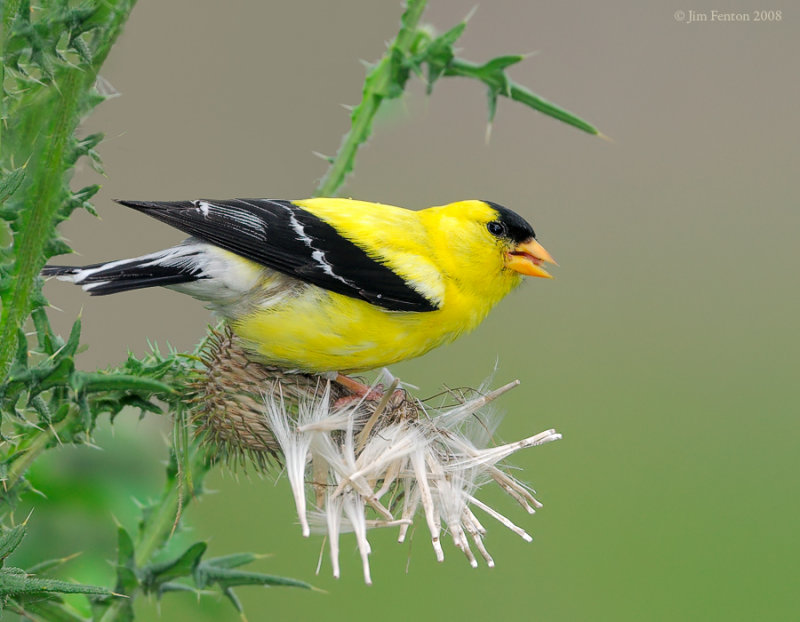
American Goldfinch (Carduelis tristis) on Thistle by Fenton

American Goldfinch (Carduelis tristis) on Thistle by Fenton

Lee’s Addition:

Therefore I love Your commandments Above gold, yes, above fine gold. (Psalms 119:127 NASB)

The American Goldfinch is a member of the Fringillidae – Finches Family. It is alway a joy to see them come to my feeders.

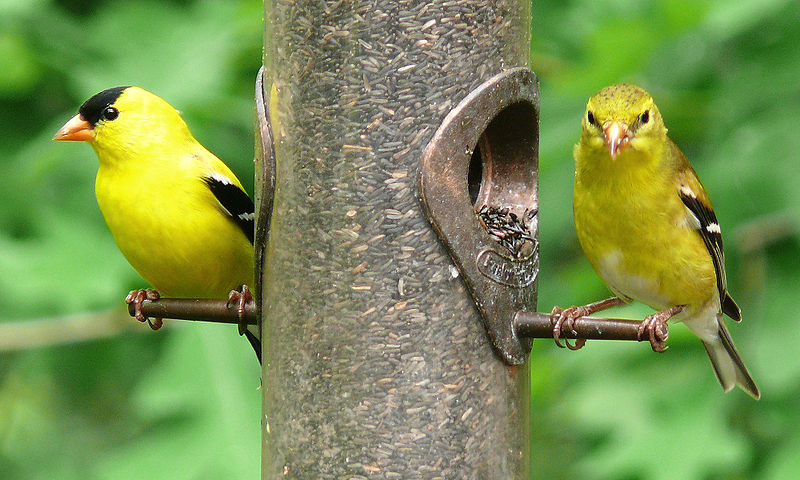
American Goldfinch (Carduelis tristis) Male and Female ©WikiC

American Goldfinch (Carduelis tristis) Male and Female ©WikiC

The American Goldfinch (Carduelis tristis), also known as the Eastern Goldfinch and Wild Canary, is a small North American bird in the finch family. It is migratory, ranging from mid-Alberta to North Carolina during the breeding season, and from just south of the Canadian border to Mexico during the winter.

The American Goldfinch male is a vibrant yellow in the summer and an olive color during the winter months, while the female is a dull yellow-brown shade which brightens only slightly during the summer. The male displays brightly colored plumage during the breeding season to attract a mate.

The American Goldfinch is a granivore and created for the consumption of seedheads, with a conical beak to remove the seeds and agile feet to grip the stems of seedheads while feeding. It is a social bird, and will gather in large flocks while feeding and migrating. It may behave territorially during nest construction, but this aggression is short-lived. Its breeding season is tied to the peak of food supply, beginning in late July, which is relatively late in the year for a finch. This species is generally monogamous, and produces one brood each year.

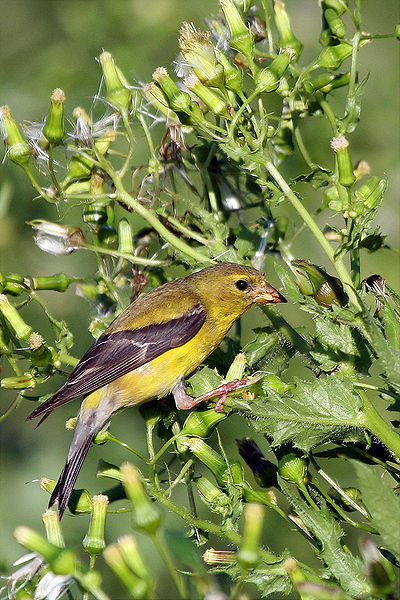
American Goldfinch (Carduelis tristis) Female ©WikiC

American Goldfinch (Carduelis tristis) Female ©WikiC

The American Goldfinch is a small finch, 4.3–5.5 in (11–14 centimeters) long, with a wingspan of 7.5–8.7 in (19–22 centimeters). The beak is small, conical, and pink for most of the year, but turns bright orange with the spring molt in both sexes.[19] The shape and size of the beak aid in the extraction of seeds from the seed heads of thistles, sunflowers, and other plants.

The American Goldfinch undergoes a molt in the spring and autumn, which it undergoes twice a year. During the winter molt it sheds all its feathers; in the spring, it sheds all but the wing and tail feathers, which are dark brown in the female and black in the male. The markings on these feathers remain through each molt, with bars on the wings and white under and at the edges of the short, notched tail. The plumage coloration is especially pronounced after the spring molt, when the bright color of the male’s summer plumage is needed to attract a mate.

Once the spring molt is complete, the body of the male is a brilliant lemon yellow with a striking jet black cap and white rump that is visible during flight.] The female is mostly brown, lighter on the underside with a yellow bib. After the autumn molt, the bright summer feathers are replaced by duller plumage, becoming buff below and olive-brown above, with a pale yellow face and bib. The autumn plumage is almost identical in both sexes, but the male has yellow shoulder patches. In some winter ranges, the goldfinches lose all traces of yellow, becoming a predominantly medium tan-gray color with an olive tinge evident only on close viewing.

The immature American Goldfinch has a dull brown back, and the underside is pale yellow. The shoulders and tail are dull black with buff-colored, rather than white, markings on wings and rump. This coloration is the same in both genders.

The song of the American Goldfinch is a series of musical warbles and twitters, often with a long note. A tsee-tsi-tsi-tsit call is often given in flight; it may also be described as per-chic-o-ree. While the female incubates the eggs, she calls to her returning mate with a soft continuous teeteeteeteete sound. The young begin to use a call of chick-kee or chick-wee shortly before fledging, which they use until they have left the nest entirely. There are two defense calls made by adults during nesting; a sweeet call made to rally other goldfinches to the nest and distract predators, and a bearbee used to signal to the nestlings to quiet them and get them to crouch down in the nest to become less conspicuous.
(Wikipedia with editing)

American Goldfinch song from xeno-canto by Andrew Spencer

*

Birds Illustrated by Color Photography – Revisited

The above article is an article in the monthly serial for October 1897 “designed to promote Knowledge of Bird-Live.” These include Color Photography, as they call them, today they are drawings. There are at least three Volumes that have been digitized by Project Gutenberg.

To see the whole series of – Birds Illustrated by Color Photography – Revisited

*

(Information from Wikipedia and other internet sources)

Next Article – The Chimney Swift

The Previous Article – The Lost Mate


Wordless Birds

Links:

Fringillidae – Finches Family

American Goldfinch – All About Birds

American Goldfinch – WhatBird

American Goldfinch – National Geographic

American Goldfinch – Wikipedia

*

Vol. 2, No. 4 – The Lost Mate

swallow4

THE LOST MATE.

Shine! Shine! Shine!
Pour down your warmth, great Sun!
While we bask—we two together.

Two together!
Winds blow south, or winds blow north,
Day come white, or night come black,
Home, or rivers and mountains from home,
Singing all time, minding no time,
If we two but keep together.

Till of a sudden,
May be killed, unknown to her mate,
One forenoon the she-bird crouched not on the nest,
Nor returned that afternoon, nor the next,
Nor ever appeared again.

And thence forward, all summer, in the sound of the sea,
And at night, under the full of moon, in calmer weather,
Over the hoarse surging of the sea,
Or flitting from briar to briar by day,
I saw, I heard at intervals, the remaining one.

Blow! blow! blow!
Blow up, sea-winds, along Paumanok’s shore!
I wait and I wait, till you blow my mate to me.
—Walt Whitman.


Lee’s Addition:

My heart is severely pained within me, And the terrors of death have fallen upon me. (Psalms 55:4 NKJV)

This is a sad one, but it is part of the series. The above photo is from an email about the mate being hit by a car and the other showing its emotions and trying to encourage it to get up.

Here is a YouTube I found about that email.

Fortunately we, as humans have a soul, and as Christians we have hope about our future. Even when we lose a loved one.

But I do not want you to be ignorant, brethren, concerning those who have fallen asleep, lest you sorrow as others who have no hope. For if we believe that Jesus died and rose again, even so God will bring with Him those who sleep in Jesus. For this we say to you by the word of the Lord, that we who are alive and remain until the coming of the Lord will by no means precede those who are asleep. For the Lord Himself will descend from heaven with a shout, with the voice of an archangel, and with the trumpet of God. And the dead in Christ will rise first. Then we who are alive and remain shall be caught up together with them in the clouds to meet the Lord in the air. And thus we shall always be with the Lord. Therefore comfort one another with these words. (1 Thessalonians 4:13-18 NKJV)

*

Birds Illustrated by Color Photography – Revisited

The above article is an article in the monthly serial for October 1897 “designed to promote Knowledge of Bird-Live.” These include Color Photography, as they call them, today they are drawings. There are at least three Volumes that have been digitized by Project Gutenberg.

To see the whole series of – Birds Illustrated by Color Photography – Revisited

*

(Information from Wikipedia and other internet sources)

Next Article – The American Goldfinch

The Previous Article – Blackburnian Warbler


Wordless Birds

*

Vol. 2, No. 4 – The Blackburnian Warbler

Blackburnian Warbler of Birds Illustrated by Color Photography, 1897

Blackburnian Warbler of Birds Illustrated by Color Photography, 1897

From col. Chi. Acad. Sciences. Copyrighted by
Nature Study Pub. Co., 1897, Chicago.

THE BLACKBURNIAN WARBLER.

imgi

F the children had had the naming of birds we venture to say that it would have been more appropriately done, and “Blackburnian,” as many other names of Warblers, would have had no place in literature. There are about seventy-five well known Warblers, nearly all with common names indicating the most characteristic colors or habits, or partly descriptive of the bird itself. The common names of this beautiful Warbler are Orange-throated Warbler and Hemlock Warbler. Some one has suggested that it should be called the Torch Bird, for “half a dozen of them as they flash about in the pines, raising their wings and jerking their tails, make the darkest shadows seem breaking into little tongues of flame.”

The Orange-throat is only migratory in Illinois, passing through in spring and fall, its summer home being chiefly if not wholly, to the northward, while it passes the winter in Central America and northern South America. It is found in New York and in portions of Massachusetts, frequenting the coniferous forests, and building its nest in bushes or small trees a few feet above the ground. Dr. C. Hart Merriam found a pair of these birds nesting in a grove of large white pines in Lewis County, New York. In the latter part of May the female was observed building, and on the second of June the nest contained four fresh eggs of the Warbler and one of the Cow bird. The nest was saddled on the horizontal limb about eight feet from the ground and about ten feet from the trunk. Nests have been found in pine trees in Southern Michigan at an elevation of forty feet. In all cases the nests are placed high in hemlocks or pines, which are the bird’s favorite resorts. From all accounts the nests of this species are elegantly and compactly made, consisting of a densely woven mass of spruce twigs, soft vegetable down, rootlets, and fine shreds of bark. The lining is often intermixed with horse hairs and feathers. Four eggs of greenish-white or very pale bluish-green, speckled or spotted, have usually been found in the nests.

The autumnal male Warblers resemble the female. They have two white bands instead of one; the black stripes on the side are larger; under parts yellowish; the throat yellowish, passing into purer yellow behind. Few of our birds are more beautiful than the full plumaged male of this lovely bird, whose glowing orange throat renders it a conspicuous object among the budding and blossoming branches of the hemlocks. Chapman says, coming in May, before the woods are fully clad, he seems like some bright plumaged tropical bird who has lost his way and wandered to northern climes. The summer is passed among the higher branches in coniferous forests, and in the early fall the bird returns to surroundings which seem more in keeping with its attire.

Mr. Minot describes the Blackburnian Warbler’s summer song as resembling the syllables wee-see-wee-see, while in the spring its notes may be likened to wee-see-wee-see, tsee, tsee, tsee, repeated, the latter syllables being on ascending scale, the very last shrill and fine.

Summary:

BLACKBURNIAN WARBLER.Dendroica blackburniæ.

Range—Eastern North America; breeds from northern Minnesota and southern Maine northward to Labrador and southward along the Alleghenies to South Carolina; winters in the tropics.

Nest—Of fine twigs and grasses, lined with grasses and tendrils, in coniferous trees, ten to forty feet up.

Eggs—Four, grayish white or bluish white, distinctly and obscurely spotted, speckled, and blotched with cinnamon brown or olive brown.


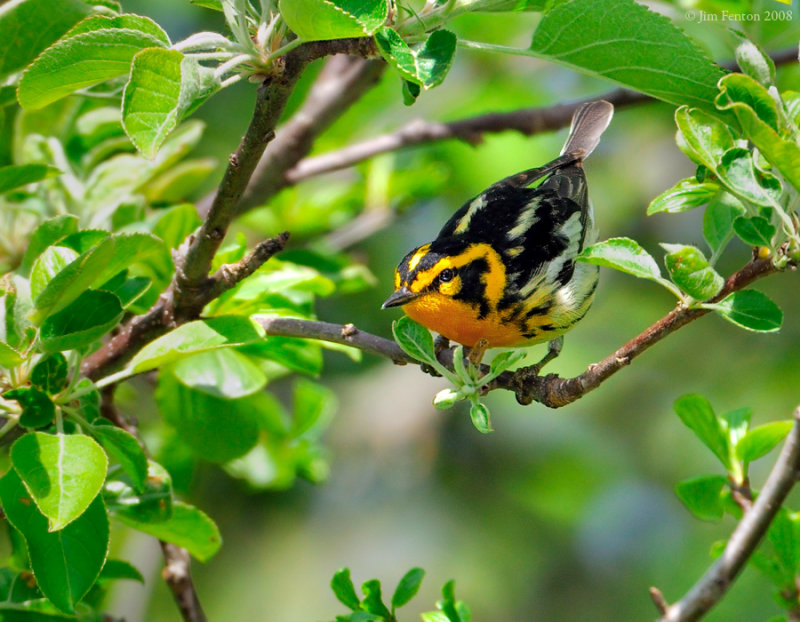
Blackburnian Warbler (Dendroica fusca) by J Fenton

Blackburnian Warbler (Dendroica fusca) by J Fenton

Lee’s Addition:

Beside them the birds of the heavens dwell; they sing among the branches. (Psalms 104:12 ESV)

What a gorgeous beauty the Lord created with this Warbler. Aren’t they just a delight to behold. The male of course is the most colorful. They belong to the Parulidae – New World Warblers Family. A nice photo of a male and female is on Looking back … scroll to the end of the article.

“The Blackburnian Warbler (Setophaga fusca) is a small New World warbler. They breed in eastern North America, from southern Canada, westwards to the southern Canadian Prairies, the Great Lakes region and New England, to North Carolina.

Blackburnian Warblers are migratory, wintering in southern Central America and in South America, and are very rare vagrants to western Europe. These birds were named after Anna Blackburne, an English botanist.

Blackburnian Warblers are around 4.3 to 5.1 in (11 to 13 cm) long, with a 7.9 to 8.7 in (20 to 22 cm) wingspan, and weigh 0.28 to 0.46 oz (8 to 13 g). The average mass of an adult bird is 0.34 oz (9.7 g).

Blackburnian Warblers display dark gray backs and double white wing bars, with yellowish rumps and dark brown crowns. The underparts of these birds are white, and are tinged with yellow and streaked black. The head is strongly patterned in yellow and black, with a flaming-orange throat. It is the only North American warbler with this striking plumage. Other plumages, including the fall male and adult female, are washed-out versions of the summer male, and in particular lack the bright colors and strong head pattern. Basic plumages show weaker yellows and gray in place of black in the breeding male. Blackburnian Warblers’ songs are a simple series of high swi notes, which often ascend in pitch. Their call is a high sip.

WhatBird’s Sound Page for the Blackburnian

Blackburnian Warbler (Dendroica fusca) by Raymond Barlow

Blackburnian Warbler (Dendroica fusca) by               Raymond Barlow

Blackburnian Warblers are solitary during winter and highly territorial on their breeding grounds and do not mix with other passerine species outside of the migratory period. However, during migration, they often join local mixed foraging flocks of species such as chickadees, kinglets and nuthatches. These birds are basically insectivorous, but will include berries in their diets in wintertime. They usually forage by searching for insects or spiders in treetops. The breeding habitats of these birds are mature coniferous woodlands or mixed woodlands, especially ones containing spruce and hemlocks. It typically winters in tropical montane forests.

Blackburnian Warblers build a nest consisting of an open cup of twigs, bark, plant fibers, and rootlets held to branch with spider web and lined with lichens, moss, hair, and dead pine needles that’s placed near the end of a branch. 3-5 whitish eggs are laid its nest which is usually placed 2–38 m (5–80 feet) above the ground, on a horizontal branch.” (Wikipedia with editing)

*

Birds Illustrated by Color Photography – Revisited

The above article is an article in the monthly serial for October 1897 “designed to promote Knowledge of Bird-Live.” These include Color Photography, as they call them, today they are drawings. There are at least three Volumes that have been digitized by Project Gutenberg.

To see the whole series of – Birds Illustrated by Color Photography – Revisited

*

(Information from Wikipedia and other internet sources)

Next Article – The Lost Mate

The Previous Article – White-Breasted Nuthatch


ABC’s of the Gospel

Links:

Blackburnian Warbler – Wikipedia

Blackburnian Warbler – All About Birds

Blackburnian Warbler – WhatBird

*

Vol. 2, No. 3 – The White-Breasted Nuthatch

White-breasted Nuthatch or Birds Illustrated by Color Photography, 1897

White-breasted Nuthatch or Birds Illustrated by Color Photography, 1897

From col. F. M. Woodruff. Copyrighted by
Nature Study Pub. Co., 1897, Chicago.

THE WHITE-BREASTED NUTHATCH.

imgn

EARLY every one readily recognizes this species as it runs up and down and around the branches and trunks of trees in search of insect food, now and then uttering its curious Quauk, quauk, quauk. The White-breasted Nuthatch is often improperly called “Sapsucker,” a name commonly applied to the Downy Woodpecker and others. It is a common breeding bird and usually begins nesting early in April, and two broods are frequently reared in a season. For its nesting place it usually selects the decayed trunk of a tree or stub, ranging all the way from two to sixty feet above the ground. The entrance may be a knot hole, a small opening, or a small round hole with a larger cavity at the end of it. Often the old excavation of the Downy Woodpecker is made use of. Chicken feathers, hair, and a few dry leaves loosely thrown together compose the nest.

This Nuthatch is abundant throughout the State of Illinois, and is a permanent resident everywhere except perhaps of the extreme northern counties. It seems to migrate in spring and return in autumn, but, in reality, as is well known, only retreats to the woodlands to breed, emerging again when the food supply grows scant in the autumn.

The Nuthatches associate familiarly with the Kinglets and Titmice, and often travel with them. Though regarded as shy birds they are not really so. Their habits of restlessness render them difficult of examination. “Tree-mice” is the local name given them by the farmers, and would be very appropriate could they sometimes remain as motionless as that diminutive animal.

Careful observation has disclosed that the Nuthatches do not suck the sap from trees, but that they knock off bits of decayed or loose bark with the beak to obtain the grubs or larvae beneath. They are beneficial to vegetation. Ignorance is responsible for the misapplied names given to many of our well disposed and useful birds, and it would be well if teachers were to discourage the use of inappropriate names and familiarize the children with those recognized by the best authorities.

Referring to the Nuthatches Mr. Baskett says: “They are little bluish gray birds, with white undervests—sometimes a little soiled. Their tails are ridiculously short, and never touch the tree; neither does the body, unless they are suddenly affrighted, when they crouch and look, with their beaks extended, much like a knot with a broken twig on it. I have sometimes put the bird into this attitude by clapping my hands loudly near the window. It is an impulse that seems to come to the bird before flight, especially if the head should be downward. His arrival is sudden, and seems often to be distinguished by turning a somersault before alighting, head downward, on the tree trunk, as if he had changed his mind so suddenly about alighting that it unbalanced him.

“I once saw two Nuthatches at what I then supposed was a new habit. One spring day some gnats were engaged in their little crazy love waltzes in the air, forming small whirling clouds, and the birds left off bark-probing and began capturing insects on the wing. They were awkward about it with their short wings, and had to alight frequently to rest. I went out to them, and so absorbed were they that they allowed me to approach within a yard of a limb that they came to rest upon, where they would sit and pant till they caught their breath, when they went at it again. They seemed fairly to revel in a new diet and a new exercise.”

Summary:

WHITE-BREASTED NUTHATCH.Sitta carolinensis. Other name: “Sapsucker,” improperly called.

Range—Eastern United States and British Provinces.

Nest—Decayed trunk of tree or stub, from two to six feet from ground, composed of chicken feathers, hair, and dry leaves.

Eggs—Five to eight; white with a roseate tinge, speckled with reddish brown and a slight tinge of purple.


White-breasted Nuthatch (Sitta carolinensis) by Matt Wagner

White-breasted Nuthatch (Sitta carolinensis) by Matt Wagner

Lee’s Addition:

If a bird’s nest should chance to be before you in the way, in any tree or on the ground, with young ones or eggs, and the mother bird is sitting on the young or on the eggs, you shall not take the mother bird with the young. (Deuteronomy 22:6 AMP)

This bird belongs to the Sittidae – Nuthatches Family and is a cousin to 27 other Nuthatches around the world.

The White-breasted Nuthatch (Sitta carolinensis) is a small songbird of the nuthatch family which breeds in old-growth woodland across much of temperate North America. It is a stocky bird, with a large head, short tail, powerful bill and strong feet. The upperparts are pale blue-gray, and the face and underparts are white. It has a black cap and a chestnut lower belly. The nine subspecies differ mainly in the color of the body plumage.

Like other nuthatches, the White-breasted Nuthatch forages for insects on trunks and branches, and is able to move head-first down trees. Seeds form a substantial part of its winter diet, as do acorns and hickory nuts that were stored by the bird in the fall. The nest is in a hole in a tree, and the breeding pair may smear insects around the entrance as a deterrent to squirrels. Adults and young may be killed by hawks, owls and snakes, and forest clearance may lead to local habitat loss, but this is a common species with no major conservation concerns over most of its range.

The White-breasted Nuthatch has a large head, short tail, short wings, a powerful bill and strong feet; it is 5–6 in (13–14 cm) long, with a wingspan of 8–11 in (20–27 cm) and a weight of 0.64–1.06 oz (18–30 g).

The adult male of the nominate subspecies, S. c. carolinensis, has pale blue-gray upperparts, a glossy black cap (crown of the head), and a black band on the upper back. The wing coverts and flight feathers are very dark gray with paler fringes, and the closed wing is pale gray and black, with a thin white wing bar. The face and the underparts are white. The outer tail feathers are black with broad diagonal white bands across the outer three feathers, a feature readily visible in flight.

The female has, on average, a narrower black back band, slightly duller upperparts and buffer underparts than the male. Her cap may be gray, but many females have black caps, and cannot be reliably distinguished from the male in the field. In the northeastern United States, at least 10% of females have black caps, but the proportion rises to 40–80% in the Rocky Mountains, Mexico and the southeastern U.S. Juveniles are similar to the adult, but duller plumaged.

Like other nuthatches, this is a noisy species with a range of vocalizations. The male’s mating song is a rapid nasal qui-qui-qui-qui-qui-qui-qui. The contact call between members of a pair, given most frequently in the fall and winter is a thin squeaky nit, uttered up to 30 times a minute. A more distinctive sound is a shrill kri repeated rapidly with mounting anxiety or excitement kri-kri-kri-kri-kri-kri-kri-kri; the Rocky Mountains and Great Basin subspecies have a higher, faster yididitititit call,[2] and Pacific birds a more nasal beeerf.

Three other, significantly smaller, nuthatches have ranges which overlap that of White-breasted, but none has white plumage completely surrounding the eye. Further distinctions are that the Red-breasted Nuthatch has a black eye line and reddish underparts, and the Brown-headed and Pygmy Nuthatches each have a brown cap, and a white patch on the nape of the neck.

The White-breasted Nuthatch is monogamous, and pairs form following a courtship in which the male bows to the female, spreading his tail and drooping his wings while swaying back and forth; he also feeds her morsels of food. The pair establish a territory and then remain together year-round until one partner dies or disappears. The nest cavity is usually a natural hole in a decaying tree, sometimes an old woodpecker nest. The nest hole is usually 10–40 ft (3–12 m) high in a tree and is lined with fur, fine grass, and shredded bark. The clutch is five to nine eggs which are creamy-white, speckled with reddish brown. The eggs are incubated by the female for 13 to 14 days prior to hatching, and the chicks fledge in a further 18 to 26 days. Both adults feed the chicks in the nest and for about two weeks after fledging, and the male also feeds the female while she is incubating. This species of nuthatch roosts in tree holes or behind loose bark when not breeding, and has the unusual habit of removing its faeces from the roost site in the morning. It usually roosts alone except in very cold weather, when up to 29 birds have been recorded together. (From Wikipedia with editing)

*

Birds Illustrated by Color Photography – Revisited

The above article is an article in the monthly serial for September 1897 “designed to promote Knowledge of Bird-Live.” These include Color Photography, as they call them, today they are drawings. There are at least three Volumes that have been digitized by Project Gutenberg.

To see the whole series of – Birds Illustrated by Color Photography – Revisited

*

(Information from Wikipedia and other internet sources)

Next Article – Blackburnian Warbler

The Previous Article – The Captive’s Escape

Sharing The Gospel

Links:

Sittidae – Nuthatches Family

White-breasted Nuthatch – All About Birds

White-breasted Nuthatch – Wikipedia

White-breasted Nuthatch – WhatBird

*

Vol. 2, No. 3 – The Captive’s Escape

Bird in Cage ©WikiC

Bird in Cage ©WikiC

THE CAPTIVE’S ESCAPE.

I saw such a sorrowful sight, my dears,
Such a sad and sorrowful sight,
As I lingered under the swaying vines,
In the silvery morning light.
The skies were so blue and the day was so fair
With beautiful things untold,
You would think no sad and sorrowful thing
Could enter its heart of gold.

A fairy-like cage was hanging there,
So gay with turret and dome.
You’d be sure a birdie would gladly make
Such a beautiful place its home.
But a wee little yellow-bird sadly chirped
As it fluttered to and fro;
I know it was longing with all its heart
To its wild-wood home to go.

I heard a whir of swift-rushing wings,
And an answering gladsome note;
As close to its nestlings’ prison bars,
I saw the poor mother bird float.
I saw her flutter and strive in vain
To open the prison door.
Then sadly cling with drooping wing
As if all her hopes were o’er.

But ere I could reach the prison house
And let its sweet captive free,
She was gone like a yellow flash of light,
To her home in a distant tree.
“Poor birdie,” I thought, “you shall surely go,
When mamma comes back again;”
For it hurt me so that so small a thing
Should suffer so much of pain.

And back in a moment she came again
And close to her darling’s side
With a bitter-sweet drop of honey dew,
Which she dropped in its mouth so wide.
Then away, with a strange wild mournful note
Of sorrow, which seemed to say
“Goodbye, my darling, my birdie dear,
Goodbye for many a day.”

A quick wild flutter of tiny wings,
A faint low chirp of pain,
A throb of the little aching heart
And birdie was free again.
Oh sorrowful anguished mother-heart,
’Twas all that she could do,
She had set it free from a captive’s life
In the only way she knew.

Poor little birdie! it never will fly
On tiny and tireless wing.
Through the pearly blue of the summer sky,
Or sing the sweet songs of spring.
And I think, little dears, if you had seen
The same sad sorrowful sight,
You never would cage a free wild bird
To suffer a captive’s plight.
—Mary Morrison.


Red-vented Bulbul (Pycnonotus cafer) at Zoo Miami by Lee

Red-vented Bulbul (Pycnonotus cafer) at Zoo Miami by Lee

Lee’s Addition:

As a cage is full of birds, so are their houses full of deceit and treachery; therefore they have become great and grown rich, (Jeremiah 5:27 AMP)

It is always sad to see the birds in a cage. Yes, I enjoy seeing birds from foreign lands and also birds that are endangered at the Zoos. Most Zoos have Aviaries which let the birds fly around more freely, but even they “cage” them at times. We were just at the Zoo this past week and they added some new Cockatoos. Unfortunately, they are in cages, large cages, but still cages. One of the few times I have really felt sorry for them. It makes it hard to photograph through those wire also.

Zoo Miami’s Wings of Asia was one of the nicest Aviaries I have been to so far. They have around 54,ooo square feet of space to fly around in and it is very well landscaped. Made me feel like I was outside actually “birdwatching.” You had to really search for many of the birds, not just look in a cage. We go to Lowry Park Zoo in Tampa and they have a several nice sized aviaries for the birds to fly around in and not feel so “couped up.”

This just happened to be the one of the next articles we have been covering in the Birds Illustrated by Color Photography.

*

Birds Illustrated by Color Photography – Revisited

The above article is an article in the monthly serial for September 1897 “designed to promote Knowledge of Bird-Live.” These include Color Photography, as they call them, today they are drawings. There are at least three Volumes that have been digitized by Project Gutenberg.

To see the whole series of – Birds Illustrated by Color Photography – Revisited

*

(Information from Wikipedia and other internet sources)

Next Article – The White-Breasted Nuthatch

The Previous Article – How The Birds Secured Their Rights

Wordless – Hummingbirds

*

Vol. 2, No. 3 – How The Birds Secured Their Rights

Song Sparrow (Melospiza melodia) by Ray

Song Sparrow by Ray

HOW THE BIRDS SECURED THEIR RIGHTS.

Deuteronomy xxxii 6-7.—“If a bird’s nest chance to be before thee in the way, in any tree, or on the ground, young ones or eggs, and the dam sitting upon the young, or upon the eggs, thou shalt not take the dam with the young. But thou shalt in anywise let the dam go, that it may be well with thee, and that thou may prolong thy days.”

imgi

T is said that the following petition was instrumental in securing the adoption in Massachusetts of a law prohibiting the wearing of song and insectivorous birds on women’s hats. It is stated that the interesting document was prepared by United States Senator Hoar. The foregoing verse of Scripture might have been quoted by the petitioning birds to strengthen their position before the lawmakers:

“To the Great and General Court of the Commonwealth of Massachusetts: We, the song birds of Massachusetts and their playfellows, make this our humble petition. We know more about you than you think we do. We know how good you are. We have hopped about the roofs and looked in at the windows of the houses you have built for poor and sick and hungry people, and little lame and deaf and blind children. We have built our nests in the trees and sung many a song as we flew about the gardens and parks you have made so beautiful for your children, especially your poor children, to play in. Every year we fly a great way over the country, keeping all the time where the sun is bright and warm. And we know that whenever you do anything the other people all over this great land between the seas and the great lakes find it out, and pretty soon will try to do the same. We know. We know.

“We are Americans just the same as you are. Some of us, like some of you, came across the great sea. But most of the birds like us have lived here a long while; and the birds like us welcomed your fathers when they came here many, many years ago. Our fathers and mothers have always done their best to please your fathers and mothers.

“Now we have a sad story to tell you. Thoughtless or bad people are trying to destroy us. They kill us because our feathers are beautiful. Even pretty and sweet girls, who we should think would be our best friends, kill our brothers and children so that they may wear our plumage on their hats. Sometimes people kill us for mere wantonness. Cruel boys destroy our nests and steal our eggs and our young ones. People with guns and snares lie in wait to kill us; as if the place for a bird were not in the sky, alive, but in a shop window or in a glass case. If this goes on much longer all our song birds will be gone. Already we are told in some other countries that used to be full of birds they are now almost gone. Even the Nightingales are being killed in Italy.

“Now we humbly pray that you will stop all this and will save us from this sad fate. You have already made a law that no one shall kill a harmless song bird or destroy our nests or our eggs. Will you please make another one that no one shall wear our feathers, so that no one shall kill us to get them? We want them all ourselves. Your pretty girls are pretty enough without them. We are told that it is as easy for you to do it as for a blackbird to whistle.

“If you will, we know how to pay you a hundred times over. We will teach your children to keep themselves clean and neat. We will show them how to live together in peace and love and to agree as we do in our nests. We will build pretty houses which you will like to see. We will play about your garden and flowerbeds—ourselves like flowers on wings—without any cost to you. We will destroy the wicked insects and worms that spoil your cherries and currants and plums and apples and roses. We will give you our best songs, and make the spring more beautiful and the summer sweeter to you. Every June morning when you go out into the field, Oriole and Bluebird and Blackbird and Bobolink will fly after you, and make the day more delightful to you. And when you go home tired after sundown Vesper Sparrow will tell you how grateful we are. When you sit down on your porch after dark, Fifebird and Hermit Thrush and Wood Thrush will sing to you; and even Whip-poor-will will cheer you up a little. We know where we are safe. In a little while all the birds will come to live in Massachusetts again, and everybody who loves music will like to make a summer home with you.”

The singers are:

Brown Thrasher, King Bird,
Robert o’Lincoln, Swallow,
Vesper Sparrow, Cedar Bird,
Hermit Thrush, Cow-bird,
Robin Redbreast, Martin,
Song Sparrow, Veery,
Scarlet Tanager, Vireo,
Summer Redbird, Oriole,
Blue Heron, Blackbird,
Humming Bird, Fifebird,
Yellow-bird, Wren,
Whip-poor-will, Linnet,
Water Wagtail, Pewee,
Woodpecker, Phoebe,
Pigeon Woodpecker, Yoke Bird,
Indigo Bird, Lark,
Yellow Throat, Sandpiper,
Wilson’s Thrush, Chewink.
Chickadee,

Black-capped Chickadee (Poecile atricapillus) by Kent Nickell

Black-capped Chickadee (Poecile atricapillus) by Kent Nickell

Lee’s Addition:

By them the birds of the heavens have their home; They sing among the branches. (Psalms 104:12 NKJV)

Things were tough for the birds back in 1897 and I guess they wanted their rights protected. This was one way to do it. Thankfully, today there is very few of the feathers and birds being stuck on hats for the ladies. Most don’t wear hats these days. Hunters still hunt, but not so much for “Songbirds.” Unfortunately young folks still like to cause problems for the birds instead of enjoying their songs and antics. They fail to realize the beauty of God’s created avian critters. Several groups became concerned and several laws were passed to protect the birds.

See National Council of Women about this hat campaign.

Lacey Act

By the late 1800s, the hunting and shipment of birds for the commercial market (to embellish the platters of elegant restaurants) and the plume trade (to provide feathers to adorn lady’s fancy hats) had taken their toll on many bird species. Passenger pigeons, whose immense flocks had once darkened the skies, were nearing extinction. Populations of the Eskimo curlew and other shorebirds had been decimated. The snowy egret and other colonial-nesting wading birds had been reduced to mere remnants of their historical populations. The Lacey Act (passed on May 25, 1900) prohibited game taken illegally in one state to be shipped across state boundaries contrary to the laws of the state where taken. The Lacey Act has become a very effective tool for enforcing the wildlife protective laws of the States and the Federal government (a detailed synopsis is available). However, in the early years of the 20th century the Act was ineffective in stopping interstate shipments, largely because of the huge profits enjoyed by the market hunters and the lack of officers to enforce the law. These early failures of the Lacey Act led to passage of the Weeks-McLean Law. (The Migratory Bird Program – Conserving America’s Birds – U.S. Fish & Wildlife Service)

*

Birds Illustrated by Color Photography – Revisited

The above article is an article in the monthly serial for September 1897 “designed to promote Knowledge of Bird-Live.” These include Color Photography, as they call them, today they are drawings. There are at least three Volumes that have been digitized by Project Gutenberg.

To see the whole series of – Birds Illustrated by Color Photography – Revisited

*

(Information from Wikipedia and other internet sources)

Next Article – The Captive’s Escape

The Previous Article – The Mourning Dove

Gospel Message

Links:

Birds Vol 1 #5 – National Council of Women

Migratory Bird Treaty Act of 1918 – Wikipedia

*

Vol. 2, No. 3 – The Mourning Dove

The Mourning Dove for Birds Illustrated by Color Photography, 1897

The Mourning Dove for Birds Illustrated by Color Photography, 1897

THE MOURNING DOVE.

Dear Young Bird Lovers:

Most every person thinks that, while my actions are very pretty and attractive, and speak much in my favor, I can only really say, Coo-o, Coo-o, which they also think does not mean anything at all. Well, I just thought I would undeceive them by writing you a letter. Many grown up people fancy that we birds cannot express ourselves because we don’t know very much. Of course, there is a good reason why they have this poor opinion of us. They are so busy with their own private concerns that they forget that there are little creatures like ourselves in the world who, if they would take a little time to become acquainted with them, would fill their few hours of leisure with a sweeter recreation than they find in many of their chosen outings. A great English poet, whose writings you will read when you get older, said you should look through Nature up to Nature’s God. What did he mean? I think he had us birds in his mind, for it is through a study of our habits, more perhaps than that of the voiceless trees or the dumb four-footed creatures that roam the fields, that your hearts are opened to see and admire real beauty. We birds are the true teachers of faith, hope, and charity,—faith, because we trust one another; hope, because, even when nature seems unkind, sending the drifting snow and the bitter blasts of winter, we sing a song of summer time; and charity, because we are never fault finders.

I believe, without knowing it, I have been telling you about myself and my mate. We Doves are very sincere, and every one says we are constant.

If you live in the country, children, you must often hear our voices. We are so tender and fond of each other that we are looked upon as models for children, and even grown-up folks. My mate does not build a very nice nest—only uses a few sticks to keep the eggs from falling out—but she is a good mother and nurses the little ones very tenderly. Some people are so kind that they build for us a dove cote, supply us with wheat and corn, and make our lives as free from care and danger as they can. Come and see us some day, and then you can tell whether my picture is a good one. The artist thinks it is and he certainly took lots of pains with it.

Now, if you will be kind to all birds, you will find me, in name only,

From col. F. M. Woodruff. Copyrighted by Nature Study Pub. Co., 1897, Chicago.

*

Summary: 

MOURNING DOVE.Zenaidura macrura. Other names: “Carolina Dove,” “Turtle Dove.”

Range—Whole of temperate North America, south to Panama and the West Indies.

Nest—Rim of twigs sufficient to retain the eggs.

Eggs—Usually two; white.


Mourning Dove (Zenaida macroura) by Quy Tran

Mourning Dove (Zenaida macroura) by Quy Tran

Lee’s Addition:

So I said, “Oh, that I had wings like a dove! I would fly away and be at rest. (Psalms 55:6 NKJV)

Doves are mentioned many times throughout Scripture therefore making them on of our Birds of the Bible. Below are the sounds of a song of this Dove and also the sound of the Mourning Dove flying. You can hear how they named it “mourning.”

Dove Song

Wing Sound

The Mourning Dove is a member of the Columbidae – Pigeons, Doves Family. They have over 330 cousin doves and pigeon that are part of the family. Doves and Turtledoves are mentioned 47 times in the NKJV.

“The bird is also called the Turtle Dove or the American Mourning Dove or Rain Dove, and formerly was known as the Carolina Pigeon or Carolina Turtledove. It is one of the most abundant and widespread of all North American birds. It is also the leading gamebird, with more than 20 million birds (up to 70 million in some years) shot annually in the U.S., both for sport and for meat. Its ability to sustain its population under such pressure stems from its prolific breeding: in warm areas, one pair may raise up to six broods a year.

Its plaintive woo-OO-oo-oo-oo call gives the bird its name. The wings can make an unusual whistling sound upon take-off and landing. The bird is a strong flier, capable of speeds up to 55 mph (88 km/h).

Mourning Doves are light grey and brown and generally muted in color. Males and females are similar in appearance. The species is generally monogamous, with two squabs (young) per brood. Both parents incubate and care for the young. Mourning Doves eat almost exclusively seeds, but the young are fed crop milk by their parents.

The Mourning Dove occupies a wide variety of open and semi-open habitats, such as urban areas, farms, prairie, grassland, and lightly wooded areas. It avoids swamps and thick forest. The species has adapted well to areas altered by humans. It commonly nests in trees in cities or near farmsteads.

Most Mourning Doves migrate along flyways over land. On rare occasions, mourning doves have been seen flying over the Gulf of Mexico; but this is exceptional. Spring migration north runs from March to May. Fall migration south runs from September to November, with immatures moving first, followed by adult females and then by adult males. Migration is usually during the day, in flocks, and at low altitudes. However, not all individuals migrate. Even in Canada some mourning doves remain through winter, sustained by the presence of bird feeders.” (Wikipedia)

*

Birds Illustrated by Color Photography – Revisited

The above article is an article in the monthly serial for September 1897 “designed to promote Knowledge of Bird-Live.” These include Color Photography, as they call them, today they are drawings. There are at least three Volumes that have been digitized by Project Gutenberg.

To see the whole series of – Birds Illustrated by Color Photography – Revisited

*

(Information from Wikipedia and other internet sources)

Next Article – How The Birds Secured Their Rights

The Previous Article – The Ruby-Crowned Kinglet

Wordless Birds

Links:

Bible Birds – Doves and Pigeons

Mourning Dove – Wikipedia

Mourning Dove – All About Birds

Mourning Doves – National Geographic

*

Vol. 2, No. 3 – The Ruby-Crowned Kinglet

The Ruby-crowned Kinglet for Birds Illustrated by Color Photography, 1897

The Ruby-crowned Kinglet for Birds Illustrated by Color Photography, 1897

THE RUBY-CROWNED KINGLET.

ASKETT says that the Kinglets come at a certain early spring date before the leaves are fully expanded, and flutter upward, while they take something from beneath the budding leaf or twig. It is a peculiar motion, which with their restless ways, olive-green color, and small size, readily distinguishes them. It is rare that one is still. “But the ruby-crowned sometimes favors me with a song, and as it is a little long, he usually is quiet till done. It is one of the sweetest little lullaby-like strains. One day I saw him in the rose bush just near voluntarily expand the plumage of his crown and show the brilliant golden-ruby feathers beneath. Usually they are mostly concealed. It was a rare treat, and visible to me only because of my rather exalted view. He generally reserves this display for his mate, but he was here among some Snow-birds and Tree Sparrows, and seemed to be trying to make these plain folks envious of the pretty feathers in his hat.”

These wonderfully dainty little birds are of great value to the farmer and the fruit grower, doing good work among all classes of fruit trees by killing grubs and larvae. In spite of their value in this respect, they have been, in common with many other attractive birds, recklessly killed for millinery purposes.

It is curious to see these busy wanderers, who are always cheery and sociable, come prying and peering about the fruit trees, examining every little nook of possible concealment with the greatest interest. They do not stay long after November, and return again in April.

The nest of this Kinglet is rarely seen. It is of matted hair, feathers, moss, etc., bulky, round, and partly hanging. Until recently the eggs were unknown. They are of a dirty cream-white, deepening at larger end to form a ring, some specimens being spotted.

Mr. Nehrling, who has heard this Kinglet sing in central Wisconsin and northern Illinois, speaks of the “power, purity, and volume of the notes, their faultless modulation and long continuance,” and Dr. Elliott Coues says of it: “The Kinglet’s exquisite vocalization defies description.” Dr. Brewer says that its song is clear, resonant, and high, a prolonged series, varying from the lowest tones to the highest, and terminating with the latter. It may be heard at quite a distance, and in some respects bears more resemblance to the song of the English Sky-lark than to that of the Canary, to which Mr. Audubon compares it.

From col. F. M. Woodruff. Copyrighted by
Nature Study Pub. Co., 1897, Chicago.

Summary:

RUBY-CROWNED KINGLET.Regulus calendula.

Range—Entire North America, wintering in the South and in northern Central America.

Nest—Very rare, only six known; of hair, feathers, moss, etc., bulky, globular, and partly pensile.

Eggs—Five to nine; dull whitish or pale puffy, speckled.


Ruby-crowned Kinglet (Regulus calendula) by BirdingPix

Ruby-crowned Kinglet (Regulus calendula) by BirdingPix

Lee’s Addition:

He will bless those who fear the LORD, Both small and great. (Psalms 115:13 NKJV)

Then a voice came from the throne, saying, “Praise our God, all you His servants and those who fear Him, both small and great!” (Revelation 19:5 NKJV)

“Kinglets are among the smallest of all passerines, ranging in size from 3.2–4.3 in (8–11 cm) and weighing 0.2–0.3 oz (6–8 g); the sexes are the same size. They have medium-length wings and tails, and small needle-like bills. The plumage is overall grey-green, offset by pale wingbars, and the tail tip is incised. Five species have a single stiff feather covering the nostrils, but in the Ruby-crowned Kinglet, this is replaced by several short, stiff bristles. Most kinglets have distinctive head markings, and the males possess a colourful crown patch. In the females, the crown is duller and yellower. The long feathers forming the central crown stripe can be erected; they are inconspicuous most of the time, but are used in courtship and territorial displays when the raised crest is very striking.” (Kinglet-Wikipedia)

“The Ruby-crowned Kinglet (Regulus calendula) is a very small passerine bird found throughout North America. The bird has olive-green plumage with two white wing bars and a white eye-ring. Males have a red crown patch, which is usually concealed. The sexes are identical (apart from the crown), and juveniles are similar in plumage to adults. It is one of the smallest songbirds in North America.

The kinglet is migratory, and its range extends from northwest Canada and Alaska south to Mexico. Its breeding habitat is spruce-fir forests in the northern, mountainous, United States and Canada. The Ruby-crowned Kinglet builds a cup-shaped nest, which may be pensile or placed on a tree branch and is often hidden. It lays up to 12 eggs, and has the largest clutch of any North American passerine for its size. It is mainly insectivorous, but also eats fruits and seeds.” (Ruby-crowned Kinglet-Wikipedia)

*

Birds Illustrated by Color Photography – Revisited

The above article is an article in the monthly serial for September 1897 “designed to promote Knowledge of Bird-Live.” These include Color Photography, as they call them, today they are drawings. There are at least three Volumes that have been digitized by Project Gutenberg.

To see the whole series of – Birds Illustrated by Color Photography – Revisited

*

(Information from Wikipedia and other internet sources)

Next Article – The Mourning Dove

The Previous Article – The Phoebe

Sharing The Gospel

Links:

Regulidae – Goldcrests, Kinglets

Ruby-crowned Kinglet – Wikipedia

Ruby-crowned Kinglet – Whatbird

Ruby-crowned Kinglet – IBC

*

Vol. 2, No. 3 – The Phoebe

The Phoebe or Birds Illustrated by Color Photography, 1897

The Phoebe or Birds Illustrated by Color Photography, 1897

From col. J. G. Parker. Jr. Copyrighted by
Nature Study Pub. Co., 1897, Chicago.

THE PHOEBE

Oft the Phoebe’s cheery notes
Wake the laboring swain;
“Come, come!” say the merry throats,
“Morn is here again.”
Phoebe, Phoebe! let them sing for aye,
Calling him to labor at the break of day.
—C. C. M.

EARLY everywhere in the United States we find this cheerful bird, known as Pewee, Barn Pewee, Bridge Pewee, or Phoebe, or Pewit Flycatcher. “It is one of that charming coterie of the feathered tribe who cheer the abode of man with their presence.” There are few farmyards without a pair of Pewees, who do the farmer much service by lessening the number of flies about the barn, and by calling him to his work in the morning by their cheery notes.

Dr. Brewer says that this species is attracted both to the vicinity of water and to the neighborhood of dwellings, probably for the same reason—the abundance of insects in either situation. They are a familiar, confiding, and gentle bird, attached to localities, and returning to them year after year. Their nests are found in sheltered situations, as under a bridge, a projecting rock, in the porches of houses, etc. They have been known to build on a small shelf in the porch of a dwelling, against the wall of a railroad station, within reach of the passengers, and under a projecting window-sill, in full view of the family, entirely unmoved by the presence of the latter at meal time.

Like all the flycatcher family the Phoebe takes its food mostly flying. Mrs. Wright says that the Pewee in his primitive state haunts dim woods and running water, and that when domesticated he is a great bather, and may be seen in the half-light dashing in and out of the water as he makes trips to and from the nest. After the young are hatched both old and young disport themselves about the water until moulting time. She advises: “Do not let the Phoebes build under the hoods of your windows, for their spongy nests harbor innumerable bird-lice, and under such circumstances your fly-screens will become infested and the house invaded.”

In its native woods the nest is of moss, mud, and grass placed on a rock, near and over running water; but in the vicinity of settlements and villages it is built on a horizontal bridge beam, or on timber supporting a porch or shed. The eggs are pure white, somewhat spotted. The notes, to some ears, are Phoebe, phoebe, pewit, phoebe! to others, of somewhat duller sense of hearing, perhaps, Pewee, pewee, pewee! We confess to a fancy that the latter is the better imitation.

Summary:

PHOEBE.Sayornis phœbe. Other names: “Pewit,” “Pewee.”

Range—Eastern North America; in winter south to Mexico and Cuba.

Nest—Compactly and neatly made of mud and vegetable substances, with lining of grass and feathers.

Eggs—Four or five; pure white, sometimes sparsely spotted with reddish brown dots at larger end.


Eastern Phoebe (Sayornis phoebe) by Dan

Eastern Phoebe (Sayornis phoebe) by Dan

Lee’s Addition:

I know all the birds of the mountains, And the wild beasts of the field are Mine. (Psalms 50:11 NKJV)

Luckily today, at least here, we can ignore this one remark; “She advises: ‘Do not let the Phoebes build under the hoods of your windows, for their spongy nests harbor innumerable bird-lice, and under such circumstances your fly-screens will become infested and the house invaded.’ ” I am sure back in 1897 that was a problem for them. Isn’t it amazing how times have changed for humans, but the birds are pretty well doing the same nest building and living as before. Not sure of the interchange between the Phoebe and the Pewee. They are in the same family, Tyrannidae – Tyrant Flycatchers, but they are different species.

There are three Phoebes:
Eastern Phoebe (Sayornis phoebe)
Black Phoebe (Sayornis nigricans)
Say’s Phoebe (Sayornis saya)

There are 14 Pewees and Wood Pewees:

Greater Pewee (Contopus pertinax)
Dark Pewee (Contopus lugubris)
Smoke-colored Pewee (Contopus fumigatus)
Ochraceous Pewee (Contopus ochraceus)
Western Wood Pewee (Contopus sordidulus)
Eastern Wood Pewee (Contopus virens)
Tropical Pewee (Contopus cinereus)
Tumbes Pewee (Contopus punensis)
White-throated Pewee (Contopus albogularis)
Blackish Pewee (Contopus nigrescens)
Cuban Pewee (Contopus caribaeus)
Hispaniolan Pewee (Contopus hispaniolensis)
Jamaican Pewee (Contopus pallidus)
Lesser Antillean Pewee (Contopus latirostris)

The genus Sayornis is a small group of medium-sized insect-eating birds in the Tyrant flycatcher family Tyrranidae native to North and South America.

They prefer semi-open or open areas. These birds wait on a perch and then catch insects in flight, also sometimes picking them up from the ground. Their nest is an open cup sometimes placed on man-made structures.

They often slowly lower and raise their tails while perched.

This species appears remarkably big-headed, especially if it puffs up the small crest. Its plumage is gray-brown above. It has a white throat, dirty gray breast and buffish underparts which become whiter during the breeding season. Two indistinct buff bars are present on each wing. Its lack of an eye ring and wingbars, and its all dark bill distinguish it from other North American tyrant flycatchers, and it pumps its tail up and down like other phoebes when perching on a branch. The Eastern Phoebe’s call is a sharp chip, and the song, from which it gets its name, is fee-bee. (Wikipedia)
*

Birds Illustrated by Color Photography – Revisited

The above article is an article in the monthly serial for September 1897 “designed to promote Knowledge of Bird-Live.” These include Color Photography, as they call them, today they are drawings. There are at least three Volumes that have been digitized by Project Gutenberg.

To see the whole series of – Birds Illustrated by Color Photography – Revisited

*

(Information from Wikipedia and other internet sources)

Next Article – The Ruby-Crowned Kinglet

The Previous Article – The House Wren

Gospel Presentation

Links:

Eastern Phoebe

Phoebe (bird) – Wikipedia

*

Vol. 2, No. 3 – The House Wren

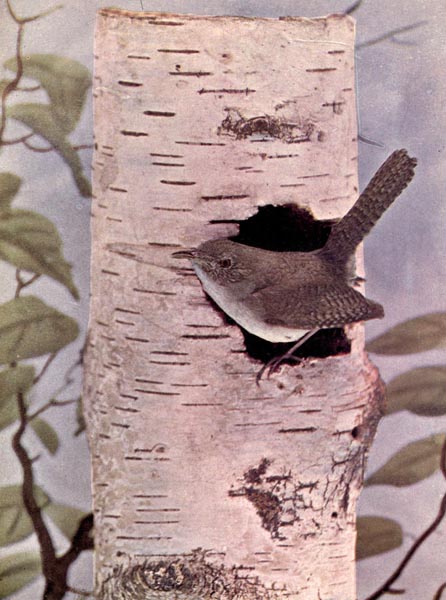
The House Wren for Birds Illustrated by Color Photography, 1897

The House Wren for Birds Illustrated by Color Photography, 1897

From col. F. M. Woodruff. Copyrighted by
Nature Study Pub. Co., 1897, Chicago.

THE HOUSE WREN.

“It was a merry time
When Jenny Wren was young,
When prettily she looked,
And sweetly, too, she sung.”

imgi

N looking over an old memorandum book the other day,” says Col. S. T. Walker, of Florida, “I came across the following notes concerning the nesting of the House Wren. I was sick at the time, and watched the whole proceeding, from the laying of the first stick to the conclusion. The nest was placed in one of the pigeonholes of my desk, and the birds effected an entrance to the room through sundry cracks in the log cabin.”

Nest begun April 15th.
Nest completed and first egg laid April 27th.
Last egg laid May 3rd.
Began sitting May 4th.
Hatching completed May 18th.
Young began to fly May 27th.
Young left the nest June 1st.
Total time occupied 47 days.

Such is the usual time required for bringing forth a brood of this species of Wren, which is the best known of the family. In the Atlantic states it is more numerous than in the far west, where wooded localities are its chosen haunts, and where it is equally at home in the cottonwoods of the river valleys, and on the aspens just below the timber line on lofty mountains.

Mrs. Osgood Wright says very quaintly that the House Wren is a bird who has allowed the word male to be obliterated from its social constitution at least: that we always speak of Jenny Wren: always refer to the Wren as sheas we do of a ship. That it is Johnny Wren who sings and disports himself generally, but it is Jenny, who, by dint of much scolding and fussing, keeps herself well to the front. She chooses the building-site and settles all the little domestic details. If Johnny does not like her choice, he may go away and stay away; she will remain where she has taken up her abode and make a second matrimonial venture.

The House Wren’s song is a merry one, sudden, abruptly ended, and frequently repeated. It is heard from the middle of April to October, and upon the bird’s arrival it at once sets about preparing its nest, a loose heap of sticks with a soft lining, in holes, boxes, and the like. From six to ten tiny, cream-colored eggs are laid, so thickly spotted with brown that the whole egg is tinged.

The House Wren is not only one of our most interesting and familiar neighbors, but it is useful as an exterminator of insects, upon which it feeds. Frequently it seizes small butterflies when on the wing. We have in mind a sick child whose convalescence was hastened and cheered by the near-by presence of the merry House Wren, which sings its sweet little trilling song, hour after hour, hardly stopping long enough to find food for its meals.

Summary:

HOUSE WREN.Troglodytes aedon.

Range—Eastern United States and southern Canada, west to the Mississippi Valley; winters in southern portions.

Nest—Miscellaneous rubbish, sticks, grasses, hay, and the like.

Eggs—Usually seven; white, dotted with reddish brown.


House Wren Proof Shot by Lee at Circle B

House Wren Proof Shot by Lee at Circle B – Cropped

Lee’s Addition:

Sing unto him, sing psalms unto him, talk ye of all his wondrous works. (1 Chronicles 16:9 KJV)

What a neat little bird. I was thrilled to get to see one up close just this last Saturday. We don’t see them often, at least I don’t. We were birdwatching out at Circle B Bar Reserve and the Wren just sat there and sang while three of us tried to get its picture. My photos are not so good, but at least they are a “proof shot.” I have heard and seen the Carolina Wren out there occasionally, but not the House.

House Wren Proof Shot Singing cropped

House Wren Proof Shot Singing cropped

*

Now here is a real photo by a much better photographer:

House Wren (Troglodytes aedon) by Ray

House Wren (Troglodytes aedon) by Ray

Wrens belong to the Wrens – Troglodytidae Family which has 83 species at present. “The wrens are mostly small, brownish passerine birds in the mainly New World family Troglodytidae. Only the Eurasian Wren occurs in the Old World, where in Anglophone regions it is commonly known simply as the “wren” as it is the originator of the name. The name wren has been applied to other unrelated birds, particularly the New Zealand wrens (Acanthisittidae) and the Australian wrens (Maluridae).

Most wrens are small and rather inconspicuous, except for their loud and often complex songs. Notable exceptions are the relatively large members of the genus Campylorhynchus, which can be quite bold in their behavior. Wrens have short wings that are barred in most species, and they often hold their tails upright. As far as known, wrens are primarily insectivorous, eating insects, spiders and other small arthropods, but many species also eat vegetable matter and some will take small frogs/lizards.

The House Wren, (Troglodytes aedon), is a very small songbird of the wren family, Troglodytidae. It occurs from Canada to southernmost South America, and is thus the most widely distributed bird in the Americas. It occurs in most suburban areas in its range and it is the single most common wren. Its taxonomy is highly complex and some subspecies groups are often considered separate species.

Adults are 4.3 to 5.1 in (11 to 13 cm) long, with a 5.9 in (15 cm) wingspan and weigh about 0.35 to 0.42 oz (10 to 12 g ). Among standard measurements, the wing chord is 1.9 to 2.1 in (4.7 to 5.3 cm), the tail is 1.5 to 1.7 in (3.9 to 4.4 cm),  The subspecies vary greatly, with upper parts ranging from dull greyish-brown to rich rufescent-brown, and the underparts ranging from brown, over buff and pale grey, to pure white. All subspecies have blackish barring to the wings and tail, and some also to the flanks. All subspecies show a faint eye-ring and eyebrow and have a long, thin bill with a blackish upper mandible, and a black-tipped yellowish or pale grey lower mandible. The legs are pinkish or grey. The short tail is typically held cocked.

This bird’s rich bubbly song is commonly heard during the nesting season but rarely afterwards. There is marked geographical variation in its song, though somewhat more gradual than in the birds’ outward appearance which can strikingly differ e.g. on neighboring islands in the Caribbean. Birds from far north and south of the species’ range nonetheless have songs that differ markedly.” (Wikipedia w/editing)

*

Birds Illustrated by Color Photography – Revisited

The above article is an article in the monthly serial for September 1897 “designed to promote Knowledge of Bird-Live.” These include Color Photography, as they call them, today they are drawings. There are at least three Volumes that have been digitized by Project Gutenberg.

To see the whole series of – Birds Illustrated by Color Photography – Revisited

*

(Information from Wikipedia and other internet sources)

Next Article – The Phoebe

The Previous Article – The Ruby-Throated Humming Bird

ABC’s of the Gospel

Links:

Wrens – Troglodytidae Family

House Wren – All About Birds

House Wren – Wikipedia

Vol. 2, No. 3 – The Ruby-Throated Humming Bird

The Ruby-throated Humming Bird or Birds Illustrated by Color Photography, 1897

The Ruby-throated Humming Bird or Birds Illustrated by Color Photography, 1897

THE RUBY-THROATED HUMMING BIRD.

Is it a gem, half bird,
Or is it a bird, half gem?
—Edgar Fawcett.

imgo

F all animated beings this is the most elegant in form and the most brilliant in colors, says the great naturalist Buffon. The stones and metals polished by our arts are not comparable to this jewel of Nature. She has it least in size of the order of birds, maxime miranda in minimis. Her masterpiece is the Humming bird, and upon it she has heaped all the gifts which the other birds may only share. Lightness, rapidity, nimbleness, grace, and rich apparel all belong to this little favorite. The emerald, the ruby, and the topaz gleam upon its dress. It never soils them with the dust of earth, and its aerial life scarcely touches the turf an instant. Always in the air, flying from flower to flower, it has their freshness as well as their brightness. It lives upon their nectar, and dwells only in the climates where they perennially bloom.

All kinds of Humming birds are found in the hottest countries of the New World. They are quite numerous and seem to be confined between the two tropics, for those which penetrate the temperate zones in summer stay there only a short time. They seem to follow the sun in its advance and retreat; and to fly on the zephyr wing after an eternal spring.

The smaller species of the Humming birds are less in size than the great fly wasp, and more slender than the drone. Their beak is a fine needle and their tongue a slender thread. Their little black eyes are like two shining points, and the feathers of their wings so delicate that they seem transparent. Their short feet, which they use very little, are so tiny one can scarcely see them. They rarely alight during the day. They have a swift continual humming flight. The movement of their wings is so rapid that when pausing in the air, the bird seems quite motionless. One sees him stop before a blossom, then dart like a flash to another, visiting all, plunging his tongue into their hearts, flattening them with his wings, never settling anywhere, but neglecting none. He hastens his inconsistencies only to pursue his loves more eagerly and to multiply his innocent joys. For this light lover of flowers lives at their expense without ever blighting them. He only pumps their honey, and for this alone his tongue seems designed.

The vivacity of these small birds is only equaled by their courage, or rather their audacity. Sometimes they may be seen furiously chasing birds twenty times their size, fastening upon their bodies, letting themselves be carried along in their flight, while they peck fiercely until their tiny rage is satisfied. Sometimes they fight each other vigorously. Impatience seems their very essence. If they approach a blossom and find it faded, they mark their spite by a hasty rending of the petals. Their only voice is a weak cry of Screp, screp, frequent and repeated, which they utter in the woods from dawn until at the first rays of the sun they all take flight and scatter over the country.

The Ruby-throat is the only native Humming bird of eastern North America, where it is a common summer resident from May to October, breeding from Florida to Labrador. The nest is a circle an inch and a half in diameter, made of fern wood, plant down, and so forth, shingled with lichens to match the color of the branch on which it rests. Its only note is a shrill, mouse-like squeak.
From col. F. M. Woodruff. Copyrighted by
Nature Study Pub. Co., 1897, Chicago.

Ruby-throated Hummingbird by Ray’s Wildlife

THE RUBY-THROATED HUMMING BIRD.

Dear Young Folks:

I fancy you think I cannot stop long enough to tell you a story, even about myself. It is true, I am always busy with the flowers, drinking their honey with my long bill, as you must be busy with your books, if you would learn what they teach. I always select for my food the sweetest flowers that grow in the garden.

Do you think you would be vain if you had my beautiful colors to wear? Of course, you would not, but so many of my brothers and sisters have been destroyed to adorn the bonnets and headdresses of the thoughtless that the children cannot be too early taught to love us too well to do us harm. Have you ever seen a ruby? It is one of the most valued of gems. It is the color of my throat, and from its rare and brilliant beauty I get a part of my name. The ruby is worn by great ladies and, with the emerald and topaz, whose bright colors I also wear, is much esteemed as an ornament.

If you will come into the garden in the late afternoon, between six and seven o’clock, when I am taking my supper, and when the sun is beginning to close his great eye, you will see his rays shoot sidewise and show all the splendor of my plumage. You will see me, too, if your eyes are sharp enough, draw up my tiny claws, pause in front of a rose, and remain seemingly motionless. But listen, and you will hear the reason for my name—a tense humming sound. Some call me a Hummer indeed.

I spend only half the year in the garden, coming in May and saying farewell in October. After my mate and I are gone you may find our nest. But your eyes will be sharp indeed if they detect it when the leaves are on the trees, it is so small and blends with the branches. We use fern-wool and soft down to build it, and shingle it with lichens to match the branch it nests upon. You should see the tiny eggs of pure white. But we, our nest and our eggs, are so dainty and delicate that they should never be touched. We are only to be looked at and admired.

Farewell. Look for me when you go a-Maying.

Ruby.

Summary:

RUBY-THROATED HUMMING BIRD.Trochilus colubris.

Range—Eastern North America to the Plains north to the fur countries, and south in winter to Cuba and Veragua.

Nest—A circle an inch and a half in diameter, made of fern wool, etc., shingled with lichens to match the color of the branch on which it is saddled.

Eggs—Two; pure white, the size of soup beans.


Hummingbird nest in Central Am by Bob-Nan

Hummingbird nest by Bob-Nan

Lee’s Addition:

Like birds hovering, so will the Lord of hosts defend Jerusalem; He will protect and deliver it, He will pass over and spare and preserve it. (Isaiah 31:5 AMP)

The Lord has created another fantastic little bird. The Ruby-Throated Hummingbird is 7–9 cm (2.8–3.5 in) long and has a 8–11 cm (3.1–4.3 in) wingspan.  Adults are metallic green above and greyish white below, with near-black wings. Their bill, at up to 2 cm (0.79 in), is long, straight and very slender. As in all hummingbirds, the toes and feet of this species are quite small, with a middle toe of around 0.6 cm (0.24 in) and a tarsus of approximately 0.4 cm (0.16 in). The Ruby-throated Hummingbird can only shuffle if it wants to move along a branch, though it can scratch its head and neck with its feet.

Hummingbirds have many skeletal and flight muscle adaptations which allow the bird great agility in flight. Muscles make up 25-30% of their body weight, and they have long, blade-like wings that, unlike the wings of other birds, connect to the body only from the shoulder joint. This adaptation allows the wing to rotate almost 180°, enabling the bird to fly not only forward but fly backwards, and to hover in front of flowers as it feeds on nectar, or hovers mid-air to catch tiny insects. Hummingbirds are the only known birds that can fly backwards. During hovering, (and likely other modes of flight) ruby-throated hummingbird wings beat 55 times per second.

The Hummingbirds are in the Trochilidae – Hummingbirds Family and there are 342 species (IOC 3.1) members. I think they are one of the neatest families that the Creator designed. They are so colorful and many have an iridescent shine to them when they turn in the sun just the right way.

The Ruby-Throated Hummingbird (Archilochus colubris) is a small hummingbird. It is the only species of hummingbird that regularly nests east of the Mississippi River in North America.

Ruby-throated Hummingbird (Archilochus colubris) -Turkey Run SP

Ruby-throated Hummingbird (Archilochus colubris) -Turkey Run SP by Lee

The breeding habitat is throughout most of eastern North America and the Canadian prairies, in deciduous and pine forests and forest edges, orchards, and gardens. The female builds a nest in a protected location in a shrub or a tree. Of all North American hummingbirds, this species has the largest breeding range.

The Ruby-Throated Hummingbird is migratory, spending most of the winter in southern Mexico, Central America as far south as South America, and the West Indies. It breeds throughout the eastern United States, east of the 100th meridian, and in southern Canada in eastern and mixed deciduous forest. In winter, it is seen mostly in Mexico.

*

Birds Illustrated by Color Photography – Revisited

The above article is an article in the monthly serial for September 1897 “designed to promote Knowledge of Bird-Live.” These include Color Photography, as they call them, today they are drawings. There are at least three Volumes that have been digitized by Project Gutenberg.

To see the whole series of – Birds Illustrated by Color Photography – Revisited

*

(Information from Wikipedia and other internet sources)

Next Article – The House Wren

The Previous Article – The Cuckoo

Wordless Birds

Links:

Ruby-throated Hummingbird – All About Birds

Ruby-throated Hummingbird – Wikipedia

Ruby-throated Hummingbird – National Geographic