Vol 2, #6 – The Mountain Bluebird


Mountain Bluebird (Sialia currucoides) for Birds Illustrated

Mountain Bluebird (Sialia currucoides) for Birds Illustrated

From col. Chi. Acad. Sciences. Copyrighted by
Nature Study Pub. Co., 1897, Chicago.

THE MOUNTAIN BLUEBIRD.

imgi

N an early number of Birds we presented a picture of the common Bluebird, which has been much admired. The mountain Bluebird, whose beauty is thought to excel that of his cousin, is probably known to few of our readers who live east of the Rocky Mountain region, though he is a common winter sojourner in the western part of Kansas, beginning to arrive there the last of September, and leaving in March and April. The habits of these birds of the central regions are very similar to those of the eastern, but more wary and silent. Even their love song is said to be less loud and musical. It is a rather feeble, plaintive, monotonous warble, and their chirp and twittering notes are weak. They subsist upon the cedar berries, seeds of plants, grasshoppers, beetles, and the like, which they pick up largely upon the ground, and occasionally scratch for among the leaves. During the fall and winter they visit the plains and valleys, and are usually met with in small flocks, until the mating season.

Nests of the Mountain Bluebird have been found in New Mexico and Colorado, from the foothills to near timber line, usually in deserted Woodpecker holes, natural cavities in trees, fissures in the sides of steep rocky cliffs, and, in the settlements, in suitable locations about and in the adobe buildings. In settled portions of the west it nests in the cornice of buildings, under the eaves of porches, in the nooks and corners of barns and outhouses, and in boxes provided for its occupation. Prof. Ridgway found the Rocky Mountain Bluebird nesting in Virginia City, Nevada, in June. The nests were composed almost entirely of dry grass. In some sections, however, the inner bark of the cedar enters largely into their composition. The eggs are usually five, of a pale greenish-blue.

The females of this species are distinguished by a greener blue color and longer wings, and this bird is often called the Arctic Bluebird. It is emphatically a bird of the mountains, its visits to the lower portions of the country being mainly during winter.

Heaped in the hollows of the grove, the autumn leaves lie dead;
They rustle to the eddying gust, and to the rabbits’ tread.
The Robin and the Wren are flown, and from the shrubs the Jay,
And from the wood-top calls the Crow all through the gloomy day.
—Bryant.

Summary:

MOUNTAIN BLUEBIRD.Sialia arctica. Other names: “Rocky Mountain” and “Arctic Bluebird.”

Range—Rocky Mountain region, north to Great Slave Lake, south to Mexico, west to the higher mountain ranges along the Pacific.

Nest—Placed in deserted Woodpecker holes, natural cavities of trees, nooks and corners of barns and outhouses; composed of dry grass.

Eggs—Commonly five, of pale, plain greenish blue.


Mountain Bluebird (Sialia currucoides) by Daves BirdingPix

Mountain Bluebird (Sialia currucoides) by Daves BirdingPix

Lee’s Addition:

…In the LORD put I my trust: how say ye to my soul, Flee as a bird to your mountain? … If the foundations be destroyed, what can the righteous do? The LORD is in his holy temple, the LORD’S throne is in heaven: his eyes behold, his eyelids try, the children of men. … For the righteous LORD loveth righteousness; his countenance doth behold the upright.
(Psalms 11:1,3,4,7 KJV)

The Mountain Bluebird belongs to the Turdidae – Thrushes Family and as such have Thrush characteristics. Since blue is my favorite color, the bluebirds are some of my favorites. The Lord has used such variety in His coloration, that I am happy that blue was one of them. We have also the Eastern and Western Bluebirds plus the Asian and Philippine Fairy-bluebirds.

The Mountain Bluebird (Sialia currucoides) is a medium-sized bird weighing about 1.1 ounces (30 g) with a length from 6.3–7.9 in (16–20 cm). They have light underbellies and black eyes. Adult males have thin bills that are bright turquoise-blue and somewhat lighter beneath. Adult females have duller blue wings and tail, grey breast, grey crown, throat and back. In fresh fall plumage, the female’s throat and breast are tinged with red-orange; brownish near the flank contrasting with white tail underparts. Call is a thin few; Song is warbled high chur chur.

The mountain bluebird is migratory. Their range varies from Mexico in the winter to as far north as Alaska, throughout the western U.S. and Canada. Northern birds migrate to the southern parts of the range; southern birds are often permanent residents. Some birds may move to lower elevations in winter. They inhabit open rangelands, meadows, generally at elevations above 5,000 feet. Contrary to popular belief, mountain bluebirds are not a species of concern in the United States. The turn around in mountain bluebird numbers is due to the overwhelming efforts of landowners in the West to provide nest boxes for these birds. At one time, mountain bluebird numbers were threatened because of increased agricultural activities destroying habitats.

These birds hover over the ground and fly down to catch insects, also flying from a perch to catch them. They mainly eat insects, over 90%, and berries. They may forage in flocks in winter, when they mainly eat grasshoppers. Mountain bluebirds will come to a platform feeder with live meal worms, berries, or peanuts.

Mountain Bluebird (Sialia currucoides) by Ian Montgomery nest

Mountain Bluebird (Sialia currucoides) by Ian Montgomery nest

Their breeding habitat is open country across western North America, including mountain areas, as far north as Alaska. They nest in pre-existing cavities or in nest boxes. In remote areas, these birds are less affected by competition for natural nesting locations than other bluebirds. Mountain bluebirds are a monogamous breed. The male can be seen singing from bare branches. The singing takes place right at dawn, just when the sun rises. Females usually build the nests themselves. Eggs: pale blue and unmarked, sometimes white. Clutch Size: 4-5 eggs. Young are naked and helpless at hatching and may have some down. Incubation normally last 14 days and the young will take about 21 days before they leave the nest. Both males and females fiercely protect the nest.

It is the state bird of Idaho and Nevada.

Mountain bluebirds are cavity nesters and can become very partial to a nest box, especially if they have successfully raised a clutch. They may even re-use the same nest, though not always. Providing nest boxes is a great way to observe these beautiful birds. Mountain bluebirds will not abandon a nest if human activity is detected close by or at the nest. Because of this, mountain bluebirds can be easily banded while they are still in the nest.

Mountain Bluebird (Sialia currucoides) by Margaret Sloan

Mountain Bluebird (Sialia currucoides) by Margaret Sloan

*

Mountain Bluebird (Sialia currucoides) by Ian Montgomery

Mountain Bluebird (Sialia currucoides) by Ian Montgomery

Birds Illustrated by Color Photography – Revisited

The above article is an article in the monthly serial for October 1897 “designed to promote Knowledge of Bird-Live.” These include Color Photography, as they call them, today they are drawings. There are at least three Volumes that have been digitized by Project Gutenberg.

To see the whole series of – Birds Illustrated by Color Photography – Revisited

*

(Information from Wikipedia and other internet sources, with editing)

Next Article – The English Sparrow

The Previous Article – The Ornithological Congress

Gospel Presentation

Links:

*

Vol 2, #6 – The Ornithological Congress

My Mom and Me

My Mom and Me (from an e-mail)

THE ORNITHOLOGICAL CONGRESS.

imgw

E had the pleasure of attending the Fifteenth Congress of the American Ornithologists’ Union, which met and held its three days annual session in the American Museum of Natural History, New York City, November 9-11, 1897. Dr. C. Hart Merriam, of the Department of Agriculture, Washington D.C., presided, and there were present about one hundred and fifty of the members, resident in nearly all the states of the Union.

The first paper read was one prepared by J. C. Merrill, entitled “In Memoriam: Charles Emil Bendire.” The character, accomplishments, and achievements of the deceased, whose valuable work in biographizing American birds is so well known to those interested in ornithology, were referred to in so appropriate a manner that the paper, though not elaborate as it is to be hoped it may ultimately be made, will no doubt be published for general circulation. Major Bendire’s services to American ornithology are of indisputable value, and his untimely death eclipsed to some extent, possibly wholly, the conclusion of a series of bird biographies which, so far as they had appeared, were deemed to be adequate, if not perfect.

Mr. Frank M. Chapman, the well known authority on birds, and whose recent books are valuable additions to our literature, had, it may be presumed, a paper to read on the “Experiences of an Ornithologist in Mexico,” though he did not read it. He made, on the contrary, what seemed to be an extemporaneous talk, exceedingly entertaining and sufficiently instructive to warrant a permanent place for it in the Auk, of which he is associate editor. We had the pleasure of examining the advance sheets of a new book from his pen, elaborately illustrated in color, and shortly to be published. Mr. Chapman is a comparatively young man, an enthusiastic student and observer, and destined to be recognized as one of our most scientific thinkers, as many of his published pamphlets already indicate. Our limited space precludes even a reference to them now. His remarks were made the more attractive by the beautiful stuffed specimens with which he illustrated them.

Prof. Elliott Coues, in an address, “Auduboniana, and Other Matters of Present Interest,” engaged the delighted attention of the Congress on the morning of the second day’s session. His audience was large. In a biographical sketch of Audubon the Man, interspersed with anecdote, he said so many interesting things that we regret we omitted to make any notes that would enable us to indicate at least something of his characterization. No doubt just what he said will appear in an appropriate place. Audubon’s portfolio, in which his precious manuscripts and drawings were so long religiously kept, which he had carried with him to London to exhibit to possible publishers, a book so large that two men were required to carry it, though the great naturalist had used it as an indispensable and convenient companion for so many years, was slowly and we thought reverently divested by Dr. Coues of its wrappings and held up to the surprised and grateful gaze of the spectators. It was dramatic. Dr. Coues is an actor. And then came the comedy. He could not resist the inclination to talk a little—not disparagingly, but truthfully, reading a letter never before published, of Swainson to Audubon declining to associate his name with that of Audubon “under the circumstances.” All of which, we apprehend, will duly find a place on the shelves of public libraries.

John James Audubon 1826 ©WikiC

John James Audubon 1826 ©WikiC

We would ourself like to say something of Audubon as a man. To us his life and character have a special charm. His was a beautiful youth, like that of Goethe. His love of nature, for which he was willing to make, and did make, sacrifices, will always be inspiring to the youth of noble and gentle proclivities; his personal beauty, his humanity, his love-life, his domestic virtues, enthrall the ingenuous mind; and his appreciation—shown in his beautiful compositions—of the valleys of the great river, La Belle Rivière, through which its waters, shadowed by the magnificent forests of Ohio and Kentucky, wandered—all of these things have from youth up shed a sweet fragrance over his memory and added greatly to our admiration of and appreciation for the man.

So many subjects came before the Congress that we cannot hope to do more than mention the titles of a few of them. Mr. Sylvester D. Judd discussed the question of “Protective Adaptations of insects from an Ornithological Point of View;” Mr. William C. Rives talked of “Summer Birds of the West Virginia Spruce Belt;” Mr. John N. Clark read a paper entitled “Ten Days among the Birds of Northern New Hampshire;” Harry C. Oberholser talked extemporaneously of “Liberian Birds,” and in a most entertaining and instructive manner, every word he said being worthy of large print and liberal embellishment; Mr. J. A. Allen, editor of The Auk, said a great deal that was new and instructive about the “Origin of Bird Migration;” Mr. O. Widmann read an interesting paper on “The Great Roosts on Gabberet Island, opposite North St. Louis;” J. Harris Reed presented a paper on “The Terns of Gull Island, New York;” A. W. Anthony read of “The Petrels of Southern California,” and Mr. George H. Mackay talked interestingly of “The Terns of Penikese Island, Mass.”

There were other papers of interest and value. “A Naturalist’s Expedition to East Africa,” by D. G. Elliot, was, however, the pièce de résistance of the Congress. The lecture was delivered in the lecture hall of the Museum, on Wednesday at 8 p. m. It was illustrated by stereopticon views, and in the most remarkable manner. The pictures were thrown upon an immense canvas, were marvellously realistic, and were so much admired by the great audience, which overflowed the large lecture hall, that the word demonstrative does not describe their enthusiasm. But the lecture! Description, experience, suffering, adventure, courage, torrid heat, wild beasts, poisonous insects, venomous serpents, half-civilized peoples, thirst,—almost enough of torture to justify the use of Coleridge’s Ancient Mariner in illustration,—and yet a perpetual, quiet, rollicking, jubilant humor, all-pervading, and, at the close, on the lecturer’s return once more to the beginning of civilization, the eloquent picture of the Cross, “full high advanced,” all combined, made this lecture, to us, one of the very few platform addresses entirely worthy of the significance of unfading portraiture.

C. C. Marble.


Silver-breasted Broadbill (Serilophus lunatus) by Peter Ericsson

Silver-breasted Broadbill (Serilophus lunatus) by Peter Ericsson

Lee’s Addition:

And further, by these, my son, be admonished: of making many books there is no end; and much study is a weariness of the flesh. (Ecclesiastes 12:12 KJV)

“The International Ornithologists’ Union, formerly International Ornithological Committee (IOC), is to facilitate worldwide communication in ornithology and conservation based on the up-to-date taxonomy of world birds and recommended English names that follow explicit guidelines for spelling and construction.

To this end we  provide a complete list of world bird species and their subspecies, including recently extinct ones. We update the list regularly to include newly described species,  proposed and accepted splits and lumps, corrections of nomenclature, and changes of names or classification.” (From IOC’s website)

The IOC, or now the IOU is where our list of the Birds of the World come from. Thankfully, these ornithologists get together and try to maintain lists and compare birds from other countries, which are called by different name, to see if they are one-in-the-same. There is much work that goes on by them and their work is much appreciated by birders around the world.

*

Birds Illustrated by Color Photography – Revisited

The above article is an article in the monthly serial for October 1897 “designed to promote Knowledge of Bird-Live.” These include Color Photography, as they call them, today they are drawings. There are at least three Volumes that have been digitized by Project Gutenberg.

To see the whole series of – Birds Illustrated by Color Photography – Revisited

*

(Information from Wikipedia and other internet sources, with editing)

Next Article – The Mountain Bluebird

The Previous Article – Bird Miscellany Plus 

Gospel Message

Links:

International Ornithological Congress

IOC World Bird List

Birds of the World – Lee’s Birdwatching Adventures

*

Birds Of The Bible – Joy And Laughter

Laughing Kookaburra (Dacelo novaeguineae) at LPZoo

Laughing Kookaburra (Dacelo novaeguineae) by Lee

While we were at Lowry Park Zoo last week, we also had the joy of hearing the Laughing Kookaburra (Dacelo novaeguineae) sounding off with its mate. Seems like the Myna birds and the singing dogs were not the only ones in a happy mood. The two Kookaburras got to “laughing” also. They sort of set the tone to put you a joyful mood.

For You, O Lord, have made me glad by Your works; at the deeds of Your hands I joyfully sing. (Psalms 92:4 AMP) Make a joyful noise to the Lord, all the earth; break forth and sing for joy, yes, sing praises! (Psalms 98:4 AMP)

I have always enjoyed seeing the Kookaburras. When we were at the National Aviary I tried recording them, but by the time I got the camera on, they stopped. I recorded them this time but didn’t get the camera focused on them until about half way through. Oh, the challenges of birdwatching! Well, at least trying to get a recording to use on the blog anyway. When you put all the events together; the singing Bali Myna, the singing dogs, and these singing Kookaburras, it brings to mind a story in the Bible. When Paul and Silas where in prison, (behind bars) they were joyful just the same. All of these critters plus the men (Paul and Silas) are behind bars, yet they are joyful and carrying on with their lives. Could there be a lesson there for us to learn and observe?

And at midnight Paul and Silas prayed, and sang praises unto God: and the prisoners heard them. (Acts 16:25 KJV)

Consider it wholly joyful, my brethren, whenever you are enveloped in or encounter trials of any sort or fall into various temptations. (James 1:2 AMP)

We all have things come into our lives, but our attitude affects how well we handle those circumstances. Prayer is one of the best ways to find peace in the midst of trials. Knowing the Lord Jesus Christ as personal Savior is the absolute best way. I trust you know Him.

Gospel Message

*

This video has two of my photos to cover the blurred part, but the sound is the whole recording.

The Laughing Kookaburra (Dacelo novaeguineae) is a carnivorous bird in the kingfisher family Halcyonidae. Native to eastern Australia, it has also been introduced to parts of New Zealand, Tasmania and Western Australia. Male and female adults are similar in plumage, which is predominantly brown and white. A common and familiar bird, this species of kookaburra is well known for its laughing call.

There are actually 6 Kookaburras:

  • Lilac Kingfisher (Cittura cyanotis)
  • Shovel-billed Kookaburra (Clytoceyx rex)
  • Laughing Kookaburra (Dacelo novaeguineae)
  • Blue-winged Kookaburra (Dacelo leachii)
  • Spangled Kookaburra (Dacelo tyro)
  • Rufous-bellied Kookaburra (Dacelo gaudichaud)

See:

Birds of the Bible

Laughing Kookaburra – Wikipedia

Alcedinidae – Kingfishers – Family

*

Birds of the Bible – Heron’s Teaching

Green Heron (Butorides virescens) by Lee

Green Heron (Butorides virescens) by Lee

“But now ask the beasts, and they will teach you; And the birds of the air, and they will tell you; (Job 12:7 NKJV)

I have thinking about that Green Heron in the video I posted a few days ago. (Green Heron Fishing With Bread) The verse above makes me think there has to be some lessons to learn from it. These are just some of my thoughts and I am sure you can come up with some of your own.

One that comes to thought right off is that bird’s patience. Are we?

These wait all upon thee; that thou mayest give them their meat in due season. That thou givest them they gather: thou openest thine hand, they are filled with good. (Psalms 104:27-28 KJV)

The verse used on the article tells how the Lord protects and provides for His creation. Will He not provide for us also. He loves us and wants to meet our needs, just as was provided for this Heron.

Look at the birds of the air, for they neither sow nor reap nor gather into barns; yet your heavenly Father feeds them. Are you not of more value than they? (Matthew 6:26 NKJV)

Another lesson is that the bird is doing something that we wouldn’t think it could do. You wonder where it learned that behavior. For us, the Lord wants us to do something, and if we are willing, we are amazed at what we can do. Things we would never think we had the capacity to do He helps us perform..

Jesus said unto him, If thou canst believe, all things are possible to him that believeth. (Mark 9:23 KJV)

I can do all things through Christ which strengtheneth me. (Philippians 4:13 KJV)

He (the heron) has a goal in mind and isn’t going to give up even though it takes several attempts to accomplish his goal. The Lord tells us to become “fishers of men” and we need to keep trying and not give up. Even when our “bread” is down to hardly anything and you think you might as well give up, you try one more time.

So then neither is he that planteth any thing, neither he that watereth; but God that giveth the increase. Now he that planteth and he that watereth are one: and every man shall receive his own reward according to his own labour. (1 Corinthians 3:7-8 KJV)

On a more light side, I am not so sure that the Heron wasn’t bordering on “gluttony.” Did you see that last part where it is swallowing the fish. Looks like it almost “bit of more than it could chew.”

But put ye on the Lord Jesus Christ, and make not provision for the flesh, to fulfil the lusts thereof. (Romans 13:14 KJV)

These are but a few and if you have some, leave a comment and share them with us.

Birds of the Bible – Herons

Birds of the Bible

Bible Birds

Wordless Birds

*

Thanks to MrBeemBom for taking the video and sharing it on YouTube.

*

Birds of the Bible – Remembering

Bleeding-Heart Pigeon ©WikiC

Bleeding-Heart Pigeon ©WikiC

And God remembered Noah, and every living thing, and all the cattle that was with him in the ark: and God made a wind to pass over the earth, and the waters asswaged; (Genesis 8:1 KJV)

Today, here in the United States, is Memorial Day. A day when we remember those who have given their all in the service of our country. We honor those who we can no longer thank. As this is being written, they are laying a wreath at the tomb of the unknown soldier at Arlington National Cemetary.

My father was one of those who passed away as a result of his being in the trenches in WW I. He suffered for several years from the effects of the “mustard gas” that was sprayed on them. It is good for us to remember things and honor events.

Yesterday, in the morning service, the event of the 12 stones being taken for the Jordon River by the Israelites for a memorial was taught. That was a memorial to remind them of the way the LORD protected them and made a way for them to cross over the Jordon. It is good to remember things and honor events.

And Joshua said unto them, Pass over before the ark of the LORD your God into the midst of Jordan, and take ye up every man of you a stone upon his shoulder, according unto the number of the tribes of the children of Israel: That this may be a sign among you, that when your children ask their fathers in time to come, saying, What mean ye by these stones? Then ye shall answer them, That the waters of Jordan were cut off before the ark of the covenant of the LORD; when it passed over Jordan, the waters of Jordan were cut off: and these stones shall be for a memorial unto the children of Israel for ever. (Joshua 4:5-7 KJV)

Mourning Dove (Zenaida macroura) by Quy Tran

Mourning Dove (Zenaida macroura) by Quy Tran

Our Scripture above is where the God remembered those He was protecting from the flood that were aboard the ark. He did not forget them. In time, the waters went down and they were able to leave the ark.

And it came to pass in the six hundred and first year, in the first month, the first day of the month, that the waters were dried up from the earth; and Noah removed the covering of the ark and looked, and indeed the surface of the ground was dry. And in the second month, on the twenty-seventh day of the month, the earth was dried. Then God spoke to Noah, saying, “Go out of the ark, you and your wife, and your sons and your sons’ wives with you. Bring out with you every living thing of all flesh that is with you: birds and cattle and every creeping thing that creeps on the earth, so that they may abound on the earth, and be fruitful and multiply on the earth.” (Genesis 8:13-17 NKJV)

It does us good to remember what the God has done through His creation and protection during the flood. Just as He provided salvation for them from the flood, and only those in the ark were saved. Today, we have a Savior who said:

Jesus saith unto him, I am the way, the truth, and the life: no man cometh unto the Father, but by me. (John 14:6 KJV)

Bald Eagle Brings Nesting Material by Aesthetic Photos

Bald Eagle Brings Nesting Material by Aesthetic Photos

Happy Memorial Day! Lord Bless your day as you remember.

See:

Gospel Message

Birds of the Bible

Bible Birds

P.S. Check out this article:

‘Sarge, Will You Tell Us About God?’ – The Story of God’s Miraculous Protection of an Entire U. S. Marine Unit, From A Walk In The Word

*

Bible Birds – Mother Birds and Their Young – (Re-post)

My Mom and Me 26

Yesterday’s My Mom And Me – Email blog inspired me to write a new article for the Birds of the Bible For Kids. It is called:”

Bible Birds – Mother Birds and Their Young.

Please check it out. It is geared for a younger audience.

*

Birds of the Bible – Details

Mandarin Duck (Aix galericulata) by Dan

Mandarin Duck (Aix galericulata) by Dan

Currently, I am reading through Leviticus. When I cam to the Tabernacle, my first thoughts were, “Here we go again” with all the details about how to make it. The LORD gave Moses the details and then he shared those details with all the workers and skilled craftsmen as to how it was supposed to be prepared. It includes down to the number of rings to hold the curtains, like 50 on this side and 50 on that side, etc. The colors Gold, Blue, Purple and Scarlet are constantly mentioned.

Details, details, details. I stopped grumbling when I thought about how the LORD in His creative acts was so, “detailed.” Much of the Bible gives us details about God, the Lord, and the Holy Spirit.It is one of God’s attributes that He is so omnipotent, omniscient, understanding, etc. because He does know all the “details.”

For since the creation of the world His invisible attributes are clearly seen, being understood by the things that are made, even His eternal power and Godhead, so that they are without excuse, (Romans 1:20 NKJV)

We are told to look around us to observe creation and we can see His attributes. Think of just the birds. Are they not each different and made with so much detail. So, here is my attempt to share with you some of the neatly “detailed” birds in a slideshow. My first thoughts were of the Mandarin Duck with its lines and marks. Looks like a paintbrush was used by the Hand of our Creator. I have been trying to think of a bird that is gold, blue, purple and scarlet, but so far, it allude me. (The Mandarin Duck is close)

This slideshow is only featuring the colors and feather designs, but how about all the bills, feet, and other aspects of the birds? Enjoy these beautiful birds. (Thanks to all those who took the photos also.)

This slideshow requires JavaScript.

*

(I hardly got to the Passerines. Sorry)

See:

Birds of the Bible

Falling Plates

*

Birds of the Bible – Coat of Many Colors II

Sunset Lorikeet (Trichoglossus forsteni) ©WikiC

Sunset Lorikeet (Trichoglossus forsteni) ©WikiC

Now Israel loved Joseph more than all his children, because he was the son of his old age: and he made him a coat of many colours. (Genesis 37:3 KJV)

After I finished the Birds of the World – Kingfishers, Australasian Warblers, White-Eyes and Doves article last week, I decided to finish up the Psittacidae – Parrots Family. I still needed 150 photos or drawings to complete the 363 species needed. Well, last night, it was finished and at 100% for images.

Looking at all those Parrots and others in the family, they definitely have “Coats of Many Colors” also. Just wanted to share their beautifully created plumage also. Most of us are familiar with parrots and parakeets. Many have them as pets or have seen them in the wild. So you are sort of familiar with them, but I am sure as you view the slideshow, you will see many that you haven’t seen before.

I also want to share the only birds I had personally. My preference is that the birds roam free, or are being kept from extinction in zoos or other similar situation. There is nothing wrong with having a pet, but I am just stating my preference. We ended up with two Monk Parakeets when we lived in south Florida. They are wild down there (up here also), but one day the neighbor boys came to my door and told me about an injured Monk Parakeet. A teenager had shot it out of a tree and the smaller boys found it. They said, “You love birds and you will know what to do.” That began the adventure with my bird. I had never kept a bird in my life, but knew that my veterinarian was also a bird vet. Long story short, I ended up with a one-winged bird that could never go back to the wild. My “free bird” ended up costing over $200 for vet bills. (This was over 20 years ago). Dan wanted to call it “One-armed Bandit” because it cost me so much, but I took the “t” off of “Bandit” and it became “Bandi.” I think it was a “she” because she was so sweet.

Well a year later, my friend bought two Monks and told me there was one more, but it had a deformed leg. Another long story short, I bought “Hoppy” for $25 and ended up spending another $200 getting a broken leg repaired. It was an amazing surgery the vet performed. “Hoppy” had to be a male, because he could be mischievous at times, but he learned to talk and was quite enjoyable (most of the time). The picture shows “Hoppy” with the bandage in front and “Bandi” in the background.

Monk Parakeet (Myiopsitta monachus) Hoppy & Bandi

Hoppy in front, Bandi in back – Monk Parakeet (Myiopsitta monachus)

The only two verses in Scripture, that I know of, that would apply to this would be:

For every kind of beasts, and of birds, and of serpents, and of things in the sea, is tamed, and hath been tamed of mankind: (James 3:7 KJV)

As a cage is full of birds, so are their houses full of deceit: therefore they are become great, and waxen rich. (Jeremiah 5:27 KJV)

Back to the Coats of Many Colors, below is a slideshow showing some of our beautiful and personable members of the Psittacidae – Parrots Family.

*

This slideshow requires JavaScript.

See Also:

Psittacidae – Parrots Family

Birds of the Bible – Coat of Many Colors I

Birds of the Bible 

Birds of the World

*

Birds of the Bible – Wing Survey

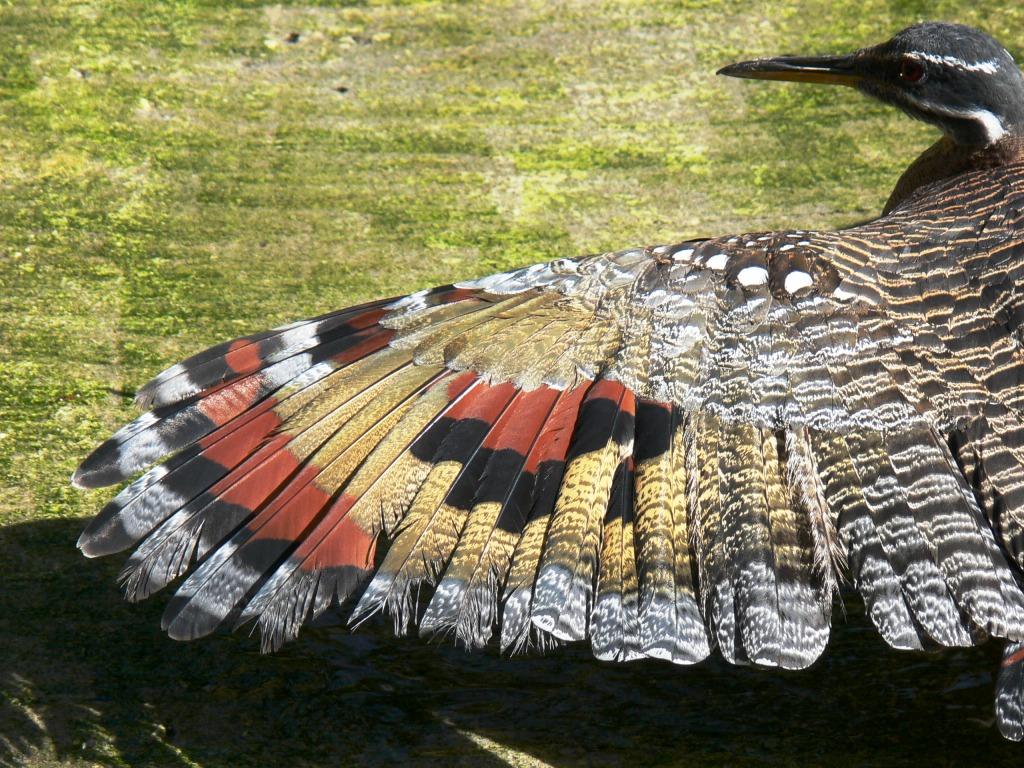
Sunbittern (Eurypyga helias) Left Wing by Lee at Lowry Park Zoo

Sunbittern (Eurypyga helias) Left Wing by Lee at Lowry Park Zoo

While reading in Exodus 25 this week, I noticed that the plan for the Ark is written out in quite specific details. The plans for the mercy seat was to be covered by the outstretched wings of the cherubims of gold.

And the cherubims shall stretch forth their wings on high, covering the mercy seat with their wings, and their faces shall look one to another; toward the mercy seat shall the faces of the cherubims be. (Exodus 25:20 KJV)

I wondered if I had written much about “wings”, so I checked and found only three articles, so far:

I am curious about what can be found, so, let’s see what we can find. Of course my e-Sword is fired up and ready for the searching. Searching first with just “wing”, only 6 verses show up. I Kings 6:24, 6:27; 2 Chronicles 3:11-2 all refer to the wing of the cherub. Isaiah 10:14 actually mentions a bird having its eggs taken and not moving its wing, opening its mouth or peeping. It is used as an illustration.

And my hand hath found as a nest the riches of the people: and as one gathereth eggs that are left, have I gathered all the earth; and there was none that moved the wing, or opened the mouth, or peeped. (Isaiah 10:14 KJV)

Ezekiel 17:23 is the verse used in Fowl (Birds) of Every Wing.

Searching again with “wings” this time shows 64 verses (KJV). Again the cherubims are mentioned in Exodus 25:20, 37:9; I Kings 6:26, 8:6, 8:7; 1 Chronicles 28:18; 2 Chronicles 3:11, 3:13, 5:7-8. Cherubim and serephim wings are again mentioned later in the prophecies of Isaiah (Isa 6:2, 8:8, 18:1, and 40:31), Ezekiel (Exe 1:6-11, 1:23-25, 3:13, 10:5-21, 11:22) and Daniel.  Ezekiel 17:3 & 7 mention “A great eagle with great wings, longwinged, full of feathers” and “another great eagle with great wings and many feathers” Daniel 7:4 and 6 mention “eagle’s wings” and “wings of a fowl

Wedge-tailed Eagle (Aquila audax) ©WikiC

Wedge-tailed Eagle (Aquila audax) ©WikiC

Eagles’ wings are mentioned several more times:

Ye have seen what I did unto the Egyptians, and how I bare you on eagles‘ wings, and brought you unto myself. (Exodus 19:4 KJV)

As an eagle stirreth up her nest, fluttereth over her young, spreadeth abroad her wings, taketh them, beareth them on her wings: (Deuteronomy 32:11 KJV)

Wilt thou set thine eyes upon that which is not? for riches certainly make themselves wings; they fly away as an eagle toward heaven. (Proverbs 23:5 KJV)

But they that wait upon the LORD shall renew their strength; they shall mount up with wings as eagles; they shall run, and not be weary; and they shall walk, and not faint. (Isaiah 40:31 KJV)

For thus saith the LORD; Behold, he shall fly as an eagle, and shall spread his wings over Moab. (Jeremiah 48:40 KJV)

Behold, he shall come up and fly as the eagle, and spread his wings over Bozrah: and at that day shall the heart of the mighty men of Edom be as the heart of a woman in her pangs. (Jeremiah 49:22 KJV)

Indian Peafowl (Pavo cristatus) by Nikhil Devasar

Indian Peafowl (Pavo cristatus) by Nikhil Devasar

Of course other birds are named such as:

Gavest thou the goodly wings unto the peacocks? or wings and feathers unto the ostrich? (Job 39:13 KJV)

Doth the hawk fly by thy wisdom, and stretch her wings toward the south? (Job 39:26 KJV)

And I said, Oh that I had wings like a dove! for then would I fly away, and be at rest. (Psalms 55:6 KJV)

Though ye have lien among the pots, yet shall ye be as the wings of a dove covered with silver, and her feathers with yellow gold. (Psalms 68:13 KJV)

Then lifted I up mine eyes, and looked, and, behold, there came out two women, and the wind was in their wings; for they had wings like the wings of a stork: and they lifted up the ephah between the earth and the heaven. (Zechariah 5:9 KJV)

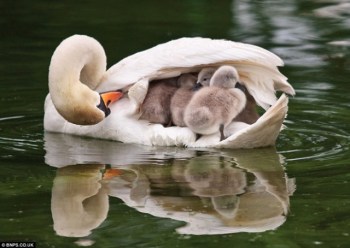
O Jerusalem, Jerusalem, thou that killest the prophets, and stonest them which are sent unto thee, how often would I have gathered thy children together, even as a hen gathereth her chickens under her wings, and ye would not! (Matthew 23:37 KJV)

O Jerusalem, Jerusalem, which killest the prophets, and stonest them that are sent unto thee; how often would I have gathered thy children together, as a hen doth gather her brood under her wings, and ye would not! (Luke 13:34 KJV)

Baby Chick Peeping Out From Under His Mom's Wing - ©©

Baby Chick Peeping Out From Under His Mom’s Wing – ©©

Other references to wings:

  • wings of the wind – 2 Samuel 22:11
  • under whose wings thou art come to trust. – Ruth 2:12
  • hide me under the shadow of thy wings – Psalm 17:8
  • fly upon the wings of the wind – Psalm 18:10
  • trust under the shadow of thy wings. – Psalm 36:7
  • in the shadow of thy wings will I make my refuge – Psalm 57:1
  • rust in the covert of thy wings – Psalm 61:4
  • in the shadow of thy wings will I rejoice – Psalm 63:7
  • He shall cover thee with his feathers, and under his wings shalt thou trust – Psalm 91:4
  • the wings of the wind – Psalm 104:3
  • If I take the wings of the morning – Psalm 139:9
  • for a bird of the air shall carry the voice, and that which hath wings shall tell the matter. – Ecclesiastes 10:20
  • stretching out of his wings – Isaiah 8:8
  • shadowing with wings – Isaiah 18:1
  • Give wings unto Moab, that it may flee and get away – Jeremiah 48:9
  • The wind hath bound her up in her wings – Hosea 4:19
  • healing in his wings – Malachi 4:2

That is an interesting survey of the verses with wing or wings in them. Now I will have to get busy and use this information in some future articles. There are definitely some trends that can be seen. Do you see them? Shadow, wind, healing and trust, just to name a few.

*

Birds of the Bible

Wordless Birds

*

Vol. 2, No. 4 – The Kingbird

Kingbird of Birds Illustrated by Color Photography, 1897

Kingbird of Birds Illustrated by Color Photography, 1897

From col. F. M. Woodruff. Copyrighted by
Nature Study Pub. Co., 1897, Chicago.

THE KINGBIRD.

imgi

T is somewhat strange that there should be little unity of opinion concerning a bird as well known as is this charming fellow, who has at least one quality which we all admire—courage. We will quote a few of the opinions of well-known observers as to whether his other characteristics are admirable, and let the reader form his own conclusion.

John Burroughs says of him: “The exquisite of the family, and the braggart of the orchard, is the Kingbird, a bully that loves to strip the feathers off its more timid neighbors like the Bluebird, that feeds on the stingless bees of the hive, the drones, and earns the reputation of great boldness by teasing large hawks, while it gives a wide berth to the little ones.” Decidedly, this classifies him with the English Sparrow. But we will hear Dr. Brewer: “The name, Kingbird, is given it on the supposition that it is superior to all other birds in the reckless courage with which it will maintain an unequal warfare. My own observations lead me to the conclusion that writers have somewhat exaggerated the quarrelsome disposition of this bird. I have never, or very rarely, known it to molest or attack any other birds than those which its own instinct prompts it to drive away in self-defense, such as Hawks, Owls, Eagles, Crows, Jays, Cuckoos, and Grackles.” That Dr. Coues is a friend of the Kingbird, his language amply proves: “The Kingbird is not quarrelsome—simply very lively. He is the very picture of dash and daring in defending his home, and when he is teaching his youngsters how to fly. He is one of the best of neighbors, and a brave soldier. An officer of the guild of Sky Sweepers, also a Ground Gleaner and Tree Trapper killing robber-flies, ants, beetles, and rose-bugs. A good friend to horses and cattle, because he kills the terrible gadflies. Eats a little fruit, but chiefly wild varieties, and only now and then a bee.” If you now have any difficulty in making up your verdict, we will present the testimony of one other witness, who is, we think, an original observer, as well as a delightful writer, Bradford Torrey. He was in the country. “Almost, I could have believed myself in Eden,” he says. “But, alas, even the birds themselves were long since shut out of that garden of innocence, and as I started back toward the village a Crow went hurrying past me, with a Kingbird in hot pursuit. The latter was more fortunate than usual, or more plucky, actually alighting on the Crow’s back, and riding for some distance. I could not distinguish his motions—he was too far away for that—but I wished him joy of his victory, and grace to improve it to the full. For it is scandalous that a bird of the Crow’s cloth should be a thief; and so, although I reckon him among my friends—in truth, because I do so—I am always able to take it patiently when I see him chastised for his fault.”

The Kingbird is a common bird in Eastern United States, but is rare west of the Rocky Mountains. It is perhaps better known by the name of Beebird or Bee-martin. The nest is placed in an orchard or garden, or by the roadside, on a horizontal bough or in the fork at a moderate height; sometimes in the top of the tallest trees along streams. It is bulky, ragged, and loose, but well capped and brimmed, consisting of twigs, grasses, rootlets, bits of vegetable down, and wool firmly matted together, and lined with feathers, hair, etc.

Eastern Kingbird (Tyrannus tyrannus) by Margaret Sloan

Eastern Kingbird (Tyrannus tyrannus) by Margaret Sloan


THE KINGBIRD.

You think, my young friends, because I am called Kingbird I should be large and fine looking.

Well, when you come to read about Kings in your history-book you will find that size has nothing to do with Kingliness. I have heard, indeed, that some of them were very puny little fellows, in mind as well as in body.

If it is courage that makes a king then I have the right to be called Kingbird. They say I have a reckless sort of courage, because I attack birds a great deal larger than myself.

I would not call it courage to attack anything smaller than myself, would you? A big man finds it easy to shoot a little bird in the air; and a big boy does not need to be brave to kill or cripple some poor little animal that crosses his path. He only needs to be a coward to do that!

I only attack my enemies,—the Hawks, Owls, Eagles, Crows, Jays, and Cuckoos. They would destroy my young family if I did not drive them away. Mr. Crow especially is a great thief. When my mate is on her nest I keep a sharp lookout, and when one of my enemies approaches I give a shrill cry, rise in the air, and down I pounce on his back; I do this more than once, and how I make the feathers fly!

The little hawks and crows I never attack, and yet they call me a bully. Sometimes I do go for a Song-bird or a Robin, but only when they come too near my nest. People wonder why I never attack the cunning Catbird. I’ll never tell them, you may be sure!

To what family do I belong? To a large family called Flycatchers. Because some Kings are tyrants I suppose, they call me the Tyrant Flycatcher. Look for me next summer on top of a wire fence or dead twig of a tree, and watch me, every few minutes, dash into the air, seize a passing insect, and then fly back to the same perch again.

Any other names? Yes, some folks call me the Bee Bird or Bee Martin. Once in awhile I change my diet and do snap up a bee! but it is always a drone, not a honey-bee. Some ill-natured people say I choose the drones because they can’t sting, and not because they are tramp bees and will not work.

Sing? Yes, when my mate is on her nest I please her with a soft pretty song, at other times my call-note is a piercing Kyrie-K-y-rie! I live with you only in the summer. When September comes I fly away to a warmer climate.

Summary:

KINGBIRD.Tyrannus tyrannus.

Range—North America north to New Brunswick and Manitoba; rare west of the Rocky Mountains; winters in Central and South America.

Nest—Compact and symmetrical, of weed-stocks, grasses, and moss, lined with plant down, fine grasses, and rootlets, generally at the end of a branch fifteen to twenty-five feet from the ground.

Eggs—Three to five, white, spotted with umber.


Eastern Kingbird (Tyrannus tyrannus) by Margaret Sloan Eating

Eastern Kingbird (Tyrannus tyrannus) Eating by Margaret Sloan

Lee’s Addition:

Sing praises to God, sing praises! Sing praises to our King, sing praises! For God is the King of all the earth; Sing praises with understanding. (Psalms 47:6-7 NKJV)

The Eastern Kingbird (Tyrannus tyrannus) is a large tyrant flycatcher native to North America that are part of the Tyrannidae – Tyrant Flycatchers Family. There are 421 species assigned to that family, at present. Eleven of those are Kingbirds.

Adults are grey-black on the upperparts with light underparts; they have a long black tail with a white end and long pointed wings. They have a red patch on their crown, seldom seen. They are of average size for a kingbird, at 7.5–9 in (19–23 cm), 13–15 in (33–38 cm) across the wings and weighing 1.2-1.9 oz (33-55 g).

The call is a high-pitched, buzzing and unmusical chirp, frequently compared to an electric fence.

Eastern Kingbird call from xeno-canto.

An Eastern Kingbird's nest and eggs.

Eastern Kingbird (Tyrannus tyrannus) Nest ©WikiC

Their breeding habitat is open areas across North America. They make a sturdy cup nest in a tree or shrub, sometimes on top of a stump or pole. These birds aggressively defend their territory, even against much larger birds.

These birds migrate in flocks to South America. There is one European record, from Ireland in October 2012.

They wait on an open perch and fly out to catch insects in flight, sometimes hovering to pick food off vegetation. They also eat berries and fruit, mainly in their wintering areas.

Some eastern kingbirds place their nests in the open while others hide nests very well. Eastern kingbirds in Southern British Columbia can nest in open fields; in shrubs over open water; high in tall trees and even in the tops of small stumps. Both male and female participate in nest defense, but females may stay on well-hidden nests longer than females with open nests who may leave nests earlier to chase away predators. Those pairs nesting in the open may be able to see predators coming earlier and rely on aggressive behavior to protect their young.

They can recognize and remove cowbird eggs from their nests. Still, blue jays, American crows, squirrels, and tree-climbing snakes are on occasion nest predators. American kestrels are probable predators of adults.

For the LORD is the great God, And the great King above all gods. In His hand are the deep places of the earth; The heights of the hills are His also. The sea is His, for He made it; And His hands formed the dry land. Oh come, let us worship and bow down; Let us kneel before the LORD our Maker. (Psalms 95:3-6 NKJV)

There are 12 other Kingbirds in the Tyrannus genus.

*

Birds Illustrated by Color Photography – Revisited

The above article is an article in the monthly serial for October 1897 “designed to promote Knowledge of Bird-Live.” These include Color Photography, as they call them, today they are drawings. There are at least three Volumes that have been digitized by Project Gutenberg.

To see the whole series of – Birds Illustrated by Color Photography – Revisited

*

(Information from Wikipedia and other internet sources)

Next Article – John James Audubon

The Previous Article – The Slate-Colored Junco


ABC’s of the Gospel

Links:

Eastern Kingbird – All About Birds

Eastern Kingbird – All About Birds

SIMILAR BIRDS – From All About Birds

Eastern Kingbird – Wikipedia

*