
Eared Dove (Zenaida auriculata) by Robert Scanlon
Also he sent forth a dove from him, to see if the waters were abated from off the face of the ground; (Genesis 8:8 KJV)

Eared Dove (Zenaida auriculata) by Robert Scanlon
Also he sent forth a dove from him, to see if the waters were abated from off the face of the ground; (Genesis 8:8 KJV)
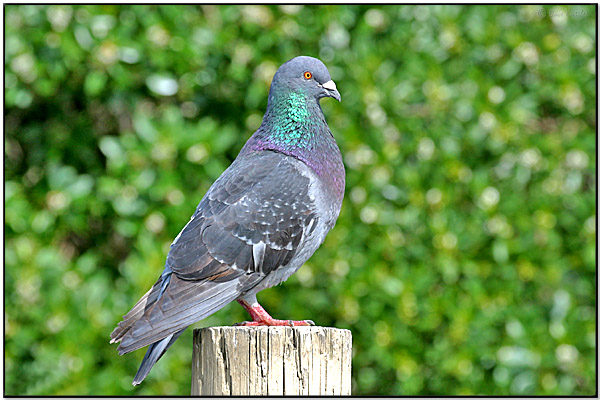
Common Pigeon -aka Rock(Columba livia) by Daves BirdingPix
Bible Birds – Dove, Turtledove and Pigeon’s Introduction

Giant Fruit Bat at Cincinnati Zoo by Dan
And the stork, the heron after her kind, and the lapwing, and the bat. All fowls that creep, going upon all four, shall be an abomination unto you. Yet these may ye eat of every flying creeping thing that goeth upon all four, which have legs above their feet, to leap withal upon the earth; Even these of them ye may eat; the locust after his kind, and the bald locust after his kind, and the beetle after his kind, and the grasshopper after his kind. But all other flying creeping things, which have four feet, shall be an abomination unto you.
(Leviticus 11:19-23 KJV)
While we were at the Cincinnati Zoo, we were able to see and photograph several Bat species. They were really cool and I wanted to share them with you.

Giant Fruit Bat at Cincinnati Zoo by Lee
Then I remembered that I had written about them in Birds of the Bible – The Bat?, in 2010. That article was about the controversy over whether a Bat is a Bird. This time, I am mainly sharing the photos of the Bats that are there at the Zoo and comments about them. Just one personal observation about the above verses. The use of “fowl” in the King James Version and some of the others seems to refer to any creature that had wings and flies. I quoted the whole context because; 1) The verse and chapter separations were inserted later, 2) Birds, bats, and insects all seem to be referred to with the same collective term, “fowl.” I do not have a problem with the bat. It is not a bird.
The only other verses using “bat” or “bats” are:
And the stork, and the heron after her kind, and the lapwing, and the bat. (Deuteronomy 14:18 KJV)
In that day a man shall cast his idols of silver, and his idols of gold, which they made each one for himself to worship, to the moles and to the bats; (Isaiah 2:20 KJV)
The bats we saw at the Cincinnati Zoo were the Giant Fruit Bats and the Vampire Bats. They are amazing creatures of design and creation from their Creator, the Lord.
*

Giant Fruit Bat’s Foot amazed me
Giant Fruit Bat (Pteropus giganteus) or Indian Flying Fox is found in Bangladesh, China, India, the Maldives, Nepal, Pakistan, and Sri Lanka. Also known as the greater Indian fruit bat, it lives in mainly forests. It is a very large bat with a wingspan between 3 ft 10 in and 4 ft 10 in (1.2 and 1.5 m). It is nocturnal and feeds mainly on ripe fruits, such as mangoes and bananas, and nectar. This bat is gregarious and lives in colonies which can number a few hundred. Their offspring have no specific name besides ‘young’. They have one to two young.
The Indian flying fox lives in tropical forests and swamps, where a large body of water is nearby.
The way they were hanging up there amazed me. I zoomed in and took a photo of its foot. Also, they almost looked like a large cocoon hanging up there with the wings wrapper around them. The first photo, Dan caught one of them stretching.
*
*

Common Vampire Bat Cincinnati Zoo by Lee (Shot through glass into a dark exhibit)
(Common) Vampire Bat (Desmodus rotundus) – The common vampire bat mainly feeds on the blood of livestock, approaching its prey at night while they are sleeping. It uses its razor-sharp teeth to cut open the skin of its hosts and laps up their blood with its long tongue. They are native to the New World, ranging from Mexico to Brazil, Chile, and Argentina.
The common vampire bat is short-haired, with silver-gray fur on its undersides, sharply separated from the darker fur on its back. It has small, somewhat rounded ears, a deeply grooved lower lip, and a flat, leaf-shaped nose. A well-developed, clawed thumb on each wing is used to climb onto prey and to assist the animal in take-off. The bat averages about 3.5 in (9 cm) long with a wingspan of 7 in (18 cm). It commonly weighs about 2 oz (57 grams), but its weight can double after a single feeding. The braincase is relatively large, but the snout is reduced to accommodate large incisors and canines. It has the fewest teeth among bats.

Common Vampire Bat – Cincinnati Zoo by Lee
Common vampire bats have good eyesight. They are able to distinguish different optical patterns and may use vision for long-range orientation. These bats also have well-developed senses of smell and hearing: the cochlea (ear) is highly sensitive to low-frequency sounds, and the nasal passages are relatively large. They emit echolocation signals orally, and thus fly with their mouths open for navigation.

Common Vampire Bat – Cincinnati Zoo by Lee
*
(Wikipedia with editing)
*
*
Links:
Giant Fruit Bats – Cincinnati Zoo
Indian Flying Fox – Wikipedia
Vampire Bats – Cincinnati Zoo
Common Vampire Bat – Wikipedia
*

Scripture Alphabet of Animals: The Mole
By Harriet N. Cook (1814-1843)
I remember but two places in the Bible where this animal is mentioned. One is in Leviticus, where it is named among the unclean animals which the Israelites were forbidden to eat; and the other is this verse in the second chapter of Isaiah:
In that day a man shall cast his idols of silver, and his idols of gold, which they made each one for himself to worship, to the moles and to the bats.
Have you read about the first missionaries who went to the Sandwich Islands?……

Scripture Alphabet of Animals: The Leopard
By Harriet N. Cook (1814-1843)
The leopard is a beautiful animal, though very savage and cruel. It is about as large as the largest of our dogs, but it looks much more like a ….

Scripture Alphabet of Animals: The Ibex or the Wild Goat
By Harriet N. Cook (1814-1843)
The Ibex is a kind of goat, but different from the one described at page 33. It is sometimes called the Rock Goat, or Wild Goat; and the last is the name given it in the Bible. It resembles the common goat, but is larger, and its horns are much longer; they are sometimes considerably more than a …..

Scripture Alphabet of Animals: The Fox or Jackal
By Harriet N. Cook (1814-1843)
It is not quite certain whether the fox mentioned in the Bible is the same animal that we now call by that name. It probably means what we now call the ….

Scripture Alphabet of Animals: The Goat
By Harriet N. Cook (1814-1843)
There are two kinds of goat in the countries where the Bible was written; one very much like those that we sometimes see; the other differing from it in several respects, especially in the greater length of its ears. It is supposed that the prophet Amos speaks of the latter kind when he says,
As the shepherd taketh out of the mouth of the lion, two legs or a piece of an ….
Continue Reading Here

Camel Side Head Neck
Scripture Alphabet of Animals: The Camel
By Harriet N. Cook (1814-1843)
There are two or three varieties of the camel, but they do not differ from each other much more than our horses, some of which, the stout and strong, we use to draw heavy loads; others, more slender and graceful, we use for riding. The swift camel is called a …
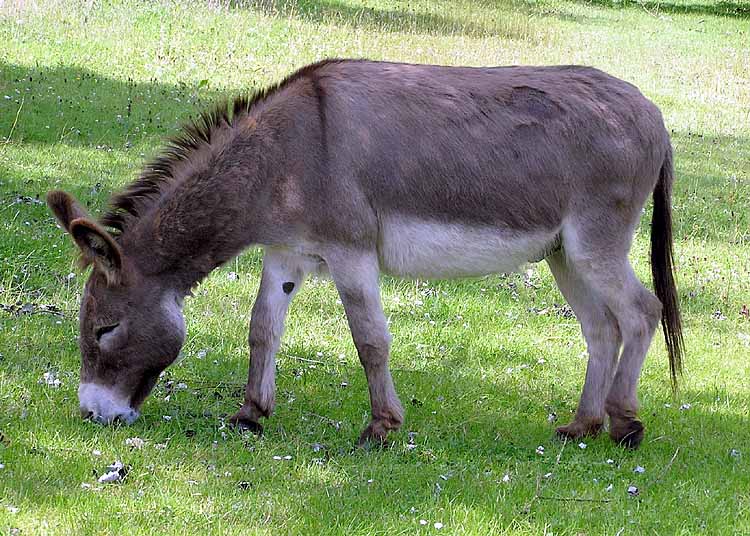
Scripture Alphabet of Animals: The Ass (Donkey)
By Harriet N. Cook (1814-1843)
Perhaps you may have seen the ass, though it is not very common in this country. It has some resemblance to a horse, but is not as large, and generally….





 Birds of the Bible For Kids