Vol. 2, # 5 – The Vermilion Fly-Catcher

THE VERMILION FLY-CATCHER

The Vermilion Fly-catcher

From col. George F. Breninger. Copyrighted by
Nature Study Pub. Co., 1897, Chicago.

THE VERMILION FLY-CATCHER

imgt

HICKETS along water courses are favorite resorts of this beautiful Fly-catcher, which may be seen only on the southern border of the United States, south through Mexico to Guatemala, where it is a common species. Mr. W. E. D. Scott notes it as a common species about Riverside, Tucson, and Florence, Arizona. Its habits are quite similar to those of other Fly-catchers, though it has not been so carefully observed as its many cousins in other parts of the country. During the nesting season, the male frequently utters a twittering song while poised in the air, in the manner of the Sparrow Hawk, and during the song it snaps its bill as if catching insects.

The Vermilion’s nest is usually placed in horizontal forks of ratana trees, and often in mesquites, not more than six feet from the ground; they are composed of small twigs and soft materials felted together, with the rims covered with lichens, and the shallow cavity lined with a few horse or cow hairs. Dr. Merrill states that they bear considerable resemblance to nests of the Wood Pewee in appearance and the manner in which they are saddled to the limb. Nests have been found, however, which lacked the exterior coating of lichens.

Three eggs are laid of a rich creamy-white with a ring of large brown and lilac blotches at the larger end.


A WINTER NEST.

Pallid, wan-faced clouds
Press close to the frozen pines,
And follow the jagged lines
Of fence, that the sleet enshrouds.

Sharp in the face of the sky,
Gaunt, thin-ribbed leaves are blown;
They rise with a shuddering moan,
Then sink in the snow and die.

At the edge of the wood a vine
Still clings to the sleeping beech,
While its stiffened tendrils reach
A nest, and around it twine.

A little gray nest all alone,
With its feathery lining of snow,
Where bleak winds, piping low,
Croon a sweet minor tone.
—Nora A. Piper.

*

Summary:

VERMILION FLY-CATCHER.Pyocephalus rubineus mexicanus.

Range—Southern Border of the United States south through Mexico and Guatemala.

Nest—In forks of ratana trees, not more than six feet up, of small twigs and soft materials felted together, the rims covered with lichens; the cavity is shallow.

Eggs—Usually three, the ground color a rich creamy-white, with a ring of large brown and lilac blotches at the larger end.


Vermilion Flycatcher (Pyrocephalus rubinus) by Margaret Sloan

Vermilion Flycatcher (Pyrocephalus rubinus) by Margaret Sloan

Lee’s Addition:

“Come now, and let us reason together,” Says the LORD, “Though your sins are like scarlet, They shall be as white as snow; Though they are red like crimson, They shall be as wool. (Isaiah 1:18 NKJV)

The Vermilion Flycatcher (Pyrocephalus rubinus) is a small passerine bird in the Tyrannidae, or tyrant flycatcher family. Most flycatchers are rather drab, but the Vermilion Flycatcher is a striking exception. It is a favourite with birders, but is not generally kept in aviculture, as the males tend to lose their vermilion colouration when in captivity.

Vermilion Flycatchers generally prefer somewhat open areas, and are found in trees or shrubs in savannah, scrub, agricultural areas, riparian woodlands, and desert as well, but usually near water. Their range includes almost all of Mexico; it extends north into the southwestern United States, and south to scattered portions of Central America, parts of northwestern and central South America, and on southwards to central Argentina. They are also found in the Galapagos Islands.

The species grows to about seven inches in length, and is strongly dimorphic; males are bright red, with dark brown plumage. Females have a peach-coloured belly with a dark grey upperside, and are similar to Say’s Phoebe.

The flycatchers feed mostly on insects such as flies, grasshoppers and beetles. These are usually taken in mid-air, after a short sally flight from a perch.

They lay 2-3 whitish eggs in a nest made of twigs, stems and roots, and lined with hair. The eggs are incubated for around two weeks by the female and the young are ready to leave the nest 15 days after hatching.

Vermilion Flycatcher (Pyrocephalus rubinus) Female on nest ©WikiC

Vermilion Flycatcher (Pyrocephalus rubinus) Female on nest ©WikiC

*

Birds Illustrated by Color Photography – Revisited

The above article is an article in the monthly serial for October 1897 “designed to promote Knowledge of Bird-Live.” These include Color Photography, as they call them, today they are drawings. There are at least three Volumes that have been digitized by Project Gutenberg.

To see the whole series of – Birds Illustrated by Color Photography – Revisited

*

(Information from Wikipedia and other internet sources)

Next Article – The Lazuli Bunting

The Previous Article – The European Kingfisher

Sharing The Gospel

Links:

*

Vol. 2, # 5 – The European Kingfisher

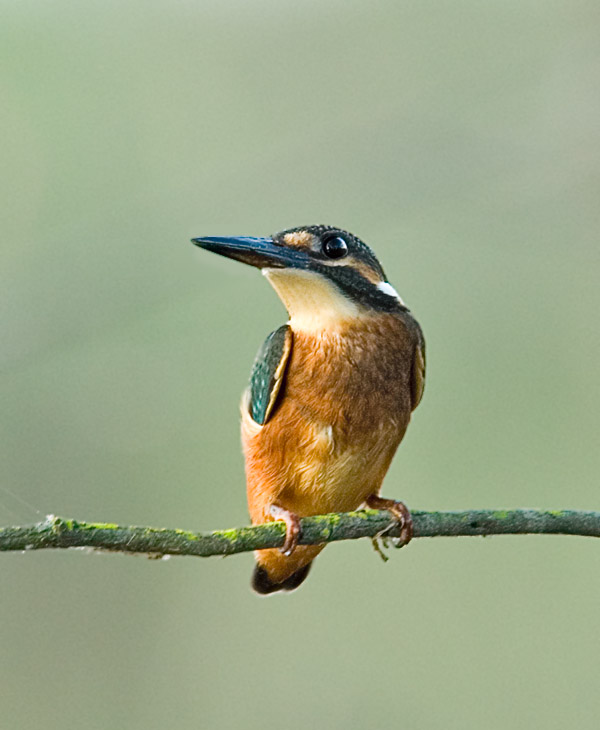
Common Kingfisher (Alcedo atthis) European Kingfisher for Birds Illustrated by Color Photography

European Kingfisher for Birds Illustrated

From col. Chi. Acad. Sciences. Copyrighted by
Nature Study Pub. Co., 1897, Chicago.

THE EUROPEAN KINGFISHER

imgr

ARELY indeed is this charming bird now found in England, where formerly it could be seen darting hither and thither in most frequented places. Of late years, according to Dixon, he has been persecuted so greatly, partly by the collector, who never fails to secure the brilliant creature for his cabinet at every opportunity, and partly by those who have an inherent love for destroying every living object around them. Gamekeepers, too, are up in arms against him, because of his inordinate love of preying on the finny tribe. Where the Kingfisher now is seen is in the most secluded places, the author adds, where the trout streams murmur through the silent woods, but seldom trod by the foot of man; or in the wooded gullies down which the stream from the mountains far above rushes and tumbles over the huge rocks, or lies in pools smooth as the finest mirror.

The Kingfisher is comparatively a silent bird, though he sometimes utters a few harsh notes as he flies swift as a meteor through the wooded glades. You not unfrequently flush the Kingfisher from the holes in the banks, and amongst the brambles skirting the stream. He roosts at night in holes, usually the nesting cavity. Sometimes he will alight on stumps and branches projecting from the water, and sit quiet and motionless, but on your approach he darts quickly away, often uttering a feeble seep, seep, as he goes.

The habits of the English Kingfisher are identical with those of the American, though the former is the more brilliant bird in plumage. (See Birds, Vol. I, p. 61.) The ancients had a very absurd idea as to its nesting habits. They believed that the bird built a floating nest, and whenever the old bird and her charge were drifted by the winds, as they floated over the briny deep, the sea remained calm. He was, therefore, to the ancient mariner, a bird held sacred in the extreme. Even now these absurd superstitions have not wholly disappeared. For instance, the nest is said to be made of the fish bones ejected by the bird, while the real facts are, that they not only nest but roost in holes, and it must follow that vast quantities of rejected fish bones accumulate, and on these the eggs are of necessity laid.

These eggs are very beautiful objects, being of a deep pinkish hue, usually six in number.

The food of the Kingfisher is not composed entirely of fish, the remains of fresh-water shrimps being found in their stomachs, and doubtless other animals inhabiting the waters are from time to time devoured.

The English Kingfisher, says Dixon, remains throughout the year, but numbers perish when the native streams are frozen. There is, perhaps, not a bird in all the ranks of the feathered gems of equatorial regions, be it ever so fair, the Humming-bird excepted, that can boast a garb so lovely as this little creature of the northland. Naturalists assert that the sun has something to do with the brilliant colors of the birds and insects of the tropics, but certainly, the Kingfisher is an exception of the highest kind. Alas, that he has no song to inspire the muse of some English bard!

Common Kingfisher (Alcedo atthis) by Phil Kwong

Common Kingfisher (Alcedo atthis) by Phil Kwong

THE EUROPEAN KINGFISHER.

Little Folks:

I shouldn’t have liked it one bit if my picture had been left out of this beautiful book. My cousin, the American Kingfisher, had his in the February number, and I find he had a good deal to say about himself in his letter, too.

Fine feathers make fine birds, they say. Well, if that is true, I must be a very fine bird, for surely my feathers are gay enough to please anybody—I think.

To see me in all my beauty, you must seek me in my native wood. I look perfectly gorgeous there, flitting from tree to tree. Or maybe you would rather see me sitting on a stump, gazing down into the clear pool which looks like a mirror.

“Oh, what a vain bird!” you would say; “see him looking at himself in the water;” when all the time I had my eye on a fine trout which I intended to catch for my dinner.

Well, though I wear a brighter dress than my American cousin, our habits are pretty much alike. I am sure he catches fish the same way I do—when he is hungry.

With a hook and line, as you do?

Oh, no; with my bill, which is long, you observe, and made for that very purpose. You should just see me catch a fish! Down I fly to a stump near the brook, or to a limb of a tree which overhangs the water, and there I sit as quiet as a mouse for quite a while.

Everything being so quiet, a fine speckled trout, or a school of troutlets, play near the surface. Now is my chance! Down I swoop, and up I come with a fish crosswise in my bill.

Back I go to my perch, toss the minnow into the air, and as it falls catch it head first and swallow it whole. I tell you this because you ought to know why I am called Kingfisher.

Do we swallow bones and all?

Yes, but we afterwards eject the bones, when we are resting or roosting in our holes in the banks of the stream. That must be the reason people who write about us say we build our nests of fish bones.

Sing?

Oh, no, we are not singing birds; but sometimes, when flying swiftly through the air, we give a harsh cry that nobody but a bird understands.

Your friend,
The English Kingfisher.

Summary:

EUROPEAN KINGFISHER.Alcedo ispida.

Range—England and portions of Europe.

Nest—In holes of the banks of streams.

Eggs—Usually six, of a deep pinkish hue.


Common Kingfisher (Alcedo atthis) by Phil Kwong

Common Kingfisher (Alcedo atthis) by Phil Kwong

Lee’s Addition:

And as He walked by the Sea of Galilee, He saw Simon and Andrew his brother casting a net into the sea; for they were fishermen. Then Jesus said to them, “Follow Me, and I will make you become fishers of men.” (Mark 1:16-17 NKJV)

The Common Kinfisher is part of the Alcedinidae – Kingfishers Family, now divided into the River Kingfishers or Alcedinidae group. Personally, Kingfishers are a favorite of mine and I enjoy the neat design, attitude and challenge to photograph the Lord gave them.

The Common Kingfisher (Alcedo atthis) also known as Eurasian Kingfisher or River Kingfisher, is a small kingfisher with seven subspecies recognized within its wide distribution across Eurasia and North Africa. It is resident in much of its range, but migrates from areas where rivers freeze in winter.

This sparrow-sized bird has the typical short-tailed, large-headed kingfisher profile; it has blue upperparts, orange underparts and a long bill. It feeds mainly on fish, caught by diving, and has special visual adaptions to enable it to see prey under water. The glossy white eggs are laid in a nest at the end of a burrow in a riverbank.

This species has the typical short-tailed, dumpy-bodied large-headed and long-billed kingfisher shape. The adult male of the western European subspecies, A. a. ispida has green-blue upperparts with pale azure-blue back and rump, a rufous patch by the bill base, and a rufous ear-patch. It has a green-blue neck stripe, white neck blaze and throat, rufous underparts, and a black bill with some red at the base. The legs and feet are bright red.[5] It is about 16 centimetres (6.3 in) long with a wingspan of 25 cm (9.8 in), and weighs 34–46 grams (1.2–1.6 oz).

The female is identical in appearance to the male except that her lower mandible is orange-red with a black tip. The juvenile is similar to the adult, but with duller and greener upperparts and paler underparts. Its bill is black, and the legs are also initially black.

The flight of the Kingfisher is fast, direct and usually low over water. The short rounded wings whirr rapidly, and a bird flying away shows an electric-blue “flash” down its back.

In North Africa, Europe and Asia north of the Himalayas this is the only small blue kingfisher. In south and southeast Asia it can be confused with six other small blue-and-rufous kingfishers, but the rufous ear patches distinguish it from all but juvenile Blue-eared Kingfisher; details of the head pattern may be necessary to differentiate the two species where both occur.

The Common Kingfisher has no song. The flight call is a short sharp whistle, chee, repeated two or three times. Anxious birds emit a harsh, shrit-it-it and nestlings call for food with a churring noise

Flight Call from xeno-canto by Marco Dragonetti

Common Kingfisher (Alcedo atthis) by W Kwong

Common Kingfisher (Alcedo atthis) by W Kwong

*

Birds Illustrated by Color Photography – Revisited

The above article is an article in the monthly serial for October 1897 “designed to promote Knowledge of Bird-Live.” These include Color Photography, as they call them, today they are drawings. There are at least three Volumes that have been digitized by Project Gutenberg.

To see the whole series of – Birds Illustrated by Color Photography – Revisited

*

(Information from Wikipedia and other internet sources)

Common Kingfisher (Alcedo atthis) by Ian

Common Kingfisher (Alcedo atthis) by Ian

Next Article – The Vermilion Fly-Catcher

The Previous Article – The Yellow-billed Tropic Bird

ABC’s of the Gospel

Links:

Common Kingfisher – Wikipedia

Common Kingfisher – xeno-canto

Alcedinidae – Kingfishers Family

*

Vol, 2, # 5 – The Yellow-Billed Tropic Bird

The Yellow-billed Tropicbird

The Yellow-billed Tropic Bird, 1897

THE YELLOW-BILLED TROPIC BIRD.

imgi

N appearance this bird resembles a large Tern (See The Black Tern), and its habits are similar to those of the Terns. Inter-tropical, it is of a wandering disposition, breeding on the islands of mid-ocean thousands of miles apart. It is noted for its elegant, airy, and long-protracted flight. Davie says that on Bourbon, Mauritius and other islands east and south of Madagascar it breeds in the crevices of the rocks of inaccessible cliffs, and in hollow trees. In the Bermuda Islands it nests about the first of May in holes in high rocky places along the shores. Here its favorite resorts are the small islands of Great Sound, Castle Harbor, and Harrington Sound. The Phaeton, as it is felicitously called, nests in the Bahamas in holes in the perpendicular faces of cliffs and on the flat surfaces of rocks. A single egg is laid, which has a ground-color of purplish brownish white, covered in some specimens almost over the entire surface with fine reddish chocolate-colored spots.

These species compose the small but distinct family of tropic birds and are found throughout the tropical and sub-tropical regions of the world. Long journeys are made by them across the open sea, their flight when emigrating being strong, rapid, and direct, and immense distances are covered by them as they course undismayed by wind or storm. In feeding, Chapman says, they course over the water, beating back and forth at a height of about forty feet, and their long willowy tail-feathers add greatly to the grace and beauty of their appearance when on the wing. They are of rare and probably accidental occurrence on our coasts.

The Songs of Nature never cease,
Her players sue not for release
In nearer fields, on hills afar,
Attendant her musicians are:
From water brook or forest tree,
For aye comes gentle melody,
The very air is music blent—
An universal instrument.
—John Vance Cheney.

***

THE YELLOW-BILLED TROPIC BIRD.

The people who make a study of birds say that I look like a large Tern, and that my habits are like his.

I don’t know whether that is so, I am sure, for I have no acquaintance with that bird, but you little folks can turn to your The Black Tern and see for yourselves if it is true.

For my part, I think I am the prettier of the two on account of my long, willowy tail-feathers. They add greatly, it is said, to the grace and beauty of my appearance when on the wing. Then, the color of my coat is much more beautiful than his, I think, don’t you think so, too?

We are not so common as the Terns, either, for they are very numerous. There are only three species of our family, so we consider ourselves quite distinct.

What are we noted for?

Well, principally for our long distance flights across the sea, elegant and airy, as the writers say of us. Maybe that is the reason they call us the Phaeton sometimes.

Do we go north in the summer as so many other birds do?

Ugh! You make me shudder. No, indeed! We never go farther north than Florida. Our home, or where we build our nests, is in the tropical and sub-tropical regions, where the weather is very warm, you know.

We are great wanderers and build our nests on islands, way out in the ocean many thousands of miles apart.

In trees?

Oh, no, but in any hole we see in the face of a great rock or cliff, and sometimes right on the top of a rock.

How many eggs?

Only one. That is the reason, you see, that our family remains small.

Sing?

Oh, my, no! We are not singing birds. We have a call-note, though harsh and guttural, which sounds like tip, tip, tip.

Summary:

YELLOW-BILLED TROPIC BIRD.Phaethon flavirostris. Other names: “Phaeton.” (Now ~ White-tailed Tropicbird (Phaethon lepturus)

Range.—Tropical coasts; Atlantic coasts of tropical America, West Indies, Bahamas, Bermudas; casual in Florida and accidental in Western New York and Nova Scotia. (Chapman.)

Nest—In holes in the perpendicular faces of cliffs, also on the flat surfaces of rocks.

Eggs—One, ground color of purplish brownish white, covered with fine reddish chocolate-colored spots. (Davie.)


White-tailed Tropicbird (Phaethon lepturus) by Ian

White-tailed Tropicbird (Phaethon lepturus) by Ian

Lee’s Addition:

So it shall be, while My glory passes by, that I will put you in the cleft of the rock, and will cover you with My hand while I pass by. (Exodus 33:22 NKJV)

Our Yellow-billed Tropic Bird is now the White-tailed Tropicbird (Phaethon lepturus). It’s name has gone through several changes according to Avibase. What a lovely bird the Lord created with this family of birds. They are members of the Phaethontidae – Tropicbird Family which only has three species; the Yellow-billed, Red-tailed and Red-billed.

The White-tailed Tropicbird Phaethon lepturus, is a tropicbird, smallest of three closely related seabirds of the tropical oceans and smallest member of the order Phaethontiformes. It occurs in the tropical Atlantic, western Pacific and Indian Oceans. It also breeds on some Caribbean islands, and a few pairs have started nesting recently on Little Tobago, joining the Red-billed Tropicbird colony. In addition to the tropical Atlantic, it nests as far north as Bermuda, where it is locally called a “Longtail”.

White-tailed Tropicbird (Phaethon lepturus) ©WikiC

White-tailed Tropicbird (Phaethon lepturus) ©WikiC

The White-tailed Tropicbird breeds on tropical islands laying a single egg directly onto the ground or a cliff ledge. It disperses widely across the oceans when not breeding, and sometimes wanders far. It feeds on fish and squid, caught by surface plunging, but this species is a poor swimmer. The call is a high screamed keee-keee-krrrt-krrt-krrt.

The adult White-tailed Tropicbird is a slender, mainly white bird, 71–80 cm long including the very long central tail feathers, which double its total length. The wingspan is 89–96 cm, and there is a black band on the inner wing There is black through the eye and the bill is orange-yellow to orange red. The bill colour, pure white back and black wing bar distinguish this species from Red-billed.

Sexes are similar, although males average longer tailed, but juveniles lack the tail streamers, have a green-yellow bill, and a finely barred back.

*

Birds Illustrated by Color Photography – Revisited

The above article is an article in the monthly serial for October 1897 “designed to promote Knowledge of Bird-Live.” These include Color Photography, as they call them, today they are drawings. There are at least three Volumes that have been digitized by Project Gutenberg.

To see the whole series of – Birds Illustrated by Color Photography – Revisited

*

(Information from Wikipedia and other internet sources)

Next Article – The European Kingfisher

The Previous Article – The Cerulean Warbler

Wordless Birds

Links:

*

Vol, 2, # 5 – The Cerulean Warbler

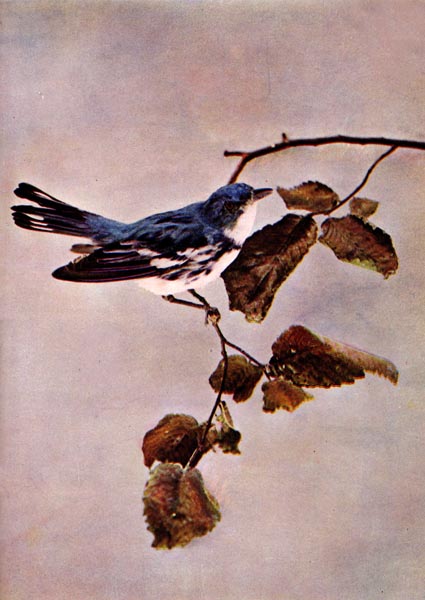
Cerulean Warbler (Setophaga cerulea)

Cerulean Warbler (Setophaga cerulea) – Birds Illustrated by Color Photography

THE CERULEAN WARBLER.

imgt

HIS beautiful little sky-blue feathered creature is well named Azure Warbler, or again White-throated Blue Warbler, and is the most abundant of the genus here.

It is a bird of the wood, everywhere associated with the beautiful tall forests of the more northern counties of western New York, sometimes found in the open woods of pasture-lands, and quite partial to hardwood trees. In its flitting motion in search of insect-prey, and in the jerking curves of its more prolonged flight, as also in its structure, it is a genuine Wood Warbler and keeps for the most part to what Thoreau calls the “upper story” of its sylvan domain.

All Warblers, it has been said, depend upon their markings rather than song for their identity, which renders the majority of the tribe of greater interest to the scientist than to the novice. Until you have named four or five of the commonest species as landmarks, you will be considerably confused.

Audubon described the song of the Cerulean Warbler as “extremely sweet and mellow,” whereas it is a modest little strain, says Chapman, or trill, divided into syllables like zee, zee, zee, ze-ee-ee-eep, or according to another observer, rheet, rheet, rheet, rheet, ridi, idi, e-e-e-e-ee; beginning with several soft warbling notes and ending in a rather prolonged but quite musical squeak. The latter and more rapid part of the strain, which is given in the upward slide, approaches an insect quality of tone which is more or less peculiar to all true Warblers, a song so common as to be a universal characteristic of our tall forests.

It is not strange that the nest of this species has been so seldom discovered, even where the bird is very abundant during the breeding season. It is built in the higher horizontal branches of forest trees, always out some distance from the trunk, and ranging from twenty to fifty feet above the ground. One described by Dr. Brewer, found in Ontario, near Niagara Falls, was built in a large oak tree at the height of fifty or more feet from the ground. It was placed horizontally on the upper surface of a slender limb between two small twigs; and the branch on which it was thus saddled was only an inch and a half in thickness, being nine feet from the trunk of the tree. The abandoned home was secured with great difficulty.

The nest is a rather slender fabric, somewhat similar to the nest of the Redstart, and quite small for the bird, consisting chiefly of a strong rim firmly woven of strips of fine bark, stems of grasses, and pine needles, bound round with flaxen fibres of plants and wool. Around the base a few bits of hornets’ nests, mosses, and lichens are loosely fastened. The nest within is furnished with fine stems and needles, the flooring very thin and slight.

The bird is shy when started from the nest, and has a sharp chipping alarm-note common to the family.

The Cerulean Warbler is found in the Eastern States, but is more numerous west of the Allegheny mountains, and throughout the heavily wooded districts of the Mississippi valley. In winter it migrates to Central America and Cuba. The Warblers are of unfailing interest to the lover of bird life. Apart from the beauty of the birds themselves, with their perpetually contrasting colors among the green leaves, their pretty ways furnish to the silent watcher an ever changing spectacle of the innocent life in the tree-tops.

Summary:

CERULEAN WARBLERDendræca caerulea. Other names: “Azure Warbler;” “White-throated Blue Warbler.”

Range—Mississippi valley as far north as Minnesota, and eastward as far as Lockport, N. Y. (Davison.) Winters in the tropics.

Nest—Of fine grasses bound with spider’s silk, lined with strips of bark and with a few lichens attached to its upper surface, in a tree, twenty-five to fifty feet from the ground. (Chapman.)

Eggs—Four, creamy-white, thickly covered with rather heavy blotches of reddish brown.


Cerulean Warbler (Dendroica cerulea) ©WikC

Cerulean Warbler (Dendroica cerulea) ©WikC

Lee’s Addition:

The birds of heaven dwell by them; they give forth their voice from among the branches. (Psalms 104:12 Darby)

The Lord has given us another neat little bird to observe. The color reminds us of the blue sky above. The Cerulean Warblers are part of the Parulidae – New World Warblers Family.

“Adult males have pale cerulean blue upperparts and white underparts with a black necklace across the breast; they also have black streaks on the back and flanks. Females and immature birds have greyer or greenish upperparts, a pale stripe over the eye, and no streaking on the back and no necklace. All of these birds, regardless of their age, have wing bars and a thin pointed bill. A small wood warbler of about 4 inches (11.5 cm) in length, with long pointed wings, short tail, and long under tail coverts. Males have blue upper parts and white below with black streaking on back and upper tail coverts. Females are bluish-green to olive-green above with white under parts and a white or yellowish eyebrow stripe. Both sexes have 2 white wing bars and white tail spots. Juveniles are similar to female with brownish/gray upper parts, white under parts and a pale crown stripe. The cerulean warbler is often found high in the canopy of mature forests.

Their breeding habitats are mature deciduous forests in eastern North America. They migrate to spend the boreal winter in forested mountain areas in South America. The cerulean warbler is an early migrant and arrives on breeding grounds up to 2 weeks before other wood warbler migrants. Males arrive one week before females and pairs form as soon as females arrive. Age of first breeding is one year. Both sexes participate in nest site selection but construction is carried out by the female who may take up to a week to construct the nest.

They forage actively high in trees, sometimes catching insects in flight. These birds mainly eat insects. Their nests are cup-shaped, and are placed on a horizontal branch high in a hardwood tree. The song is a buzzed zray zray zray zray zeeee. The call is a slurred chip.

Song by Tayler Brooks – xeno-canto.org

The Cerulean Warbler is the fastest declining neotropical migrant songbird. Among the many threats they face, their wintering habitat in the northern Andes is dwindling rapidly. Cerulean Warblers depend on shade coffee plantations during the winter. In fragmented forest areas, this bird is vulnerable to nest parasitism by the Brown-headed Cowbird. This bird’s numbers are declining faster than any other warbler species in the USA; its population in 2006 was less than one-fifth of what it was 40 years before.

The Cerulean Warbler has been recorded as a vagrant to Iceland.” (Wikipedia and NY DEC with editing)

Cerulean Warbler (Dendroica cerulea) at nest ©L Walkinshaw

Cerulean Warbler (Dendroica cerulea) at nest ©L Walkinshaw

*

Birds Illustrated by Color Photography – Revisited

The above article is an article in the monthly serial for October 1897 “designed to promote Knowledge of Bird-Live.” These include Color Photography, as they call them, today they are drawings. There are at least three Volumes that have been digitized by Project Gutenberg.

To see the whole series of – Birds Illustrated by Color Photography – Revisited

*

(Information from Wikipedia and other internet sources)

Next Article – The Yellow-billed Tropic Bird

The Previous Article – The Wild Turkey

*

Wordless Birds

Links:

*

Vol. 2, No. 5 – The Wild Turkey

THE WILD TURKEY

The Wild Turkey
From Col. Fred. Kaempfer.
Copyrighted by Nature Study Pub. Co., 1897, Chicago.

THE WILD TURKEY.

imgi

T has been observed that when the Turkey makes its appearance on table all conversation should for the moment be suspended. That it is eaten in silence on some occasions may be inferred from the following anecdote: A certain judge of Avignon, famous for his love of the glorious bird, which the American people have wisely selected for the celebration of Thanksgiving Day, said to a friend: “We have just been dining on a superb Turkey. It was excellent. Stuffed with truffles to the very throat—tender, delicate, filled with perfume! We left nothing but the bones!” “How many were there of you?” asked his friend. “Two,” replied the judge, “the Turkey—and myself!” The reason, no doubt, why this brilliant bird, which so much resembles the domestic Turkey, is now almost extinct. It was formerly a resident of New England, and is still found to some extent as far north-west as the Missouri River and south-west as Texas. In Ohio it was formerly an abundant resident. Dr. Kirtland (1850) mentions the time when Wild Turkeys were more common than tame ones are now.

The nests of this bird are very difficult to discover, as they are made on the ground, midst tall, thick weeds or tangled briars. The female will not leave the nest until almost trodden upon. It is stated that when the eggs are once touched, she will abandon her nest.

The Turkey became known to Europeans almost immediately upon the discovery of America by the Spaniards in 1518, and it is probable that it is distinctively an American bird. In its wild state, its plumage, as in the case of the Honduras Turkey, grows more lustrous and magnificent as the family extends southward.

The “Gobblers,” as the males are called, associate in parties of ten to one hundred, seeking their food apart from the females, which wander singly with their young or in troops with other hens and their families, sometimes to the number of seventy or eighty. They travel on foot, unless disturbed by the hunter or a river compels them to take wing. It is said that when about to cross a river, they select a high eminence from which to start, that their flight may be more sure, and in such a position they sometimes remain for a day or more, as if in consultation. On such occasions the males gobble vociferously, strutting about pompously as if to animate their companions. At the signal note of their leader, they wing their way to the opposite shore.

The Wild Turkey feeds on many kinds of berries, fruits, and grasses. Beetles, tadpoles, young frogs, and lizards are sometimes found in its crop. When the Turkeys reach their destination, they disperse in flocks, devouring the mast as they proceed.

Pairing time begins in March. The sexes roost apart, but at no great distance, so that when the female utters a call, every male within hearing responds, rolling note after note in rapid succession, in a voice resembling that of the tame Turkey when he hears any unusual noise. Where the Turkeys are numerous, the woods from one end to the other, sometimes for many miles, resound with these voices of wooing.

The specimen of the Wild Turkey presented in this number of Birds is of extraordinary size and beauty, and has been much admired. The day is not far distant when a living specimen of this noble bird will be sought for in vain in the United States.


WILD TURKEYMeleagris gallopava.

Range—Eastern United States from Pennsylvania southward to Florida, west to Wisconsin, the Indian Territory and Texas.

Nest—On the ground, at the base of a bush or tree.

Eggs—Ten to fourteen, pale cream buff, finely and evenly speckled with grayish brown.


Wild Turkey (Meleagris gallopavo) by Lee at LPZoo

Wild Turkey (Meleagris gallopavo) by Lee at LPZoo

Lee’s Addition:

Of all clean birds you may eat. (Deuteronomy 14:11 AMP)

The Wild Turkey (Meleagris gallopavo) is native to North America and is the heaviest member of the diverse Galliformes and are in the Phasianidae – Pheasants, Fowl & Allies Family. It is the same species as the domestic turkey, which was originally derived from a southern Mexican subspecies of Wild Turkey (not the related Ocellated Turkey). Although native to North America, the Wild Turkey got its name due to the trade routes in place. During the 16th Century, the major trade route from the Americas and Asia required the goods to go to Constantinople in Turkey before being sent to Britain. The British at the time therefore, associated the Wild Turkey with the country Turkey and the name stuck.

Adult wild turkeys have long reddish-yellow to grayish-green legs. The body feathers are generally blackish and dark brown overall with a coppery sheen that becomes more complex in adult males. Adult males, called toms or gobblers, have a large, featherless, reddish head, red throat, and red wattles on the throat and neck. The head has fleshy growths called caruncles. Juvenile males are called jakes, the difference between an adult male and a juvenile is that the jake has a very short beard and his tail fan has longer feathers in the middle. The adult male’s tail fan will be all the same length. When males are excited, a fleshy flap on the bill expands, and this, the wattles and the bare skin of the head and neck all become engorged with blood, almost concealing the eyes and bill. The long fleshy object over a male’s beak is called a snood. When a male turkey is excited, its head turns blue; when ready to fight, it turns red. Each foot has three toes in front, with a shorter, rear-facing toe in back; males have a spur behind each of their lower legs.

Male turkeys have a long, dark, fan-shaped tail and glossy bronze wings. The male is substantially larger than the female, and his feathers have areas of red, purple, green, copper, bronze, and gold iridescence. Females, called hens, have feathers that are duller overall, in shades of brown and gray. The primary wing feathers have white bars. Turkeys have 5000 to 6000 feathers. Tail feathers are of the same length in adults, different lengths in juveniles.

Males typically have a “beard”, a tuft of coarse hair (modified feathers) growing from the center of the breast. Beards average 230 mm (9.1 in) in length. In some populations, females have a beard, usually shorter and thinner than that of the male. The adult male (or “tom”) normally weighs from 5 to 11 kg (11 to 24 lb) and measures 100–125 cm (39–49 in) in length. The adult female (or “hen”) is typically much smaller at 2.5–5.4 kg (5.5–12 lb) and is 76 to 95 cm (30 to 37 in) long. The wings are relatively small, as is typical of the galliform order, and the wingspan ranges from 1.25 to 1.44 m (4 ft 1 in to 4 ft 9 in). The bill is also relatively small. The tarsus of the Wild Turkey is quite long and sturdy. The tail is also relatively long The record-sized adult male Wild Turkey, … weighed 16.85 kg (37.1 lb). While it is usually rather lighter than the waterfowl, after the Trumpeter Swan, the turkey has the second heaviest maximum weight of any North American bird. Going on average mass, several other birds on the continent, including the American White Pelican and the very rare California Condor and Whooping Crane surpass the mean weight of turkeys.

Turkeys have many vocalizations: “gobbles,” “clucks,” “putts,” “purrs,” “yelps,” “cutts,” “whines,” “cackles,” and “kee-kees.” In early spring, male turkeys, also called gobblers or toms, gobble to announce their presence to females and competing males. The gobble can carry for up to a mile. Males also emit a low-pitched “drumming” sound; produced by the movement of air in the air sack in the chest, similar to the booming of a prairie chicken. In addition they produce a sound known as the “spit” which is a sharp expulsion of air from this air sack. Hens “yelp” to let gobblers know their location. Gobblers often yelp in the manner of females, and hens can gobble, though they rarely do so. Immature males, called jakes, often yelp.

(Audio from xeno.canto.org)

Males Displaying:

Female Calling:

Alarm Call by several birds.

Wild turkeys prefer hardwood and mixed conifer-hardwood forests with scattered openings such as pastures, fields, orchards and seasonal marshes. Open, mature forest with a variety of interspersion of tree species appear to be preferred. In the Northeast of North America, turkeys are most profuse in hardwood timber of oak-hickory and forests of red oak, beech, cherry and white ash. Best ranges for turkeys in the Coastal Plain and Piedmont sections have an interspersion of clearings, farms, and plantations with preferred habitat along principal rivers and in cypress and tupelo swamps. Appalachian and Cumberland plateaus, birds occupy mixed forest of oaks and pines on southern and western slopes, also hickory with diverse understories. Bald cypress and sweet gum swamps of s. Florida; also hardwood of Cliftonia in north-central Florida. Lykes Fisheating Creek area of s. Florida has hardwood hammocks, glades of short grasses with isolated live oak; nesting in neighboring prairies. Original habitat here was mainly longleaf pine with turkey oak and slash pine “flatwoods,” now mainly replaced by slash pine plantations.

Wild turkeys are omnivorous, foraging on the ground or climbing shrubs and small trees to feed. They prefer eating hard mast such as acorns, nuts, and various trees, including hazel, chestnut, hickory, and pinyon pine as well as various seeds, berries such as juniper and bearberry, roots and insects. Turkeys also occasionally consume amphibians and small reptiles such as lizards and snakes. Poults have been observed eating insects, berries, and seeds. Wild turkeys often feed in cow pastures, sometimes visit back yard bird feeders, and favor croplands after harvest to scavenge seed on the ground. Turkeys are also known to eat a wide variety of grasses.

Males are polygamous, mating with as many hens as they can. Male wild turkeys display for females by puffing out their feathers, spreading out their tails and dragging their wings. This behavior is most commonly referred to as strutting. Their heads and necks are colored brilliantly with red, blue and white. The color can change with the turkey’s mood, with a solid white head and neck being the most excited. They use gobbling, drumming/booming and spitting as signs of social dominance, and to attract females. Courtship begins during the months of March and April, which is when turkeys are still flocked together in winter areas. (Wikipedia with editing)

This was taken on the Roaring Fork Drive in Gatlinburg, TN last October.

*

Birds Illustrated by Color Photography – Revisited

The above article is an article in the monthly serial for October 1897 “designed to promote Knowledge of Bird-Live.” These include Color Photography, as they call them, today they are drawings. There are at least three Volumes that have been digitized by Project Gutenberg.

To see the whole series of – Birds Illustrated by Color Photography – Revisited

*

(Information from Wikipedia and other internet sources)

Next Article – The Cerulean Warbler

The Previous Article – The Piping Belted Plover

*

Sharing The Gospel

Links:

*

The Belted Piping Plover – Vol II # 5

The Belted Piping Plover

The Belted Piping Plover

From col. F. M. Woodruff. Copyrighted by Nature Study Pub. Co., 1897, Chicago.

THE BELTED PIPING PLOVER.

imgi

N the Missouri river region and in contiguous parts of the interior of the United States, the Belted Piping Plover is a common summer resident, and is found along the shores of the great lakes, breeding on the flat, pebbly beach between the sand dunes and shore. It is the second of the ring-necked Plovers, and arrives in April in scattering flocks, which separate into pairs a month later. It strays at times into the interior, and has been known to breed on the borders of ponds many miles from the coast. In New England, however, it seldom wanders far from the shore, and prefers sand islands near the main land for its nesting haunts. Nelson says, that some thirty pairs, which were breeding along the beach at Waukegan, within a space of two miles, successfully concealed their nests, for which he made diligent search, although the birds were continually circling about or standing at a short distance, uttering an occasional note of alarm.

These birds have a soft, low, piping note, which they utter not only upon the wing, but occasionally as they run about upon the ground, and, during the early nesting season, a peculiar, loud, prolonged, musical call, that readily attracts attention. In other respects, their habits are not noticeably differed from the Semi-palmated. (See July Birds)

Their nests are without lining, a mere depression in the sand. The eggs are usually four, light gray to creamy buff, finely and rather sparsely speckled or dotted with blackish brown and purplish gray.

The female Belted Piping Plover is similar to the male, but with the dark colors lighter and less in extent. The young have no black band in front, while the collar around the neck is ashy brown.

These interesting and valuable game birds are found associated with various beach birds and Sandpipers, and they become exceedingly fat during the latter part of the summer.

All the Plovers have a singular habit when alighting on the ground in the nesting time; they drop their wings, stand with their legs half bent, and tremble as if unable to support their bodies. In this absurd position they will stand, according to a well-known observer, for several minutes, uttering a curious sound, and then seem to balance themselves with great difficulty. This singular manœuvre is no doubt intended to produce a belief that they may be easily caught, and thus turn the attention of the egg-gatherer from the pursuit of the eggs to themselves, their eggs being recognized the world over, as a great delicacy.


The Plover utters a piping sound

While on the wing or on the ground;

All a tremble it drops its wings,

And, with legs half bent, it sings:

“My nest is near, come take the eggs,

And take me too,—I’m off my legs.”

In vain men search with eager eyes,

No nest is found, the Plover flies!

—C. C. M


Summary:

THE BELTED PIPING PLOVER.Aegialitis meloda circumcincta.

Range—Missouri river region; occasionally eastward to the Atlantic coast.

Nest—Depression in the sand without lining.

Eggs—Four, light gray to creamy buff, finely speckled with blackish brown and purplish gray.


Piping Plover (Charadrius melodus) by J Fenton

Piping Plover (Charadrius melodus) by J Fenton

Lee’s Addition:

Keep me as the apple of the eye, hide me under the shadow of thy wings, (Psalms 17:8 KJV)

Even though these birds make nest right out in the open, the Lord has given them the instincts and knowledge to protect themselves and their young. He does not leave them defenseless. Jim Fenton did a great job capturing these little birds. I especially like the one below. That little one is under not only the shadow of both wings, but the whole body. Aren’t we like that sometimes? We feel like we need lots of protection and love from our Savior.

Today this bird is known only as a Piping Plover and is in the Charadriidae Family of Plovers, Dotterels and Lapwings. Currently there are 67 species assigned to the family. According to What Bird, “Piping plovers will sometimes extend one foot out into wet sand and vibrate it to scare up food items, a foraging technique known as foot-trembling.” That may explain the trembling mentioned above. They also use the “feigned broken wing” like Killdeers to lure predators away from their nests.

You can listen to their call here: Piping Plover.

Wikipedia says, “The Piping Plover (Charadrius melodus) is a small sand-colored, sparrow-sized shorebird that nests and feeds along coastal sand and gravel beaches in North America. The adult has yellow-orange legs, a black band across the forehead from eye to eye, and a black ring around the neck. This chest band is usually thicker in males during the breeding season, and it’s the only reliable way to tell the sexes apart. It is difficult to see when standing still as it blends well with open, sandy beach habitats. It typically runs in short and stops.

There are 2 subspecies of Piping Plovers: the eastern population is known as Charadrius melodus melodus and the mid-west population is known as Charadrius melodus circumcinctus. The bird’s name is derived from its plaintive bell-like whistles which are often heard before the bird is visible. On average, circumcinctus is darker overall with more contrastingly dark cheeks and lores. Breeding male circumcinctus shows more extensive black on forehead and bill-base and more often shows complete breast-bands. Some overlap exists.

Their breeding habitat includes beaches or sand flats on the Atlantic coast, the shores of the Great Lakes, and in the mid-west of Canada and the United States. They nest on sandy or gravel beaches or shoals. These shorebirds forage for food on beaches, usually by sight, moving across the beaches in short bursts. Generally, Piping Plovers will forage for food around the high tide wrack zone and along the waters edge. They mainly eat insects, marine worms, and crustaceans.

Piping Plover (Charadrius melodus) by J Fenton

Piping Plover (Charadrius melodus) by J Fenton

Piping Plovers migrate north in the summer and winters to the south on the Gulf of Mexico, the southern Atlantic coast of the United States and the Caribbean. They begin migrating north beginning in mid-March. Their breeding grounds extend from southern Newfoundland south to the northern parts of South Carolina. They begin mating and nesting on the beach in mid-April.

After a chick hatches it is able to feed within hours. The adults’ role is then to protect them from the elements by brooding them. They also alert them to any danger. Like many other species of plovers, adult Piping Plovers will often feign a “broken wing display”, drawing attention to themselves and away from the chicks when a predator may be threatening the chicks’ safety. The “broken wing display” is also used during the nesting period to distract predators from the nest.[3] A major defense mechanism in the chicks is their ability to blend in with the sand. It takes about 30 days before a chick achieves flight capability. They must be able to fly at least 50 yards before they can be considered as fledglings.

(Wikipedia with editing)

*

Birds Illustrated by Color Photography – Revisited

The above article is an article in the monthly serial for October 1897 “designed to promote Knowledge of Bird-Live.” These include Color Photography, as they call them, today they are drawings. There are at least three Volumes that have been digitized by Project Gutenberg.

To see the whole series of – Birds Illustrated by Color Photography – Revisited

*

(Information from Wikipedia and other internet sources)

Next Article – The Wild Turkey

The Previous Article – The Turnstone


Gospel Presentation

Links:

Piping Plover – What Bird

Piping Plover – xeno-canto

Piping Plover – Wikipedia

Charadriidae Family of Plovers, Dotterels and Lapwings

*

Vol. 2, No. 5 – The Turnstone

The Turnstone - Birds Illustrated by Color Photography

The Turnstone

THE TURNSTONE.

imgt

HIS small plover-like bird is found on the sea-coasts of nearly all countries; in America, from Greenland and Alaska to Chili and Brazil; more or less common in the interior along the shores of the Great Lakes and larger rivers.

It is generally found in company with flocks of the smaller species of Sandpipers, its boldly marked plumage contrasting with surroundings, while the Sandpipers mingle with the sands and unless revealed by some abrupt movement can hardly be seen at a little distance.

The name Turnstone has been applied to this bird on account of its curious habit of dexterously inserting its bill beneath stones and pebbles along the shore in quest of food, overturning them in search of the insects or prey of any kind which may be lurking beneath. It is found on smooth, sandy beaches, though more commonly about the base of rocky cliffs and cones. The eggs of horseshoe crabs are its particular delight.

In the nesting season the Turnstone is widely distributed throughout the northern portions of both continents, and wanders southward along the sea-coasts of all countries. In America it breeds commonly in the Barren Lands of the Arctic coasts and the Anderson River districts, on the Islands of Franklin and Liverpool bays, nesting in July. In the Hudson’s Bay country the eggs are laid in June. The nest is a hollow scratched in the earth, and is lined with bits of grass.

The Turnstone is known by various names: “Brant Bird,” “Bead-bird,” “Horse-foot-Snipe,” “Sand-runner,” “Calico-back,” “Chicaric” and “Chickling.” The two latter names have reference to its rasping notes, “Calico-back,” to the variegated plumage of the upper parts.

In summer the adults are oddly pied above with black, white, brown, and chestnut-red, but the red is totally wanting in winter. They differ from the true Plovers in the well developed hind-toe, and the strong claws, but chiefly in the more robust feet, without trace of web between the toes.

The eggs are greenish-drab in color, spotted, blotched, and dotted irregularly and thickly with yellowish and umber brown. The eggs are two or four, abruptly pyriform in shape.

Summary:

TURNSTONE.Arenaria interpres. Other names: “Brant Bird,” “Calico-back,” “Bead-bird,” “Sand-runner,” “Chickling,” “Horse-foot Snipe.”

Range—Nearly cosmopolitan; nests in the Arctic regions, and in America migrates southward to Patagonia. (Chapman.)

Nest—A slight depression on the ground.

Eggs—Two or four, greenish-drab, spotted all over with brown.


Ruddy Turnstone - MacDill

Ruddy Turnstone – MacDill by Lee

Lee’s Addition:

A gift is as a precious stone in the eyes of him that hath it: whithersoever it turneth, it prospereth. (Proverbs 17:8 KJV)

Amazing! Today, Dan and I went over to Tampa and we carried our cameras along. We went to the shore and were taking photos of the birds that were having a field day just off shore. Brown Pelicans, Cormorants, and lots of Laughing Gulls and terns were diving for the fish that must have been clustered right there. Later we walked down to where the terns and gulls were landed to take more photos. While I was standing there, this one odd bird landed by me and then stayed for about a minute and was gone. Guess he couldn’t find any of his kind. At the time, I thanked the Lord for letting me see it and did not know then that it was the next bird in this series.

I didn’t recognize it until this evening while going through my photos. It was a Ruddy Turnstone! I have never seen one in breeding plumage before and thought I had gotten me a new bird, but no, seen them before.

I am thankful that the photos turned out so good. Dan showed me how to adjust my viewfinder setting properly. I have just looked through it and tried to make things out clear. I was taught to put some lines or text up in the viewfinder and adjust it so that is clear. Then the pictures will be clear when I use my program mode. Worked pretty good.

I haven’t said much lately about my eye, but it has recently gotten worse. (My camera eye) When I went to the eye doctor this week, I was told the vision has gone from 20/50 to 20/80 since my last checkup 6 weeks ago. That is one reason I haven’t been doing as many blogs as usual.

Long story short, my cataract has increased and will need to have an implant, but they can’t do it until my 6 months check up for my retina surgery. That is in June. Then if all is well, the cataract will be taken care of. In the mean time, my vision is blurry and will most likely get worse before it can be taken care of. Your prayers are appreciated that I don’t get discouraged and that I’ll get a good report in June. So far, I am thankful for what I can see. Today was an experiment for me to see if I could still get a good photo and to just enjoy watching the Lord’s amazing creations flying and having a good time “fishing.”

Ruddy Turnstone and Forster's Tern 5-10-13

Ruddy Turnstone and Forster’s Tern

The Ruddy Turnstone (Arenaria interpres) is a small wading bird, one of two species of turnstone in the genus Arenaria. It is now classified in the sandpiper family Scolopacidae but was formerly sometimes placed in the plover family Charadriidae. It is a highly migratory bird, breeding in northern parts of Eurasia and North America and flying south to winter on coastlines almost worldwide. It is the only species of turnstone in much of its range and is often known simply as Turnstone. (Wikipedia)

*

Birds Illustrated by Color Photography – Revisited

The above article is an article in the monthly serial for October 1897 “designed to promote Knowledge of Bird-Live.” These include Color Photography, as they call them, today they are drawings. There are at least three Volumes that have been digitized by Project Gutenberg.

To see the whole series of – Birds Illustrated by Color Photography – Revisited

*

(Information from Wikipedia and other internet sources)

Next Article – Belted Piping Plover

The Previous Article – The American White-Fronted Goose


ABC’s of the Gospel

Links:

Ruddy Turnstone – Wikipedia

Charadriidae – Plovers Family

*

Vol. 2, No. 5 – The American White-fronted Goose

Greater White-fronted Goose (Anser albifrons) by Nikhil Devasar

Greater White-fronted Goose (Anser albifrons) by Nikhil Devasar

From col. Chi. Acad. Sciences. Copyrighted by
Nature Study Pub. Co., 1897, Chicago.

THE AMERICAN WHITE-FRONTED GOOSE.

“As stupid as a Goose!”

Yes, I know that is the way our family is usually spoken of. But then I’m not a tame Goose, you know. We wild fellows think we know a little more than the one which waddles about the duck-pond in your back yard.

He sticks to one old place all the time. Waddles and talks and looks the same year after year. We migratory birds, on the other hand, fly from place to place. Our summers are passed here, our winters there; so that we pick up a thing or two the common Goose never dreams of.

“The laughing Goose!”

Yes, some people call me that. I don’t know why, unless my Honk, honk, honk! sounds like a laugh. Perhaps, though, it is because the look about my mouth is so pleasant.

Did you ever see a flock of us in motion, in October or November, going to our winter home?

Ah, that is a sight! When the time comes for us to start, we form ourselves into a figure like this >· a big gander taking the lead where the dot is. Such a honk, honk, honking you never heard. People who have heard us, and seen us, say it sounds like a great army overhead.

Where do we live in summer, and what do we eat?

You will find us throughout the whole of North America, but in greater numbers on the Pacific coast. The fresh-water lakes are our favorite resorts. We visit the wheat fields and corn fields, nibbling the young, tender blades and feeding on the scattered grain. The farmers don’t like it a bit, but we don’t care. That is the reason our flesh tastes so sweet.

And tough!

My, how you talk! It is only we old fellows that are tough, we fellows over a year old. But of course a great many people don’t know that, or don’t care.

Why, I once heard of a gander that had waddled around a barnyard for five long years. Thanksgiving Day arrived, and they roasted him for dinner.

Think of eating an old, old friend like that!

Where do we build our nests?

Away up north, in Alaska, and on the islands of the Arctic Sea. We make them of hay, feathers, and down, building them in hollow places on the ground.

How many eggs?

Six. I am very good to my mate, and an affectionate father.

Summary:

AMERICAN WHITE-FRONTED GOOSEAnser albifrons gambeli. Other names: “Laughing Goose,” “Speckle Belly.”

Range—North America, breeding far northward; in winter south to Mexico and Cuba, rare on the Atlantic coast.

Nest—On the ground, of grasses lined with down.

Eggs—Six or seven, dull greenish-yellow with obscure darker tints.


Greater White-fronted Goose (Anser albifrons) by Nikhil Devasar

Greater White-fronted Goose (Anser albifrons) by Nikhil Devasar

Lee’s Addition:

Blessed are ye that hunger now: for ye shall be filled. Blessed are ye that weep now: for ye shall laugh. (Luke 6:21 KJV)

Greater White-fronted Goose by Ashley Fisher (xeno-canto) recorded in U.K.

Flock flying over by Jonathon Jongsma (xeno-canto) recorded in U.S.

The Greater White-fronted Goose (Anser albifrons) is a species of goose. The Greater White-fronted Goose is more closely related to the smaller Lesser White-fronted Goose (A. erythropus). In Europe it has been known as simply “White-fronted Goose”; in North America it is known as the Greater White-fronted Goose (or “Greater Whitefront”), and this name is also increasingly adopted internationally. It is named for the patch of white feathers bordering the base of its bill. But even more distinctive are the salt-and-pepper markings on the breast of adult birds, which is why the goose is colloquially called the “Specklebelly” in North America.

These Geese belong to the Anatidae – Ducks, Geese & Swans Family.

Greater White-fronted Geese are 25–32 in (64–81 cm) in length, have a 51–65 in (130–165 cm) wingspan and weigh 4.3–7.3 lb (1.93–3.31 kg). They have bright orange legs and mouse-coloured upper wing-coverts. They are smaller than Greylag Geese. As well as being larger than the Lesser White-fronted Goose, the Greater White-fronted Goose lacks the yellow eye-ring of that species, and the white facial blaze does not extend upwards so far as in Lesser.

The male is typical larger in size, both sexes are similar in appearance – greyish brown birds with light grey breasts dappled with dark brown to black blotches and bars. Both males and females also have a pinkish bill and orange legs and feet.

Greater White-fronted Goose (Anser albifrons frontalis) ©WikiC

Greater White-fronted Goose (Anser albifrons frontalis) ©WikiC

The Greater White-fronted Goose is divided into four subspecies. The nominate subspecies A. a. albifrons breeds in the far north of Europe and Asia, and winters further south and west in Europe.
Two other restricted-range races occur in northern North America: A. a. gambeli in interior northwest Canada, and wintering on the coast of the Gulf of Mexico, slightly larger than the nominate form, and Tule Goose, A. a. elgasi, in southwest Alaska, largest and longest-billed of all, wintering in California. All these races are similar in plumage, differing only in size.

Finally, the very distinct Greenland White-fronted Goose, A. a. flavirostris, breeding in western Greenland, is much darker overall, with only a very narrow white tip to the tail (broader on the other races), more black barring on its belly, and usually has an orange (not pink) bill. It winters in Ireland and western Scotland.

Birds breeding in the far east of Siberia east to Arctic Canada, wintering in the United States and Japan, have been described as A. a. frontalis on the basis of their slightly larger size and a marginally longer bill. Another putative East Asian subspecies albicans has also been described. A 2012 study has found that frontalis and albicans do not merit subspecies status, the former being synonymised with gambelli and the latter with the nominate subspecies; this study found that these forms had been named on the wintering grounds from specimens whose breeding grounds were unknown.

Recent ecological studies suggest the Greenland birds should probably be considered a separate species from A. albifrons. Of particular interest is its unusually long period of parental care and association, which may last several years and can include grandparenting, possibly uniquely among the Anseriformes.

Weather conditions are a key factor in the annual breeding success of White-fronted Geese. In the Arctic, the window of opportunity for nesting, incubating eggs, and raising a brood to flight state is open briefly, for about three months. Arriving in late May or early June, White-fronted Geese begin departing for fall staging areas in early September. This means that a delayed snowmelt or late spring storm can significantly reduce the birds’ reproductive success. (Wikipeedia with editing)

*

Birds Illustrated by Color Photography – Revisited

The above article is an article in the monthly serial for October 1897 “designed to promote Knowledge of Bird-Live.” These include Color Photography, as they call them, today they are drawings. There are at least three Volumes that have been digitized by Project Gutenberg.

To see the whole series of – Birds Illustrated by Color Photography – Revisited

*

(Information from Wikipedia and other internet sources)

Next Article – The Turnstone

The Previous Article – The Summer Tanager

Wordless Birds

Links:

Greater White-fronted Goose – All About Birds

Greater White-fronted Goose – Wikipedia

Anatidae – Ducks, Geese & Swans Family

*

Vol. 2, No. 5 – The Summer Tanager

Summer Tanager (Piranga rubra) Male ©WikiC

Summer Tanager (Piranga rubra) Male ©WikiC

From col. F. M. Woodruff. Copyrighted by
Nature Study Pub. Co., 1897, Chicago.

THE SUMMER TANAGER.

imgt

HE TANAGERS are birds of such uncommon beauty that when we have taken the pictures of the entire family the group will be a notable one and will add attractiveness to the portfolio. [See Vol. I, Red-Rumped Tanager and Scarlet Tanager] This specimen is also called the Summer Red-bird or Rose Tanager, and is found pretty generally distributed over the United States during the summer months, wintering in Cuba, Central America, and northern South America. As will be seen, the adult male is a plain vermilion red. The plumage of the female is less attractive. In habits this species resembles the Scarlet Tanager, perhaps the most brilliant of the group, but is not so retiring, frequenting open groves and often visiting towns and cities.

The nesting season of this charming bird extends to the latter part of July, but varies with the latitude and season. Bark strips and leaves interwoven with various vegetable substances compose the nest, which is usually built on a horizontal or drooping branch, near its extremity and situated at the edge of a grove near the roadside. Davie says: “All the nests of this species which I have seen collected in Ohio are very thin and frail structures; so thin that the eggs may often be seen from beneath. A nest sent me from Lee county, Texas, is compactly built of a cottony weed, a few stems of Spanish moss, and lined with fine grass stems.” Mr. L. O. Pindar states that nests found in Kentucky are compactly built, but not very thickly lined. The eggs are beautiful, being a bright, light emerald green, spotted, dotted, and blotched with various shades of lilac, brownish-purple, and dark brown.

Chapman says the Summer Tanager may be easily identified, not alone by its color but by its unique call-note, a clearly enunciated chicky, tucky, tuck. Its song bears a general resemblance to that of the Scarlet, but to some ears is much sweeter, better sustained, and more musical. It equals in strength, according to one authority, that of the Robin, but is uttered more hurriedly, is more “wiry,” and much more continued.

The Summer Tanager is to a greater or less extent known to farmers as the Red Bee-Bird. Its food consists largely of hornets, wasps, and bees.

The male of this species requires several years to attain the full plumage. Immature individuals, it is said, show a mixture of red and yellow in relative proportions according to age. The female has more red than the male, but the tint is peculiar, a dull Chinese orange, instead of a pure rosy vermilion, as in the male.

An interesting study for many of our readers during the summer months when the Tanagers are gay in their full plumage, would be to seek out, with Birds in hand, the most attractive denizens of the groves, identifying and observing them in their haunts until the entire group, of which five species are represented in the United States, is made familiar. When we remember that there are about three hundred and eighty known species of Tanagers in Tropical America, it would seem a light task to acquaint oneself with the small family at home.

Summary:

SUMMER TANAGER.Piranga rubra. Other names: “Summer Red-bird,” “Rose Tanager.”

Range—Eastern United States west to the edge of the Plains; north regularly to about 40°—New Jersey, central Ohio, Illinois, casually north to Connecticut and Ontario, accidentally to Nova Scotia, wintering in Cuba, Central America, and northern South America. (Davie.)

Nest—Of bark strips and leaves interwoven with various vegetable substances, on drooping branch of tree.

Eggs—Three or four, bluish-white or greenish-blue, with cinnamon or olive-brown markings.


Summer Tanager (Piranga rubra) male by Kent Nickell

Summer Tanager (Piranga rubra) male by Kent Nickell

Lee’s Addition:

Now learn a parable of the fig tree; When her branch is yet tender, and putteth forth leaves, ye know that summer is near: (Mark 13:28 KJV)

Thou hast set all the borders of the earth: thou hast made summer and winter. (Psalms 74:17 KJV)

The Summer Tanager (Piranga rubra), is a medium-sized American songbird. Formerly placed in the tanager family (Thraupidae), it and other members of its genus are now classified in the cardinal family (Cardinalidae). The species’s plumage and vocalizations are similar to other members of the cardinal family.

Their breeding habitat is open wooded areas, especially with oaks, across the southern United States, extending as far north as Iowa. These birds migrate to Mexico, Central America and northern South America. This tanager is an extremely rare vagrant to western Europe.

Summer Tanager (Piranga rubra) by Beedie Savage

Summer Tanager (Piranga rubra) by Beedie Savage

Adults have stout pointed bills and measure 17 cm (6.7 in) in length and 29 g (1.0 oz) in weight. Adult males are rose red and similar in appearance to the Hepatic Tanager, although the latter has a dark bill; females are orangish on the underparts and olive on top, with olive-brown wings and tail. As with all other birds, all red and orange colorations are acquired through their diet.

These birds are often out of sight, foraging high in trees, sometimes flying out to catch insects in flight. They mainly eat insects, especially bees and wasps, and berries. Fruit of Cymbopetalum mayanum (Annonaceae) are an especially well-liked food in their winter quarters, and birds will forage in human-altered habitat. Consequently, these trees can be planted to entice them to residential areas, and they may well be attracted to bird feeders. Summer Tanagers build a cup nest on a horizontal tree branch.

The Summer Tanager has an American Robin-like song, similar enough that novices sometimes mistake this bird for that species. The song consists of melodic units, repeated in a constant stream. The Summer Tanager’s song, however, is much more monotonous than that of T. migratorius, often consisting of as few as 3 or 4 distinct units. It is clearer and less nasal than the song of the Scarlet Tanager.

The Summer Tanager also has a sharp, agitated-sounded call pi-tuk or pik-i-tuk-i-tuk.

Call

Song

(From Wikipedia with editing and xeno-canto)

*

Birds Illustrated by Color Photography – Revisited

The above article is an article in the monthly serial for October 1897 “designed to promote Knowledge of Bird-Live.” These include Color Photography, as they call them, today they are drawings. There are at least three Volumes that have been digitized by Project Gutenberg.

To see the whole series of – Birds Illustrated by Color Photography – Revisited

*

(Information from Wikipedia and other internet sources)

Next Article – The American White-Fronted Goose

The Previous Article – John James Audubon

*

ABC’s of the Gospel

Links:

Summer Tanager – Wikipedia

Cardinalidae – Grosbeaks, Saltators & Allies

Thraupidae – Tanagers and Allies

Summer Tanager Sounds – xeno-canto

*

Vol. 2, No. 5 – John James Audubon

John James Audubon - Oil on canvas©WikiC (1826)

John James Audubon – Oil on canvas ©WikiC (1826)

JOHN JAMES AUDUBON

imgj

OHN JAMES AUDUBON has always been a favorite with the writer, for the invincibleness of his love of Nature and of birds is only equalled by the spontaneous freshness of his style, springing from an affectionate and joyous nature. Recently there was found by accident, in an old calf-skin bound volume, an autobiography of the naturalist. It is entitled “Audubon’s Story of his Youth,” and would make a very pretty book. As introductory to the diaries and ornithological biographies of the birds, it would be very useful.

Two or three incidents in the life of this fascinating character are interesting as showing the influence of the accidental in ultimate achievement.

“One incident,” he says, “which is as perfect in my memory as if it had occurred this very day, I have thought thousands of times since, and will now put on paper as one of the curious things which perhaps did lead me in after times to love birds, and to finally study them with pleasure infinite. My mother had several beautiful parrots, and some monkeys; one of the latter was a full-grown male of a very large species. One morning, while the servants were engaged in arranging the room I was in, ‘Pretty Polly’ asking for her breakfast as usual, ‘Du pain au lait pour le perroquet Mignonne,’ (bread and milk for the parrot Mignonne,) the man of the woods probably thought the bird presuming upon his rights in the scale of nature; be this as it may, he certainly showed his supremacy in strength over the denizen of the air, for, walking deliberately and uprightly toward the poor bird, he at once killed it, with unnatural composure. The sensations of my infant heart at this cruel sight were agony to me. I prayed the servant to beat the monkey, but he, who for some reason, preferred the monkey to the parrot, refused. I uttered long and piercing cries, my mother rushed into the room; I was tranquilized; the monkey was forever afterward chained, and Mignonne buried with all the pomp of a cherished lost one. This made, as I have said, a very deep impression on my youthful mind.”

In consequence of the long absences of his father, who was an admiral in the French navy, the young naturalist’s education was neglected, his mother suffering him to do much as he pleased, and it was not to be wondered at, as he says, that instead of applying closely to his studies, he preferred associating with boys of his own age and disposition, who were more fond of going in search of bird’s nests, fishing, or shooting, than of better studies. Thus almost every day, instead of going to school, he usually made for the fields where he spent the day, returning with his little basket filled with what he called curiosities, such as birds’ nests, birds’ eggs, curious lichens, flowers of all sorts, and even pebbles gathered along the shore of some rivulet. Nevertheless, he did study drawing and music, for which he had some talent. His subsequent study of drawing under the celebrated David, richly equipped him for a work which he did not know was ever to be his, and enabled him to commence a series of drawings of birds of France, which he continued until he had upwards of two hundred completed. “All bad enough,” he says, “yet they were representations of birds, and I felt pleased with them.” Before sailing for France, he had begun a series of drawings of the birds of America, and had also begun a study of their habits. His efforts were commended by one of his friends, who assured him the time might come when he should be a great American naturalist, which had such weight with him that he felt a certain degree of pride in the words, even then, when he was about eighteen years of age.

“The store at Louisville went on prosperously, when I attended to it; but birds were birds then as now, and my thoughts were ever and anon turning toward them as the objects of my greatest delight. I shot, I drew, I looked on nature only; my days were happy beyond human conception, and beyond this I really cared not.” [How like Agassiz, who said he had not time to make money.] As he could not bear to give the attention required by his business, his business abandoned him. “Indeed, I never thought of business beyond the ever-engaging journeys which I was in the habit of taking to Philadelphia or New York, to purchase goods; those journeys I greatly enjoyed, as they afforded me ample means to study birds and their habits as I traveled through the beautiful, the darling forests of Ohio, Kentucky, and Pennsylvania.” Poor fellow, how many ups and downs he had! He lost everything and became burdened with debt. But he did not despair for had he not a talent for drawing? He at once undertook to take portraits of the human head divine in black chalk, and thanks to his master, David, succeeded admirably. He established a large drawing school at Cincinnati, and formed an engagement to stuff birds for the museum there at a large salary.

“One of the most extraordinary things among all these adverse circumstances” he adds, “was, that I never for a day give up listening to the songs of our birds, or watching their peculiar habits, or delineating them in the best way I could; nay, during my deepest troubles, I frequently would wrench myself from the persons around me and retire to some secluded part of our noble forests; and many a time, at the sound of the wood-thrushes’ melodies, have I fallen on my knees and there prayed earnestly to our God. This never failed to bring me the most valuable of thoughts, and always comfort, and it was often necessary for me to exert my will and compel myself to return to my fellow-beings.”

Do you not fancy that Audubon was himself a rara avis and worthy of admiration and study?

Such a man, in the language of a contemporary, should have a monument in the old Creole country in which he was born, and whose birds inspired his childish visions. It should be the most beautiful work possible to the sculptor’s art, portraying Audubon in the garb he wore when he was proud and happy to be called the “American Woodman,” and at his feet should stand the Eagle which he named the “Bird of Washington,” and near should perch the Mocking Bird, as once, in his description, it flew and fluttered and sang to the mind’s eye and ear from the pages of the old reading book.

C. C. Marble.

Plate 41 of Birds of America by John James Audubon depicting Ruffed Grouse by John J Audubon ©WikiC.

Plate 41 of Birds of America by John James Audubon depicting Ruffed Grouse by John J Audubon ©WikiC.


Lee’s Addition:

Drawings can help one to:

Remember his marvellous works that he hath done; his wonders, and the judgments of his mouth; (Psalms 105:5 KJV)

John James Audubon (Jean-Jacques Audubon) (April 26, 1785 – January 27, 1851) was a French-American ornithologist, naturalist, and painter. He was notable for his expansive studies to document all types of American birds and for his detailed illustrations that depicted the birds in their natural habitats. His major work, a color-plate book entitled The Birds of America (1827–1839), is considered one of the finest ornithological works ever completed. Audubon identified 25 new species.

Much has been written about John J Audubon, see links below. He is known for his artistic ability and I found this from Wikipedia interesting, though it would have been nice to have not had to kill the birds. Back then, unfortunately, they did not have cameras like we have today with zoom lens and video cameras that could have recorded the details.

Ivory-billed Woodpecker by John J Audubon ©WikiC

Ivory-billed Woodpecker by John J Audubon

“Audubon developed his own methods for drawing birds. First, he killed them using fine shot. He then used wires to prop them into a natural position, unlike the common method of many ornithologists, who prepared and stuffed the specimens into a rigid pose. When working on a major specimen like an eagle, he would spend up to four 15-hour days, preparing, studying, and drawing it. His paintings of birds are set true-to-life in their natural habitat. He often portrayed them as if caught in motion, especially feeding or hunting. This was in stark contrast to the stiff representations of birds by his contemporaries, such as Alexander Wilson. Audubon based his paintings on his extensive field observations.

He worked primarily with watercolor early on. He added colored chalk or pastel to add softness to feathers, especially those of owls and herons. He employed multiple layers of watercoloring, and sometimes used gouache. All species were drawn life-size which accounts for the contorted poses of the larger birds as Audubon strove to fit them within the page size. Smaller species were usually placed on branches with berries, fruit, and flowers. He used several birds in a drawing to present all views of anatomy and wings. Larger birds were often placed in their ground habitat or perching on stumps. At times, as with woodpeckers, he combined several species on one page to offer contrasting features. He frequently depicted the birds’ nests and eggs, and occasionally natural predators, such as snakes. He usually illustrated male and female variations, and sometimes juveniles. In later drawings, Audubon used assistants to render the habitat for him. Going beyond faithful renderings of anatomy, Audubon employed carefully constructed composition, drama, and slightly exaggerated poses to achieve artistic as well as scientific effects.” (Wikipedia)

*

Birds Illustrated by Color Photography – Revisited

The above article is an article in the monthly serial for October 1897 “designed to promote Knowledge of Bird-Live.” These include Color Photography, as they call them, today they are drawings. There are at least three Volumes that have been digitized by Project Gutenberg.

To see the whole series of – Birds Illustrated by Color Photography – Revisited

*

(Information from Wikipedia and other internet sources)

Next Article – The Summer Tanager

The Previous Article – The Kingbird


Wordless Birds

Links:

John James Audubon – Wikipedia

The Birds of America – Wikipedia

*

Vol. 2, No. 3 – The White-Breasted Nuthatch

White-breasted Nuthatch or Birds Illustrated by Color Photography, 1897

White-breasted Nuthatch or Birds Illustrated by Color Photography, 1897

From col. F. M. Woodruff. Copyrighted by
Nature Study Pub. Co., 1897, Chicago.

THE WHITE-BREASTED NUTHATCH.

imgn

EARLY every one readily recognizes this species as it runs up and down and around the branches and trunks of trees in search of insect food, now and then uttering its curious Quauk, quauk, quauk. The White-breasted Nuthatch is often improperly called “Sapsucker,” a name commonly applied to the Downy Woodpecker and others. It is a common breeding bird and usually begins nesting early in April, and two broods are frequently reared in a season. For its nesting place it usually selects the decayed trunk of a tree or stub, ranging all the way from two to sixty feet above the ground. The entrance may be a knot hole, a small opening, or a small round hole with a larger cavity at the end of it. Often the old excavation of the Downy Woodpecker is made use of. Chicken feathers, hair, and a few dry leaves loosely thrown together compose the nest.

This Nuthatch is abundant throughout the State of Illinois, and is a permanent resident everywhere except perhaps of the extreme northern counties. It seems to migrate in spring and return in autumn, but, in reality, as is well known, only retreats to the woodlands to breed, emerging again when the food supply grows scant in the autumn.

The Nuthatches associate familiarly with the Kinglets and Titmice, and often travel with them. Though regarded as shy birds they are not really so. Their habits of restlessness render them difficult of examination. “Tree-mice” is the local name given them by the farmers, and would be very appropriate could they sometimes remain as motionless as that diminutive animal.

Careful observation has disclosed that the Nuthatches do not suck the sap from trees, but that they knock off bits of decayed or loose bark with the beak to obtain the grubs or larvae beneath. They are beneficial to vegetation. Ignorance is responsible for the misapplied names given to many of our well disposed and useful birds, and it would be well if teachers were to discourage the use of inappropriate names and familiarize the children with those recognized by the best authorities.

Referring to the Nuthatches Mr. Baskett says: “They are little bluish gray birds, with white undervests—sometimes a little soiled. Their tails are ridiculously short, and never touch the tree; neither does the body, unless they are suddenly affrighted, when they crouch and look, with their beaks extended, much like a knot with a broken twig on it. I have sometimes put the bird into this attitude by clapping my hands loudly near the window. It is an impulse that seems to come to the bird before flight, especially if the head should be downward. His arrival is sudden, and seems often to be distinguished by turning a somersault before alighting, head downward, on the tree trunk, as if he had changed his mind so suddenly about alighting that it unbalanced him.

“I once saw two Nuthatches at what I then supposed was a new habit. One spring day some gnats were engaged in their little crazy love waltzes in the air, forming small whirling clouds, and the birds left off bark-probing and began capturing insects on the wing. They were awkward about it with their short wings, and had to alight frequently to rest. I went out to them, and so absorbed were they that they allowed me to approach within a yard of a limb that they came to rest upon, where they would sit and pant till they caught their breath, when they went at it again. They seemed fairly to revel in a new diet and a new exercise.”

Summary:

WHITE-BREASTED NUTHATCH.Sitta carolinensis. Other name: “Sapsucker,” improperly called.

Range—Eastern United States and British Provinces.

Nest—Decayed trunk of tree or stub, from two to six feet from ground, composed of chicken feathers, hair, and dry leaves.

Eggs—Five to eight; white with a roseate tinge, speckled with reddish brown and a slight tinge of purple.


White-breasted Nuthatch (Sitta carolinensis) by Matt Wagner

White-breasted Nuthatch (Sitta carolinensis) by Matt Wagner

Lee’s Addition:

If a bird’s nest should chance to be before you in the way, in any tree or on the ground, with young ones or eggs, and the mother bird is sitting on the young or on the eggs, you shall not take the mother bird with the young. (Deuteronomy 22:6 AMP)

This bird belongs to the Sittidae – Nuthatches Family and is a cousin to 27 other Nuthatches around the world.

The White-breasted Nuthatch (Sitta carolinensis) is a small songbird of the nuthatch family which breeds in old-growth woodland across much of temperate North America. It is a stocky bird, with a large head, short tail, powerful bill and strong feet. The upperparts are pale blue-gray, and the face and underparts are white. It has a black cap and a chestnut lower belly. The nine subspecies differ mainly in the color of the body plumage.

Like other nuthatches, the White-breasted Nuthatch forages for insects on trunks and branches, and is able to move head-first down trees. Seeds form a substantial part of its winter diet, as do acorns and hickory nuts that were stored by the bird in the fall. The nest is in a hole in a tree, and the breeding pair may smear insects around the entrance as a deterrent to squirrels. Adults and young may be killed by hawks, owls and snakes, and forest clearance may lead to local habitat loss, but this is a common species with no major conservation concerns over most of its range.

The White-breasted Nuthatch has a large head, short tail, short wings, a powerful bill and strong feet; it is 5–6 in (13–14 cm) long, with a wingspan of 8–11 in (20–27 cm) and a weight of 0.64–1.06 oz (18–30 g).

The adult male of the nominate subspecies, S. c. carolinensis, has pale blue-gray upperparts, a glossy black cap (crown of the head), and a black band on the upper back. The wing coverts and flight feathers are very dark gray with paler fringes, and the closed wing is pale gray and black, with a thin white wing bar. The face and the underparts are white. The outer tail feathers are black with broad diagonal white bands across the outer three feathers, a feature readily visible in flight.

The female has, on average, a narrower black back band, slightly duller upperparts and buffer underparts than the male. Her cap may be gray, but many females have black caps, and cannot be reliably distinguished from the male in the field. In the northeastern United States, at least 10% of females have black caps, but the proportion rises to 40–80% in the Rocky Mountains, Mexico and the southeastern U.S. Juveniles are similar to the adult, but duller plumaged.

Like other nuthatches, this is a noisy species with a range of vocalizations. The male’s mating song is a rapid nasal qui-qui-qui-qui-qui-qui-qui. The contact call between members of a pair, given most frequently in the fall and winter is a thin squeaky nit, uttered up to 30 times a minute. A more distinctive sound is a shrill kri repeated rapidly with mounting anxiety or excitement kri-kri-kri-kri-kri-kri-kri-kri; the Rocky Mountains and Great Basin subspecies have a higher, faster yididitititit call,[2] and Pacific birds a more nasal beeerf.

Three other, significantly smaller, nuthatches have ranges which overlap that of White-breasted, but none has white plumage completely surrounding the eye. Further distinctions are that the Red-breasted Nuthatch has a black eye line and reddish underparts, and the Brown-headed and Pygmy Nuthatches each have a brown cap, and a white patch on the nape of the neck.

The White-breasted Nuthatch is monogamous, and pairs form following a courtship in which the male bows to the female, spreading his tail and drooping his wings while swaying back and forth; he also feeds her morsels of food. The pair establish a territory and then remain together year-round until one partner dies or disappears. The nest cavity is usually a natural hole in a decaying tree, sometimes an old woodpecker nest. The nest hole is usually 10–40 ft (3–12 m) high in a tree and is lined with fur, fine grass, and shredded bark. The clutch is five to nine eggs which are creamy-white, speckled with reddish brown. The eggs are incubated by the female for 13 to 14 days prior to hatching, and the chicks fledge in a further 18 to 26 days. Both adults feed the chicks in the nest and for about two weeks after fledging, and the male also feeds the female while she is incubating. This species of nuthatch roosts in tree holes or behind loose bark when not breeding, and has the unusual habit of removing its faeces from the roost site in the morning. It usually roosts alone except in very cold weather, when up to 29 birds have been recorded together. (From Wikipedia with editing)

*

Birds Illustrated by Color Photography – Revisited

The above article is an article in the monthly serial for September 1897 “designed to promote Knowledge of Bird-Live.” These include Color Photography, as they call them, today they are drawings. There are at least three Volumes that have been digitized by Project Gutenberg.

To see the whole series of – Birds Illustrated by Color Photography – Revisited

*

(Information from Wikipedia and other internet sources)

Next Article – Blackburnian Warbler

The Previous Article – The Captive’s Escape

Sharing The Gospel

Links:

Sittidae – Nuthatches Family

White-breasted Nuthatch – All About Birds

White-breasted Nuthatch – Wikipedia

White-breasted Nuthatch – WhatBird

*

Vol. 2, No. 3 – The Captive’s Escape

Bird in Cage ©WikiC

Bird in Cage ©WikiC

THE CAPTIVE’S ESCAPE.

I saw such a sorrowful sight, my dears,
Such a sad and sorrowful sight,
As I lingered under the swaying vines,
In the silvery morning light.
The skies were so blue and the day was so fair
With beautiful things untold,
You would think no sad and sorrowful thing
Could enter its heart of gold.

A fairy-like cage was hanging there,
So gay with turret and dome.
You’d be sure a birdie would gladly make
Such a beautiful place its home.
But a wee little yellow-bird sadly chirped
As it fluttered to and fro;
I know it was longing with all its heart
To its wild-wood home to go.

I heard a whir of swift-rushing wings,
And an answering gladsome note;
As close to its nestlings’ prison bars,
I saw the poor mother bird float.
I saw her flutter and strive in vain
To open the prison door.
Then sadly cling with drooping wing
As if all her hopes were o’er.

But ere I could reach the prison house
And let its sweet captive free,
She was gone like a yellow flash of light,
To her home in a distant tree.
“Poor birdie,” I thought, “you shall surely go,
When mamma comes back again;”
For it hurt me so that so small a thing
Should suffer so much of pain.

And back in a moment she came again
And close to her darling’s side
With a bitter-sweet drop of honey dew,
Which she dropped in its mouth so wide.
Then away, with a strange wild mournful note
Of sorrow, which seemed to say
“Goodbye, my darling, my birdie dear,
Goodbye for many a day.”

A quick wild flutter of tiny wings,
A faint low chirp of pain,
A throb of the little aching heart
And birdie was free again.
Oh sorrowful anguished mother-heart,
’Twas all that she could do,
She had set it free from a captive’s life
In the only way she knew.

Poor little birdie! it never will fly
On tiny and tireless wing.
Through the pearly blue of the summer sky,
Or sing the sweet songs of spring.
And I think, little dears, if you had seen
The same sad sorrowful sight,
You never would cage a free wild bird
To suffer a captive’s plight.
—Mary Morrison.


Red-vented Bulbul (Pycnonotus cafer) at Zoo Miami by Lee

Red-vented Bulbul (Pycnonotus cafer) at Zoo Miami by Lee

Lee’s Addition:

As a cage is full of birds, so are their houses full of deceit and treachery; therefore they have become great and grown rich, (Jeremiah 5:27 AMP)

It is always sad to see the birds in a cage. Yes, I enjoy seeing birds from foreign lands and also birds that are endangered at the Zoos. Most Zoos have Aviaries which let the birds fly around more freely, but even they “cage” them at times. We were just at the Zoo this past week and they added some new Cockatoos. Unfortunately, they are in cages, large cages, but still cages. One of the few times I have really felt sorry for them. It makes it hard to photograph through those wire also.

Zoo Miami’s Wings of Asia was one of the nicest Aviaries I have been to so far. They have around 54,ooo square feet of space to fly around in and it is very well landscaped. Made me feel like I was outside actually “birdwatching.” You had to really search for many of the birds, not just look in a cage. We go to Lowry Park Zoo in Tampa and they have a several nice sized aviaries for the birds to fly around in and not feel so “couped up.”

This just happened to be the one of the next articles we have been covering in the Birds Illustrated by Color Photography.

*

Birds Illustrated by Color Photography – Revisited

The above article is an article in the monthly serial for September 1897 “designed to promote Knowledge of Bird-Live.” These include Color Photography, as they call them, today they are drawings. There are at least three Volumes that have been digitized by Project Gutenberg.

To see the whole series of – Birds Illustrated by Color Photography – Revisited

*

(Information from Wikipedia and other internet sources)

Next Article – The White-Breasted Nuthatch

The Previous Article – How The Birds Secured Their Rights

Wordless – Hummingbirds

*