Fantastic Close-up – Wow!

A friend just posted this to my Facebook and I have to share it. It is from Imgur.

I don’t even need six words. Only one will do.

Wow!!!

“Thou art the God that doest wonders: thou hast declared thy strength among the people.
(Psalms 77:14 KJV)

Green-Crowned Brilliant photographed by Chris Morgan


Birdwatching Term – Mobbing


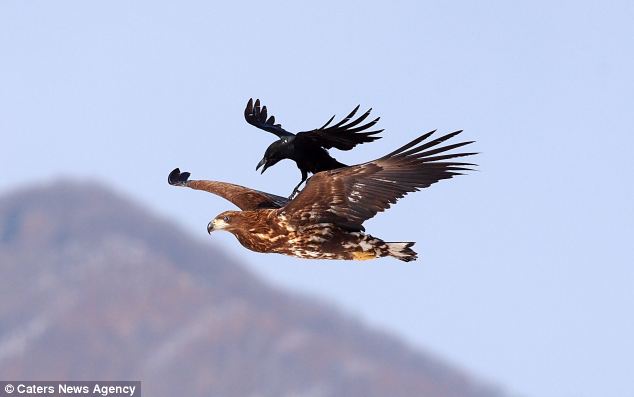
Crow on Eagles Back ©©

Maybe A Little Too Close – Crow on Eagles Back ©©

Birdwatching Term – Mobbing

In the recent article, The Old Orchard Bully – Chapter 2, the whole group of birds united to chase off the Black Cat. That is called, “mobbing.”

Some ask why don’t the bigger birds fight back? Here are a few quotes from various sources:

“This behavior – like calling your family for help – is used by many bird species. The best time to observe mobbing is spring and early summer, when breeding birds are trying to protect their nests and young. Birds including swallows, blackbirds, and even these American Crows, seen here mobbing a Red-tailed Hawk, know that there is strength and power in numbers. And they’ve learned to join forces to protect themselves. Be sure to watch the video!”

Quote from Why Don’t Hawks Fight Back? :All agreed that if a red-tailed hawk reached out and grabbed a crow with its talons, that would be the end of the crow. Or as one of the professionals put it, in scientific terms, “the crow would be toast.” But although large raptors have the necessary weapons, the energy cost of pursuing or otherwise attempting to catch a crow is normally not worth it. Crows are agile creatures and would be very difficult to catch in flight. So a hawk typically ignores the crows or flies away.”

A Great Horned Owl being mobbed!

http://www.youtube.com/watch?v=6ecEZuIcHxs&rel=0

*

Just as the Lord helps His Created critters, the Lord gives us promises about seeking His help:

But the LORD your God you shall fear; and He will deliver you from the hand of all your enemies.” (2 Kings 17:39 NKJV)

Give us help from trouble, For the help of man is useless. Through God we will do valiantly, For it is He who shall tread down our enemies. (Psalms 60:11-12 NKJV)

I have pursued my enemies and overtaken them; Neither did I turn back again till they were destroyed. (Psalms 18:37 NKJV)

O my God, I trust in You; Let me not be ashamed; Let not my enemies triumph over me. (Psalms 25:2 NKJV)

My times are in Your hand; Deliver me from the hand of my enemies, And from those who persecute me. (Psalms 31:15 NKJV)

For I will not trust in my bow, Nor shall my sword save me. But You have saved us from our enemies, And have put to shame those who hated us. In God we boast all day long, And praise Your name forever. Selah (Psalms 44:6-8 NKJV)

Some interesting links about mobbing:

Why Don’t The Crows Fight Back? – Savannah River Ecology Lab

Small Birds Mob Big Ones – Bird Note, with audio

Mobbing – RSPB

The Superb Fairywren – The Corporate Mob ~ by a j mithra

Birdwatching Terms

Birdwatching Tips 

Watching Birds

Wordless Birds

*


Dad and Mom its feeding time..

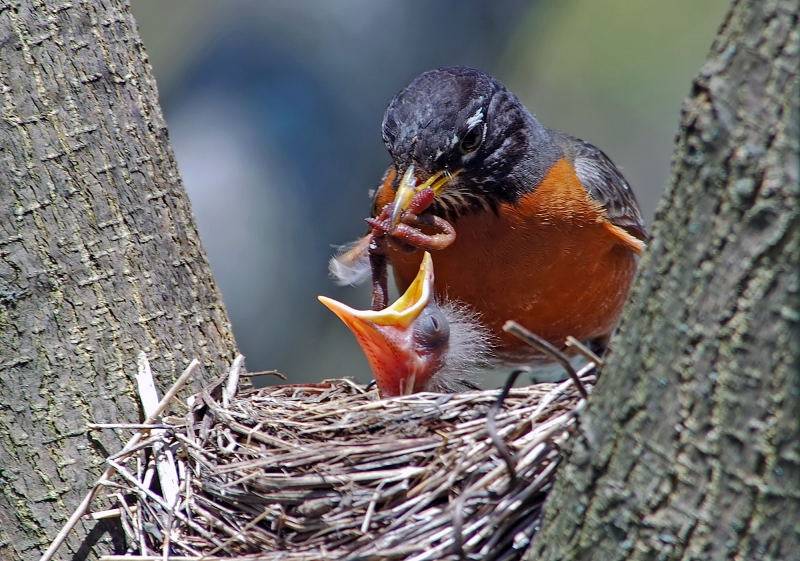
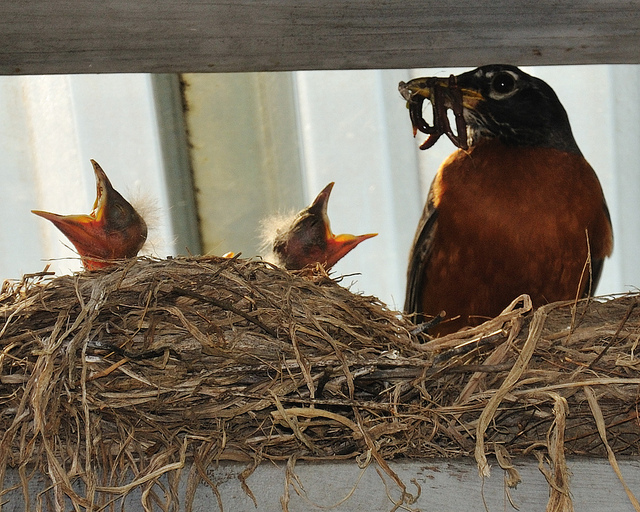
American Robin (Turdus migratorius)with youngsters by Raymond Barlow

American Robin (Turdus migratorius)with youngsters by Raymond Barlow

This is for every blessed parent who so anxiously works hard in raising their kids in the way of the Lord…
And for the kids being fed by their parents.

Birds emerge from the shell blind and so weak
they can’t even hold their heads up.
Parents must feed babies frequently because
baby birds digest their food quickly.

The larger the babies grow, the more food they require.
Baby Crows need at least half their weight in food
every day just to stay alive.
a baby Belted Kingfishers eat 1 to 1 3/4 times
their weight in fish every day.
American Robin (Turdus migratorius) with young in nest

American Robin (Turdus migratorius) with young in nest

On average, a songbird nestling
receives four-12 feedings
of protein-rich insect food every hour.
Young Hawks are fed about once an hour.
Feeding duties aren’t always divided
equally between the sexes.
This varies with the species and
the inclination of the individual bird.
One male House Wren – a single male
whose mate disappeared – fed his nestlings
1,217 times between 4:15 a.m. and 8 p.m.
That’s about one trip every 47 seconds.
It’s astonishing how much a young bird can eat.
In one instance, a young American Robin,
who was supposed to leave the nest that day,
was experimentally fed all the earthworms it would eat.
Each worm was measured.
The Robin ate 14 feet of worms.
Orni-Theology

Orni-Theology

If birds can feed so much to their chicks every day,

how much would God expect us as a parent
to nourish our kids with spiritual food.
Well, do we feed the word of God to our kids every day?
Kids, are you eating well? Are you reading and listening to the Word of God?

“In the beginning was the Word, and the Word was with God, and the Word was God.” John 1:1/blockquote>

Yours in YESHUA,
a j mithra
(Found this on the Kid’s blog. AJ wrote it especially for that blog before joining the Lord in Glory)

*

Birdwatching Terms – About’s Bird Bill Parts

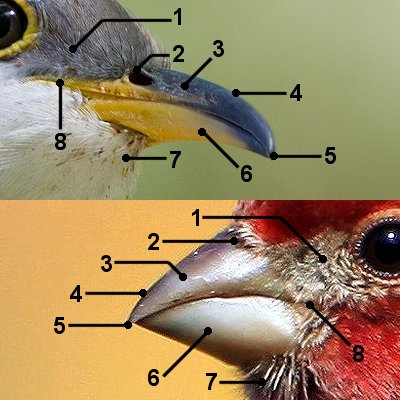
Bird Bill Parts From About

About's Bill-Parts ©Dan Pancamo/nigel

About’s Bill-Parts ©Dan Pancamo/nigel

Bird Bill Parts.  ©Dan Pancamo / nigel

The dove came to him toward evening, and behold, in her beak was a freshly picked olive leaf. So Noah knew that the water was abated from the earth. (Genesis 8:11 NASB)

A bird’s bill, also called a beak, is a critical piece of its anatomy, not only for foraging, defense, singing and other behaviors, but also for birders to make a proper identification. Depending on the bird, a bill can provide clues to far more than species: age, gender, diet and foraging behaviors can all be learned by studying a bill. By knowing the basic parts of a bill and the bird’s face and head immediately adjacent to the bill, birders can be better prepared to look for the subtle clues bills can reveal about every bird.

Overall Bill Features

Some of the most important aspects of a bird’s bill are not specific features, but the general jizz of the bill. When first studying bird bills, look for…

  • Size: How large does the bill appear in proportion to the bird’s head? Check for length as compared to the length of the head as well as the width of the bill and how that width may change along the bill’s length.
  • Shape: Bill shapes vary widely, from delicate triangles or thin, needle-like bills to thick, bulbous bills to sharply curved bills to radical shapes that include spoon-like tips or horny casques. When the shape is very unique, that can be a diagnostic clue for a bird’s identity even if other field marks cannot be seen.
  • Color: The color of a bill can be a clue for species, gender or age. Note the overall color as well as any specific markings, such as a colored tip or base, subterminal band or color differences between the top and bottom of the bill.

Specific Bill Parts

When birders can get a good look at a bill, there are a number of different parts that can yield clues about the bird’s identity, such as…

  1. Lores: While not part of the bill itself, the lores are the space between the base of a bird’s bill and the forward edge of its eyes. This area may be a different color or show a smudge or eye line that can be an identification clue.
  2. Nares: More commonly called the nostrils, the position of the nares as well as their size and shape are important to note for bird’s identities. In some types of birds, such as raptors, the nares are covered by a fleshy cere, while in others, such as many seabirds, elongated tube-like nares help filter seawater.
  3. Maxilla: Also called the upper mandible, the maxilla is the top half of a bird’s bill. Size, length and shape will vary, and some birds have knobs, fleshy wattles or other features that distinguish the maxilla.
  4. Culmen: Difficult to see on many bird species, the culmen is the center line drawn down the length of a bird’s maxilla. In some species, this can be a very distinct peak that divides the sides of the bill, while it may not be noticeable in other species.
  5. Tip: The tip of a bird’s bill may be different shapes, such as blunt or sharply pointed, depending on the bird’s general diet. Hooks are common at the tip of carnivorous birds’ bills, while many waterfowl have small bumps, called nails, on the tip of the maxilla.
  6. Mandible: The lower half of a bird’s bill is called the mandible or lower mandible. The color may vary from the maxilla either along the entire length or just at one end, and can be a great clue for identification. Some birds, such as many gulls, may show spots or other markings just on the mandible.
  7. Chin: Not directly part of the bill, the chin is the area of feathers immediately adjacent to the base of a bird’s mandible. In some species, the color of the chin may vary from the throat or face, providing a valuable identification clue.
  8. Gape: This is a fleshy area at the base of the bill where the upper and lower mandibles meet. In young birds, it is often enlarged or may seem so because the birds have not developed their mature feathers to help conceal it, and it may be brightly colored so their mouths are more noticeable when they beg for food. On some species, such as the bananaquit, the gape remains colorful on adult birds.
Bananaquit (Coereba flaveola) by Raymond Barlow

Bananaquit (Coereba flaveola) by Raymond Barlow

It can be difficult to see many of the subtle details of a bird’s bill, but understanding the different bill parts is a great way for birders to refine their identification skills and learn more about every bird they see.

Photo – Yellow-Billed Cuckoo (Above) © Dan Pancamo
Photo – House Finch (Below) © nigel

*

This is a good introduction to the bird’s bill. Look for more articles on the individual parts of the beak.

From About Birding/Wild Birds – Bird Identification

More Birdwatching Terms 

Birdwatching Tips

*


Why Use The Birds of the World?

Green-billed Toucan (Ramphastos dicolorus) ©WikiC

Green-billed Toucan (Ramphastos dicolorus) ©WikiC

The list of all the Birds of the World are updated about every four months. Which we try to keep up with their (I.O.C.) newest lists.

You are probably wondering why you would need it. Let me share some things about it and then give you some ideas how it my be handy for one of your school projects.

The I.O.C. is actually the International Ornithological Committee. “Ornithological” basically means those who study birds or bird related. They maintain a list of all the birds around the world. They set standards of how to name them, what scientific classification to place the birds in, and divide them into Orders and Families, etc.

They are needed because we may call a bird by one name, yet someone in a different country or area may call it by a different name. They realize that those two names belong to the same bird. It is a very hard task to keep track of all those 10,000 plus birds, but that is what they try to do.

They give every bird an English name as a standard. Then they also want every one to spell the words the same. For instance, some people spell the “Grey” or “Gray” to mean the same color. To keep things simple, all the birds are spelled as “Grey.” That is just one example.

There are committees all over the world working on the birds of the area they live in, then those committees get together to combine all the list to make one big list. That is what was just updated.

On our Birds of the World section, you will find the birds listed by Orders (40 main classifications), then by Families (240 groups of closely related birds). The reason all of that is not duplicated here would be very time-consuming. There are hundreds of pages and thousands of photos on that site.

Wood Duck (Aix sponsa) by Dan

Wood Duck (Aix sponsa) by Dan

Projects for school or your own information:

You know the name of a bird’s name, but need to find  the Species name,  Go to the Species Index to find these choices:

If you know that it called Madagascan something, go to the First Name of Bird  index and choose the “M” page

If you know it is a Duck, go to the Last Name of Bird  index and choose the “D – Last Name” page.

The Families have four indexes to help you find the Families of birds.

When you find your bird in the right family, almost every bird has a link to a photo or video.

I will share more tips on how to use those indexes in another article.

Another reason is because we believe the Lord created all the beautiful birds and He should get all the credit.

In the beginning God created the heavens and the earth. (Genesis 1:1 NKJV)

So God created great sea creatures and every living thing that moves, with which the waters abounded, according to their kind, and every winged bird according to its kind. And God saw that it was good. (Genesis 1:21 NKJV)

*

ABC’s of the Gospel

ABC Blocks

ABC’s of the Gospel

The ABC’s of the Gospel:


  • All have sinned and come short of the glory of God (Romans 6:23)
  • But God commendeth His love toward us, in that while we were yet sinners, Christ died for us. (Romans 5:8; John 1:29)
  • Call upon the name of the Lord (Romans 10:13; Isaiah 1:18)

Lead in the sinner’s prayer.

  • Dear God, I know I’m a sinner…
  • I ask you to forgive my sins right now…
  • I believe that Jesus died to save me…
  • I receive Him now as my Savior…
  • In Jesus’ name I pray, Amen

(Adopted from Pastor Jerry Smith’s – Dealing With Children)

Use A Simple Plan – Above

Obtain permission from parents for baptism if they accept the Lord.

*

More Good News

*

Child’s Book of Water Birds – Re-visited

Child's Book of Water Birds - Book Cover

The Child’s Book of Water Birds

Revisited

An anonymous writer wrote the Child’s Book of Water Birds in 1855. You can see how Project Gutenberg published it as an e-book. (Public Domain) CLICK HERE

Below are the links to my “Re-visited” versions here. Moved these over from the Birds of the Bible for Kids blog and can be found in the Kid’s Section under Watching Birds.

The six different birds were written to a very young reader. I trust you will enjoy reading them for yourself or to your children or grand-children. They can be used to introduce you/them to birds.

Here are my versions of the Six Birds:

The Swan

Childs Bk of Water Birds swan

The Coot

Childs Bk of Water Birds coot

The Dabchick

Childs Bk of Water Birds dabchick

The Teal

Childs Bk of Water Birds teal

The Goose

Childs Bk of Water Birds goose

The Oystercatcher

Childs Bk of Water Birds oystercatcher

*

The Bible tells us that we are to

Train up a child in the way he should go: and when he is old, he will not depart from it. (Proverbs 22:6 KJV)

Introducing children to the amazing birds the Lord has created is a tiny step to help with that training. Introducing them to the Lord Jesus Christ, is the major step.

Wordless Birds

*

Bible Birds Finally Moved

Snow Bunting (Plectrophenax nivalis) by Ray

Snow Bunting (Plectrophenax nivalis) by Ray

And let the beauty of the LORD our God be upon us: and establish thou the work of our hands upon us; yea, the work of our hands establish thou it. (Psalms 90:17 KJV)

Man goeth forth unto his work and to his labour until the evening. (Psalms 104:23 KJV)

Been working most of the day, moving the Bible Birds pages to Lee’s Birdwatching Adventures. It has been a challenge, but with dust still flying, they are now here.

I posted an article on the Birds of the Bible For Kids blog explaining the move of those articles. You might want to read that article because it affects this blog.

Changes On The Way

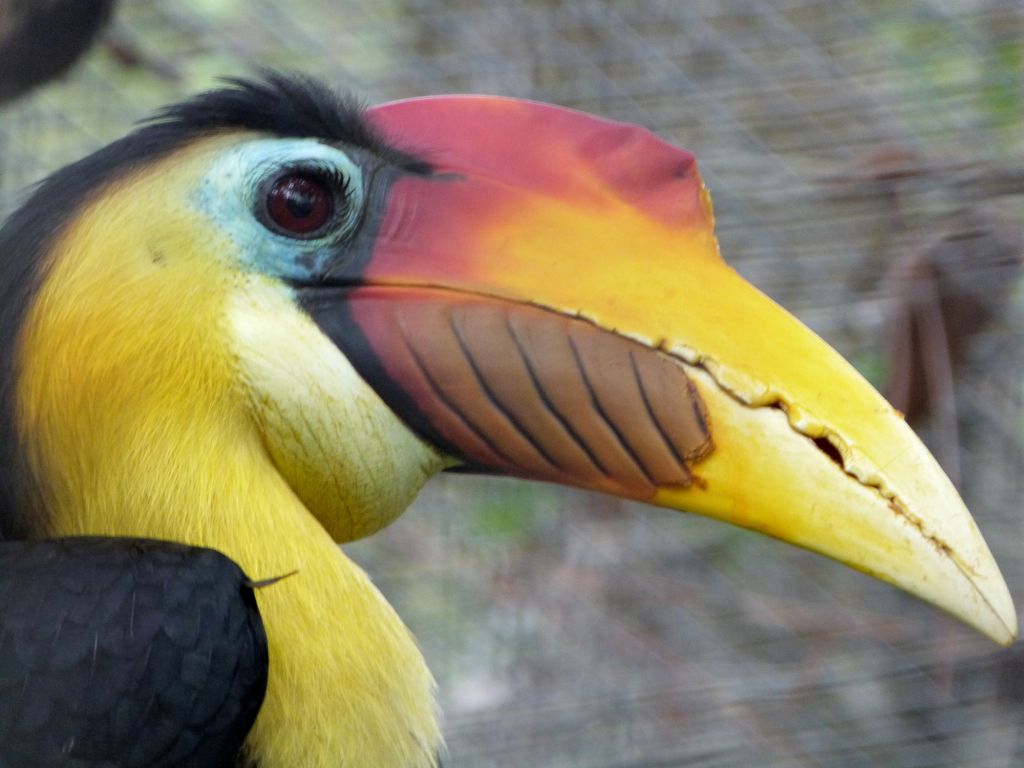
Wrinkled Hornbill (Aceros corrugatus) Brevard Zoo by Lee

Wrinkled Hornbill (Aceros corrugatus) Brevard Zoo by Lee

You can find the Bible Birds listed in the Kid’s Section. The side menu is now working also for that section. (I think it’s correct). Just hover your mouse over the Kid’s Section and you will see the Bible Birds, along with the Watching Birds, Bird Tales and Scripture Alphabet of Animals sections.

Thanks you for being patient while things are being moved around and I trust you will see much improvement soon. As mentioned in the Changes on the Way article, “Our purpose is to Glorify Our Lord and show forth His great creation through His Birds and other Critters.”

There is still lots of work ahead, as other sections are moved to the blog. Just wanted to let you know why things are changing and dust is flying still. I have another big challenge coming next, but that will have to hold for now.

*

Old Mr. Owl Writes A Book

Great Horned Owl (Bubo virginianus) by Bob-Nan

Great Horned Owl (Bubo virginianus) by Bob-Nan

OLD MR. OWL WRITES A BOOK

Daddys Bedtime Story Images

Old Mr. Owl Danced with the Rest

“Old Mr. Owl wanted to write a book and he asked the fairies how to set about doing it,” commenced daddy.

“‘Well,’ said the fairy queen, ‘it makes a good deal of difference, old Mr. Owl, what you want to write about.’

“‘What nonsense!’ he said. ‘It’s just that I want to know how to start off with my book. Just think what a marvelous book it will be—as for as long as folks can remember I’ve been called the Wise Bird—the bird who’s awake at night and whose eyes are so very bright!’

“‘Before I started saying what a fine book it would be, if I were you, I’d write it and give other people the chance to say so,’ said the fairy queen.

“Mr. Owl began to write with his pen, made out of one of Mr. Turkey Gobbler’s best feathers, on a large, flat stone, which he put in the hollow of his tree. Very late in the night, he awakened the fairies who had been sleeping, and told them to listen to his book. Then he called all the owls from the neighborhood with a loud hoot-hoot. But before he began to read, he said:

“‘I’ve not enough light. I will hurt my eyes—my beautiful, wise, big eyes.’

“You see he had made a special arrangement to have his own lights, and when he said that he hadn’t enough, from all over came countless little fireflies. They sparkled and gave the most beautiful light all over the woods, and Mr. Owl put his spectacles on his nose, and said:

“‘Now I see to perfection—which means quite all right.’ And Mr. Owl commenced reading his book.

“It told about the parties, balls, and picnics in fairyland, and of the wild adventures and happenings in the woods. The fairies were absolutely delighted that a book had been written with so much about them in it.

“And the fairy queen was more than happy, for the last chapter was all about her.

“‘Well,’ said Mr. Owl, ‘you made me ashamed of myself for boasting about my book before I had written it, and so the only thing I could do was to write a wise chapter all about you.’

“And the fairy queen smiled with pleasure and also with amusement—for Mr. Owl had certainly thought he could write a wise book—though the next time, perhaps, he wouldn’t say so before he had written it.

“The fireflies had been sparkling and flashing lights all this time, and finally they whispered:

“‘Have a dance, all of you; we’ll give you the light and dance too. It is not well to read books all the time—you must dance.’

“So they all ended off with a fine dance, and old Mr. Owl, with his book under his wing, danced with the rest of the owls and fairies. But before the evening was over he presented to the fairy queen a copy of his book, which said on the cover, ‘A BOOK, by Wise Mr. Owl.'”
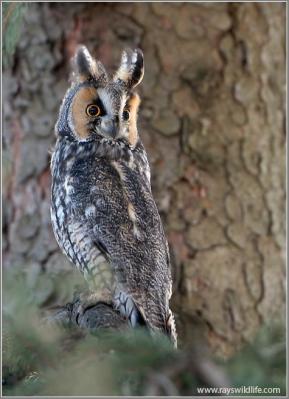

Barred Owl by Ray

Barred Owl by Ray


Lee’s Addition:

But I say to every one of you, through the grace given to me, not to have an over-high opinion of himself, but to have wise thoughts, as God has given to every one a measure of faith. (Romans 12:3 BBE)

But he giveth more grace. Wherefore he saith, God resisteth the proud, but giveth grace unto the humble. (James 4:6 KJV)

Figured it was about time the first chapter was added to the Daddy’s Bedtime Bird Stories. We do need to be careful not to think too highly of ourselves. Let other complement what you do.

*

Another Bird Tale From

Daddy’s Bedtime Bird Stories – Gutenberg ebooks

By

Mary Graham Bonner

With four illustrations in color by
Florence Choate and Elizabeth Curtis

Daddys Bedtime Story Images

These stories first appeared in the American Press Association Service and the Western Newspaper Union.


Many of the sketches in this volume are the work of Rebecca McCann, creator of the “Cheerful Cherub,” etc.

Daddys Bedtime Story Images
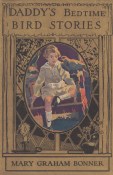
Daddy’s Bedtime Bird Stories by Mary Graham Bonner – 1917

*

Links:

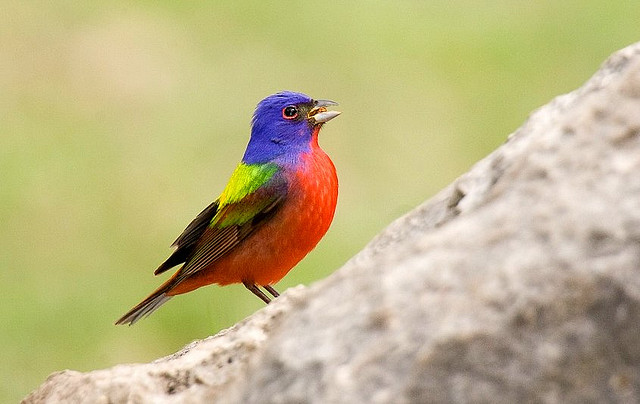
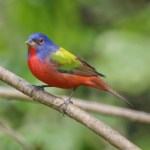
Painted Bunting (Passerina ciris) ©©Flickr

Bird Tales


Daddys Bedtime Story Images


 Daddy’s Bedtime Bird Stories


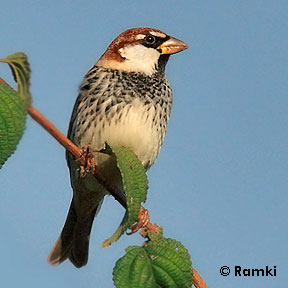
Spanish Sparrow (Passer hispaniolensis) by Nikhil Devasar


 Wordless Birds


Eastern Screech Owl (Megascops asio) baby Reinier Munguia

  Owls


*

Eagles and Ravens

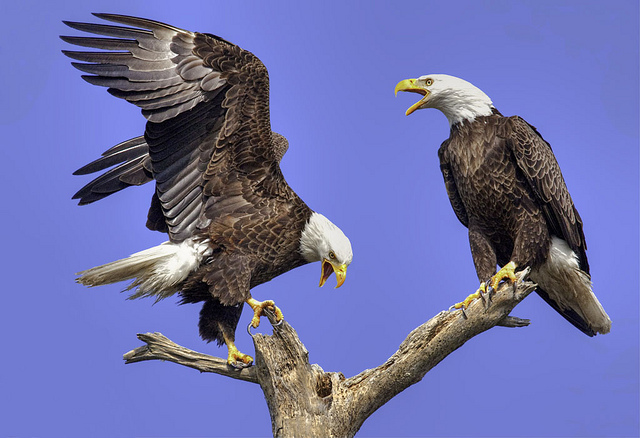
Bald Eagle (Haliaeetus leucocephalus) by PattiKru

Bald Eagle (Haliaeetus leucocephalus) by PattiKru

EAGLES AND RAVENS

He is Very Brave

He is Very Brave


“Some white-tailed eagles were boasting one day of their bravery,” commenced daddy. “They were also saying how fine they were in every way and that their very name meant something splendid and free and strong.

“As a matter of fact, though the white-tailed eagles won’t admit it, they are less brave than any of the eagle families.
“The ravens are not kindly at all and they love to fight. They had often thought it would be great sport to have those ‘silly white-tailed eagles,’ as they called them, admit that they were not brave and have their leader beg for mercy from General Raven.
“And, as you can imagine, when Brother Black Raven heard the eagles boasting he knew it was high time to begin and frighten them.
“So he called all the ravens together. Some of them were having their naps, but as soon as Brother Black Raven called them, up they got in a great hurry, spread their wings and drilled a little bit just like soldiers. Only instead of marching they flew.
“As General Raven came near the nest of the white-tailed eagles, he said in a very queer, croaking sort of voice:
“‘Good-morning!’ That was rather mean of him to say, for, of course, he didn’t really wish them a ‘Good-morning.’
“‘Do you want to fight?’ asked General Raven.
“Still not a sound from the eagles. There was a slight fluster and trembling, which the ravens could hear and which made them grin with delight, but the eagles never said a word. They didn’t even look at the ravens! For they were so frightened they didn’t dare look at them, and they kept thinking, ‘Oh, won’t those awful ravens and their ugly old general go away?’ The eagles, of course, thought the ravens were very ugly because they were so afraid of them.
“‘For the last time, do you want to fight us, eh?’ asked General Raven. And still the eagles said not a word—nor made a sound. ‘Well, let me say then for all of us,’ said General Raven, ‘that we think you’re very cowardly, and we heard you talking before we came of your bravery. We wouldn’t fight you because you’re afraid of us, but you’ll have to admit it after this,’ and with a deep chuckle off went General Raven and his followers.
“The eagles did not go on boasting, but they were very contented that the ravens had gone away!”

Northern Raven (Corvus corax) by Kent Nickell

Northern Raven (Corvus corax) by Kent Nickell

Lee’s Addition:

For I say, through the grace given to me, to everyone who is among you, not to think of himself more highly than he ought to think, but to think soberly, as God has dealt to each one a measure of faith. (Romans 12:3 NKJV)

By pride comes nothing but strife, But with the well-advised is wisdom. (Proverbs 13:10 NKJV)

We should be careful not to think too much or ourselves or boast. We can have confidence through Christ, but should never get “proud.”

*

From Daddy’s Bedtime Bird Stories – Gutenberg ebooks By Mary Graham Bonner With four illustrations in color by Florence Choate and Elizabeth CurtisDaddys Bedtime Story ImagesThese stories first appeared in the American Press Association Service and the Western Newspaper Union.


Many of the sketches in this volume are the work of Rebecca McCann, creator of the “Cheerful Cherub,” etc.Daddy's Bedtime Bird Stories by Mary Graham Bonner - 1917Daddy’s Bedtime Bird Stories by Mary Graham Bonner – 1917

*

Links:

Painted Bunting (Passerina ciris) ©©Flickr


  Bird Tales


  Daddy’s Bedtime Bird Stories


Spanish Sparrow (Passer Hispaniolensis) female ©WikiC


  Wordless Birds


*

Bible Birds – Peacocks Page Updated

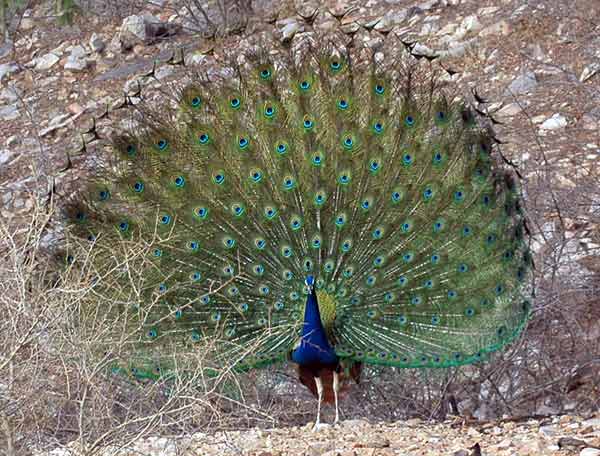
Indian Peafowl (Pavocristatus) by Nikhil Devasar

Indian Peafowl (Pavocristatus) by Nikhil Devasar

Gavest thou the goodly wings unto the peacocks? or wings and feathers unto the ostrich?  (Job 39:13)

Peacocks belong to the  Phasianidae – Pheasants, Fowl & Allies Family.

Click to See the updated page with a Slideshow and the article

*