Cranes know when it’s time to move south for winter. And robins, warblers, and bluebirds know when it’s time to come back again. But my people? My people know nothing, not the first thing of GOD and his rule. (Jeremiah 8:7 MSG)
The LORD recompense thy work, and a full reward be given thee of the LORD God of Israel, under whose wings thou art come to trust. (Ruth 2:12 KJV)
While searching for “wing” or “wings” in my e-Sword, I discovered this really great verse. Let’s dig into it.
Searching further using “under” and “wing” here are a few more verses that sort of relate to the verse above:
Keep me as the apple of the eye, hide me under the shadow of thy wings, (Psalms 17:8 KJV)
How excellent is thy lovingkindness, O God! therefore the children of men put their trust under the shadow of thy wings. (Psalms 36:7 KJV)
He shall cover thee with his feathers, and under his wings shalt thou trust: his truth shall be thy shield and buckler. (Psalms 91:4 KJV)
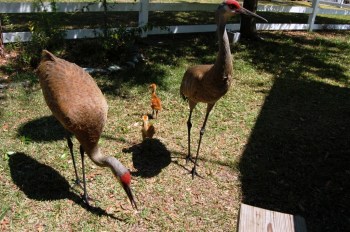
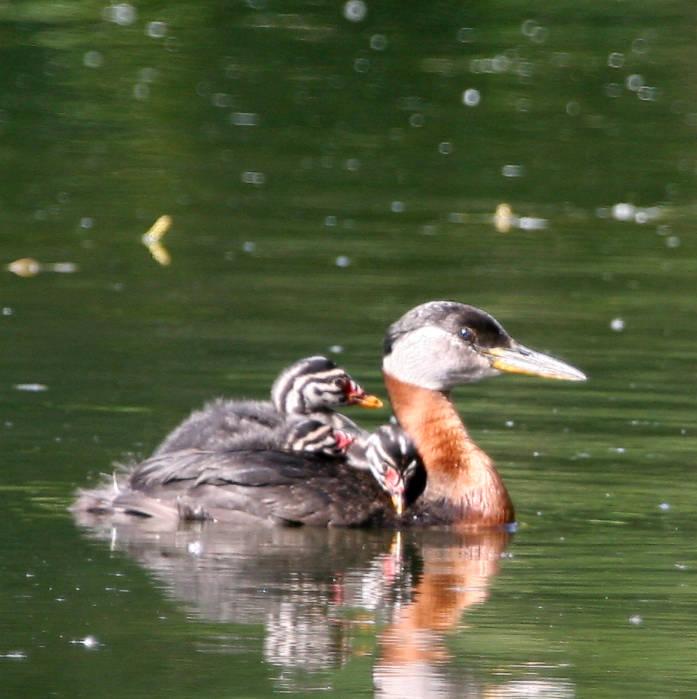
Matthew 23:37 and Luke 13:34 mention being gathered under the wing, but they were not willing. Also, in Birds of the Bible – Under His Wing we covered. no pun intended, how birds protect their young under their wings and how God protects us. But the verse above seem to imply our trust.
What is being trusted? Boaz is implying that Ruth is trusting in the “LORD God of Israel.” She is from another country, another culture and religious way of life, but has turned her trust over to the LORD. That is something I did personally way back in 1960. I put my trust in the Lord to be my personal Savior. It was the best decision of my life.
Storks Shadowing Baby in Lakeland by Dan
In the Psalms verses, we can know that the Lord keeps His Eye on His own and we should desire to be the “apple of the eye.” Notice in the other verses that while we are under the wings we are trusting. Who? The Lord or LORD. Why do we trust? Wow! Look around at all the Lord has done just in creation and care of the birds. How about our care? We know through promises all through the Word of God that He cares for us. We know He doesn’t lie or do things for our harm. We also know that He is just and will give judgment when needed. We could go on and on, but you can also see that the Lord Jesus Christ is “trustworthy.”
We know the birds trust their parents to protect them while they are under their wings. Should we not trust the Savior while we are under His wings?
Here is a quote from the Believer’s Bible Commentary:
“2:4-12 When Boaz arrived from Bethlehem, he asked the identity of the young woman. Learning that she was Naomi’s daughter-in-law, he cordially invited her to continue gleaning in his fields and to share the water provided for his workers. In praising her for the loyal and selfless step that she had taken, Boaz concluded with a little prayer for her:
The LORD repay your work, and a full reward be given you by the LORD God of Israel, under whose wings you have come for refuge (v. 12).
Leon Morris comments:
In due course, the prayer was answered through him who uttered it. He recognizes the religious aspect of Ruth’s change of country by saying that she has come to trust (AV) under Yahweh’s wings. The imagery is probably that of a tiny bird struggling under the wings of a foster-mother. It gives a vivid picture of trust and security. . . .
From J. Vernon McGee:
“She had come to trust the Lord God. This is the reason she had left the land of Moab and made that radical decision. She had said that the God of Naomi would be her God. She had turned from idolatry to the living and true God. This woman has come to trust God; she was one of His children. Therefore this is the wonderful testimony that she had there in the land of Israel. And Boaz says, “May a full reward be given to you. May you be recompensed for this decision.”
From Matthew Henry:
“(5.) He (Boaz) prayed for her (Ruth_2:12): The Lord recompense thy work. Her strong affection to the commonwealth of Israel, to which she was by birth an alien, was such a work of the divine grace in her as would certainly be crowned with a full reward by him under whose wings she had come to trust. Note, Those that by faith come under the wings of the divine grace, and have a full complacency and confidence in that grace, may be sure of a full recompense of reward for their so doing. From this expression, the Jews describe a proselyte to be one that is gathered under the wings of the divine majesty.”
From John Gill’s Exposition:
“under whose wings thou art come to trust; whom she professed to be her God, and whom she determined to serve and worship; whose grace and favour she expected, and to whose care and protection she committed herself: the allusion is either to fowls, which cover their young with their wings, and thereby keep them warm and comfortable, and shelter and protect them, see Psa_36:7 or to the wings of the cherubim overshadowing the mercy seat, Exo_25:20 and the phrase is now adopted by the Jews to express proselytism; and so the Targum here,”thou art come to be proselyted, and to be hid under the wings of the Shechinah of his glory,”or his glorious Shechinah.”
Snowy Egret – Wind Blown at Ft DeSoto 11-22-12 Thanksgiving
Dan and I just got back from a trip to Tampa for just 2 nights for the Thanksgiving holiday. My brother had a knee replacement on Wednesday (he’s doing fine), so we tied visiting him and doing some birdwatching in that area. Do you know how much we carried with us for just three days? Of course we carried our binoculars, cameras, tripod, laptop, plus clothes. Plus…
I also am starting my reading cycle through the Bible again and just read about Noah and the Ark. Because the earth had become so corrupt and violent, God said He was going to destroy man, beast, creeping things and birds.
So the LORD said, “I will destroy man whom I have created from the face of the earth, both man and beast, creeping thing and birds of the air, for I am sorry that I have made them.” But Noah found grace in the eyes of the LORD. This is the genealogy of Noah. Noah was a just man, perfect in his generations. Noah walked with God. (Genesis 6:7-9 NKJV)
And God said to Noah, “The end of all flesh has come before Me, for the earth is filled with violence through them; and behold, I will destroy them with the earth. (Genesis 6:13 NKJV)
Willit – Laughing Gull – Forster’s Tern at Ft DeSoto 11-22-12 Thanksgiving
Most of us know this history in the Word. Through Genesis 6, the Ark is built and Noah keeps trying to tell others to repent, but eventually the time comes and it is time to “Load the Ark.”
And of every living thing of all flesh you shall bring two of every sort into the ark, to keep them alive with you; they shall be male and female. Of the birds after their kind, of animals after their kind, and of every creeping thing of the earth after its kind, two of every kind will come to you to keep them alive. And you shall take for yourself of all food that is eaten, and you shall gather it to yourself; and it shall be food for you and for them.” Thus Noah did; according to all that God commanded him, so he did. (Genesis 6:19-22 NKJV)
Noah didn’t need to worry about taking cameras and laptops, but they had a whole lot more to get loaded on the Ark. We have all taken trips and know how long it takes to get everything in the car or van. Can you imagine when the LORD finally said that it was time to “start loading.” Noah and his family had been preparing and gathering the food, water, and supplies. If I read the first few verses of Genesis 7 correctly, they had a week (seven days) to put that in and the animals and birds. Those came to Noah, but they still had to arrange them into the different places on board the Ark. Whew! Some of us have enough trouble just loading the trunk.
Many believe the Critters rested most of the time while on board.
I am thankful that Noah and his family lived righteously and that they found grace. If not, I wouldn’t be writing this blog, nor would I be enjoying all the things the Lord created, especially the birds I love to write about.
The Phoebe or Birds Illustrated by Color Photography, 1897
From col. J. G. Parker. Jr. Copyrighted by
Nature Study Pub. Co., 1897, Chicago.
THE PHOEBE
Oft the Phoebe’s cheery notes
Wake the laboring swain;
“Come, come!” say the merry throats,
“Morn is here again.”
Phoebe, Phoebe! let them sing for aye,
Calling him to labor at the break of day.
—C. C. M.
EARLY everywhere in the United States we find this cheerful bird, known as Pewee, Barn Pewee, Bridge Pewee, or Phoebe, or Pewit Flycatcher. “It is one of that charming coterie of the feathered tribe who cheer the abode of man with their presence.” There are few farmyards without a pair of Pewees, who do the farmer much service by lessening the number of flies about the barn, and by calling him to his work in the morning by their cheery notes.
Dr. Brewer says that this species is attracted both to the vicinity of water and to the neighborhood of dwellings, probably for the same reason—the abundance of insects in either situation. They are a familiar, confiding, and gentle bird, attached to localities, and returning to them year after year. Their nests are found in sheltered situations, as under a bridge, a projecting rock, in the porches of houses, etc. They have been known to build on a small shelf in the porch of a dwelling, against the wall of a railroad station, within reach of the passengers, and under a projecting window-sill, in full view of the family, entirely unmoved by the presence of the latter at meal time.
Like all the flycatcher family the Phoebe takes its food mostly flying. Mrs. Wright says that the Pewee in his primitive state haunts dim woods and running water, and that when domesticated he is a great bather, and may be seen in the half-light dashing in and out of the water as he makes trips to and from the nest. After the young are hatched both old and young disport themselves about the water until moulting time. She advises: “Do not let the Phoebes build under the hoods of your windows, for their spongy nests harbor innumerable bird-lice, and under such circumstances your fly-screens will become infested and the house invaded.”
In its native woods the nest is of moss, mud, and grass placed on a rock, near and over running water; but in the vicinity of settlements and villages it is built on a horizontal bridge beam, or on timber supporting a porch or shed. The eggs are pure white, somewhat spotted. The notes, to some ears, are Phoebe, phoebe, pewit, phoebe! to others, of somewhat duller sense of hearing, perhaps, Pewee, pewee, pewee! We confess to a fancy that the latter is the better imitation.
Summary:
PHOEBE.—Sayornis phœbe. Other names: “Pewit,” “Pewee.”
Range—Eastern North America; in winter south to Mexico and Cuba.
Nest—Compactly and neatly made of mud and vegetable substances, with lining of grass and feathers.
Eggs—Four or five; pure white, sometimes sparsely spotted with reddish brown dots at larger end.
Eastern Phoebe (Sayornis phoebe) by Dan
Lee’s Addition:
I know all the birds of the mountains, And the wild beasts of the field are Mine. (Psalms 50:11 NKJV)
Luckily today, at least here, we can ignore this one remark; “She advises: ‘Do not let the Phoebes build under the hoods of your windows, for their spongy nests harbor innumerable bird-lice, and under such circumstances your fly-screens will become infested and the house invaded.’ ” I am sure back in 1897 that was a problem for them. Isn’t it amazing how times have changed for humans, but the birds are pretty well doing the same nest building and living as before. Not sure of the interchange between the Phoebe and the Pewee. They are in the same family, Tyrannidae – Tyrant Flycatchers, but they are different species.
There are three Phoebes:
Eastern Phoebe (Sayornis phoebe)
Black Phoebe (Sayornis nigricans)
Say’s Phoebe (Sayornis saya)
The genus Sayornis is a small group of medium-sized insect-eating birds in the Tyrant flycatcher family Tyrranidae native to North and South America.
They prefer semi-open or open areas. These birds wait on a perch and then catch insects in flight, also sometimes picking them up from the ground. Their nest is an open cup sometimes placed on man-made structures.
They often slowly lower and raise their tails while perched.
This species appears remarkably big-headed, especially if it puffs up the small crest. Its plumage is gray-brown above. It has a white throat, dirty gray breast and buffish underparts which become whiter during the breeding season. Two indistinct buff bars are present on each wing. Its lack of an eye ring and wingbars, and its all dark bill distinguish it from other North American tyrant flycatchers, and it pumps its tail up and down like other phoebes when perching on a branch. The Eastern Phoebe’s call is a sharp chip, and the song, from which it gets its name, is fee-bee. (Wikipedia)
*
The above article is an article in the monthly serial for September 1897 “designed to promote Knowledge of Bird-Live.” These include Color Photography, as they call them, today they are drawings. There are at least three Volumes that have been digitized by Project Gutenberg.
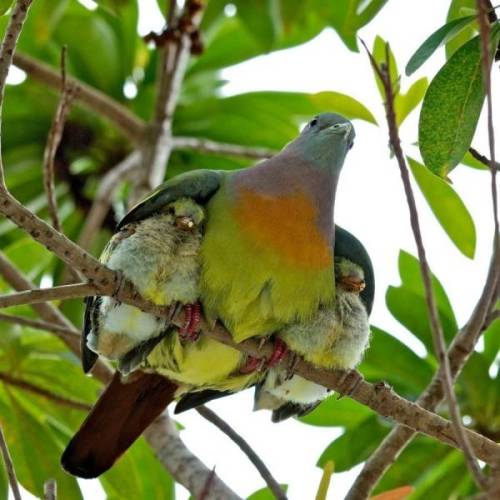
Under His Wings – ( Male Pink-necked Green Pigeon by Rik Seet)
Be merciful to me, O God, be merciful to me! For my soul trusts in You; And in the shadow of Your wings I will make my refuge, Until these calamities have passed by. (Psalms 57:1 NKJV)
In our devotions this morning, we read Psalm 57. The first verse caught my attention because of the shelter from the wings of a bird. Also, I just received again the above picture in an e-mail. Only about the 30th time I have received it. Apparently it is as precious to others as it is to me.
With the Hurricane – Superstorm Sandy just passing by the last few days, this is a good time to remember to put and keep our trust in the Lord.
The beginning of that verse has this title attached: “To the Chief Musician. Set to “Do Not Destroy.” a Michtam of David When He Fled from Saul into the Cave.” David was trying to hide from Saul, just as those up north have been trying to hide from that storm.
“David took refuge under the shelter of God’s wings. He stood “steadfast,” a term indicating firmness, certainty, and determination (v.7). His faith was not blown about by the wind. He clung tenaciously to God. That is why today’s psalm spends more time on the character off God than on the writer’s circumstances.’ (Today in the Word, Day 16, Psalms)
My heart is steadfast, O God, my heart is steadfast; I will sing and give praise. (Psalms 57:7 NKJV)
Another quote, “the prayer (vv 1-4) emphasizes God’s character. He is merciful, protecting, caring, just, and faithful. The enemy may be “ravenous beasts,” but the psalmist can hide beneath His wings as a chick hides beneath a mother bird.”
Be merciful to me, O God, be merciful to me! For my soul trusts in You; And in the shadow of Your wings I will make my refuge, Until these calamities have passed by. I will cry out to God Most High, To God who performs all things for me. He shall send from heaven and save me; He reproaches the one who would swallow me up. Selah. God shall send forth His mercy and His truth. My soul is among lions; I lie among the sons of men Who are set on fire, Whose teeth are spears and arrows, And their tongue a sharp sword. (Psalms 57:1-4 NKJV)
Verses 5 and 11 “focuses our attention on God’s chief attribute–His glory and worthiness to be worshiped”
Be exalted, O God, above the heavens; Let Your glory be above all the earth. (Psalms 57:5 NKJV)
Our prayers and thoughts are with those going through this storm. We have been there in the midst of hurricanes before (Andrew, Charlie, Jean, Frances and those that passed near) and we know it is hard, but there is always a peace that only the Lord can give to get you through. Look to Him.
Summer Yellow-Bird for Birds Illustrated by Color Photography, 1897
THE YELLOW WARBLER.
N a recent article Angus Gaines describes so delightfully some of the characteristics of the Yellow Warbler, or Summer Yellow-bird, sometimes called the Wild Canary, that we are tempted to make use of part of it. “Back and forth across the garden the little yellow birds were flitting, dodging through currant and gooseberry bushes, hiding in the lilacs, swaying for an instant on swinging sprays of grape vines, and then flashing out across the garden beds like yellow sunbeams. They were lithe, slender, dainty little creatures, and were so quick in their movements that I could not recognize them at first, but when one of them hopped down before me, lifted a fallen leaf and dragged a cutworm from beneath it, and, turning his head, gave me a sidewise glance with his victim still struggling in his beak, I knew him. His gay coat was yellow without the black cap, wings, and tail which show in such marked contrast to the bright canary hue of that other yellow bird, the Gold-finch.
“Small and delicate as these birds are, they had been on a long journey to the southward to spend the winter, and now on the first of May, they had returned to their old home to find the land at its fairest—all blossoms, buds, balmy air, sunshine, and melody. As they flitted about in their restless way, they sang the soft, low, warbling trills, which gave them their name of Yellow Warbler.”
Mrs. Wright says these beautiful birds come like whirling leaves, half autumn yellow, half green of spring, the colors blending as in the outer petals of grass-grown daffodils. “Lovable, cheerful little spirits, darting about the trees, exclaiming at each morsel that they glean. Carrying sun glints on their backs wherever they go, they should make the gloomiest misanthrope feel the season’s charm. They are so sociable and confiding, feeling as much at home in the trees by the house as in seclusion.”
The Yellow-bird builds in bushes, and the nest is a wonderful example of bird architecture. Milkweed, lint and its strips of fine bark are glued to twigs, and form the exterior of the nest. Its inner lining is made of the silky down on dandelion-balls woven together with horse-hair. In this dainty nest are laid four or five creamy white eggs, speckled with lilac tints and red-browns. The unwelcome egg of the Cow-bird is often found in the Yellow-bird’s nest, but this Warbler builds a floor over the egg, repeating the expedient, if the Cow-bird continues her mischief, until sometimes a third story is erected.
A pair of Summer Yellow-birds, we are told, had built their nest in a wild rose bush, and were rearing their family in a wilderness of fragrant blossoms whose tinted petals dropped upon the dainty nest, or settled upon the back of the brooding mother. The birds, however, did not stay “to have their pictures taken,” but their nest may be seen among the roses.
The Yellow Warbler’s song is Sweet-sweet-sweet-sweet-sweet-sweeter-sweeter: seven times repeated.
Range—The whole of North America; breeding throughout its range. In winter, the whole of middle America and northern South America.
Nest—Built in an apple tree, cup-shaped, neat and compact, composed of plant fibres, bark, etc.
Eggs—Four or five; greenish-white, spotted.
American Yellow Warbler (Dendroica aestiva) by J Fenton
Lee’s Addition:
I will praise the name of God with a song, and will magnify him with thanksgiving. (Psalms 69:30 KJV)
This Yellow Warbler is now the American Yellow Warbler (Setophaga aestiva) which is the Parulidae – New World Warblers Family.
The Yellow Warbler (Setophaga petechia, formerly Dendroica petechia) is a New World warbler species. Sensu lato, they make up the most widespread Setophaga species, breeding in almost the whole of North America and down to northern South America.
Other than in male breeding plumage, all subspecies are very similar. Winter, female and immature birds all have similarly greenish-yellow uppersides and are a duller yellow below. Young males soon acquire breast and, where appropriate, head coloration. Females are somewhat duller, most notably on the head. In all, the remiges and rectrices are blackish olive with yellow edges, sometimes appearing as an indistinct wing-band on the former. The eyes and the short thin beak are dark, while the feet are lighter or darker olive-buff.
The 35 subspecies of D. petechia sensu lato can be divided into three main groups according to the males’ head color in the breeding season. Each of these groups is sometimes considered a separate species, or the aestiva group (Yellow Warbler) is considered a species different from D. petechia (Mangrove Warbler, including Golden Warbler); the latter option is the one currently accepted by the International Ornithological Congress World Bird List.
American Yellow Warbler (Dendroica aestiva) by Daves BirdingPix
The above article is an article in the monthly serial for September 1897 “designed to promote Knowledge of Bird-Live.” These include Color Photography, as they call them, today they are drawings. There are at least three Volumes that have been digitized by Project Gutenberg.
While looking up the word “birds” in the Dictionary section of my e-Sword program, there is an “i” symbol that shows on the tab of the name of a dictionary. That “i” indicates that there is information about your search word. The Smith’s Bible Dictionary had an “i” so I investigated it. This is what I saw:
Birds Birds. See Sparrow.
So when I went there, this interesting definition of “sparrow” was found and I wanted to share it with you.
Eurasian Chaffinch (Fringilla coelebs) by Ian
Sparrow
Sparrow. (Hebrew, tzippor, from a root signifying to “chirp” or “twitter”, which appears to be a phonetic representation of the call-note of any passerine (sparrow-like) bird). This Hebrew word occurs upwards of forty times in the Old Testament. In all passages, except two, it is rendered by the Authorized Version indifferently as “bird” or “fowl,” and denotes any small bird, both of the sparrow-like species and such as the starling, chaffinch, greenfinch, linnet, goldfinch, corn-bunting, pipits, blackbird, song-thrush, etc. In Psalm 84:3, and Psalm 102:7, it is rendered “sparrow.”
Yea, the sparrow hath found an house, and the swallow a nest for herself, where she may lay her young, even thine altars, O LORD of hosts, my King, and my God. (Psalms 84:3 KJV)
I watch, and am as a sparrow alone upon the house top. (Psalms 102:7 KJV)
Anyone for a Sparrow Snack?
The Greek, stauthion, (Authorized Version, “sparrow”), occurs twice in the New Testament, Matthew 10:29; Luke 12:6-7. (The birds above mentioned are found in great numbers in Palestine, and are of very little value, selling for the merest trifle, and are, thus, strikingly used by our Saviour, Matthew 10:20, as an illustration of our Father’s care for his children. — Editor).
Are not two sparrows sold for a farthing? and one of them shall not fall on the ground without your Father. (Matthew 10:29 KJV)
Are not five sparrows sold for two farthings, and not one of them is forgotten before God? But even the very hairs of your head are all numbered. Fear not therefore: ye are of more value than many sparrows. (Luke 12:6-7 KJV)
Blue Rock Thrush (Monticola solitarius) by Nikhil Devasar
The blue thrush, (Petrocossyphus cyaneus), is probably the bird to which the psalmist alludes in Psa_102:7, as “the sparrow that sitteth alone upon the house-top.” It is a solitary bird, eschewing the society of its own species, and rarely more than a pair are seen together. The English tree-sparrow, (Passer montanus), is also very common, and may be seen in numbers on Mount Olivet, and also about the sacred enclosure of the mosque of Omar. This is, perhaps, the exact species referred to in Psalm 84:3.
Yea, the sparrow hath found an house, and the swallow a nest for herself, where she may lay her young, even thine altars, O LORD of hosts, my King, and my God. (Psalms 84:3 KJV)
House Sparrows visiting NA Parrot Show Outside
Dr. Thompson, in speaking of the great numbers of the house-sparrows and field-sparrows in troublesome and impertinent generation, and nestle just where you do not want them. “They stop your stove — and water-pipes with their rubbish, build in the windows and under the beams of the roof, and would stuff your hat full of stubble in half a day, if they found it hanging in a place to suit them.”
(I added the verses to make it easier and also the “blue thrush, (Petrocossyphus cyaneus)” could not be found. Photos also inserted.)
The Blue Rock Thrush (Monticola solitarius) is a species of chat. This thrush-like Old World flycatcher was formerly placed in the family Turdidae. It is now found in the Muscicapidae family.
Smith’s Bible Dictionary, originally named A Dictionary of the Bible, was a 19th century Bible dictionary containing upwards of four thousand entries that became named after its editor, William Smith. Its popularity was such that condensed dictionaries appropriated the title, “Smith’s Bible Dictionary”.
The original dictionary was published as a three volume set in 1863, in London and Boston, USA. This first edition was followed in 1893 by an expanded four volume version which was published in the United States as A dictionary of the Bible comprising its antiquities, biography, geography, and natural history, edited by Smith and J. M. Fuller.
The original publications are now in the public domain; some derivative, commercial versions are still in copyright.









 Birds of the Bible For Kids