Birds Who Build Pyramids by Creation Moments

BIRDS WHO BUILD PYRAMIDS

Listen and or Watch


Job 12:7″But ask now the beasts, and they shall teach thee; and the fowls of the air, and they shall tell thee…”

Bee-eaters are birds whose way of life and behavior are both intelligent and unusual. There are 24 species of bee-eaters.
Birds Who Build Pyramids
Bee-eaters make their living catching and eating bees and wasps with stingers. The poison in many of these stinging insects is powerful enough to kill bee-eaters, but the birds are not only skilled at avoiding stings, they know how to remove the poison from the bee when they eat it. Having captured a bee or wasp, a bee-eater will take it to a branch where he will pound its head and rub its stinging end until all of the poison has been removed from the insect’s venom sac. Once the poison is removed, the bee-eater enjoys lunch.

Bee-eaters are described as lively and sociable. You seldom see one roosting all by itself. And when the weather is cool, bee-eaters huddle together to keep each other warm. There are even reports that bee-eaters will roost on each other’s backs, forming a feathered pyramid made out of birds.

Bee-eaters Huddled Together – from email

Now, it’s possible that bee-eaters figured out that they were warmer when huddled together, although even that much intelligence had to come from their Creator. But how could bee-eaters simply “discover” how to detoxify bees? If this ability evolved by trial and error, there would probably be no descendants of the first bee-eaters around today. Obviously, this dangerous behavior would not favor survival. This makes the bee-eater one of God’s own arguments against evolution!
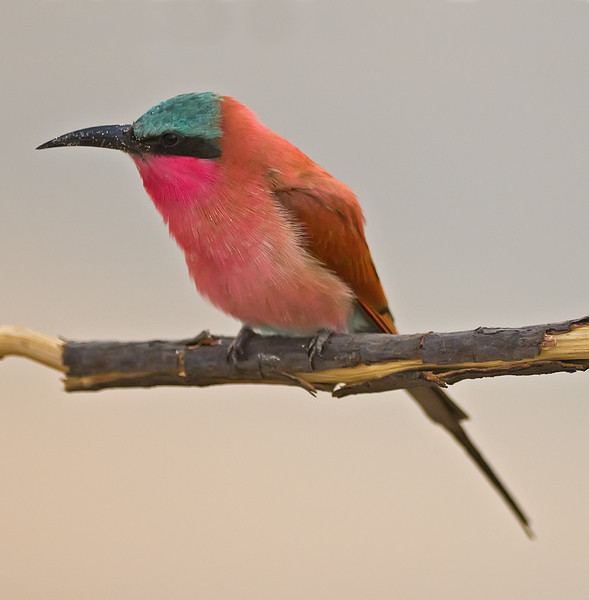
Southern Carmine Bee-eater (Merops nubicus) by Marc at Africaddict

Southern Carmine Bee-eater (Merops nubicus) by Marc at Africaddict

Prayer: “Lord, not only does Your wisdom surround us, but You have so generously given intelligence and wisdom to so many of Your creatures. I thank You for the wonder Your handiwork inspires. In Jesus’ Name. Amen.

Notes:
Clanbake. Natural History, Mar. 1990. p. 94. Photo: A male Blue-throated Bee-eater presents his mate with a captured insect. Photo taken by Lip Kee Yap and licensed under the Creative Commons Attribution-Share Alike 2.0 Generic license.

Used with permission of Creation Moments


EVOLUTION OF NEW SPECIES? – Creation Moments

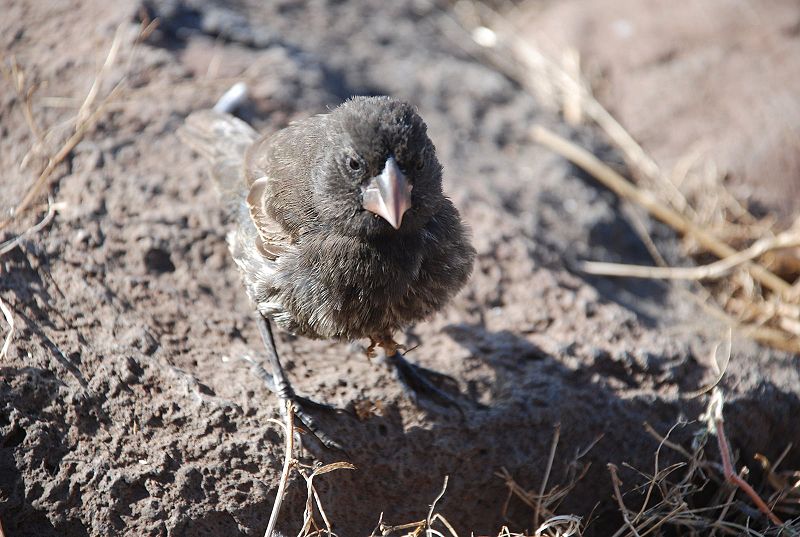
Large Cactus Finch (Geospiza conirostris) by ©Wiki -Espanola_Island, Galapagos, Ecuador

“And God created great whales, and every living creature that moveth, which the waters brought forth abundantly, after their kind, and every winged fowl after his kind: and God saw that it was good.” (Genesis 1:21)

Femal resident Finch from Daphne

It was Charles Darwin’s assumption that new species arose from previous ones by a process of natural selection. Darwin famously illustrated this point by reference to the various species of finch living on the Galapagos Islands.

Darwin’s finches recently received a new airing when a study about a new finch species appearing on the island of Daphne Major was published. Prior to the study, the island had three species of finch. A new bird was observed, which was larger than members of the existing species. Later genetic testing indicated that the bird had come from Española island, 62 miles to the southeast. Because this new bird had no other member of its species with which to mate, it mated with a bird from one of the existing species. The offspring of this so-called “Big Bird Lineage” was followed for six generations. After only two generations, sufficient changes were seen for a new species to be defined. A popular science website comments on these reports, stating, “The majority of these lineages have gone extinct but some may have led to the evolution of contemporary species.”

The problem is that the word evolution is here describing the change of species within an animal kind. This is not what we really mean by evolution when we expect to see new genetic information formed. What we have actually seen is finches changing into finches. Such variations within a kind are normal and biblically expected. This is not genuine Darwinian evolution.

Prayer:
Thank You, Lord, that Your word is true and that all that we study in science makes sense in the light of Your word. Amen.
Notes:
Ref: Princeton University. (2017, November 24). New species can develop in as little as two generations, Galapagos study finds. ScienceDaily. Retrieved November 25, 2017, from http://www.sciencedaily.com/releases/2017/11/171124084320.htm.
Image: Female resident finch from Daphne Major, License: Creative Commons Attribution Share-Alike 3.0 Unported.

Evolutionary Scientist Find A Surprise! – Creation Moments

EVOLUTIONARY SCIENTISTS FIND A SURPRISE!

“Therefore you also be ready, for the Son of Man is coming at an hour when you do not expect Him.” Matthew 24:44

Painting: Passenger PigeonAccording to the Bible’s history, human beings were created perfectly by God about 6,000 years ago. We should note that this means we were not only morally perfect, but genetically perfect as well. According to evolutionists, our ancestors split off from the monkeys millions of years ago. Both viewpoints agree that each generation of human beings adds mutations to the ongoing human gene pool.

How many mutations are added by each human generation? Researchers with the University of Sussex and the University of Edinburgh looked for the answer to this question. They examined DNA from living parents and children, as well as known mutation rates for mammals. They assumed that some mutations would be fatal and thus not added to the overall gene pool. They also assumed that a very few mutations might be helpful, an assumption that has never be demonstrated to be true. They finally calculated that 100 harmful mutations are added to the human gene pool by each generation. Their published conclusion was that, considering the millions of years humans have been evolving, we should have easily accumulated enough mutations to make us extinct a long time ago!

This research is clear evidence for a recent appearance of man, and implies that the Earth was created a relatively short time ago, as portrayed by the Genesis. However, human life on Earth will end when Jesus Christ returns to collect all believers to live in a new heavens and Earth.

Prayer:
Lord, Your Word is true so I eagerly await Your return for me. Amen.
Notes:
Notes: Nature, 1/28/99, “High genomic deleterious mutation rates in hominids,” pp. 344-347. Photo: The passenger pigeon, one of hundreds of species of extinct birds. (PD)
Used with permission of Creation Moments©2018

Passenger Pigeon (Ectopistes † migratorius †) ©WikiC Specimen

Interesting Things – Dragonfly

Thinking

Here is an interesting video fromYouTube.com – Exploration Films about the Dragonflies. It is very interesting.

Dragonfly by Phil Kwong

Dragonfly by Phil Kwong

Learning from the Dragonfly by Creation Moments

“Scientists studying the dragonfly are learning even more secrets of flight. Our best high-performance aircraft can barely lift themselves off the ground. However, the dragonfly can lift 15 times his own weight into the air.”

The Amazing Mosquito Hawk by Creation Moments

But ask now the beasts, and they shall teach thee; and the fowls of the air, and they shall tell thee: Or speak to the earth, and it shall teach thee: and the fishes of the sea shall declare unto thee. Who knoweth not in all these that the hand of the LORD hath wrought this?
(Job 12:7-9 KJV)

More articles from Creation Moments:

100 Foot Ferns “dragonflies had wingspans of six feet”

The Pre-Flood Atmosphere “dragonflies were the size of hawks”

From Creation Ministries International:

“Dragonflies

Dragonflies are probably the most beautiful of the flying insects. There are about 4,500 different varieties. They begin their life in water, where eggs hatch into rather ugly brown nymphs. The time spent living in water varies from a few weeks to several years, but for all the varieties the day comes when the nymph suddenly has the urge to climb out of the water. It sits for a while at the top of a piece of grass until its skin splits open and out comes a dragonfly! After waiting for its wings to become firm and dry, the dragonfly flies away, its lovely colours glinting in the sunshine.

Although they are very small, dragonflies are wonderfully designed for flying. Their two pairs of wings are very light, but strengthened by a network of tiny veins, which not only carry blood fluid to keep the wings stiff, but also nerves and oxygen. Some dragonflies beat their wings 40 times in one second! Dragonflies are like tiny helicopters—they can even fly backwards! In fact, Igor Sikorsky, who first designed helicopters, for the idea from watching dragonflies.

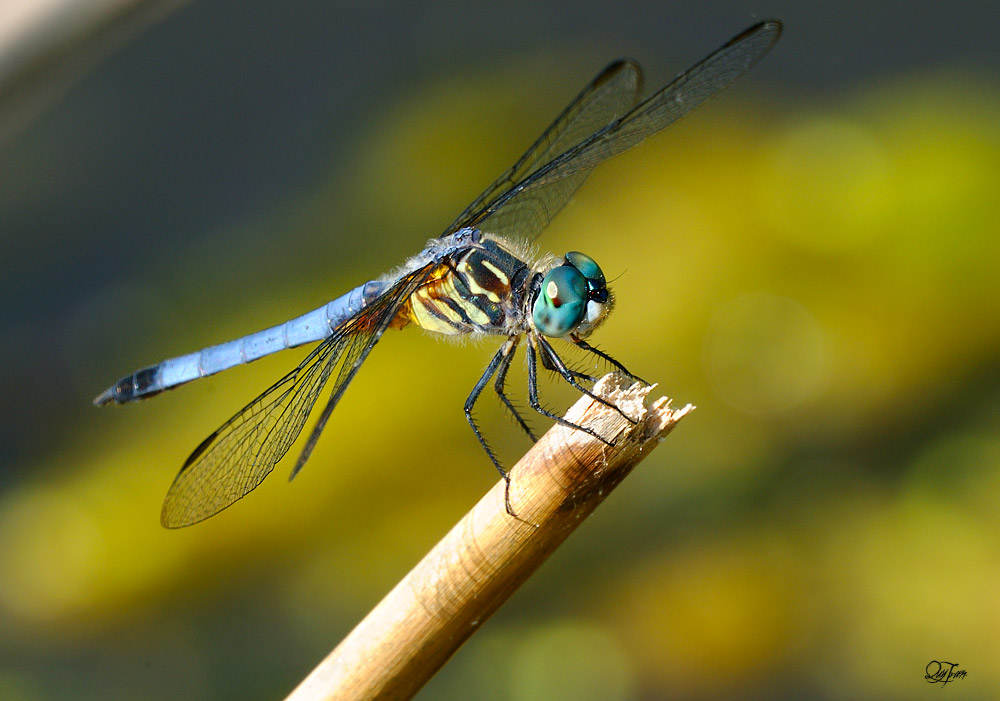
Dragonfly by QuyTran

Dragonfly by QuyTran

Another wonderful thing about dragonflies is their eyes. Each pair of eyes is actually made up of as many as 30,000 separate eyes, each with its own lens! This enables the insect to see what is happening over a wide area, and spot every tiny movement without moving its head.

The supposedly oldest fossil dragonflies are just like dragonflies are now, except that they were much larger—75 centimeters (2.5 feet) from wing-tip to wing-tip! So there is no evidence that they evolved from ancestors without wings. And surely those amazing eyes did not evolve? Dragonflies are another of the many wonders of God’s creation!” From Our World (Answers for Kids.)

Astonishing acrobatics – dragonflies – by Johathan Sarfati

(Updated 4/29/09)

Dragonflies and fighter pilots – what can we learn? by Ken Ham

*

Originally posted in 2009 – this is a duplicate.

More Interesting Things:

Interesting Things – Dragonflies II

*

*