Vol. 2, No. 4 – The American Goldfinch

American Goldfinch of Birds Illustrated by Color Photography, 1897

American Goldfinch of Birds Illustrated by Color Photography, 1897

From col. F. M. Woodruff. Copyrighted by
Nature Study Pub. Co., 1897, Chicago.

THE AMERICAN GOLDFINCH.

“Look, Mamma, look!” cried a little boy, as one day late in June my mate and I alighted on a thistle already going to seed. “Such a lovely bird! How jolly he looks, with that black velvet hat drawn over his eyes!”

“That’s a Goldfinch,” replied his mamma; “sometimes called the Jolly Bird, the Thistle Bird, the Wild Canary, and the Yellow Bird. He belongs to the family of Weed Warriors, and is very useful.”

“He sings like a Canary,” said Bobbie. “Just hear him talking to that little brown bird alongside of him.”

That was my mate, you see, who is rather plain looking, so to please him I sang my best song, “Per-chic-o-ree, per-chic-o-ree.”

“That sounds a great deal better,” said Bobbie; “because it’s not sung by a little prisoner behind cage bars, I guess.”

“It certainly is wilder and more joyous,” said his mamma. “He is very happy just now, for he and his mate are preparing for housekeeping. Later on, he will shed his lemon-yellow coat, and then you won’t be able to tell him from his mate and little ones.”

“How they are gobbling up that thistle-down,” cried Bobbie. “Just look!”

“Yes,” said his mamma, “the fluff carries the seed, like a sail to which the seed is fastened. By eating the seed, which otherwise would be carried by the wind all over the place, these birds do a great amount of good. The down they will use to line their nests.”

“How I should like to peep into their nest,” said Bobbie; “just to peep, you know; not to rob it of its eggs, as boys do who are not well brought up.”

My mate and I were so pleased at that, we flew off a little way, chirping and chattering as we went.

“Up and down, up and down,” said Bobbie; “how prettily they fly.”

“Yes,” said his mamma; “that is the way you can always tell a Goldfinch when in the air. A dip and a jerk, singing as he flies.”

“What other seeds do they eat, mamma?” presently asked Bobbie.

“The seeds of the dandelion, the sunflower, and wild grasses generally. In the winter, when these are not to be had, the poor little fellows have a very hard time. People with kind hearts, scatter canary seed over their lawns to the merry birds for their summer songs, and for keeping down the weeds.”


THE GOLDFINCH.

imga1

CCORDING to one intelligent observer, the Finches are, in Nature’s economy, entrusted with the task of keeping the weeds in subjection, and the gay and elegant little Goldfinch is probably one of the most useful, for its food is found to consist, for the greater part, of seeds most hurtful to the works of man. “The charlock that so often chokes his cereal crops is partly kept in bounds by his vigilance, and the dock, whose rank vegetation would, if allowed to cast all its seeds, spread barrenness around, is also one of his store houses, and the rank grasses, at their seeding time, are his chief support.” Another writer, whose study of this bird has been made with care, calls our American Goldfinch one of the loveliest of birds. With his elegant plumage, his rhythmical, undulatory flight, his beautiful song, and his more beautiful soul, he ought to be one of the best beloved, if not one of the most famous; but he has never yet had half his deserts. He is like the Chickadee, and yet different. He is not so extremely confiding, nor should I call him merry. But he is always cheerful, in spite of his so-called plaintive note, from which he gets one of his names, and always amiable. So far as I know, he never utters a harsh sound; even the young ones asking for food, use only smooth, musical tones. During the pairing season, his delight often becomes rapturous. To see him then, hovering and singing,—or, better still, to see the devoted pair hovering together, billing and singing,—is enough to do even a cynic good. The happy lovers! They have never read it in a book, but it is written on their hearts:

“The gentle law that each should be
The other’s heaven and harmony.”

In building his nest, the Goldfinch uses much ingenuity, lichens and moss being woven so deeply into the walls that the whole surface is quite smooth. Instead of choosing the forks of a bough, this Finch likes to make its nest near the end of a horizontal branch, so that it moves about and dances up and down as the branch is swayed by the wind. It might be thought that the eggs would be shaken out by a tolerably sharp breeze, and such would indeed be the case, were they not kept in their place by the form of the nest. On examination, it will be seen to have the edge thickened and slightly turned inward, so that when the nest is tilted on one side by the swaying of the bough, the eggs are still retained within. It is lined with vegetable down, and on this soft bed repose five pretty eggs, white, tinged with blue, and diversified with small grayish purple spots.


A curious story is told of a caged Goldfinch, which in pleasant weather always hung in a window. One day, hearing strange bird voices, the owner looked up from her seat and saw a Catbird trying to induce the Finch to eat a worm it had brought for it. By dint of coaxing and feeding the wild bird, she finally induced it to come often to the window, and one day, as she sat on the porch, the Catbird brought a berry and tried to put it into her mouth. We have often seen sparrows come to the window of rooms where canaries were imprisoned, but it has uniformly been to get food and not to administer it. The Catbird certainly thus expressed its gratitude.

Summary:

AMERICAN GOLDFINCH.Spinus tristis. Other names: “Yellow-bird,” “Thistle-bird.”

Range—Eastern North America; breeds from South Carolina to southern Labrador; winters from the northern United States to the Gulf.

Nest—Externally, of fine grasses, strips of bark and moss, thickly lined with thistle down; in trees or bushes, five to thirty feet up.

Eggs—Three to six, pale bluish white.
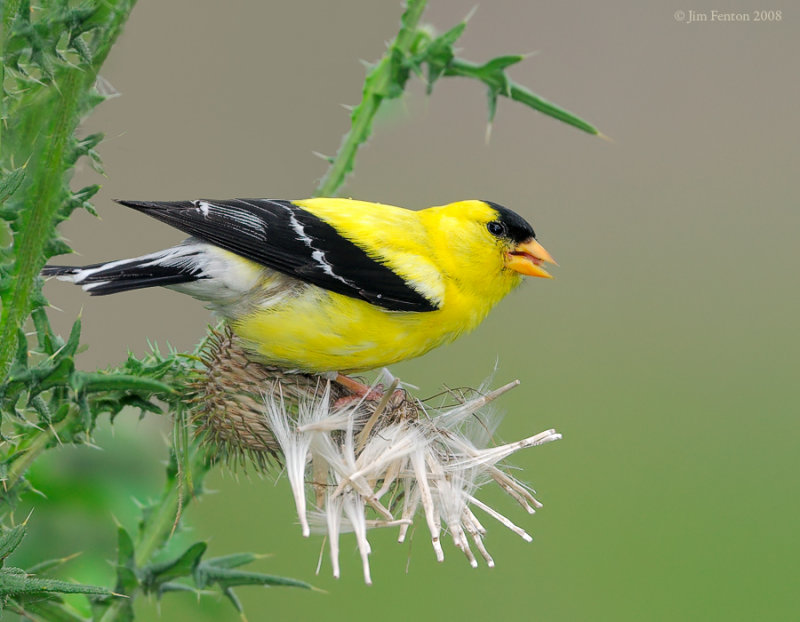

American Goldfinch (Carduelis tristis) on Thistle by Fenton

American Goldfinch (Carduelis tristis) on Thistle by Fenton

Lee’s Addition:

Therefore I love Your commandments Above gold, yes, above fine gold. (Psalms 119:127 NASB)

The American Goldfinch is a member of the Fringillidae – Finches Family. It is alway a joy to see them come to my feeders.
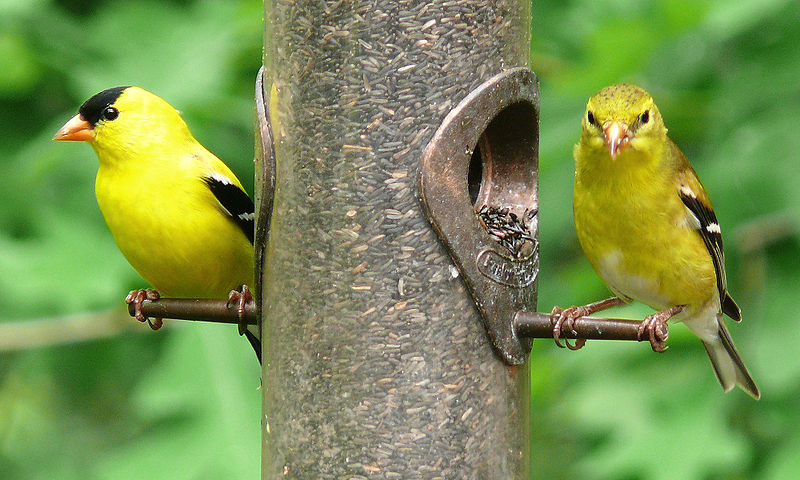
American Goldfinch (Carduelis tristis) Male and Female ©WikiC

American Goldfinch (Carduelis tristis) Male and Female ©WikiC

The American Goldfinch (Carduelis tristis), also known as the Eastern Goldfinch and Wild Canary, is a small North American bird in the finch family. It is migratory, ranging from mid-Alberta to North Carolina during the breeding season, and from just south of the Canadian border to Mexico during the winter.

The American Goldfinch male is a vibrant yellow in the summer and an olive color during the winter months, while the female is a dull yellow-brown shade which brightens only slightly during the summer. The male displays brightly colored plumage during the breeding season to attract a mate.

The American Goldfinch is a granivore and created for the consumption of seedheads, with a conical beak to remove the seeds and agile feet to grip the stems of seedheads while feeding. It is a social bird, and will gather in large flocks while feeding and migrating. It may behave territorially during nest construction, but this aggression is short-lived. Its breeding season is tied to the peak of food supply, beginning in late July, which is relatively late in the year for a finch. This species is generally monogamous, and produces one brood each year.
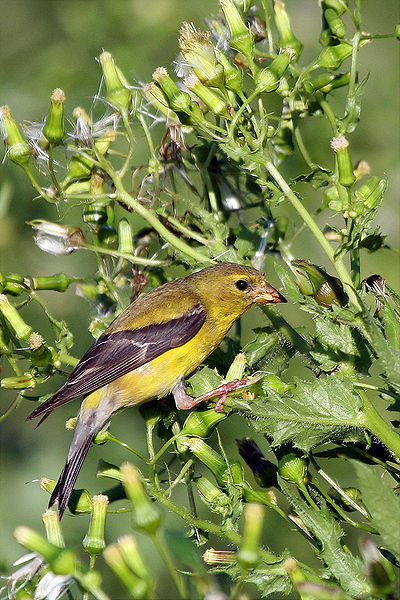
American Goldfinch (Carduelis tristis) Female ©WikiC

American Goldfinch (Carduelis tristis) Female ©WikiC

The American Goldfinch is a small finch, 4.3–5.5 in (11–14 centimeters) long, with a wingspan of 7.5–8.7 in (19–22 centimeters). The beak is small, conical, and pink for most of the year, but turns bright orange with the spring molt in both sexes.[19] The shape and size of the beak aid in the extraction of seeds from the seed heads of thistles, sunflowers, and other plants.

The American Goldfinch undergoes a molt in the spring and autumn, which it undergoes twice a year. During the winter molt it sheds all its feathers; in the spring, it sheds all but the wing and tail feathers, which are dark brown in the female and black in the male. The markings on these feathers remain through each molt, with bars on the wings and white under and at the edges of the short, notched tail. The plumage coloration is especially pronounced after the spring molt, when the bright color of the male’s summer plumage is needed to attract a mate.

Once the spring molt is complete, the body of the male is a brilliant lemon yellow with a striking jet black cap and white rump that is visible during flight.] The female is mostly brown, lighter on the underside with a yellow bib. After the autumn molt, the bright summer feathers are replaced by duller plumage, becoming buff below and olive-brown above, with a pale yellow face and bib. The autumn plumage is almost identical in both sexes, but the male has yellow shoulder patches. In some winter ranges, the goldfinches lose all traces of yellow, becoming a predominantly medium tan-gray color with an olive tinge evident only on close viewing.

The immature American Goldfinch has a dull brown back, and the underside is pale yellow. The shoulders and tail are dull black with buff-colored, rather than white, markings on wings and rump. This coloration is the same in both genders.

The song of the American Goldfinch is a series of musical warbles and twitters, often with a long note. A tsee-tsi-tsi-tsit call is often given in flight; it may also be described as per-chic-o-ree. While the female incubates the eggs, she calls to her returning mate with a soft continuous teeteeteeteete sound. The young begin to use a call of chick-kee or chick-wee shortly before fledging, which they use until they have left the nest entirely. There are two defense calls made by adults during nesting; a sweeet call made to rally other goldfinches to the nest and distract predators, and a bearbee used to signal to the nestlings to quiet them and get them to crouch down in the nest to become less conspicuous.
(Wikipedia with editing)

American Goldfinch song from xeno-canto by Andrew Spencer

*

Birds Illustrated by Color Photography – Revisited

The above article is an article in the monthly serial for October 1897 “designed to promote Knowledge of Bird-Live.” These include Color Photography, as they call them, today they are drawings. There are at least three Volumes that have been digitized by Project Gutenberg.

To see the whole series of – Birds Illustrated by Color Photography – Revisited

*

(Information from Wikipedia and other internet sources)

Next Article – The Chimney Swift

The Previous Article – The Lost Mate


Wordless Birds

Links:

Fringillidae – Finches Family

American Goldfinch – All About Birds

American Goldfinch – WhatBird

American Goldfinch – National Geographic

American Goldfinch – Wikipedia

*

Vol. 2, No. 4 – The Lost Mate

swallow4

THE LOST MATE.

Shine! Shine! Shine!
Pour down your warmth, great Sun!
While we bask—we two together.

Two together!
Winds blow south, or winds blow north,
Day come white, or night come black,
Home, or rivers and mountains from home,
Singing all time, minding no time,
If we two but keep together.

Till of a sudden,
May be killed, unknown to her mate,
One forenoon the she-bird crouched not on the nest,
Nor returned that afternoon, nor the next,
Nor ever appeared again.

And thence forward, all summer, in the sound of the sea,
And at night, under the full of moon, in calmer weather,
Over the hoarse surging of the sea,
Or flitting from briar to briar by day,
I saw, I heard at intervals, the remaining one.

Blow! blow! blow!
Blow up, sea-winds, along Paumanok’s shore!
I wait and I wait, till you blow my mate to me.
—Walt Whitman.


Lee’s Addition:

My heart is severely pained within me, And the terrors of death have fallen upon me. (Psalms 55:4 NKJV)

This is a sad one, but it is part of the series. The above photo is from an email about the mate being hit by a car and the other showing its emotions and trying to encourage it to get up.

Here is a YouTube I found about that email.

Fortunately we, as humans have a soul, and as Christians we have hope about our future. Even when we lose a loved one.

But I do not want you to be ignorant, brethren, concerning those who have fallen asleep, lest you sorrow as others who have no hope. For if we believe that Jesus died and rose again, even so God will bring with Him those who sleep in Jesus. For this we say to you by the word of the Lord, that we who are alive and remain until the coming of the Lord will by no means precede those who are asleep. For the Lord Himself will descend from heaven with a shout, with the voice of an archangel, and with the trumpet of God. And the dead in Christ will rise first. Then we who are alive and remain shall be caught up together with them in the clouds to meet the Lord in the air. And thus we shall always be with the Lord. Therefore comfort one another with these words. (1 Thessalonians 4:13-18 NKJV)

*

Birds Illustrated by Color Photography – Revisited

The above article is an article in the monthly serial for October 1897 “designed to promote Knowledge of Bird-Live.” These include Color Photography, as they call them, today they are drawings. There are at least three Volumes that have been digitized by Project Gutenberg.

To see the whole series of – Birds Illustrated by Color Photography – Revisited

*

(Information from Wikipedia and other internet sources)

Next Article – The American Goldfinch

The Previous Article – Blackburnian Warbler


Wordless Birds

*

Vol. 2, No. 4 – The Blackburnian Warbler

Blackburnian Warbler of Birds Illustrated by Color Photography, 1897

Blackburnian Warbler of Birds Illustrated by Color Photography, 1897

From col. Chi. Acad. Sciences. Copyrighted by
Nature Study Pub. Co., 1897, Chicago.

THE BLACKBURNIAN WARBLER.

imgi

F the children had had the naming of birds we venture to say that it would have been more appropriately done, and “Blackburnian,” as many other names of Warblers, would have had no place in literature. There are about seventy-five well known Warblers, nearly all with common names indicating the most characteristic colors or habits, or partly descriptive of the bird itself. The common names of this beautiful Warbler are Orange-throated Warbler and Hemlock Warbler. Some one has suggested that it should be called the Torch Bird, for “half a dozen of them as they flash about in the pines, raising their wings and jerking their tails, make the darkest shadows seem breaking into little tongues of flame.”

The Orange-throat is only migratory in Illinois, passing through in spring and fall, its summer home being chiefly if not wholly, to the northward, while it passes the winter in Central America and northern South America. It is found in New York and in portions of Massachusetts, frequenting the coniferous forests, and building its nest in bushes or small trees a few feet above the ground. Dr. C. Hart Merriam found a pair of these birds nesting in a grove of large white pines in Lewis County, New York. In the latter part of May the female was observed building, and on the second of June the nest contained four fresh eggs of the Warbler and one of the Cow bird. The nest was saddled on the horizontal limb about eight feet from the ground and about ten feet from the trunk. Nests have been found in pine trees in Southern Michigan at an elevation of forty feet. In all cases the nests are placed high in hemlocks or pines, which are the bird’s favorite resorts. From all accounts the nests of this species are elegantly and compactly made, consisting of a densely woven mass of spruce twigs, soft vegetable down, rootlets, and fine shreds of bark. The lining is often intermixed with horse hairs and feathers. Four eggs of greenish-white or very pale bluish-green, speckled or spotted, have usually been found in the nests.

The autumnal male Warblers resemble the female. They have two white bands instead of one; the black stripes on the side are larger; under parts yellowish; the throat yellowish, passing into purer yellow behind. Few of our birds are more beautiful than the full plumaged male of this lovely bird, whose glowing orange throat renders it a conspicuous object among the budding and blossoming branches of the hemlocks. Chapman says, coming in May, before the woods are fully clad, he seems like some bright plumaged tropical bird who has lost his way and wandered to northern climes. The summer is passed among the higher branches in coniferous forests, and in the early fall the bird returns to surroundings which seem more in keeping with its attire.

Mr. Minot describes the Blackburnian Warbler’s summer song as resembling the syllables wee-see-wee-see, while in the spring its notes may be likened to wee-see-wee-see, tsee, tsee, tsee, repeated, the latter syllables being on ascending scale, the very last shrill and fine.

Summary:

BLACKBURNIAN WARBLER.Dendroica blackburniæ.

Range—Eastern North America; breeds from northern Minnesota and southern Maine northward to Labrador and southward along the Alleghenies to South Carolina; winters in the tropics.

Nest—Of fine twigs and grasses, lined with grasses and tendrils, in coniferous trees, ten to forty feet up.

Eggs—Four, grayish white or bluish white, distinctly and obscurely spotted, speckled, and blotched with cinnamon brown or olive brown.


Blackburnian Warbler (Dendroica fusca) by J Fenton

Blackburnian Warbler (Dendroica fusca) by J Fenton

Lee’s Addition:

Beside them the birds of the heavens dwell; they sing among the branches. (Psalms 104:12 ESV)

What a gorgeous beauty the Lord created with this Warbler. Aren’t they just a delight to behold. The male of course is the most colorful. They belong to the Parulidae – New World Warblers Family. A nice photo of a male and female is on Looking back … scroll to the end of the article.

“The Blackburnian Warbler (Setophaga fusca) is a small New World warbler. They breed in eastern North America, from southern Canada, westwards to the southern Canadian Prairies, the Great Lakes region and New England, to North Carolina.

Blackburnian Warblers are migratory, wintering in southern Central America and in South America, and are very rare vagrants to western Europe. These birds were named after Anna Blackburne, an English botanist.

Blackburnian Warblers are around 4.3 to 5.1 in (11 to 13 cm) long, with a 7.9 to 8.7 in (20 to 22 cm) wingspan, and weigh 0.28 to 0.46 oz (8 to 13 g). The average mass of an adult bird is 0.34 oz (9.7 g).

Blackburnian Warblers display dark gray backs and double white wing bars, with yellowish rumps and dark brown crowns. The underparts of these birds are white, and are tinged with yellow and streaked black. The head is strongly patterned in yellow and black, with a flaming-orange throat. It is the only North American warbler with this striking plumage. Other plumages, including the fall male and adult female, are washed-out versions of the summer male, and in particular lack the bright colors and strong head pattern. Basic plumages show weaker yellows and gray in place of black in the breeding male. Blackburnian Warblers’ songs are a simple series of high swi notes, which often ascend in pitch. Their call is a high sip.

WhatBird’s Sound Page for the Blackburnian

Blackburnian Warbler (Dendroica fusca) by Raymond Barlow

Blackburnian Warbler (Dendroica fusca) by               Raymond Barlow

Blackburnian Warblers are solitary during winter and highly territorial on their breeding grounds and do not mix with other passerine species outside of the migratory period. However, during migration, they often join local mixed foraging flocks of species such as chickadees, kinglets and nuthatches. These birds are basically insectivorous, but will include berries in their diets in wintertime. They usually forage by searching for insects or spiders in treetops. The breeding habitats of these birds are mature coniferous woodlands or mixed woodlands, especially ones containing spruce and hemlocks. It typically winters in tropical montane forests.

Blackburnian Warblers build a nest consisting of an open cup of twigs, bark, plant fibers, and rootlets held to branch with spider web and lined with lichens, moss, hair, and dead pine needles that’s placed near the end of a branch. 3-5 whitish eggs are laid its nest which is usually placed 2–38 m (5–80 feet) above the ground, on a horizontal branch.” (Wikipedia with editing)

*

Birds Illustrated by Color Photography – Revisited

The above article is an article in the monthly serial for October 1897 “designed to promote Knowledge of Bird-Live.” These include Color Photography, as they call them, today they are drawings. There are at least three Volumes that have been digitized by Project Gutenberg.

To see the whole series of – Birds Illustrated by Color Photography – Revisited

*

(Information from Wikipedia and other internet sources)

Next Article – The Lost Mate

The Previous Article – White-Breasted Nuthatch


ABC’s of the Gospel

Links:

Blackburnian Warbler – Wikipedia

Blackburnian Warbler – All About Birds

Blackburnian Warbler – WhatBird

*

Vol. 2, No. 3 – The Phoebe

The Phoebe or Birds Illustrated by Color Photography, 1897

The Phoebe or Birds Illustrated by Color Photography, 1897

From col. J. G. Parker. Jr. Copyrighted by
Nature Study Pub. Co., 1897, Chicago.

THE PHOEBE

Oft the Phoebe’s cheery notes
Wake the laboring swain;
“Come, come!” say the merry throats,
“Morn is here again.”
Phoebe, Phoebe! let them sing for aye,
Calling him to labor at the break of day.
—C. C. M.

EARLY everywhere in the United States we find this cheerful bird, known as Pewee, Barn Pewee, Bridge Pewee, or Phoebe, or Pewit Flycatcher. “It is one of that charming coterie of the feathered tribe who cheer the abode of man with their presence.” There are few farmyards without a pair of Pewees, who do the farmer much service by lessening the number of flies about the barn, and by calling him to his work in the morning by their cheery notes.

Dr. Brewer says that this species is attracted both to the vicinity of water and to the neighborhood of dwellings, probably for the same reason—the abundance of insects in either situation. They are a familiar, confiding, and gentle bird, attached to localities, and returning to them year after year. Their nests are found in sheltered situations, as under a bridge, a projecting rock, in the porches of houses, etc. They have been known to build on a small shelf in the porch of a dwelling, against the wall of a railroad station, within reach of the passengers, and under a projecting window-sill, in full view of the family, entirely unmoved by the presence of the latter at meal time.

Like all the flycatcher family the Phoebe takes its food mostly flying. Mrs. Wright says that the Pewee in his primitive state haunts dim woods and running water, and that when domesticated he is a great bather, and may be seen in the half-light dashing in and out of the water as he makes trips to and from the nest. After the young are hatched both old and young disport themselves about the water until moulting time. She advises: “Do not let the Phoebes build under the hoods of your windows, for their spongy nests harbor innumerable bird-lice, and under such circumstances your fly-screens will become infested and the house invaded.”

In its native woods the nest is of moss, mud, and grass placed on a rock, near and over running water; but in the vicinity of settlements and villages it is built on a horizontal bridge beam, or on timber supporting a porch or shed. The eggs are pure white, somewhat spotted. The notes, to some ears, are Phoebe, phoebe, pewit, phoebe! to others, of somewhat duller sense of hearing, perhaps, Pewee, pewee, pewee! We confess to a fancy that the latter is the better imitation.

Summary:

PHOEBE.Sayornis phœbe. Other names: “Pewit,” “Pewee.”

Range—Eastern North America; in winter south to Mexico and Cuba.

Nest—Compactly and neatly made of mud and vegetable substances, with lining of grass and feathers.

Eggs—Four or five; pure white, sometimes sparsely spotted with reddish brown dots at larger end.


Eastern Phoebe (Sayornis phoebe) by Dan

Eastern Phoebe (Sayornis phoebe) by Dan

Lee’s Addition:

I know all the birds of the mountains, And the wild beasts of the field are Mine. (Psalms 50:11 NKJV)

Luckily today, at least here, we can ignore this one remark; “She advises: ‘Do not let the Phoebes build under the hoods of your windows, for their spongy nests harbor innumerable bird-lice, and under such circumstances your fly-screens will become infested and the house invaded.’ ” I am sure back in 1897 that was a problem for them. Isn’t it amazing how times have changed for humans, but the birds are pretty well doing the same nest building and living as before. Not sure of the interchange between the Phoebe and the Pewee. They are in the same family, Tyrannidae – Tyrant Flycatchers, but they are different species.

There are three Phoebes:
Eastern Phoebe (Sayornis phoebe)
Black Phoebe (Sayornis nigricans)
Say’s Phoebe (Sayornis saya)

There are 14 Pewees and Wood Pewees:

Greater Pewee (Contopus pertinax)
Dark Pewee (Contopus lugubris)
Smoke-colored Pewee (Contopus fumigatus)
Ochraceous Pewee (Contopus ochraceus)
Western Wood Pewee (Contopus sordidulus)
Eastern Wood Pewee (Contopus virens)
Tropical Pewee (Contopus cinereus)
Tumbes Pewee (Contopus punensis)
White-throated Pewee (Contopus albogularis)
Blackish Pewee (Contopus nigrescens)
Cuban Pewee (Contopus caribaeus)
Hispaniolan Pewee (Contopus hispaniolensis)
Jamaican Pewee (Contopus pallidus)
Lesser Antillean Pewee (Contopus latirostris)

The genus Sayornis is a small group of medium-sized insect-eating birds in the Tyrant flycatcher family Tyrranidae native to North and South America.

They prefer semi-open or open areas. These birds wait on a perch and then catch insects in flight, also sometimes picking them up from the ground. Their nest is an open cup sometimes placed on man-made structures.

They often slowly lower and raise their tails while perched.

This species appears remarkably big-headed, especially if it puffs up the small crest. Its plumage is gray-brown above. It has a white throat, dirty gray breast and buffish underparts which become whiter during the breeding season. Two indistinct buff bars are present on each wing. Its lack of an eye ring and wingbars, and its all dark bill distinguish it from other North American tyrant flycatchers, and it pumps its tail up and down like other phoebes when perching on a branch. The Eastern Phoebe’s call is a sharp chip, and the song, from which it gets its name, is fee-bee. (Wikipedia)
*

Birds Illustrated by Color Photography – Revisited

The above article is an article in the monthly serial for September 1897 “designed to promote Knowledge of Bird-Live.” These include Color Photography, as they call them, today they are drawings. There are at least three Volumes that have been digitized by Project Gutenberg.

To see the whole series of – Birds Illustrated by Color Photography – Revisited

*

(Information from Wikipedia and other internet sources)

Next Article – The Ruby-Crowned Kinglet

The Previous Article – The House Wren

Gospel Presentation

Links:

Eastern Phoebe

Phoebe (bird) – Wikipedia

*

Vol. 2, No. 3 – The Yellow Warbler

Summer Yellow-Bird for Birds Illustrated by Color Photography, 1897

Summer Yellow-Bird for Birds Illustrated by Color Photography, 1897

THE YELLOW WARBLER.

imgi

N a recent article Angus Gaines describes so delightfully some of the characteristics of the Yellow Warbler, or Summer Yellow-bird, sometimes called the Wild Canary, that we are tempted to make use of part of it. “Back and forth across the garden the little yellow birds were flitting, dodging through currant and gooseberry bushes, hiding in the lilacs, swaying for an instant on swinging sprays of grape vines, and then flashing out across the garden beds like yellow sunbeams. They were lithe, slender, dainty little creatures, and were so quick in their movements that I could not recognize them at first, but when one of them hopped down before me, lifted a fallen leaf and dragged a cutworm from beneath it, and, turning his head, gave me a sidewise glance with his victim still struggling in his beak, I knew him. His gay coat was yellow without the black cap, wings, and tail which show in such marked contrast to the bright canary hue of that other yellow bird, the Gold-finch.

“Small and delicate as these birds are, they had been on a long journey to the southward to spend the winter, and now on the first of May, they had returned to their old home to find the land at its fairest—all blossoms, buds, balmy air, sunshine, and melody. As they flitted about in their restless way, they sang the soft, low, warbling trills, which gave them their name of Yellow Warbler.”

Mrs. Wright says these beautiful birds come like whirling leaves, half autumn yellow, half green of spring, the colors blending as in the outer petals of grass-grown daffodils. “Lovable, cheerful little spirits, darting about the trees, exclaiming at each morsel that they glean. Carrying sun glints on their backs wherever they go, they should make the gloomiest misanthrope feel the season’s charm. They are so sociable and confiding, feeling as much at home in the trees by the house as in seclusion.”

The Yellow-bird builds in bushes, and the nest is a wonderful example of bird architecture. Milkweed, lint and its strips of fine bark are glued to twigs, and form the exterior of the nest. Its inner lining is made of the silky down on dandelion-balls woven together with horse-hair. In this dainty nest are laid four or five creamy white eggs, speckled with lilac tints and red-browns. The unwelcome egg of the Cow-bird is often found in the Yellow-bird’s nest, but this Warbler builds a floor over the egg, repeating the expedient, if the Cow-bird continues her mischief, until sometimes a third story is erected.

A pair of Summer Yellow-birds, we are told, had built their nest in a wild rose bush, and were rearing their family in a wilderness of fragrant blossoms whose tinted petals dropped upon the dainty nest, or settled upon the back of the brooding mother. The birds, however, did not stay “to have their pictures taken,” but their nest may be seen among the roses.

The Yellow Warbler’s song is Sweet-sweet-sweet-sweet-sweet-sweeter-sweeter: seven times repeated.

Summary:

YELLOW WARBLER.Dendroica æstiva. Other names: “Summer Yellow-bird,” “Wild Canary,” “Yellow-poll Warbler.”

Range—The whole of North America; breeding throughout its range. In winter, the whole of middle America and northern South America.

Nest—Built in an apple tree, cup-shaped, neat and compact, composed of plant fibres, bark, etc.

Eggs—Four or five; greenish-white, spotted.


American Yellow Warbler (Dendroica aestiva) by J Fenton

American Yellow Warbler (Dendroica aestiva) by J Fenton

Lee’s Addition:

I will praise the name of God with a song, and will magnify him with thanksgiving. (Psalms 69:30 KJV)

This Yellow Warbler is now the American Yellow Warbler (Setophaga aestiva) which is the Parulidae – New World Warblers Family.

The Yellow Warbler (Setophaga petechia, formerly Dendroica petechia) is a New World warbler species. Sensu lato, they make up the most widespread Setophaga species, breeding in almost the whole of North America and down to northern South America.

Other than in male breeding plumage, all subspecies are very similar. Winter, female and immature birds all have similarly greenish-yellow uppersides and are a duller yellow below. Young males soon acquire breast and, where appropriate, head coloration. Females are somewhat duller, most notably on the head. In all, the remiges and rectrices are blackish olive with yellow edges, sometimes appearing as an indistinct wing-band on the former. The eyes and the short thin beak are dark, while the feet are lighter or darker olive-buff.

The 35 subspecies of D. petechia sensu lato can be divided into three main groups according to the males’ head color in the breeding season. Each of these groups is sometimes considered a separate species, or the aestiva group (Yellow Warbler) is considered a species different from D. petechia (Mangrove Warbler, including Golden Warbler); the latter option is the one currently accepted by the International Ornithological Congress World Bird List.

American Yellow Warbler (Dendroica aestiva) by Daves BirdingPix

American Yellow Warbler (Dendroica aestiva) by Daves BirdingPix

*

Birds Illustrated by Color Photography – Revisited

The above article is an article in the monthly serial for September 1897 “designed to promote Knowledge of Bird-Live.” These include Color Photography, as they call them, today they are drawings. There are at least three Volumes that have been digitized by Project Gutenberg.

To see the whole series of – Birds Illustrated by Color Photography – Revisited

*

(Information from Wikipedia and other internet sources)

Next Article – The Hermit Thrush

The Previous Article – Bird Song – September

Wordless Birds

Links:

Parulidae – New World Warblers

American Yellow Warbler – All About Birds

American Yellow Warbler – Wikipedia

Yellow Warbler – What Bird

*

Birds Illustrated By Color Photography – Volume II Indroduction

BIRDS

A MONTHLY SERIAL

ILLUSTRATED BY COLOR PHOTOGRAPHY

DESIGNED TO PROMOTE

KNOWLEDGE OF BIRD-LIFE


VOLUME II.


CHICAGO  Nature Study Publishing Company


copyright, 1897 by

Nature Study Publishing Co.

chicago.


INTRODUCTION.

This is the second volume of a series intended to present, in accurate colored portraiture, and in popular and juvenile biographical text, a very considerable portion of the common birds of North America, and many of the more interesting and attractive specimens of other countries, in many respects superior to all other publications which have attempted the representation of birds, and at infinitely less expense. The appreciative reception by the public of Vol. I deserves our grateful acknowledgement. Appearing in monthly parts, it has been read and admired by thousands of people, who, through the life-like pictures presented, have made the acquaintance of many birds, and have since become enthusiastic observers of them. It has been introduced into the public schools, and is now in use as a text book by hundreds of teachers, who have expressed enthusiastic approval of the work and of its general extension. The faithfulness to nature of the pictures, in color and pose, have been commended by such ornithologists and authors as Dr. Elliott Coues, Mr. John Burroughs, Mr. J. W. Allen, editor of The Auk, Mr. Frank M. Chapman, Mr. J. W. Baskett, and others.

The general text of Birds—the biographies—has been conscientiously prepared from the best authorities by a careful observer of the feather-growing denizens of the field, the forest, and the shore, while the juvenile autobiographies have received the approval of the highest ornithological authority.

The publishers take pleasure in the announcement that the general excellence of Birds will be maintained in subsequent volumes. The subjects selected for the third and fourth volumes—many of them—will be of the rare beauty in which the great Audubon, the limner par excellence of birds, would have found “the joy of imitation.”

Nature Study Publishing Company.


BIRDS.

Illustrated by COLOR PHOTOGRAPHY.

Vol. II.   No. 1.   JULY, 1897.


Bald Eagle (Haliaeetus leucocephalus) by Lee

Bald Eagle (Haliaeetus leucocephalus) by Lee

Lee’s Addition:

This second volume does not have a cover photo for each month like Volume I did. They apparently changed their format. Also, there are no old time advertisements. These were reproduced through Gutenberg Project.

Will be posting the different birds soon. See Birds Illustrated by Color Photography – Revisted.

*

Birds Vol 1 #6 – The Volume 1. January to June 1897 – Index

Grey Catbird (Dumetella carolinensis) by Africaddict

Grey Catbird (Dumetella carolinensis) by Africaddict

VOLUME 1. JANUARY TO JUNE, 1897.

INDEX.


Img 3-6 - Birds Illustrated by Color Photographyelkhart lake.

Summer Excursion Tickets to the resorts of Wisconsin, Minnesota, Michigan, Colorado, California, Montana, Washington, Oregon, and British Columbia; also to Alaska, Japan, China, and all Trans-Pacific Points, are now on sale by the CHICAGO, MILWAUKEE & ST. PAUL RAILWAY. Full and reliable information can be had by applying to Mr. C. N. SOUTHER, Ticket Agent, 95 Adams Street, Chicago.

Please mention “BIRDS” when you write to advertisers.


Img 1-6 - Birds Illustrated by Color Photography

Please mention “BIRDS” when you write to advertisers.


Img 2-6 - Birds Illustrated by Color Photography

This wheel is made especially for the Nature Study Publishing Co., to be used as a premium. It is unique in design, of material the best, of workmanship unexcelled. No other wheel on the market can compare favorably with it for less than $100.00.

SPECIFICATIONS FOR 1897 “BIRD” BICYCLE.

Frame.—Diamond pattern; cold-drawn seamless steel tubing; 1 1/8 inch tubing in the quadrangle with the exception of the head, which is 1 1/4 inch. Height, 23, 24, 25 and 26 inches. Rear triangle 3/4 inch tubing in the lower and upright bars. Frame Parts.—Steel drop forgings, strongly reinforced connections. Forks.—Seamless steel fork sides, gracefully curved and mechanically reinforced. Steering Head.—9, 11 and 13 inches long, 1 1/4 inches diameter. Handle Bar.—Cold-drawn, weldless steel tubing, 7/8 inch in diameter, ram’s horn, upright or reversible, adapted to two positions. Handles.—Cork or corkaline; black, maroon or bright tips. Wheels.—28 inch, front and rear. Wheel Base.—43 inches. Rims.—Olds or Plymouth. Tires.—Morgan & Wright, Vim, or Hartford. Spokes.—Swaged, Excelsior Needle Co.’s best quality; 28 in front and 32 in rear wheel. Cranks.—Special steel, round and tapered; 6 1/2 inch throw. Pedals.—Brandenburg; others on order. Chain.-1/4 inch, solid link, with hardened rivet steel centers. Saddle.—Black, attractive and comfortable; our own make. Saddle Post.—Adjustable, style “T.”Tread. —4 7/8 inches. Sprocket Wheels.—Steel drop forgings, hardened. Gear.—68 regular; other gears furnished if so desired. Bearings.—Made of the best selected high-grade tool steel, carefully ground to a finish after tempering, and thoroughly dust-proof. All cups are screwed into hubs and crank hangers. Hubs.—Large tubular hubs, made from a solid bar of steel. Furnishing.—Tool-bag, wrench, oiler, pump and repair kit. Tool Bags.—In black or tan leather, as may be preferred. Handle bar, hubs, sprocket wheels, cranks, pedals, seat post, spokes, screws, nuts and washers, nickel plated over copper; remainder enameled. Weight.—22 and 24 pounds.

Send for Specifications for Diamond Frame.

NATURE STUDY PUBLISHING CO.

Agents Wanted in every Town and City to represent “BIRDS.” CHICAGO.

Please mention “BIRDS” when you write to advertisers.


We give below a list of publications, especially fine, to be read in connection with our new magazine, and shall be glad to supply them at the price indicated, or as premiums for subscriptions for “Birds.”

“Birds Through an Opera Glass”   $.75
“Bird Ways”   $.60
“In Nesting Time”   $1.25
“A Bird Lover of the West”   $1.25
“Upon the Tree Tops”   $1.25
“Wake Robin”   $1.00
“Birds in the Bush”   $1.25
“A-Birding on a Bronco”   $1.25
“Land Birds and Game Birds of New England”   $3.50
“Birds and Poets”   $1.25
“Bird Craft”   $3.00
“The Story of the Birds”   $.65
“Hand Book of Birds of Eastern North America”   $3.00

See our notice on another page concerning Bicycles. Our “Bird” Wheel is one of the best on the market—as neat and attractive as “Birds.”

We shall be glad to quote a special price for teachers or clubs.

We can furnish any article or book as premium for subscriptions for “Birds.”

Address,

Nature Study Publishing Co. Chicago, Ill.


Nature Study Publishing Company.

imgt

HE Nature Study Publishing Company is a corporation of educators and business men organized to furnish correct reproductions of the colors and forms of nature to families, schools, and scientists. Having secured the services of artists who have succeeded in photographing and reproducing objects in their natural colors, by a process whose principles are well known but in which many of the details are held secret, we obtained a charter from the Secretary of State in November, 1896, and began at once the preparation of photographic color plates for a series of pictures of birds.

The first product was the January number of “BIRDS,” a monthly magazine, containing ten plates with descriptions in popular language, avoiding as far as possible scientific and technical terms. Knowing the interest children have in our work, we have included in each number a few pages of easy text pertaining to the illustrations. These are usually set facing the plates to heighten the pleasure of the little folks as they read.

Casually noticed, the magazine may appear to be a children’s publication because of the placing of this juvenile text. But such is not the case. Those scientists who cherish with delight the famous handiwork of Audubon are no less enthusiastic over these beautiful pictures which are painted by the delicate and scientifically accurate fingers of Light itself. These reproductions are true. There is no imagination in them nor conventionalism. In the presence of their absolute truth any written description or work of human hands shrinks into insignificance. The scientific value of these photographs can not be estimated.

To establish a great magazine with a world-wide circulation is no light undertaking. We have been steadily and successfully working towards that end. Delays have been unavoidable. What was effective for the production of a limited number of copies was inadequate as our orders increased. The very success of the enterprise has sometimes impeded our progress. Ten hundred teachers in Chicago paid subscriptions in ten days. Boards of Education are subscribing in hundred lots. Improvements in the process have been made in almost every number, and we are now assured of a brilliant and useful future.

When “BIRDS” has won its proper place in public favor we shall be prepared to issue a similar serial on other natural objects, and look for an equally cordial reception for it.

PREMIUMS.

To teachers we give duplicates of all the pictures on separate sheets for use in teaching or for decoration.
To other subscribers we give a color photograph of one of the most gorgeous birds, the Golden Pheasant.
Subscriptions, $1.50 a year including one premium. Those wishing both premiums may receive them and a year’s subscription for $2.00.
We have just completed an edition of 50,000 back numbers to accommodate those who wish their subscriptions to date back to January, 1897, the first number.
We will furnish the first volume, January to June inclusive, well bound in cloth, postage paid, for $1.25. In Morocco, $2.25.

AGENTS.

10,000 agents are wanted to travel or solicit at home.

We have prepared a fine list of desirable premiums for clubs which any popular adult or child can easily form. Your friends will thank you for showing them the magazine and offering to send their money. The work of getting subscribers among acquaintances is easy and delightful. Agents can do well selling the bound volume. Vol. 1 is the best possible present for a young person or for anyone specially interested in nature.

Teachers and others meeting them at institutes do well as our agents. The magazine sells to teachers better than any other publication because they can use the extra plates for decoration, language work, nature study, and individual occupation.

NATURE STUDY PUBLISHING COMPANY,
277 Dearborn Street, Chicago.


**

How precious also are Your thoughts to me, O God! How great is the sum of them! (Psalms 139:17 NKJV)

This is the sum of the birds done in this series.

I trust you have enjoyed Vol 1 of this The Birds, Illustrated by Color Photography.

*
********************************


Birds Vol 1 #6 – Bird Song 1

Northern Mockingbird (Mimus polyglottos) by Dan

Northern Mockingbird (Mimus polyglottos) by Dan

Birds Illustrated by Color Photography – Revisited

Vol 1. June, 1897 No. 6

*

BIRD SONG

(RELOCATED – CLICK HERE)


Birds Vol 1 #1 – The Golden Oriole (or Hooded Oriole)

Golden Oriole

Golden Oriole

Birds Illustrated by Color Photography – Revisited

Vol 1. January, 1897 No. 1

*

THE GOLDEN ORIOLE

(RELOCATED – CLICK HERE)

Birds Vol 1 #1 – The Red-Rumped Tanager (Scarlet-Rumped or ?)

Red-Rumped Tanager

Red-Rumped Tanager

Birds Illustrated by Color Photography – Revisited

Vol 1. January, 1897 No. 1

*

THE RED-RUMPED TANAGER.

(RELOCATED – CLICK HERE)


Birds Vol 1 #1 – The Yellow Throated or (Black-mandibled) Toucan

Black-mandibled Toucan (Ramphastos ambiguus) for the Birds Illustrated article

Yellow Throated Toucan for the Birds Illustrated article

Birds Illustrated by Color Photography – Revisited

Vol 1. January, 1897 No. 1

*

THE YELLOW THROATED TOUCAN

(RELOCATED – CLICK HERE)