Vol. 2, No. 3 – The Hermit Thrush

THE HERMIT THRUSH.

imgi

N John Burroughs’ “Birds and Poets” this master singer is described as the most melodious of our songsters, with the exception of the Wood Thrush, a bird whose strains, more than any other’s, express harmony and serenity, and he complains that no merited poetic monument has yet been reared to it. But there can be no good reason for complaining of the absence of appreciative prose concerning the Hermit. One writer says: “How pleasantly his notes greet the ear amid the shrieking of the wind and the driving snow, or when in a calm and lucid interval of genial weather we hear him sing, if possible, more richly than before. His song reminds us of a coming season when the now dreary landscape will be clothed in a blooming garb befitting the vernal year—of the song of the Blackbird and Lark, and hosts of other tuneful throats which usher in that lovely season. Should you disturb him when singing he usually drops down and awaits your departure, though sometimes he merely retires to a neighboring tree and warbles as sweetly as before.”

In “Birdcraft” Mrs. Wright tells us, better than any one else, the story of the Hermit. She says: “This spring, the first week in May, when standing at the window about six o’clock in the morning, I heard an unusual note, and listened, thinking it at first a Wood Thrush and then a Thrasher, but soon finding that it was neither of these I opened the window softly and looked among the near by shrubs, with my glass. The wonderful melody ascended gradually in the scale as it progressed, now trilling, now legato, the most perfect, exalted, unrestrained, yet withal, finished bird song that I ever heard. At the first note I caught sight of the singer perching among the lower sprays of a dogwood tree. I could see him perfectly: it was the Hermit Thrush. In a moment he began again. I have never heard the Nightingale, but those who have say that it is the surroundings and its continuous night singing that make it even the equal of our Hermit; for, while the Nightingales sing in numbers in the moonlit groves, the Hermit tunes his lute sometimes in inaccessible solitudes, and there is something immaterial and immortal about the song.”

The Hermit Thrush is comparatively common in the northeast, and in Pennsylvania it is, with the exception of the Robin, the commonest of the Thrushes. In the eastern, as in many of the middle states, it is only a migrant. It is usually regarded as a shy bird. It is a species of more general distribution than any of the small Thrushes, being found entirely across the continent and north to the Arctic regions. It is not quite the same bird, however, in all parts of its range, the Rocky Mountain region being occupied by a larger, grayer race, while on the Pacific coast a dwarf race takes its place. It is known in parts of New England as the “Ground Swamp Robin,” and in other localities as “Swamp Angel.”

True lovers of nature find a certain spiritual satisfaction in the song of this bird. “In the evening twilight of a June day,” says one of these, “when all nature seemed resting in quiet, the liquid, melting, lingering notes of the solitary bird would steal out upon the air and move us strangely. What was the feeling it awoke in our hearts? Was it sorrow or joy, fear or hope, memory or expectation? And while we listened, we thought the meaning of it all was coming; it was trembling on the air, and in an instant it would reach us. Then it faded, it was gone, and we could not even remember what it had been.”
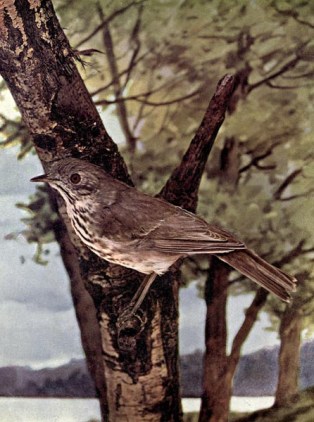

The Hermit Thrush for Birds Illustrated by Color Photography, 1897

The Hermit Thrush for Birds Illustrated by Color Photography, 1897

From col. F. M. Woodruff. Copyrighted by
Nature Study Pub. Co., 1897, Chicago.

THE HERMIT THRUSH.

I am sorry, children, that I cannot give you a specimen of my song as an introduction to the short story of my life. One writer about my family says it is like this: “O spheral, spheral! O holy, holy! O clear away, clear away! O clear up, clear up!” as if I were talking to the weather. May be my notes do sound something like that, but I prefer you should hear me sing when I am alone in the woods, and other birds are silent. It is ever being said of me that I am as fine a singer as the English Nightingale. I wish I could hear this rival of mine, and while I have no doubt his voice is a sweet one, and I am not too vain of my own, I should like to “compare notes” with him. Why do not some of you children ask your parents to invite a few pairs of Nightingales to come and settle here? They would like our climate, and would, I am sure, be welcomed by all the birds with a warmth not accorded the English Sparrow, who has taken possession and, in spite of my love for secret hiding places, will not let even me alone.

When you are older, children, you can read all about me in another part of Birds. I will merely tell you here that I live with you only from May to October, coming and going away in company with the other Thrushes, though I keep pretty well to myself while here, and while building my nest and bringing up my little ones I hide myself from the face of man, although I do not fear his presence. That is why I am called the Hermit.

If you wish to know in what way I am unlike my cousin Thrushes in appearance, turn to pages Brown Thrush and Wood Thrush, Vol. 1, of Birds. There you will see their pictures. I am one of the smallest of the family, too. Some call me “the brown bird with the rusty tail,” and other names have been fitted to me, as Ground Gleaner, Tree Trapper, and Seed Sower. But I do not like nicknames, and am just plain,

Hermit Thrush.

Summary:

HERMIT THRUSH.Turdus aonalaschkæ pallasii. Other names: “Swamp Angel,” “Ground Swamp Robin.”

Range—Eastern North America, breeding from northern United States northward; wintering from about latitude 40° to the Gulf coast.

Nest—On the ground, in some low, secluded spot, beneath shelter of deep shrubbery. Bulky and loosely made of leaves, bark, grasses, mosses, lined with similar finer material.

Eggs—Three or four; of greenish blue, unspotted.


Hermit Thrush (Catharus guttatus) ©USFWS

Hermit Thrush (Catharus guttatus) ©USFWS

Lee’s Addition:

I know all the birds of the mountains, And the wild beasts of the field are Mine. (Psa 50:11)

The Hermit Thrush’s song is ethereal and flute-like, consisting of a beginning note, then several descending musical phrases in a minor key, repeated at different pitches. They often sing from a high open location.

The Hermit Thrush is one of 185 species in the Turdidae – Thrushes Family.

Sorr, this is a little short, but I am away checking out the birds.

*

Birds Illustrated by Color Photography – Revisited

The above article is an article in the monthly serial for September 1897 “designed to promote Knowledge of Bird-Live.” These include Color Photography, as they call them, today they are drawings. There are at least three Volumes that have been digitized by Project Gutenberg.

To see the whole series of – Birds Illustrated by Color Photography – Revisited

*

(Information from Wikipedia and other internet sources)

Next Article – The Song Sparrow

The Previous Article – The Yellow Warbler

ABC’s of the Gospel

Links:

Turdidae – Thrushes Family

Hermit Thrush – All About Birds

Hermit Thrush – Wikipedia

*

Vol. 2, No. 3 – The Yellow Warbler

Summer Yellow-Bird for Birds Illustrated by Color Photography, 1897

Summer Yellow-Bird for Birds Illustrated by Color Photography, 1897

THE YELLOW WARBLER.

imgi

N a recent article Angus Gaines describes so delightfully some of the characteristics of the Yellow Warbler, or Summer Yellow-bird, sometimes called the Wild Canary, that we are tempted to make use of part of it. “Back and forth across the garden the little yellow birds were flitting, dodging through currant and gooseberry bushes, hiding in the lilacs, swaying for an instant on swinging sprays of grape vines, and then flashing out across the garden beds like yellow sunbeams. They were lithe, slender, dainty little creatures, and were so quick in their movements that I could not recognize them at first, but when one of them hopped down before me, lifted a fallen leaf and dragged a cutworm from beneath it, and, turning his head, gave me a sidewise glance with his victim still struggling in his beak, I knew him. His gay coat was yellow without the black cap, wings, and tail which show in such marked contrast to the bright canary hue of that other yellow bird, the Gold-finch.

“Small and delicate as these birds are, they had been on a long journey to the southward to spend the winter, and now on the first of May, they had returned to their old home to find the land at its fairest—all blossoms, buds, balmy air, sunshine, and melody. As they flitted about in their restless way, they sang the soft, low, warbling trills, which gave them their name of Yellow Warbler.”

Mrs. Wright says these beautiful birds come like whirling leaves, half autumn yellow, half green of spring, the colors blending as in the outer petals of grass-grown daffodils. “Lovable, cheerful little spirits, darting about the trees, exclaiming at each morsel that they glean. Carrying sun glints on their backs wherever they go, they should make the gloomiest misanthrope feel the season’s charm. They are so sociable and confiding, feeling as much at home in the trees by the house as in seclusion.”

The Yellow-bird builds in bushes, and the nest is a wonderful example of bird architecture. Milkweed, lint and its strips of fine bark are glued to twigs, and form the exterior of the nest. Its inner lining is made of the silky down on dandelion-balls woven together with horse-hair. In this dainty nest are laid four or five creamy white eggs, speckled with lilac tints and red-browns. The unwelcome egg of the Cow-bird is often found in the Yellow-bird’s nest, but this Warbler builds a floor over the egg, repeating the expedient, if the Cow-bird continues her mischief, until sometimes a third story is erected.

A pair of Summer Yellow-birds, we are told, had built their nest in a wild rose bush, and were rearing their family in a wilderness of fragrant blossoms whose tinted petals dropped upon the dainty nest, or settled upon the back of the brooding mother. The birds, however, did not stay “to have their pictures taken,” but their nest may be seen among the roses.

The Yellow Warbler’s song is Sweet-sweet-sweet-sweet-sweet-sweeter-sweeter: seven times repeated.

Summary:

YELLOW WARBLER.Dendroica æstiva. Other names: “Summer Yellow-bird,” “Wild Canary,” “Yellow-poll Warbler.”

Range—The whole of North America; breeding throughout its range. In winter, the whole of middle America and northern South America.

Nest—Built in an apple tree, cup-shaped, neat and compact, composed of plant fibres, bark, etc.

Eggs—Four or five; greenish-white, spotted.


American Yellow Warbler (Dendroica aestiva) by J Fenton

American Yellow Warbler (Dendroica aestiva) by J Fenton

Lee’s Addition:

I will praise the name of God with a song, and will magnify him with thanksgiving. (Psalms 69:30 KJV)

This Yellow Warbler is now the American Yellow Warbler (Setophaga aestiva) which is the Parulidae – New World Warblers Family.

The Yellow Warbler (Setophaga petechia, formerly Dendroica petechia) is a New World warbler species. Sensu lato, they make up the most widespread Setophaga species, breeding in almost the whole of North America and down to northern South America.

Other than in male breeding plumage, all subspecies are very similar. Winter, female and immature birds all have similarly greenish-yellow uppersides and are a duller yellow below. Young males soon acquire breast and, where appropriate, head coloration. Females are somewhat duller, most notably on the head. In all, the remiges and rectrices are blackish olive with yellow edges, sometimes appearing as an indistinct wing-band on the former. The eyes and the short thin beak are dark, while the feet are lighter or darker olive-buff.

The 35 subspecies of D. petechia sensu lato can be divided into three main groups according to the males’ head color in the breeding season. Each of these groups is sometimes considered a separate species, or the aestiva group (Yellow Warbler) is considered a species different from D. petechia (Mangrove Warbler, including Golden Warbler); the latter option is the one currently accepted by the International Ornithological Congress World Bird List.

American Yellow Warbler (Dendroica aestiva) by Daves BirdingPix

American Yellow Warbler (Dendroica aestiva) by Daves BirdingPix

*

Birds Illustrated by Color Photography – Revisited

The above article is an article in the monthly serial for September 1897 “designed to promote Knowledge of Bird-Live.” These include Color Photography, as they call them, today they are drawings. There are at least three Volumes that have been digitized by Project Gutenberg.

To see the whole series of – Birds Illustrated by Color Photography – Revisited

*

(Information from Wikipedia and other internet sources)

Next Article – The Hermit Thrush

The Previous Article – Bird Song – September

Wordless Birds

Links:

Parulidae – New World Warblers

American Yellow Warbler – All About Birds

American Yellow Warbler – Wikipedia

Yellow Warbler – What Bird

*

Vol. 2, No. 3 – Bird Song – September

American Yellow Warbler (Dendroica aestiva) singing by J Fenton

American Yellow Warbler (Dendroica aestiva) singing by J Fenton

BIRD SONG.

How songs are made
Is a mystery,
Which studied for years
Still baffles me.
—R. H. Stoddard.

imgs

OME birds are poets and sing all summer,” says Thoreau. “They are the true singers. Any man can write verses in the love season. We are most interested in those birds that sing for the love of music, and not of their mates; who meditate their strains and amuse themselves with singing; the birds whose strains are of deeper sentiment.”

Thoreau does not mention by name any of the poet-birds to which he alludes, but we think our selections for the present month include some of them. The most beautiful specimen of all, which is as rich in color and “sun-sparkle” as the most polished gem to which he owes his name, the Ruby-throated Humming Bird, cannot sing at all, uttering only a shrill mouse-like squeak. The humming sound made by his wings is far more agreeable than his voice, for “when the mild gold stars flower out” it announces his presence. Then

“A dim shape quivers about
Some sweet rich heart of a rose.”

He hovers over all the flowers that possess the peculiar sweetness that he loves—the blossoms of the honeysuckle, the red, the white, and the yellow roses, and the morning glory. The red clover is as sweet to him as to the honey bee, and a pair of them may often be seen hovering over the blossoms for a moment, and then disappearing with the quickness of a flash of light, soon to return to the same spot and repeat the performance. Squeak, squeak! is probably their call note.

Something of the poet is the Yellow Warbler, though his song is not quite as long as an epic. He repeats it a little too often, perhaps, but there is such a pervading cheerfulness about it that we will not quarrel with the author. Sweet-sweet-sweet-sweet-sweet-sweeter-sweeter! is his frequent contribution to the volume of nature, and all the while he is darting about the trees, “carrying sun-glints on his back wherever he goes.” His song is appropriate to every season, but it is in the spring, when we hear it first, that it is doubly welcome to the ear. The grateful heart asks with Bourdillon:

“What tidings hath the Warbler heard
That bids him leave the lands of summer
For woods and fields where April yields
Bleak welcome to the blithe newcomer?”

Mourning Dove (Zenaida macroura) by Quy Tran

Mourning Dove (Zenaida macroura) by Quy Tran

The Mourning Dove may be called the poet of melancholy, for its song is, to us, without one element of cheerfulness. Hopeless despair is in every note, and, as the bird undoubtedly does have cheerful moods, as indicated by its actions, its song must be appreciated only by its mate. Coo-o, coo-o! suddenly thrown upon the air and resounding near and far is something hardly to be extolled, we should think, and yet the beautiful and graceful Dove possesses so many pretty ways that every one is attracted to it, and the tender affection of the mated pair is so manifest, and their constancy so conspicuous, that the name has become a symbol of domestic concord.

The Cuckoo must utter his note in order to be recognized, for few that are learned in bird lore can discriminate him save from his notes. He proclaims himself by calling forth his own name, so that it is impossible to make a mistake about him. Well, his note is an agreeable one and has made him famous. As he loses his song in the summer months, he is inclined to make good use of it when he finds it again. English boys are so skillful in imitating the Cuckoo’s song, which they do to an exasperating extent, that the bird himself may often wish for that of the Nightingale, which is inimitable.

But the Cuckoo’s song, monotonous as it is, is decidedly to be preferred to that of the female House Wren, with its Chit-chit-chit-chit, when suspicious or in anger. The male, however, is a real poet, let us say—and sings a merry roulade, sudden, abruptly ended, and frequently repeated. He sings, apparently, for the love of music, and is as merry and gay when his mate is absent as when she is at his side, proving that his singing is not solely for her benefit.

Ruby-crowned Kinglet (Regulus calendula) by BirdingPix

Ruby-crowned Kinglet (Regulus calendula) by BirdingPix

So good an authority as Dr. Coues vouches for the exquisite vocalization of the Ruby-crowned Kinglet. Have you ever heard a wire vibrating? Such is the call note of the Ruby, thin and metallic. But his song has a fullness, a variety, and a melody, which, being often heard in the spring migration, make this feathered beauty additionally attractive. Many of the fine songsters are not brilliantly attired, but this fellow has a combination of attractions to commend him as worthy of the bird student’s careful attention.

Of the Hermit Thrush, whose song is celebrated, we will say only, “Read everything you can find about him.” He will not be discovered easily, for even Olive Thorne Miller, who is presumed to know all about birds, tells of her pursuit of the Hermit in northern New York, where it was said to be abundant, and finding, when she looked for him, that he had always “been there” and was gone. But one day in August she saw the bird and heard the song and exclaimed: “This only was lacking—this crowns my summer.”

Song Sparrow

Phoebe

White-breasted Nuthatch (Sitta carolinensis) by Matt Wagner

White-breasted Nuthatch (Sitta carolinensis) by Matt Wagner

White-breasted Nuthatch

The Song Sparrow can sing too, and the Phoebe, beloved of man, and the White-breasted Nuthatch, a little. They do not require the long-seeking of the Hermit Thrush, whose very name implies that he prefers to flock by himself, but can be seen in our parks throughout the season. But the Sparrow loves the companionship of man, and has often been a solace to him. It is stated by the biographer of Kant, the great metaphysician, that at the age of eighty he had become indifferent to much that was passing around him in which he had formerly taken great interest. The flowers showed their beautious hues to him in vain; his weary vision gave little heed to their loveliness; their perfume came unheeded to the sense which before had inhaled it with eagerness. The coming on of spring, which he had been accustomed to hail with delight, now gave him no joy save that it brought back a little Sparrow, which came annually and made its home in a tree that stood by his window. Year after year, as one generation went the way of all the earth, another would return to its birth-place to reward the tender care of their benefactor by singing to him their pleasant songs. And he longed for their return in the spring with “an eagerness and intensity of expectation.”

How many provisions nature has for keeping us simple-hearted and child-like! The Song Sparrow is one of them.

—C. C. Marble.

(All recording are from xeno-canto.org)


Lee’s Addition:

Beside them the birds of the heavens dwell; they sing among the branches. (Psalms 104:12 ESV)

He put a new song in my mouth, a song of praise to our God. Many will see and fear, and put their trust in the LORD. (Psalms 40:3 ESV)

Variety is the spice of life, or so they say. I agree. The Lord has given each species their own unique way of singing and making vocal sounds. They are as varied as we are. Some people can sing beautifully and some are like me who make more of a “joyful noise.”

It was a challenge to round up the recordings and select the ones I wanted. I trust you enjoy them as well as I do.

*

Birds Illustrated by Color Photography – Revisited

The above article is an article in the monthly serial for September 1897 “designed to promote Knowledge of Bird-Live.” These include Color Photography, as they call them, today they are drawings. There are at least three Volumes that have been digitized by Project Gutenberg.

To see the whole series of – Birds Illustrated by Color Photography – Revisited

*

(Information from Wikipedia and other internet sources)

Next Article – The Yellow Warbler

The Previous Article – Gambel’s Partridge

Sharing The Gospel

Links:

xeno-canto.org

Birds Illustrated By Color Photography – Volume II Indroduction

BIRDS

A MONTHLY SERIAL

ILLUSTRATED BY COLOR PHOTOGRAPHY

DESIGNED TO PROMOTE

KNOWLEDGE OF BIRD-LIFE


VOLUME II.


CHICAGO  Nature Study Publishing Company


copyright, 1897 by

Nature Study Publishing Co.

chicago.


INTRODUCTION.

This is the second volume of a series intended to present, in accurate colored portraiture, and in popular and juvenile biographical text, a very considerable portion of the common birds of North America, and many of the more interesting and attractive specimens of other countries, in many respects superior to all other publications which have attempted the representation of birds, and at infinitely less expense. The appreciative reception by the public of Vol. I deserves our grateful acknowledgement. Appearing in monthly parts, it has been read and admired by thousands of people, who, through the life-like pictures presented, have made the acquaintance of many birds, and have since become enthusiastic observers of them. It has been introduced into the public schools, and is now in use as a text book by hundreds of teachers, who have expressed enthusiastic approval of the work and of its general extension. The faithfulness to nature of the pictures, in color and pose, have been commended by such ornithologists and authors as Dr. Elliott Coues, Mr. John Burroughs, Mr. J. W. Allen, editor of The Auk, Mr. Frank M. Chapman, Mr. J. W. Baskett, and others.

The general text of Birds—the biographies—has been conscientiously prepared from the best authorities by a careful observer of the feather-growing denizens of the field, the forest, and the shore, while the juvenile autobiographies have received the approval of the highest ornithological authority.

The publishers take pleasure in the announcement that the general excellence of Birds will be maintained in subsequent volumes. The subjects selected for the third and fourth volumes—many of them—will be of the rare beauty in which the great Audubon, the limner par excellence of birds, would have found “the joy of imitation.”

Nature Study Publishing Company.


BIRDS.

Illustrated by COLOR PHOTOGRAPHY.

Vol. II.   No. 1.   JULY, 1897.


Bald Eagle (Haliaeetus leucocephalus) by Lee

Bald Eagle (Haliaeetus leucocephalus) by Lee

Lee’s Addition:

This second volume does not have a cover photo for each month like Volume I did. They apparently changed their format. Also, there are no old time advertisements. These were reproduced through Gutenberg Project.

Will be posting the different birds soon. See Birds Illustrated by Color Photography – Revisted.

*

Birds Vol 1 #6 – The Volume 1. January to June 1897 – Index

Grey Catbird (Dumetella carolinensis) by Africaddict

Grey Catbird (Dumetella carolinensis) by Africaddict

VOLUME 1. JANUARY TO JUNE, 1897.

INDEX.


Img 3-6 - Birds Illustrated by Color Photographyelkhart lake.

Summer Excursion Tickets to the resorts of Wisconsin, Minnesota, Michigan, Colorado, California, Montana, Washington, Oregon, and British Columbia; also to Alaska, Japan, China, and all Trans-Pacific Points, are now on sale by the CHICAGO, MILWAUKEE & ST. PAUL RAILWAY. Full and reliable information can be had by applying to Mr. C. N. SOUTHER, Ticket Agent, 95 Adams Street, Chicago.

Please mention “BIRDS” when you write to advertisers.


Img 1-6 - Birds Illustrated by Color Photography

Please mention “BIRDS” when you write to advertisers.


Img 2-6 - Birds Illustrated by Color Photography

This wheel is made especially for the Nature Study Publishing Co., to be used as a premium. It is unique in design, of material the best, of workmanship unexcelled. No other wheel on the market can compare favorably with it for less than $100.00.

SPECIFICATIONS FOR 1897 “BIRD” BICYCLE.

Frame.—Diamond pattern; cold-drawn seamless steel tubing; 1 1/8 inch tubing in the quadrangle with the exception of the head, which is 1 1/4 inch. Height, 23, 24, 25 and 26 inches. Rear triangle 3/4 inch tubing in the lower and upright bars. Frame Parts.—Steel drop forgings, strongly reinforced connections. Forks.—Seamless steel fork sides, gracefully curved and mechanically reinforced. Steering Head.—9, 11 and 13 inches long, 1 1/4 inches diameter. Handle Bar.—Cold-drawn, weldless steel tubing, 7/8 inch in diameter, ram’s horn, upright or reversible, adapted to two positions. Handles.—Cork or corkaline; black, maroon or bright tips. Wheels.—28 inch, front and rear. Wheel Base.—43 inches. Rims.—Olds or Plymouth. Tires.—Morgan & Wright, Vim, or Hartford. Spokes.—Swaged, Excelsior Needle Co.’s best quality; 28 in front and 32 in rear wheel. Cranks.—Special steel, round and tapered; 6 1/2 inch throw. Pedals.—Brandenburg; others on order. Chain.-1/4 inch, solid link, with hardened rivet steel centers. Saddle.—Black, attractive and comfortable; our own make. Saddle Post.—Adjustable, style “T.”Tread. —4 7/8 inches. Sprocket Wheels.—Steel drop forgings, hardened. Gear.—68 regular; other gears furnished if so desired. Bearings.—Made of the best selected high-grade tool steel, carefully ground to a finish after tempering, and thoroughly dust-proof. All cups are screwed into hubs and crank hangers. Hubs.—Large tubular hubs, made from a solid bar of steel. Furnishing.—Tool-bag, wrench, oiler, pump and repair kit. Tool Bags.—In black or tan leather, as may be preferred. Handle bar, hubs, sprocket wheels, cranks, pedals, seat post, spokes, screws, nuts and washers, nickel plated over copper; remainder enameled. Weight.—22 and 24 pounds.

Send for Specifications for Diamond Frame.

NATURE STUDY PUBLISHING CO.

Agents Wanted in every Town and City to represent “BIRDS.” CHICAGO.

Please mention “BIRDS” when you write to advertisers.


We give below a list of publications, especially fine, to be read in connection with our new magazine, and shall be glad to supply them at the price indicated, or as premiums for subscriptions for “Birds.”

“Birds Through an Opera Glass”   $.75
“Bird Ways”   $.60
“In Nesting Time”   $1.25
“A Bird Lover of the West”   $1.25
“Upon the Tree Tops”   $1.25
“Wake Robin”   $1.00
“Birds in the Bush”   $1.25
“A-Birding on a Bronco”   $1.25
“Land Birds and Game Birds of New England”   $3.50
“Birds and Poets”   $1.25
“Bird Craft”   $3.00
“The Story of the Birds”   $.65
“Hand Book of Birds of Eastern North America”   $3.00

See our notice on another page concerning Bicycles. Our “Bird” Wheel is one of the best on the market—as neat and attractive as “Birds.”

We shall be glad to quote a special price for teachers or clubs.

We can furnish any article or book as premium for subscriptions for “Birds.”

Address,

Nature Study Publishing Co. Chicago, Ill.


Nature Study Publishing Company.

imgt

HE Nature Study Publishing Company is a corporation of educators and business men organized to furnish correct reproductions of the colors and forms of nature to families, schools, and scientists. Having secured the services of artists who have succeeded in photographing and reproducing objects in their natural colors, by a process whose principles are well known but in which many of the details are held secret, we obtained a charter from the Secretary of State in November, 1896, and began at once the preparation of photographic color plates for a series of pictures of birds.

The first product was the January number of “BIRDS,” a monthly magazine, containing ten plates with descriptions in popular language, avoiding as far as possible scientific and technical terms. Knowing the interest children have in our work, we have included in each number a few pages of easy text pertaining to the illustrations. These are usually set facing the plates to heighten the pleasure of the little folks as they read.

Casually noticed, the magazine may appear to be a children’s publication because of the placing of this juvenile text. But such is not the case. Those scientists who cherish with delight the famous handiwork of Audubon are no less enthusiastic over these beautiful pictures which are painted by the delicate and scientifically accurate fingers of Light itself. These reproductions are true. There is no imagination in them nor conventionalism. In the presence of their absolute truth any written description or work of human hands shrinks into insignificance. The scientific value of these photographs can not be estimated.

To establish a great magazine with a world-wide circulation is no light undertaking. We have been steadily and successfully working towards that end. Delays have been unavoidable. What was effective for the production of a limited number of copies was inadequate as our orders increased. The very success of the enterprise has sometimes impeded our progress. Ten hundred teachers in Chicago paid subscriptions in ten days. Boards of Education are subscribing in hundred lots. Improvements in the process have been made in almost every number, and we are now assured of a brilliant and useful future.

When “BIRDS” has won its proper place in public favor we shall be prepared to issue a similar serial on other natural objects, and look for an equally cordial reception for it.

PREMIUMS.

To teachers we give duplicates of all the pictures on separate sheets for use in teaching or for decoration.
To other subscribers we give a color photograph of one of the most gorgeous birds, the Golden Pheasant.
Subscriptions, $1.50 a year including one premium. Those wishing both premiums may receive them and a year’s subscription for $2.00.
We have just completed an edition of 50,000 back numbers to accommodate those who wish their subscriptions to date back to January, 1897, the first number.
We will furnish the first volume, January to June inclusive, well bound in cloth, postage paid, for $1.25. In Morocco, $2.25.

AGENTS.

10,000 agents are wanted to travel or solicit at home.

We have prepared a fine list of desirable premiums for clubs which any popular adult or child can easily form. Your friends will thank you for showing them the magazine and offering to send their money. The work of getting subscribers among acquaintances is easy and delightful. Agents can do well selling the bound volume. Vol. 1 is the best possible present for a young person or for anyone specially interested in nature.

Teachers and others meeting them at institutes do well as our agents. The magazine sells to teachers better than any other publication because they can use the extra plates for decoration, language work, nature study, and individual occupation.

NATURE STUDY PUBLISHING COMPANY,
277 Dearborn Street, Chicago.


**

How precious also are Your thoughts to me, O God! How great is the sum of them! (Psalms 139:17 NKJV)

This is the sum of the birds done in this series.

I trust you have enjoyed Vol 1 of this The Birds, Illustrated by Color Photography.

*
********************************


Birds Vol 1 #6 – Bird Song 1

Northern Mockingbird (Mimus polyglottos) by Dan

Northern Mockingbird (Mimus polyglottos) by Dan

Birds Illustrated by Color Photography – Revisited

Vol 1. June, 1897 No. 6

*

BIRD SONG

(RELOCATED – CLICK HERE)


Deuteronomy 14:11-18 Visualized

I trust you like my effort to use the Slideshow this way.

Original Here


This slideshow requires JavaScript.

KJV

Most photos were provided by permission of the photographers in the sidebar.


Deuteronomy 14:11-18 KJV
(11) Of all clean birds ye shall eat.
(12) But these are they of which ye shall not eat: the eagle, and the ossifrage, and the ospray,
(13) And the glede, and the kite, and the vulture after his kind,
(14) And every raven after his kind,
(15) And the owl, and the night hawk, and the cuckow, and the hawk after his kind,
(16) The little owl, and the great owl, and the swan,
(17) And the pelican, and the gier eagle, and the cormorant,
(18) And the stork, and the heron after her kind, and the lapwing, and the bat.

Wordless Birds

*