

Common Grackle (Quiscalus quiscula) “Bronzed Grackle” for Birds Illustrated
From col. Chi. Acad. Sciences. Copyrighted by
Nature Study Pub. Co., 1897, Chicago.
Common Grackle (Quiscalus quiscula) “Bronzed Grackle” for Birds Illustrated
From col. Chi. Acad. Sciences. Copyrighted by
Nature Study Pub. Co., 1897, Chicago.
Common Grackle (Quiscalus quiscula) “Bronzed Grackle” for Birds Illustrated
From col. Chi. Acad. Sciences. Copyrighted by
Nature Study Pub. Co., 1897, Chicago.
You can call me the Crow Blackbird, little folks, if you want to. People generally call me by that name.
I look something like the Crow in the March number of Birds, don’t I? My dress is handsomer than his, though. Indeed I am said to be a splendid looking bird, my bronze coat showing very finely in the trees.
The Crow said Caw, Caw, Caw! to the little boys and girls. That was his way of talking. My voice is not so harsh as his. I have a note which some people think is quite sweet; then my throat gets rusty and I have some trouble in finishing my tune. I puff out my feathers, spread my wings and tail, then lifting myself on the perch force out the other notes of my song. Maybe you have seen a singer on the stage, instead of a perch, do the same thing. Had to get on his tip-toes to reach a high note, you know.
Like the Crow I visit the cornfields, too. In the spring when the man with the plow turns over the rich earth, I follow after and pick up all the grubs and insects I can find. They would destroy the young corn if I didn’t eat them. Then, when the corn grows up, I, my sisters, and my cousins, and my aunts drop down into the field in great numbers. Such a picnic as we do have! The farmers don’t seem to like it, but certainly they ought to pay us for our work in the spring, don’t you think? Then I think worms as a steady diet are not good for anybody, not even a Crow, do you?
We like nuts, too, and little crayfish which we find on the edges of ponds. No little boy among you can beat us in going a-nutting.
We Grackles are a very sociable family, and like to visit about among our neighbors. Then we hold meetings and all of us try to talk at once. People say we are very noisy at such times, and complain a good deal. They ought to think of their own meetings. They do a great deal of talking at such times, too, and sometimes break up in a fight.
How do I know? Well, a little bird told me so.
Yes, we build our nest as other birds do; ours is not a dainty affair; any sort of trash mixed with mud will do for the outside. The inside we line with fine dry grass. My mate does most of the work, while I do the talking. That is to let the Robin and other birds know I am at home, and they better not come around.
Yours,
Mr. Bronzed Grackle.
First come the Blackbirds clatt’rin in tall trees,
And settlin’ things in windy congresses,
Queer politicians though, for I’ll be skinned
If all on ’em don’t head against the wind.
—Lowell.

Y the more familiar name of Crow Blackbird this fine but unpopular bird is known, unpopular among the farmers for his depredations in their cornfields, though the good he does in ridding the soil, even at the harvest season, of noxious insects and grubs should be set down to his credit.
The Bronzed Grackle or Western Crow Blackbird, is a common species everywhere in its range, from the Alleghenies and New England north to Hudson Bay, and west to the Rocky Mountains. It begins nesting in favorable seasons as early as the middle of March, and by the latter part of April many of the nests are finished. It nests anywhere in trees or bushes or boughs, or in hollow limbs or stumps at any height. A clump of evergreen trees in a lonely spot is a favorite site, in sycamore groves along streams, and in oak woodlands. It is by no means unusual to see in the same tree several nests, some saddled on horizontal branches, others built in large forks, and others again in holes, either natural or those made by the Flicker. A long list of nesting sites might be given, including Martin-houses, the sides of Fish Hawk’s nests, and in church spires, where the Blackbirds’ “clatterin’” is drowned by the tolling bell.
The nest is a coarse, bulky affair, composed of grasses, knotty roots mixed with mud, and lined with fine dry grass, horse hair, or sheep’s wool. The eggs are light greenish or smoky blue, with irregular lines, dots and blotches distributed over the surface. The eggs average four to six, though nests have been found containing seven.
The Bronze Grackle is a bird of many accomplishments. He does not hop like the ordinary bird, but imitates the Crow in his stately walk, says one who has watched him with interest. He can pick beech nuts, catch cray fish without getting nipped, and fish for minnows alongside of any ten-year-old. While he is flying straight ahead you do not notice anything unusual, but as soon as he turns or wants to alight you see his tail change from the horizontal to the vertical—into a rudder. Hence he is called keel-tailed.
The Grackle is as omnivorous as the Crow or Blue Jay, without their sense of humor, and whenever opportunity offers will attack and eat smaller birds, especially the defenseless young. His own meet with the like fate, a fox squirrel having been seen to emerge from a hole in a large dead tree with a young Blackbird in its mouth. The Squirrel was attacked by a number of Blackbirds, who were greatly excited, but it paid no attention to their demonstrations and scampered off into the wood with his prey. Of their quarrels with Robins and other birds much might be written. Those who wish to investigate their remarkable habits will do well to read the acute and elaborate observations of Mr. Lyndes Jones, in a recent Bulletin of Oberlin College. He has studied for several seasons the remarkable Bronze Grackle roost on the college campus at that place, where thousands of these birds congregate from year to year, and, though more or less offensive to some of the inhabitants, add considerably to the attractiveness of the university town.
The breeding habitat is open and semi-open areas across North America east of the Rocky Mountains. The nest is a well-concealed cup in dense trees (particularly pine) or shrubs, usually near water; sometimes, the Common Grackle will nest in cavities or in man-made structures. It often nests in colonies, some being quite large. Bird houses are also a suitable nesting site. There are 4-7 eggs.
This bird is a permanent resident in much of its range. Northern birds migrate in flocks to the southeastern United States.
*

Common Grackle (Quiscalus quiscula) by Raymond Barlow
Summary:
BRONZED GRACKLE.—Quiscalus quiscula æneus. (Now Common Grackle)
Range—Eastern North America from the Alleghenies and New England north to Hudson Bay, west to the Rocky Mountains.
Nest—In sycamore trees and oak woodlands a coarse bulky structure of grasses, knotty roots, mixed with mud, lined with horse hair or wool.
Eggs—Four to six, of a light greenish or smoky-blue, with lines, dots, blotches and scrawls on the surface.

Common Grackle (Quiscalus quiscula) ©©Eric Begin at Flickr
Lee’s Addition:
Look at the birds of the air, for they neither sow nor reap nor gather into barns; yet your heavenly Father feeds them. Are you not of more value than they? (Mat 6:26 NKJV)
The “Bronzed Grackle” is actually a subspecies of the Common Grackle. They are in the Icteridae – Oropendolas, Orioles & Blackbirds Family which has 108 members (IOC 3.4). In that family, there are 11 different Grackles. What a beautiful creation from the Lord. When this bird is out in the sun, it just shines.
The LORD make His face shine upon you, And be gracious to you; (Num 6:25 NKJV)
Make Your face shine upon Your servant, And teach me Your statutes. (Psa 119:135 NKJV)
Adult Common Grackles measure from 28 to 34 cm (11 to 13 in) in length, span 14–18 in (36–46 cm) across the wings and weigh 74–142 g (2.6–5.0 oz).[2] Common grackles are less sexually dimorphic than larger grackle species but the differences between the sexes can still be noticeable. The male, which averages 4.3 oz (122 g), is larger than the female, at an average of 3.3 oz (94 g).
Adults have a long, dark bill, pale yellowish eyes and a long tail; its feathers appear black with purple, green or blue iridescence on the head, and primarily bronze sheen in the body plumage. The adult female, beyond being smaller, is usually less iridescent; her tail in particular is shorter, and unlike the males, does not keel in flight and is brown with no purple or blue gloss. The juvenile is brown with dark brown eyes.

Common Grackle (Quiscalus quiscula) Chick ©WikiC
The common grackle forages on the ground, in shallow water or in shrubs; it will steal food from other birds. It is omnivorous, eating insects, minnows, frogs, eggs, berries, seeds, grain and even small birds and mice. Grackles at outdoor eating areas often wait eagerly until someone drops some food. They will rush forward and try to grab it, often snatching food out of the beak of another bird. Grackles prefer to eat from the ground at birdfeeders, making scattered seed an excellent choice of food for them. In shopping centers, grackles can be regularly seen foraging for bugs, especially after a lawn trimming.
Along with some other species of grackles, the common grackle is known to practice “anting,” rubbing insects on its feathers to apply liquids such as formic acid secreted by the insects. (See Birdwatching – Anting)
This bird’s song is particularly harsh, especially when these birds, in a flock, are calling. Songs vary from, year round “Chewink Chewink” to a more complex breeding season “Ooo whew,whew,whew,whew,whew” call that gets faster and faster and ends with a loud “Crewhewwhew!” It also occasionally sounds like a power line buzzing. The grackle can also mimic the sounds of other birds or even humans, though not as precisely as the mockingbird, which is known to share its habitat in the Southeastern United States.
By Chris Parrish xeno-canto
In the breeding season, males tip their heads back and fluff up feathers to display and keep other males away. This same behavior is used as a defensive posture to attempt to intimidate predators. Male common grackles are less aggressive toward one another, and more cooperative and social, than the larger boat-tailed grackle species.
Grackles tend to congregate in large groups, popularly referred to as a plague. This enables them to detect birds invading their territory, and predators, which are mobbed en masse to deter the intruders.
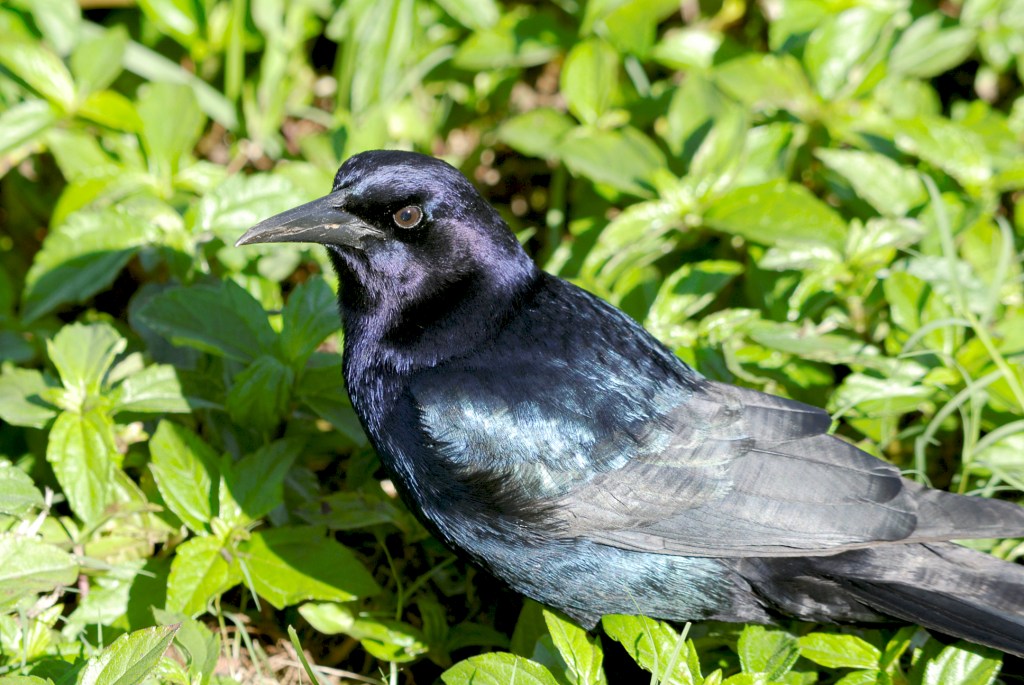
Common Grackle (Quiscalus quiscula quiscula) – Purple Form By Dan’sPix
*
Birds Illustrated by Color Photography – Revisited
The above article is an article in the monthly serial for October 1897 “designed to promote Knowledge of Bird-Live.” These include Color Photography, as they call them, today they are drawings. There are at least three Volumes that have been digitized by Project Gutenberg.
To see the whole series of – Birds Illustrated by Color Photography – Revisited
*
(Information from Wikipedia and other internet sources, with editing)
Next Article – The Ring-necked Pheasant
The Previous Article – The Verdin
Links:
Common Grackle – All About Birds
Common Grackle – Wikipedia
Common Grackle – National Geographic
Common Grackle – IBC Video
Common Grackle – xeno-canto
Icteridae – Oropendolas, Orioles & Blackbirds Family
*

Verdin (Auriparus flaviceps) for Birds Illustrated
From col. F. M. Woodruff. Copyrighted by
Nature Study Pub. Co., 1897, Chicago.
Verdin (Auriparus flaviceps) for Birds Illustrated
From col. F. M. Woodruff. Copyrighted by
Nature Study Pub. Co., 1897, Chicago.

DAINTY little creature indeed is the Yellow-headed Bush Tit, or Verdin, being smaller than the largest North American Humming Bird, which inhabits southern Arizona and southward. It is a common bird in suitable localities throughout the arid regions of Northern Mexico, the southern portions of Texas, Arizona, New Mexico, and in Lower California. In spite of its diminutive size it builds a remarkable structure for a nest—large and bulky, and a marvel of bird architecture. Davie says it is comparatively easy to find, being built near the ends of the branches of some low, thorny tree or shrub, and in the numerous varieties of cacti and thorny bushes which grow in the regions of its home.
The nest is globular, flask-shaped or retort shape in form, the outside being one mass of thorny twigs and stems interwoven, while the middle is composed of flower-stems and the lining is of feathers. The entrance is a small circular opening. Mr. Atwater says that the birds occupy the nests during the winter months. They are generally found nesting in the high, dry parts of the country, away from tall timber, where the thorns are the thickest. From three to six eggs are laid, of a bluish or greenish-white or pale blue, speckled, chiefly round the larger end, with reddish brown.

Verdin (Auriparus flaviceps) ©WikiC
“The woods were made for the hunters of dreams,
The brooks for the fishers of song.
To the hunters who hunt for the gunless game
The woods and the streams belong.
There are thoughts that moan from the soul of the pine,
And thoughts in the flower-bell curled,
And the thoughts that are blown from the scent of the fern
Are as new and as old as the world.”
*
Summary:
VERDIN.—Auriparus flaviceps. Other name: “Yellow-headed Bush Tit.”
Range—Northern regions of Mexico and contiguous portions of the United States, from southern Texas to Arizona and Lower California.
Nest—Globular, the outside being one mass of thorny twigs and stems interwoven, and lined with feathers.
Eggs—Three to six, of a bluish or greenish white color, speckled with reddish brown.

Verdin (Auriparus flaviceps) by Daves BirdingPix
Lee’s Addition:
but when it is sown, it grows up and becomes greater than all herbs, and shoots out large branches, so that the birds of the air may nest under its shade.” (Mar 4:32 NKJV)
Verdins are in the Remizidae – Penduline Tits Family which only has 12 members. The Verdin (Auriparus flaviceps) is a species of penduline tit. It is the only species in the genus Auriparus, and the only species in the family to be found in the New World.
The Verdin is a very small bird. At 4.5 inches in length, it rivals the American Bushtit as one of the smallest passerines in North America. It is gray overall, and adults have a bright yellow head and rufous “shoulder patch” (the lesser coverts). Unlike the tits, it has a sharply pointed bill.
Verdins are insectivorous, continuously foraging among the desert trees and scrubs. They are usually solitary except when they pair up to construct their conspicuous nests. Verdins occasionally try to obtain tidbits of dried sugar-water from hummingbird feeders.
Verdins are permanent residents of the southwestern United States and northern Mexico, ranging from southeastern California to Texas, throughout Baja California and into central Mexico, north of the Trans-Mexican Volcanic Belt.
The common name of the family reflects the tendency of most species to construct elaborate pear-shaped nests. These nests are woven from spiderweb, wool and animal hair and soft plant materials and is suspended from twigs and branches in trees. The nests of the African genus Anthoscopus are even more elaborate than the Eurasian Remiz, incorporating a false entrance above the true entrance which leads to a false chamber. The true nesting chamber is accessed by the parent opening a hidden flap, entering and then closing the flap shut again, the two sides sealing with sticky spider webs.
Verdins are known to build two types of nest; one for raising chicks and one for the winter, which has thicker insulation. A nest built in the summer has the opening toward the prevailing winds.
Following are a series of photos showing Verdins working on their nests. (From Verdin and Nest Photographs and Sound Recording @Earle Robinson)

Verdin (Auriparus flaviceps) Building Nest ©Earle Robinson
*

Verdin (Auriparus flaviceps) Building Nest ©Earle Robinson
*

Verdin (Auriparus flaviceps) Building Nest ©Earle Robinson
(Wikipedia and other internet sources)
*
Birds Illustrated by Color Photography – Revisited
The above article is an article in the monthly serial for October 1897 “designed to promote Knowledge of Bird-Live.” These include Color Photography, as they call them, today they are drawings. There are at least three Volumes that have been digitized by Project Gutenberg.
To see the whole series of – Birds Illustrated by Color Photography – Revisited
*
(Information from Wikipedia and other internet sources, with editing)
Next Article – The Bronzed Grackle
The Previous Article – The American Flamingo
Links:
*

(Gen 1:21) So God created great sea creatures and every living thing that moves, with which the waters abounded, according to their kind, and every winged bird according to its kind. And God saw that it was good.

American Flamingo (Phoenicopterus ruber) for Birds Illustrated
From col. Chi. Acad. Sciences. Copyrighted by
Nature Study Pub. Co., 1897, Chicago.
American Flamingo (Phoenicopterus ruber) for Birds Illustrated
From col. Chi. Acad. Sciences. Copyrighted by
Nature Study Pub. Co., 1897, Chicago.

N this interesting family of birds are included seven species, distributed throughout the tropics. Five species are American, of which one reaches our southern border in Florida. Chapman says that they are gregarious at all seasons, are rarely found far from the seacoasts, and their favorite resorts are shallow bays or vast mud flats which are flooded at high water. In feeding the bill is pressed downward into the mud, its peculiar shape making the point turn upward. The ridges along its sides serve as strainers through which are forced the sand and mud taken in with the food.
The Flamingo is resident in the United States only in the vicinity of Cape Sable, Florida, where flocks of sometimes a thousand of these rosy vermillion creatures are seen. A wonderful sight indeed. Mr. D. P. Ingraham spent more or less of his time for four seasons in the West Indies among them. He states that the birds inhabit the shallow lagoons and bays having soft clayey bottoms. On the border of these the nest is made by working the clay up into a mound which, in the first season, is perhaps not more than a foot high and about eight inches in diameter at the top and fifteen inches at the base. If the birds are unmolested they will return to the same nesting place from year to year, each season augmenting the nest by the addition of mud at the top, leaving a slight depression for the eggs. He speaks of visiting the nesting grounds where the birds had nested the previous year and their mound-like nests were still standing. The bird’s nest in June. The number of eggs is usually two, sometimes only one and rarely three. When three are found in a nest it is generally believed that the third has been laid by another female.
The stature of this remarkable bird is nearly five feet, and it weighs in the flesh six or eight pounds. On the nest the birds sit with their long legs doubled under them. The old story of the Flamingo bestriding its nest in an ungainly attitude while sitting is an absurd fiction.
The eggs are elongate-ovate in shape, with a thick shell, roughened with a white flakey substance, but bluish when this is scraped off. It requires thirty-two days for the eggs to hatch.
The very fine specimen we present in Birds represents the Flamingo feeding, the upper surface of the unique bill, which is abruptly bent in the middle, facing the ground.
*
Summary:
AMERICAN FLAMINGO.—Phœnicopterus ruber.
Range—Atlantic coasts of sub-tropical and tropical America; Florida Keys.
Nest—Mass of earth, sticks, and other material scooped up to the height of several feet and hollow at the top.
Eggs—One or two, elongate-ovate in shape, with thick shell, roughened with a white flakey substance, but bluish when this is scraped off.

American Flamingos Many With Foot Up by Lee at Gatorland
Lee’s Addition:
Honor and majesty are before Him; strength and beauty are in His sanctuary. (Psalms 96:6 AMP)
The American Flamingo is a member of the Phoenicopteridae – Flamingos Family which has six (6) species. We were just at Gatorland, in Orlando, today and were able to see and photograph some American Flamingos. (The photos are today’s – Forgot that this next article was about the Flamingo, so these were very handy.)
The American Flamingo (Phoenicopterus ruber) is a large species of flamingo closely related to the Greater Flamingo and Chilean Flamingo. It was formerly considered conspecific with the Greater Flamingo, but that treatment is now widely viewed as incorrect due to a lack of evidence. It has also been known as the Caribbean Flamingo, but the species’ presence in the Galápagos makes that name problematic. It is the only flamingo which naturally inhabits North America.
Adult American Flamingoes are smaller on average than Greater Flamingoes but are the largest flamingoes in the Americas. They measure from 47 to 57 in (120 to 145 cm) tall. The males weigh an average of 6.2 lb (2.8 kg), while females average 4.9 lb (2.2 kg). Most of its plumage is pink, giving rise to its earlier name of Rosy Flamingo and differentiating adults from the much paler Greater Flamingo. The wing coverts are red, and the primary and secondary flight feathers are black. The bill is pink and white with a restricted black tip, and the legs are entirely pink. The call is a goose-like honking.

American Flamingos with foot up at Gatorland
Flamingos often stand on one leg, the other tucked beneath the body. The reason for this behavior is not fully understood. Recent research indicates that standing on one leg may allow the birds to conserve more body heat, given that they spend a significant amount of time wading in cold water. However, the behaviour also takes place in warm water. As well as standing in the water, flamingos may stamp their webbed feet in the mud to stir up food from the bottom. (It definitely was warm today-95 degrees)
Young flamingos hatch with greyish reddish plumage, but adults range from light pink to bright red due to aqueous bacteria and beta-Carotene obtained from their food supply. A well-fed, healthy flamingo is more vibrantly coloured and thus a more desirable mate; a white or pale flamingo, however, is usually unhealthy or malnourished. Captive flamingos are a notable exception; many turn a pale pink as they are not fed carotene at levels comparable to the wild.

American Flamingo Beak at Gatorland by Lee
Flamingos filter-feed on brine shrimp and blue-green algae. Their beaks are specially adapted to separate mud and silt from the food they eat, and are uniquely used upside-down. The filtering of food items is assisted by hairy structures called lamellae which line the mandibles, and the large rough-surfaced tongue.

American Flamingo Beak cropped
*
Birds Illustrated by Color Photography – Revisited
The above article is an article in the monthly serial for October 1897 “designed to promote Knowledge of Bird-Live.” These include Color Photography, as they call them, today they are drawings. There are at least three Volumes that have been digitized by Project Gutenberg.
To see the whole series of – Birds Illustrated by Color Photography – Revisited
*
(Information from Wikipedia and other internet sources, with editing)
Next Article – The Verdin
The Previous Article – The Black Grouse
Links:
*

Pileated Woodpecker at Circle B by Lee
But you are to cling to the LORD your God, as you have done to this day. (Joshua 23:8 NASB)

Black Grouse (Lyrurus tetrix) for Birds Illustrated
From col. C. E. Petford. Copyrighted by
Nature Study Pub. Co., 1897, Chicago.
Alone on English moors I’ve seen the Black Cock stray,
Sounding his earnest love-note on the air.
—Anon.

ELL known as the Black Cock is supposed to be, we fancy few of our readers have ever seen a specimen. It is a native of the more southern countries of Europe, and still survives in many portions of the British Islands, especially those localities where the pine woods and heaths afford it shelter, and it is not driven away by the presence of human habitation.
The male bird is known to resort at the beginning of the nesting season to some open spot, where he utters his love calls, and displays his new dress to the greatest advantage, for the purpose of attracting as many females as may be willing to consort with him. His note when thus engaged is loud and resonant, and can be heard at a considerable distance. This crowing sound is accompanied by a harsh, grating, stridulous kind of cry which has been compared to the noise produced by whetting a scythe. The Black Cock does not pair, but leaves his numerous mates to the duties of maternity and follows his own desires while they prepare their nests, lay their eggs, hatch them, and bring up the young. The mother bird, however, is a fond, watchful parent, and when she has been alarmed by man or a prowling beast, has been known to remove her eggs to some other locality, where she thinks they will not be discovered.
The nest is carelessly made of grasses and stout herbage, on the ground, under the shelter of grass and bushes. There are from six to ten eggs of yellowish gray, with spots of light brown. The young are fed first upon insects, and afterwards on berries, grain, and the buds and shoots of trees.
The Black Grouse is a wild and wary creature. The old male which has survived a season or two is particularly shy and crafty, distrusting both man and dog, and running away as soon as he is made aware of approaching danger.
In the autumn the young males separate themselves from the other sex and form a number of little bachelor establishments of their own, living together in harmony until the next nesting season, when they all begin to fall in love; “the apple of discord is thrown among them by the charms of the hitherto repudiated sex, and their rivalries lead them into determined and continual battles, which do not cease until the end of the season restores them to peace and sobriety.”
The coloring of the female is quite different from that of the male Grouse. Her general color is brown, with a tinge of orange, barred with black and speckled with the same hue, the spots and bars being larger on the breast, back, and wings, and the feathers on the breast more or less edged with white. The total length of the adult male is about twenty-two inches, and that of the female from seventeen to eighteen inches. She also weighs nearly one-third less than her mate, and is popularly termed the Heath Hen.
*
Summary:
BLACK GROUSE.—Tetrao tetrix. Other name: “Black Cock.” (or Lyrurus tetrix)
Range—Southern Europe and the British Islands.
Nest—Carelessly made, of grasses and stout herbage, on the ground.
Eggs—Six to ten, of yellowish gray, with spots of light brown.

Black Grouse (Lyrurus tetrix) Cock ©WikiC
Lee’s Addition:
Like the partridge that gathers a brood which she did not hatch and sits on eggs which she has not laid, so is he who gets riches by unjust means and not by right. He will leave them, or they will leave him, in the midst of his days, and at his end he will be a fool. (Jeremiah 17:11 AMP)
The Black Grouse (Tetrao tetrix or Lyrurus tetrix) is a member of the Phasianidae – Pheasants, Fowl & Allies Family. There are twelve Grouse in the family of Turkeys, Partridges, Ptarmigans, Snowcocks, Francolins, Quail, Tragopans, Pheasants and even Peafowl in that family along with a few others. A total of 182 species are found in the Phasianidae Family.
(From Wikipedia with editing) – The Black Grouse or Blackgame (Tetrao tetrix) is a large game bird in the grouse family. It is a sedentary species, breeding across northern Eurasia in moorland and bog areas near to woodland, mostly boreal. The Black Grouse is closely related to the Caucasian Grouse.
The female is greyish-brown and has a cackling call. She takes all responsibility for nesting and caring for the chicks, as is typical with gamebirds.

Black Grouse (Lyrurus tetrix) Egg ©WikiC
The Black Grouse is one of the many species first described in the 10th edition of Systema Naturae in 1758 by Carl Linnaeus, and still bears its original binomial name. Both Tetrao and tetrix come from Ancient Greek words referring to some form of game bird.
The male and female are sometimes referred to by their folk names, Blackcock and Greyhen respectively. These names first occur in the literature with John Ray in 1674. Heathcock and Heathhen are also common names.
Black Grouse is a large bird with males being around 21 in (53 cm) long and weighing 2.2–3.2 lb (1,000–1,450 grams) and females approximately 16 in (40 cm) and weighing 1.7–2.4 lb (750–1,110 grams). The cock is very distinctive, with black plumage, apart from red wattles and a white wingbar, and a lyre-shaped tail, which appears forked in flight. His song is loud, bubbling and somewhat dove-like.
Black Grouse can be found across Europe (Swiss-Italian-French Alps specially) from Great Britain (but not Ireland) through Scandinavia and Estonia into Russia. In Eastern Europe they can be found in Hungary, Latvia, Lithuania, Poland, Belarus, Romania and Ukraine. There is a population in the Alps, and isolated remnants in Germany, France, Belgium and the Netherlands. It formerly occurred in Denmark, but the Danish Ornithological Society (DOF) has considered it extinct since 2001.
Black grouse have a very distinctive and well-recorded courtship ritual or game. At dawn in the spring, the males strut around in a traditional area and display whilst making a highly distinctive mating call. This process is called a lek – the grouse are said to be lekking. In western Europe these gatherings seldom involve more than 40 birds; in Russia 150 is not uncommon and 200 have been recorded.
The tails of black-cocks have, since late Victorian times, been popular adornments for hats worn with Highland Dress. Most commonly associated with Glengarry and Balmoral or Tam O’Shanter caps, they still continue to be worn by pipers of civilian and military pipe bands. Since 1904, all ranks of the Royal Scots and King’s Own Scottish Borderers have worn them in their full-dress headgear and that tradition is carried on in the dress glengarries of the current Scottish-super regiment, The Royal Regiment of Scotland.
*
Birds Illustrated by Color Photography – Revisited
The above article is an article in the monthly serial for October 1897 “designed to promote Knowledge of Bird-Live.” These include Color Photography, as they call them, today they are drawings. There are at least three Volumes that have been digitized by Project Gutenberg.
To see the whole series of – Birds Illustrated by Color Photography – Revisited
*
(Information from Wikipedia and other internet sources, with editing)
Next Article – The American Flamingo
The Previous Article – The Green-winged Teal
Links:
*

Green-winged Teal (Anas carolinensis) for Birds Illustrated


 Birds of the Bible For Kids