

Child’s Book of Water Birds – Book Cover

Black Grouse (Lyrurus tetrix) for Birds Illustrated
From col. C. E. Petford. Copyrighted by
Nature Study Pub. Co., 1897, Chicago.
Alone on English moors I’ve seen the Black Cock stray,
Sounding his earnest love-note on the air.
—Anon.

ELL known as the Black Cock is supposed to be, we fancy few of our readers have ever seen a specimen. It is a native of the more southern countries of Europe, and still survives in many portions of the British Islands, especially those localities where the pine woods and heaths afford it shelter, and it is not driven away by the presence of human habitation.
The male bird is known to resort at the beginning of the nesting season to some open spot, where he utters his love calls, and displays his new dress to the greatest advantage, for the purpose of attracting as many females as may be willing to consort with him. His note when thus engaged is loud and resonant, and can be heard at a considerable distance. This crowing sound is accompanied by a harsh, grating, stridulous kind of cry which has been compared to the noise produced by whetting a scythe. The Black Cock does not pair, but leaves his numerous mates to the duties of maternity and follows his own desires while they prepare their nests, lay their eggs, hatch them, and bring up the young. The mother bird, however, is a fond, watchful parent, and when she has been alarmed by man or a prowling beast, has been known to remove her eggs to some other locality, where she thinks they will not be discovered.
The nest is carelessly made of grasses and stout herbage, on the ground, under the shelter of grass and bushes. There are from six to ten eggs of yellowish gray, with spots of light brown. The young are fed first upon insects, and afterwards on berries, grain, and the buds and shoots of trees.
The Black Grouse is a wild and wary creature. The old male which has survived a season or two is particularly shy and crafty, distrusting both man and dog, and running away as soon as he is made aware of approaching danger.
In the autumn the young males separate themselves from the other sex and form a number of little bachelor establishments of their own, living together in harmony until the next nesting season, when they all begin to fall in love; “the apple of discord is thrown among them by the charms of the hitherto repudiated sex, and their rivalries lead them into determined and continual battles, which do not cease until the end of the season restores them to peace and sobriety.”
The coloring of the female is quite different from that of the male Grouse. Her general color is brown, with a tinge of orange, barred with black and speckled with the same hue, the spots and bars being larger on the breast, back, and wings, and the feathers on the breast more or less edged with white. The total length of the adult male is about twenty-two inches, and that of the female from seventeen to eighteen inches. She also weighs nearly one-third less than her mate, and is popularly termed the Heath Hen.
*
Summary:
BLACK GROUSE.—Tetrao tetrix. Other name: “Black Cock.” (or Lyrurus tetrix)
Range—Southern Europe and the British Islands.
Nest—Carelessly made, of grasses and stout herbage, on the ground.
Eggs—Six to ten, of yellowish gray, with spots of light brown.

Black Grouse (Lyrurus tetrix) Cock ©WikiC
Lee’s Addition:
Like the partridge that gathers a brood which she did not hatch and sits on eggs which she has not laid, so is he who gets riches by unjust means and not by right. He will leave them, or they will leave him, in the midst of his days, and at his end he will be a fool. (Jeremiah 17:11 AMP)
The Black Grouse (Tetrao tetrix or Lyrurus tetrix) is a member of the Phasianidae – Pheasants, Fowl & Allies Family. There are twelve Grouse in the family of Turkeys, Partridges, Ptarmigans, Snowcocks, Francolins, Quail, Tragopans, Pheasants and even Peafowl in that family along with a few others. A total of 182 species are found in the Phasianidae Family.
(From Wikipedia with editing) – The Black Grouse or Blackgame (Tetrao tetrix) is a large game bird in the grouse family. It is a sedentary species, breeding across northern Eurasia in moorland and bog areas near to woodland, mostly boreal. The Black Grouse is closely related to the Caucasian Grouse.
The female is greyish-brown and has a cackling call. She takes all responsibility for nesting and caring for the chicks, as is typical with gamebirds.

Black Grouse (Lyrurus tetrix) Egg ©WikiC
The Black Grouse is one of the many species first described in the 10th edition of Systema Naturae in 1758 by Carl Linnaeus, and still bears its original binomial name. Both Tetrao and tetrix come from Ancient Greek words referring to some form of game bird.
The male and female are sometimes referred to by their folk names, Blackcock and Greyhen respectively. These names first occur in the literature with John Ray in 1674. Heathcock and Heathhen are also common names.
Black Grouse is a large bird with males being around 21 in (53 cm) long and weighing 2.2–3.2 lb (1,000–1,450 grams) and females approximately 16 in (40 cm) and weighing 1.7–2.4 lb (750–1,110 grams). The cock is very distinctive, with black plumage, apart from red wattles and a white wingbar, and a lyre-shaped tail, which appears forked in flight. His song is loud, bubbling and somewhat dove-like.
Black Grouse can be found across Europe (Swiss-Italian-French Alps specially) from Great Britain (but not Ireland) through Scandinavia and Estonia into Russia. In Eastern Europe they can be found in Hungary, Latvia, Lithuania, Poland, Belarus, Romania and Ukraine. There is a population in the Alps, and isolated remnants in Germany, France, Belgium and the Netherlands. It formerly occurred in Denmark, but the Danish Ornithological Society (DOF) has considered it extinct since 2001.
Black grouse have a very distinctive and well-recorded courtship ritual or game. At dawn in the spring, the males strut around in a traditional area and display whilst making a highly distinctive mating call. This process is called a lek – the grouse are said to be lekking. In western Europe these gatherings seldom involve more than 40 birds; in Russia 150 is not uncommon and 200 have been recorded.
The tails of black-cocks have, since late Victorian times, been popular adornments for hats worn with Highland Dress. Most commonly associated with Glengarry and Balmoral or Tam O’Shanter caps, they still continue to be worn by pipers of civilian and military pipe bands. Since 1904, all ranks of the Royal Scots and King’s Own Scottish Borderers have worn them in their full-dress headgear and that tradition is carried on in the dress glengarries of the current Scottish-super regiment, The Royal Regiment of Scotland.
*
Birds Illustrated by Color Photography – Revisited
The above article is an article in the monthly serial for October 1897 “designed to promote Knowledge of Bird-Live.” These include Color Photography, as they call them, today they are drawings. There are at least three Volumes that have been digitized by Project Gutenberg.
To see the whole series of – Birds Illustrated by Color Photography – Revisited
*
(Information from Wikipedia and other internet sources, with editing)
Next Article – The American Flamingo
The Previous Article – The Green-winged Teal
Links:
*

Allen’s Hummingbird (Selasphorus sasin) for Birds Illustrated
Allens Humming Bird.
From col. F. M. Woodruff. Copyrighted by
Nature Study Pub. Co., 1897, Chicago.

HE Humming birds, with their varied beauties, constitute the most remarkable feature of the bird-life of America. They have absolutely no representatives in any other part of the world, the Swifts being the nearest relatives they have in other countries. Mr. Forbes says that they abound most in mountainous countries, where the surface and productions of the soil are most diversified within small areas. They frequent both open and rare and inaccessible places, and are often found on the snowy peaks of Chimborazo as high as 16,000 feet, and in the very lowest valleys in the primeval forests of Brazil, the vast palm-covered districts of the deltas of the Amazon and Orinoco, the fertile flats and savannahs of Demarara, the luxurious and beautiful region of Xalapa, (the realm of perpetual sunshine), and other parts of Mexico. Many of the highest cones of extinct and existing volcanoes have also furnished great numbers of rare species.
These birds are found as small as a bumble bee and as large as a Sparrow. The smallest is from Jamaica, the largest from Patagonia.
Allen’s Hummer is found on the Pacific coast, north to British Columbia, east to southern Arizona.
Mr. Langille, in “Our Birds in their Haunts,” beautifully describes their flights and manner of feeding. He says “There are many birds the flight of which is so rapid that the strokes of their wings cannot be counted, but here is a species with such nerve of wing that its wing strokes cannot be seen. ‘A hazy semi-circle of indistinctness on each side of the bird is all that is perceptible.’ Poised in the air, his body nearly perpendicular, he seems to hang in front of the flowers which he probes so hurriedly, one after the other, with his long, slender bill. That long, tubular, fork-shaped tongue may be sucking up the nectar from those rather small cylindrical blossoms, or it may be capturing tiny insects housed away there. Much more like a large sphynx moth hovering and humming over the flowers in the dusky twilight, than like a bird, appears this delicate, fairy-like beauty. How the bright green of the body gleams and glistens in the sunlight. Each imperceptible stroke of those tiny wings conforms to the mechanical laws of flight in all their subtle complications with an ease and gracefulness that seems spiritual. Who can fail to note that fine adjustment of the organs of flight to aerial elasticity and gravitation, by which that astonishing bit of nervous energy can rise and fall almost on the perpendicular, dart from side to side, as if by magic, or, assuming the horizontal position, pass out of sight like a shooting star? Is it not impossible to conceive of all this being done by that rational calculation which enables the rower to row, or the sailor to sail his boat?”
“What heavenly tints in mingling radiance fly,
Each rapid movement gives a different dye;
Like scales of burnished gold they dazzling show,
Now sink to shade, now like a furnace glow.”
*
Summary:
ALLEN’S HUMMING BIRD.—Selasphorus alleni.
Range—Pacific coast, north to British Columbia, east to southern Arizona.
Nest—Plant down, covered with lichens.
Eggs—Two, white.

Allen’s Hummingbird (Selasphorus sasin) ©USFWS
Lee’s Addition:
I know and am acquainted with all the birds of the mountains, and the wild animals of the field are Mine and are with Me, in My mind. (Psalms 50:11 AMP)
Deck thyself now with majesty and excellency; and array thyself with glory and beauty. (Job 40:10 KJV)
Hummingbirds are very special to me and this Allen’s Hummingbird is no exception. I am always amazed at how the Lord created all these fantastic birds. They are so small, compared to most other birds. There little feet are a delight to see. They belong to the Trochilidae – Hummingbirds Family which has 341 species currently.
The Allen’s Hummingbird (Selasphorus sasin) is a species of hummingbird. The Allen’s Hummingbird is a small bird, with mature adults reaching only 3 to 3½ inches (75 to 90 mm) in length. The male Allen’s has a green back and forehead, with rust-colored rufous flanks, rump, and tail. The male’s throat is also an iridescent orange-red. The female and immature Allen’s Hummingbirds are similarly colored, but lack the iridescent throat patch, instead having a series of speckles on their throat. Females are mostly green, featuring rufous colors only on the tail, which also has white tips. The immature Allen’s Hummingbirds are so similar to the female Rufous Hummingbird that the two are almost indistinguishable in the field. Both species’ breeding seasons and ranges are common factors used to differentiate between the two species in a particular geographical area. They belong to the Trochilidae – Hummingbirds Family which has 341 species currently.

Allen’s Hummingbird (Selasphorus sasin) at flower ©WikiC
The Allen’s Hummingbird is common only in the brushy woods, gardens, and meadows of coastal California from Santa Barbara north, and a minuscule portion of lower Oregon. The nominate race of Allen’s Hummingbird is migratory, and winters along the Pacific coast of central Mexico. A second race is a permanent resident on the Channel Islands off southern California. (“It has a longer wing, tail, and bill“) This population colonized the Palos Verdes Peninsula of Los Angeles County in the 1960s and has since spread over much of Los Angeles and Orange Counties.
The courtship flight of the male Allen’s Hummingbird is a frantic back and forth flight arc of about 25 feet (7.5 m) similar to the motion of a swinging pendulum, followed by a high-speed dive from about 100 feet (30 m). The male is also highly aggressive and territorial. Hot-tempered despite its diminutive stature, a male Allen’s Hummingbird will chase any other males from its territory, as well as any other hummingbird species, and they have even been known to attack and rout predatory birds several times larger than themselves such as kestrels and hawks.
The Allen’s Hummingbird constructs its nest out of plant fibers, down, and weed stems, coating the nest with lichens to give it structure. The nest is placed above ground on a tree branch or the stalk or stem of a plant. The female lays two white eggs, which she will incubate for 15 to 17 days. The young will leave the nest about three weeks after hatching. The mother will continue to feed the fledglings for several more weeks, then the young are left to fend for themselves.

Allen’s Hummingbird (Selasphorus sasin) ©WikiC
*
Birds Illustrated by Color Photography – Revisited
The above article is an article in the monthly serial for October 1897 “designed to promote Knowledge of Bird-Live.” These include Color Photography, as they call them, today they are drawings. There are at least three Volumes that have been digitized by Project Gutenberg.
To see the whole series of – Birds Illustrated by Color Photography – Revisited
*
(Information from Wikipedia and other internet sources, with editing)
Next Article – The Green-winged Teal
The Previous Article – The English Sparrow
Links:
Allen’s Hummingbird – Wikipedia
Allen’s Hummingbird – All About Birds
Allen’s Hummingbird – Hummingbirds Net
Allen’s Hummingbird – WhatBird
*

Mountain Bluebird (Sialia currucoides) for Birds Illustrated
From col. Chi. Acad. Sciences. Copyrighted by
Nature Study Pub. Co., 1897, Chicago.

N an early number of Birds we presented a picture of the common Bluebird, which has been much admired. The mountain Bluebird, whose beauty is thought to excel that of his cousin, is probably known to few of our readers who live east of the Rocky Mountain region, though he is a common winter sojourner in the western part of Kansas, beginning to arrive there the last of September, and leaving in March and April. The habits of these birds of the central regions are very similar to those of the eastern, but more wary and silent. Even their love song is said to be less loud and musical. It is a rather feeble, plaintive, monotonous warble, and their chirp and twittering notes are weak. They subsist upon the cedar berries, seeds of plants, grasshoppers, beetles, and the like, which they pick up largely upon the ground, and occasionally scratch for among the leaves. During the fall and winter they visit the plains and valleys, and are usually met with in small flocks, until the mating season.
Nests of the Mountain Bluebird have been found in New Mexico and Colorado, from the foothills to near timber line, usually in deserted Woodpecker holes, natural cavities in trees, fissures in the sides of steep rocky cliffs, and, in the settlements, in suitable locations about and in the adobe buildings. In settled portions of the west it nests in the cornice of buildings, under the eaves of porches, in the nooks and corners of barns and outhouses, and in boxes provided for its occupation. Prof. Ridgway found the Rocky Mountain Bluebird nesting in Virginia City, Nevada, in June. The nests were composed almost entirely of dry grass. In some sections, however, the inner bark of the cedar enters largely into their composition. The eggs are usually five, of a pale greenish-blue.
The females of this species are distinguished by a greener blue color and longer wings, and this bird is often called the Arctic Bluebird. It is emphatically a bird of the mountains, its visits to the lower portions of the country being mainly during winter.
Heaped in the hollows of the grove, the autumn leaves lie dead;
They rustle to the eddying gust, and to the rabbits’ tread.
The Robin and the Wren are flown, and from the shrubs the Jay,
And from the wood-top calls the Crow all through the gloomy day.
—Bryant.
Summary:
MOUNTAIN BLUEBIRD.—Sialia arctica. Other names: “Rocky Mountain” and “Arctic Bluebird.”
Range—Rocky Mountain region, north to Great Slave Lake, south to Mexico, west to the higher mountain ranges along the Pacific.
Nest—Placed in deserted Woodpecker holes, natural cavities of trees, nooks and corners of barns and outhouses; composed of dry grass.
Eggs—Commonly five, of pale, plain greenish blue.

Mountain Bluebird (Sialia currucoides) by Daves BirdingPix
Lee’s Addition:
…In the LORD put I my trust: how say ye to my soul, Flee as a bird to your mountain? … If the foundations be destroyed, what can the righteous do? The LORD is in his holy temple, the LORD’S throne is in heaven: his eyes behold, his eyelids try, the children of men. … For the righteous LORD loveth righteousness; his countenance doth behold the upright.
(Psalms 11:1,3,4,7 KJV)
The Mountain Bluebird belongs to the Turdidae – Thrushes Family and as such have Thrush characteristics. Since blue is my favorite color, the bluebirds are some of my favorites. The Lord has used such variety in His coloration, that I am happy that blue was one of them. We have also the Eastern and Western Bluebirds plus the Asian and Philippine Fairy-bluebirds.
The Mountain Bluebird (Sialia currucoides) is a medium-sized bird weighing about 1.1 ounces (30 g) with a length from 6.3–7.9 in (16–20 cm). They have light underbellies and black eyes. Adult males have thin bills that are bright turquoise-blue and somewhat lighter beneath. Adult females have duller blue wings and tail, grey breast, grey crown, throat and back. In fresh fall plumage, the female’s throat and breast are tinged with red-orange; brownish near the flank contrasting with white tail underparts. Call is a thin few; Song is warbled high chur chur.
The mountain bluebird is migratory. Their range varies from Mexico in the winter to as far north as Alaska, throughout the western U.S. and Canada. Northern birds migrate to the southern parts of the range; southern birds are often permanent residents. Some birds may move to lower elevations in winter. They inhabit open rangelands, meadows, generally at elevations above 5,000 feet. Contrary to popular belief, mountain bluebirds are not a species of concern in the United States. The turn around in mountain bluebird numbers is due to the overwhelming efforts of landowners in the West to provide nest boxes for these birds. At one time, mountain bluebird numbers were threatened because of increased agricultural activities destroying habitats.
These birds hover over the ground and fly down to catch insects, also flying from a perch to catch them. They mainly eat insects, over 90%, and berries. They may forage in flocks in winter, when they mainly eat grasshoppers. Mountain bluebirds will come to a platform feeder with live meal worms, berries, or peanuts.

Mountain Bluebird (Sialia currucoides) by Ian Montgomery nest
Their breeding habitat is open country across western North America, including mountain areas, as far north as Alaska. They nest in pre-existing cavities or in nest boxes. In remote areas, these birds are less affected by competition for natural nesting locations than other bluebirds. Mountain bluebirds are a monogamous breed. The male can be seen singing from bare branches. The singing takes place right at dawn, just when the sun rises. Females usually build the nests themselves. Eggs: pale blue and unmarked, sometimes white. Clutch Size: 4-5 eggs. Young are naked and helpless at hatching and may have some down. Incubation normally last 14 days and the young will take about 21 days before they leave the nest. Both males and females fiercely protect the nest.
It is the state bird of Idaho and Nevada.
Mountain bluebirds are cavity nesters and can become very partial to a nest box, especially if they have successfully raised a clutch. They may even re-use the same nest, though not always. Providing nest boxes is a great way to observe these beautiful birds. Mountain bluebirds will not abandon a nest if human activity is detected close by or at the nest. Because of this, mountain bluebirds can be easily banded while they are still in the nest.

Mountain Bluebird (Sialia currucoides) by Margaret Sloan
*

Mountain Bluebird (Sialia currucoides) by Ian Montgomery
Birds Illustrated by Color Photography – Revisited
The above article is an article in the monthly serial for October 1897 “designed to promote Knowledge of Bird-Live.” These include Color Photography, as they call them, today they are drawings. There are at least three Volumes that have been digitized by Project Gutenberg.
To see the whole series of – Birds Illustrated by Color Photography – Revisited
*
(Information from Wikipedia and other internet sources, with editing)
Next Article – The English Sparrow
The Previous Article – The Ornithological Congress
Links:
*

Autumn Bird ©Flickr by YlvaS
Red and yellow, green and brown,
Leaves are whirling, rustling down;
Acorn babes in their cradles lie,
Through the bare trees the brown birds fly;
The Robin chirps as he flutters past—
November days have come at last.
—Clara Louise Strong.
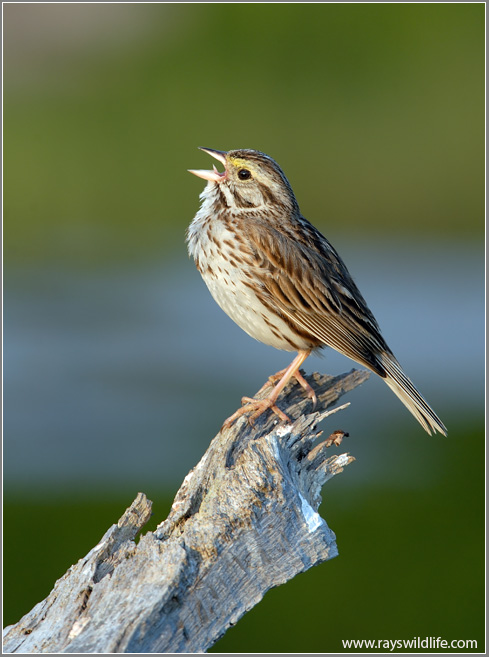
Savannah Sparrow singing by Ray
“I have watched birds at their singing under many and widely differing circumstances, and I am sure that they express joyous anticipation, present content, and pleasant recollection, each as the mood moves, and with equal ease.”
—M. Thompson.
“The act of singing is evidently a pleasurable one; and it probably serves as an outlet for superabundant nervous energy and excitement, just as dancing, singing, and field sports do with us.”
—A. R. Wallace.
“The bird upon the tree utters the meaning of the wind—a voice of the grass and wild flower, words of the green leaf; they speak through that slender tone. Sweetness of dew and rifts of sunshine, the dark hawthorn touched with breadths of open bud, the odor of the air, the color of the daffodil—all that is delicious and beloved of spring-time are expressed in his song.”
—Richard Jefferies.

White-throated Sparrow (Zonotrichia albicollis) by Anthony
Pallid, wan-faced clouds
Press close to the frozen pines,
And follow the jagged lines
Of fence, that the sleet enshrouds.
Sharp in the face of the sky,
Gaunt, thin-ribbed leaves are blown;
They rise with a shuddering moan,
Then sink in the snow and die.
At the edge of the wood a vine
Still clings to the sleeping beech,
While its stiffened tendrils reach
A nest, and around it twine.
A little gray nest all alone,
With its feathery lining of snow,
Where bleak winds, piping low,
Croon a sweet minor tone.
—Nora A. Piper.
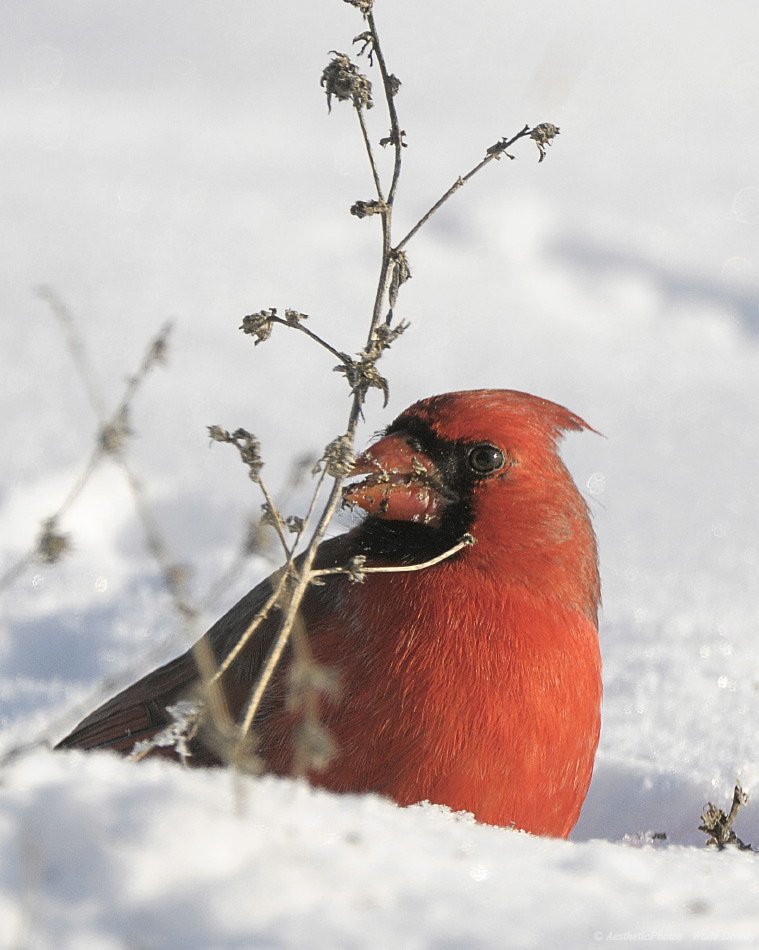
Northern Cardinal (Cardinalis cardinalis) by Aestheticphotos
Along the narrow sandy height
I watch them swiftly come and go,
Or round the leafless wood,
Like flurries of wind-driven snow,
Revolving in perpetual flight,
A changing multitude.
Nearer and nearer still they sway,
And, scattering in a circled sweep,
Rush down without a sound;
And now I see them peer and peep,
Across yon level bleak and gray,
Searching the frozen ground,—
Until a little wind upheaves,
And makes a sudden rustling there,
And then they drop their play,
Flash up into the sunless air,
And like a flight of silver leaves
Swirl round and sweep away.
Archibald Lampman.

Crane Migration over Israel
Black shadows fall
From the lindens tall,
That lift aloft their massive wall
Against the southern sky;
And from the realms
Of the shadowy elms,
A tide-like darkness overwhelms
The fields that round us lie.
But the night is fair
And everywhere
A warm, soft vapor fills the air
And distant sounds seem near;
And above, in the light
Of the star-lit night,
Swift birds of passage wing their flight
Through the dewy atmosphere.
I hear the beat
Of their pinions fleet,
As from the land of snow and sleet
They seek a southern lea.
I hear the cry
Of their voices high
Falling dreamily through the sky,
But their forms I cannot see.
—Longfellow.
Lee’s Addition:
For he saith to the snow, Be thou on the earth; likewise to the small rain, and to the great rain of his strength. (Job 37:6 KJV)
Like the cold of snow [brought from the mountains] in the time of harvest, so is a faithful messenger to those who send him; for he refreshes the life of his masters. (Proverbs 25:13 AMP)
For as the rain and snow come down from the heavens, and return not there again, but water the earth and make it bring forth and sprout, that it may give seed to the sower and bread to the eater, (Isaiah 55:10 AMP)
These are some of the articles in the Volume 2, #5, November, that really didn’t belong with any of the individual birds. I have just put them all together here. It is hard to think about this time of the year when we are in summer time, but if you live in the Southern Hemisphere, then they might be able to “think cold weather.”
This blog ends the November issue of Birds Illustrated by Color Photography, 1897. Next will be the December issue, so expect more “out of season” articles in the near future.
*
Birds Illustrated by Color Photography – Revisited
The above article is an article in the monthly serial for October 1897 “designed to promote Knowledge of Bird-Live.” These include Color Photography, as they call them, today they are drawings. There are at least three Volumes that have been digitized by Project Gutenberg.
To see the whole series of – Birds Illustrated by Color Photography – Revisited
*
(Information from Wikipedia and other internet sources, with editing)
Next Article – Vol. II, #6, Ornithologica Congress
The Previous Article – Vermilion Flycatcher Version II
Links:
*

The Yellow-billed Tropic Bird, 1897
N appearance this bird resembles a large Tern (See The Black Tern), and its habits are similar to those of the Terns. Inter-tropical, it is of a wandering disposition, breeding on the islands of mid-ocean thousands of miles apart. It is noted for its elegant, airy, and long-protracted flight. Davie says that on Bourbon, Mauritius and other islands east and south of Madagascar it breeds in the crevices of the rocks of inaccessible cliffs, and in hollow trees. In the Bermuda Islands it nests about the first of May in holes in high rocky places along the shores. Here its favorite resorts are the small islands of Great Sound, Castle Harbor, and Harrington Sound. The Phaeton, as it is felicitously called, nests in the Bahamas in holes in the perpendicular faces of cliffs and on the flat surfaces of rocks. A single egg is laid, which has a ground-color of purplish brownish white, covered in some specimens almost over the entire surface with fine reddish chocolate-colored spots.
These species compose the small but distinct family of tropic birds and are found throughout the tropical and sub-tropical regions of the world. Long journeys are made by them across the open sea, their flight when emigrating being strong, rapid, and direct, and immense distances are covered by them as they course undismayed by wind or storm. In feeding, Chapman says, they course over the water, beating back and forth at a height of about forty feet, and their long willowy tail-feathers add greatly to the grace and beauty of their appearance when on the wing. They are of rare and probably accidental occurrence on our coasts.
The Songs of Nature never cease,
Her players sue not for release
In nearer fields, on hills afar,
Attendant her musicians are:
From water brook or forest tree,
For aye comes gentle melody,
The very air is music blent—
An universal instrument.
—John Vance Cheney.
***
The people who make a study of birds say that I look like a large Tern, and that my habits are like his.
I don’t know whether that is so, I am sure, for I have no acquaintance with that bird, but you little folks can turn to your The Black Tern and see for yourselves if it is true.
For my part, I think I am the prettier of the two on account of my long, willowy tail-feathers. They add greatly, it is said, to the grace and beauty of my appearance when on the wing. Then, the color of my coat is much more beautiful than his, I think, don’t you think so, too?
We are not so common as the Terns, either, for they are very numerous. There are only three species of our family, so we consider ourselves quite distinct.
What are we noted for?
Well, principally for our long distance flights across the sea, elegant and airy, as the writers say of us. Maybe that is the reason they call us the Phaeton sometimes.
Do we go north in the summer as so many other birds do?
Ugh! You make me shudder. No, indeed! We never go farther north than Florida. Our home, or where we build our nests, is in the tropical and sub-tropical regions, where the weather is very warm, you know.
We are great wanderers and build our nests on islands, way out in the ocean many thousands of miles apart.
In trees?
Oh, no, but in any hole we see in the face of a great rock or cliff, and sometimes right on the top of a rock.
How many eggs?
Only one. That is the reason, you see, that our family remains small.
Sing?
Oh, my, no! We are not singing birds. We have a call-note, though harsh and guttural, which sounds like tip, tip, tip.
Summary:
YELLOW-BILLED TROPIC BIRD.—Phaethon flavirostris. Other names: “Phaeton.” (Now ~ White-tailed Tropicbird (Phaethon lepturus)
Range.—Tropical coasts; Atlantic coasts of tropical America, West Indies, Bahamas, Bermudas; casual in Florida and accidental in Western New York and Nova Scotia. (Chapman.)
Nest—In holes in the perpendicular faces of cliffs, also on the flat surfaces of rocks.
Eggs—One, ground color of purplish brownish white, covered with fine reddish chocolate-colored spots. (Davie.)

White-tailed Tropicbird (Phaethon lepturus) by Ian
Lee’s Addition:
So it shall be, while My glory passes by, that I will put you in the cleft of the rock, and will cover you with My hand while I pass by. (Exodus 33:22 NKJV)
Our Yellow-billed Tropic Bird is now the White-tailed Tropicbird (Phaethon lepturus). It’s name has gone through several changes according to Avibase. What a lovely bird the Lord created with this family of birds. They are members of the Phaethontidae – Tropicbird Family which only has three species; the Yellow-billed, Red-tailed and Red-billed.
The White-tailed Tropicbird Phaethon lepturus, is a tropicbird, smallest of three closely related seabirds of the tropical oceans and smallest member of the order Phaethontiformes. It occurs in the tropical Atlantic, western Pacific and Indian Oceans. It also breeds on some Caribbean islands, and a few pairs have started nesting recently on Little Tobago, joining the Red-billed Tropicbird colony. In addition to the tropical Atlantic, it nests as far north as Bermuda, where it is locally called a “Longtail”.

White-tailed Tropicbird (Phaethon lepturus) ©WikiC
The White-tailed Tropicbird breeds on tropical islands laying a single egg directly onto the ground or a cliff ledge. It disperses widely across the oceans when not breeding, and sometimes wanders far. It feeds on fish and squid, caught by surface plunging, but this species is a poor swimmer. The call is a high screamed keee-keee-krrrt-krrt-krrt.
The adult White-tailed Tropicbird is a slender, mainly white bird, 71–80 cm long including the very long central tail feathers, which double its total length. The wingspan is 89–96 cm, and there is a black band on the inner wing There is black through the eye and the bill is orange-yellow to orange red. The bill colour, pure white back and black wing bar distinguish this species from Red-billed.
Sexes are similar, although males average longer tailed, but juveniles lack the tail streamers, have a green-yellow bill, and a finely barred back.
*
Birds Illustrated by Color Photography – Revisited
The above article is an article in the monthly serial for October 1897 “designed to promote Knowledge of Bird-Live.” These include Color Photography, as they call them, today they are drawings. There are at least three Volumes that have been digitized by Project Gutenberg.
To see the whole series of – Birds Illustrated by Color Photography – Revisited
*
(Information from Wikipedia and other internet sources)
Next Article – The European Kingfisher
The Previous Article – The Cerulean Warbler
Links:
*
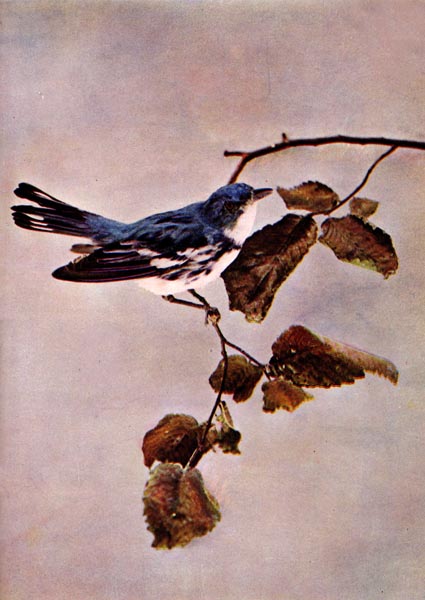
Cerulean Warbler (Setophaga cerulea) – Birds Illustrated by Color Photography
HIS beautiful little sky-blue feathered creature is well named Azure Warbler, or again White-throated Blue Warbler, and is the most abundant of the genus here.
It is a bird of the wood, everywhere associated with the beautiful tall forests of the more northern counties of western New York, sometimes found in the open woods of pasture-lands, and quite partial to hardwood trees. In its flitting motion in search of insect-prey, and in the jerking curves of its more prolonged flight, as also in its structure, it is a genuine Wood Warbler and keeps for the most part to what Thoreau calls the “upper story” of its sylvan domain.
All Warblers, it has been said, depend upon their markings rather than song for their identity, which renders the majority of the tribe of greater interest to the scientist than to the novice. Until you have named four or five of the commonest species as landmarks, you will be considerably confused.
Audubon described the song of the Cerulean Warbler as “extremely sweet and mellow,” whereas it is a modest little strain, says Chapman, or trill, divided into syllables like zee, zee, zee, ze-ee-ee-eep, or according to another observer, rheet, rheet, rheet, rheet, ridi, idi, e-e-e-e-ee; beginning with several soft warbling notes and ending in a rather prolonged but quite musical squeak. The latter and more rapid part of the strain, which is given in the upward slide, approaches an insect quality of tone which is more or less peculiar to all true Warblers, a song so common as to be a universal characteristic of our tall forests.
It is not strange that the nest of this species has been so seldom discovered, even where the bird is very abundant during the breeding season. It is built in the higher horizontal branches of forest trees, always out some distance from the trunk, and ranging from twenty to fifty feet above the ground. One described by Dr. Brewer, found in Ontario, near Niagara Falls, was built in a large oak tree at the height of fifty or more feet from the ground. It was placed horizontally on the upper surface of a slender limb between two small twigs; and the branch on which it was thus saddled was only an inch and a half in thickness, being nine feet from the trunk of the tree. The abandoned home was secured with great difficulty.
The nest is a rather slender fabric, somewhat similar to the nest of the Redstart, and quite small for the bird, consisting chiefly of a strong rim firmly woven of strips of fine bark, stems of grasses, and pine needles, bound round with flaxen fibres of plants and wool. Around the base a few bits of hornets’ nests, mosses, and lichens are loosely fastened. The nest within is furnished with fine stems and needles, the flooring very thin and slight.
The bird is shy when started from the nest, and has a sharp chipping alarm-note common to the family.
The Cerulean Warbler is found in the Eastern States, but is more numerous west of the Allegheny mountains, and throughout the heavily wooded districts of the Mississippi valley. In winter it migrates to Central America and Cuba. The Warblers are of unfailing interest to the lover of bird life. Apart from the beauty of the birds themselves, with their perpetually contrasting colors among the green leaves, their pretty ways furnish to the silent watcher an ever changing spectacle of the innocent life in the tree-tops.
Summary:
CERULEAN WARBLER—Dendræca caerulea. Other names: “Azure Warbler;” “White-throated Blue Warbler.”
Range—Mississippi valley as far north as Minnesota, and eastward as far as Lockport, N. Y. (Davison.) Winters in the tropics.
Nest—Of fine grasses bound with spider’s silk, lined with strips of bark and with a few lichens attached to its upper surface, in a tree, twenty-five to fifty feet from the ground. (Chapman.)
Eggs—Four, creamy-white, thickly covered with rather heavy blotches of reddish brown.

Cerulean Warbler (Dendroica cerulea) ©WikC
Lee’s Addition:
The birds of heaven dwell by them; they give forth their voice from among the branches. (Psalms 104:12 Darby)
The Lord has given us another neat little bird to observe. The color reminds us of the blue sky above. The Cerulean Warblers are part of the Parulidae – New World Warblers Family.
“Adult males have pale cerulean blue upperparts and white underparts with a black necklace across the breast; they also have black streaks on the back and flanks. Females and immature birds have greyer or greenish upperparts, a pale stripe over the eye, and no streaking on the back and no necklace. All of these birds, regardless of their age, have wing bars and a thin pointed bill. A small wood warbler of about 4 inches (11.5 cm) in length, with long pointed wings, short tail, and long under tail coverts. Males have blue upper parts and white below with black streaking on back and upper tail coverts. Females are bluish-green to olive-green above with white under parts and a white or yellowish eyebrow stripe. Both sexes have 2 white wing bars and white tail spots. Juveniles are similar to female with brownish/gray upper parts, white under parts and a pale crown stripe. The cerulean warbler is often found high in the canopy of mature forests.
Their breeding habitats are mature deciduous forests in eastern North America. They migrate to spend the boreal winter in forested mountain areas in South America. The cerulean warbler is an early migrant and arrives on breeding grounds up to 2 weeks before other wood warbler migrants. Males arrive one week before females and pairs form as soon as females arrive. Age of first breeding is one year. Both sexes participate in nest site selection but construction is carried out by the female who may take up to a week to construct the nest.
They forage actively high in trees, sometimes catching insects in flight. These birds mainly eat insects. Their nests are cup-shaped, and are placed on a horizontal branch high in a hardwood tree. The song is a buzzed zray zray zray zray zeeee. The call is a slurred chip.
Song by Tayler Brooks – xeno-canto.org
The Cerulean Warbler is the fastest declining neotropical migrant songbird. Among the many threats they face, their wintering habitat in the northern Andes is dwindling rapidly. Cerulean Warblers depend on shade coffee plantations during the winter. In fragmented forest areas, this bird is vulnerable to nest parasitism by the Brown-headed Cowbird. This bird’s numbers are declining faster than any other warbler species in the USA; its population in 2006 was less than one-fifth of what it was 40 years before.
The Cerulean Warbler has been recorded as a vagrant to Iceland.” (Wikipedia and NY DEC with editing)

Cerulean Warbler (Dendroica cerulea) at nest ©L Walkinshaw
*
Birds Illustrated by Color Photography – Revisited
The above article is an article in the monthly serial for October 1897 “designed to promote Knowledge of Bird-Live.” These include Color Photography, as they call them, today they are drawings. There are at least three Volumes that have been digitized by Project Gutenberg.
To see the whole series of – Birds Illustrated by Color Photography – Revisited
*
(Information from Wikipedia and other internet sources)
Next Article – The Yellow-billed Tropic Bird
The Previous Article – The Wild Turkey
*
Links:
*

The Wild Turkey
From Col. Fred. Kaempfer.
Copyrighted by Nature Study Pub. Co., 1897, Chicago.
T has been observed that when the Turkey makes its appearance on table all conversation should for the moment be suspended. That it is eaten in silence on some occasions may be inferred from the following anecdote: A certain judge of Avignon, famous for his love of the glorious bird, which the American people have wisely selected for the celebration of Thanksgiving Day, said to a friend: “We have just been dining on a superb Turkey. It was excellent. Stuffed with truffles to the very throat—tender, delicate, filled with perfume! We left nothing but the bones!” “How many were there of you?” asked his friend. “Two,” replied the judge, “the Turkey—and myself!” The reason, no doubt, why this brilliant bird, which so much resembles the domestic Turkey, is now almost extinct. It was formerly a resident of New England, and is still found to some extent as far north-west as the Missouri River and south-west as Texas. In Ohio it was formerly an abundant resident. Dr. Kirtland (1850) mentions the time when Wild Turkeys were more common than tame ones are now.
The nests of this bird are very difficult to discover, as they are made on the ground, midst tall, thick weeds or tangled briars. The female will not leave the nest until almost trodden upon. It is stated that when the eggs are once touched, she will abandon her nest.
The Turkey became known to Europeans almost immediately upon the discovery of America by the Spaniards in 1518, and it is probable that it is distinctively an American bird. In its wild state, its plumage, as in the case of the Honduras Turkey, grows more lustrous and magnificent as the family extends southward.
The “Gobblers,” as the males are called, associate in parties of ten to one hundred, seeking their food apart from the females, which wander singly with their young or in troops with other hens and their families, sometimes to the number of seventy or eighty. They travel on foot, unless disturbed by the hunter or a river compels them to take wing. It is said that when about to cross a river, they select a high eminence from which to start, that their flight may be more sure, and in such a position they sometimes remain for a day or more, as if in consultation. On such occasions the males gobble vociferously, strutting about pompously as if to animate their companions. At the signal note of their leader, they wing their way to the opposite shore.
The Wild Turkey feeds on many kinds of berries, fruits, and grasses. Beetles, tadpoles, young frogs, and lizards are sometimes found in its crop. When the Turkeys reach their destination, they disperse in flocks, devouring the mast as they proceed.
Pairing time begins in March. The sexes roost apart, but at no great distance, so that when the female utters a call, every male within hearing responds, rolling note after note in rapid succession, in a voice resembling that of the tame Turkey when he hears any unusual noise. Where the Turkeys are numerous, the woods from one end to the other, sometimes for many miles, resound with these voices of wooing.
The specimen of the Wild Turkey presented in this number of Birds is of extraordinary size and beauty, and has been much admired. The day is not far distant when a living specimen of this noble bird will be sought for in vain in the United States.
WILD TURKEY—Meleagris gallopava.
Range—Eastern United States from Pennsylvania southward to Florida, west to Wisconsin, the Indian Territory and Texas.
Nest—On the ground, at the base of a bush or tree.
Eggs—Ten to fourteen, pale cream buff, finely and evenly speckled with grayish brown.

Wild Turkey (Meleagris gallopavo) by Lee at LPZoo
Lee’s Addition:
Of all clean birds you may eat. (Deuteronomy 14:11 AMP)
The Wild Turkey (Meleagris gallopavo) is native to North America and is the heaviest member of the diverse Galliformes and are in the Phasianidae – Pheasants, Fowl & Allies Family. It is the same species as the domestic turkey, which was originally derived from a southern Mexican subspecies of Wild Turkey (not the related Ocellated Turkey). Although native to North America, the Wild Turkey got its name due to the trade routes in place. During the 16th Century, the major trade route from the Americas and Asia required the goods to go to Constantinople in Turkey before being sent to Britain. The British at the time therefore, associated the Wild Turkey with the country Turkey and the name stuck.
Adult wild turkeys have long reddish-yellow to grayish-green legs. The body feathers are generally blackish and dark brown overall with a coppery sheen that becomes more complex in adult males. Adult males, called toms or gobblers, have a large, featherless, reddish head, red throat, and red wattles on the throat and neck. The head has fleshy growths called caruncles. Juvenile males are called jakes, the difference between an adult male and a juvenile is that the jake has a very short beard and his tail fan has longer feathers in the middle. The adult male’s tail fan will be all the same length. When males are excited, a fleshy flap on the bill expands, and this, the wattles and the bare skin of the head and neck all become engorged with blood, almost concealing the eyes and bill. The long fleshy object over a male’s beak is called a snood. When a male turkey is excited, its head turns blue; when ready to fight, it turns red. Each foot has three toes in front, with a shorter, rear-facing toe in back; males have a spur behind each of their lower legs.
Male turkeys have a long, dark, fan-shaped tail and glossy bronze wings. The male is substantially larger than the female, and his feathers have areas of red, purple, green, copper, bronze, and gold iridescence. Females, called hens, have feathers that are duller overall, in shades of brown and gray. The primary wing feathers have white bars. Turkeys have 5000 to 6000 feathers. Tail feathers are of the same length in adults, different lengths in juveniles.
Males typically have a “beard”, a tuft of coarse hair (modified feathers) growing from the center of the breast. Beards average 230 mm (9.1 in) in length. In some populations, females have a beard, usually shorter and thinner than that of the male. The adult male (or “tom”) normally weighs from 5 to 11 kg (11 to 24 lb) and measures 100–125 cm (39–49 in) in length. The adult female (or “hen”) is typically much smaller at 2.5–5.4 kg (5.5–12 lb) and is 76 to 95 cm (30 to 37 in) long. The wings are relatively small, as is typical of the galliform order, and the wingspan ranges from 1.25 to 1.44 m (4 ft 1 in to 4 ft 9 in). The bill is also relatively small. The tarsus of the Wild Turkey is quite long and sturdy. The tail is also relatively long The record-sized adult male Wild Turkey, … weighed 16.85 kg (37.1 lb). While it is usually rather lighter than the waterfowl, after the Trumpeter Swan, the turkey has the second heaviest maximum weight of any North American bird. Going on average mass, several other birds on the continent, including the American White Pelican and the very rare California Condor and Whooping Crane surpass the mean weight of turkeys.
Turkeys have many vocalizations: “gobbles,” “clucks,” “putts,” “purrs,” “yelps,” “cutts,” “whines,” “cackles,” and “kee-kees.” In early spring, male turkeys, also called gobblers or toms, gobble to announce their presence to females and competing males. The gobble can carry for up to a mile. Males also emit a low-pitched “drumming” sound; produced by the movement of air in the air sack in the chest, similar to the booming of a prairie chicken. In addition they produce a sound known as the “spit” which is a sharp expulsion of air from this air sack. Hens “yelp” to let gobblers know their location. Gobblers often yelp in the manner of females, and hens can gobble, though they rarely do so. Immature males, called jakes, often yelp.
Males Displaying:
Female Calling:
Alarm Call by several birds.
Wild turkeys prefer hardwood and mixed conifer-hardwood forests with scattered openings such as pastures, fields, orchards and seasonal marshes. Open, mature forest with a variety of interspersion of tree species appear to be preferred. In the Northeast of North America, turkeys are most profuse in hardwood timber of oak-hickory and forests of red oak, beech, cherry and white ash. Best ranges for turkeys in the Coastal Plain and Piedmont sections have an interspersion of clearings, farms, and plantations with preferred habitat along principal rivers and in cypress and tupelo swamps. Appalachian and Cumberland plateaus, birds occupy mixed forest of oaks and pines on southern and western slopes, also hickory with diverse understories. Bald cypress and sweet gum swamps of s. Florida; also hardwood of Cliftonia in north-central Florida. Lykes Fisheating Creek area of s. Florida has hardwood hammocks, glades of short grasses with isolated live oak; nesting in neighboring prairies. Original habitat here was mainly longleaf pine with turkey oak and slash pine “flatwoods,” now mainly replaced by slash pine plantations.
Wild turkeys are omnivorous, foraging on the ground or climbing shrubs and small trees to feed. They prefer eating hard mast such as acorns, nuts, and various trees, including hazel, chestnut, hickory, and pinyon pine as well as various seeds, berries such as juniper and bearberry, roots and insects. Turkeys also occasionally consume amphibians and small reptiles such as lizards and snakes. Poults have been observed eating insects, berries, and seeds. Wild turkeys often feed in cow pastures, sometimes visit back yard bird feeders, and favor croplands after harvest to scavenge seed on the ground. Turkeys are also known to eat a wide variety of grasses.
Males are polygamous, mating with as many hens as they can. Male wild turkeys display for females by puffing out their feathers, spreading out their tails and dragging their wings. This behavior is most commonly referred to as strutting. Their heads and necks are colored brilliantly with red, blue and white. The color can change with the turkey’s mood, with a solid white head and neck being the most excited. They use gobbling, drumming/booming and spitting as signs of social dominance, and to attract females. Courtship begins during the months of March and April, which is when turkeys are still flocked together in winter areas. (Wikipedia with editing)
This was taken on the Roaring Fork Drive in Gatlinburg, TN last October.
*
Birds Illustrated by Color Photography – Revisited
The above article is an article in the monthly serial for October 1897 “designed to promote Knowledge of Bird-Live.” These include Color Photography, as they call them, today they are drawings. There are at least three Volumes that have been digitized by Project Gutenberg.
To see the whole series of – Birds Illustrated by Color Photography – Revisited
*
(Information from Wikipedia and other internet sources)
Next Article – The Cerulean Warbler
The Previous Article – The Piping Belted Plover
*
Links:
*

Green Heron (Butorides virescens) by Lee
“But now ask the beasts, and they will teach you; And the birds of the air, and they will tell you; (Job 12:7 NKJV)
I have thinking about that Green Heron in the video I posted a few days ago. (Green Heron Fishing With Bread) The verse above makes me think there has to be some lessons to learn from it. These are just some of my thoughts and I am sure you can come up with some of your own.
One that comes to thought right off is that bird’s patience. Are we?
These wait all upon thee; that thou mayest give them their meat in due season. That thou givest them they gather: thou openest thine hand, they are filled with good. (Psalms 104:27-28 KJV)
The verse used on the article tells how the Lord protects and provides for His creation. Will He not provide for us also. He loves us and wants to meet our needs, just as was provided for this Heron.
Look at the birds of the air, for they neither sow nor reap nor gather into barns; yet your heavenly Father feeds them. Are you not of more value than they? (Matthew 6:26 NKJV)
Another lesson is that the bird is doing something that we wouldn’t think it could do. You wonder where it learned that behavior. For us, the Lord wants us to do something, and if we are willing, we are amazed at what we can do. Things we would never think we had the capacity to do He helps us perform..
Jesus said unto him, If thou canst believe, all things are possible to him that believeth. (Mark 9:23 KJV)
I can do all things through Christ which strengtheneth me. (Philippians 4:13 KJV)
He (the heron) has a goal in mind and isn’t going to give up even though it takes several attempts to accomplish his goal. The Lord tells us to become “fishers of men” and we need to keep trying and not give up. Even when our “bread” is down to hardly anything and you think you might as well give up, you try one more time.
So then neither is he that planteth any thing, neither he that watereth; but God that giveth the increase. Now he that planteth and he that watereth are one: and every man shall receive his own reward according to his own labour. (1 Corinthians 3:7-8 KJV)
On a more light side, I am not so sure that the Heron wasn’t bordering on “gluttony.” Did you see that last part where it is swallowing the fish. Looks like it almost “bit of more than it could chew.”
But put ye on the Lord Jesus Christ, and make not provision for the flesh, to fulfil the lusts thereof. (Romans 13:14 KJV)
These are but a few and if you have some, leave a comment and share them with us.
*
Thanks to MrBeemBom for taking the video and sharing it on YouTube.
*


 Birds of the Bible For Kids