Vol 2, #6 – The Ornithological Congress

My Mom and Me

My Mom and Me (from an e-mail)

THE ORNITHOLOGICAL CONGRESS.

imgw

E had the pleasure of attending the Fifteenth Congress of the American Ornithologists’ Union, which met and held its three days annual session in the American Museum of Natural History, New York City, November 9-11, 1897. Dr. C. Hart Merriam, of the Department of Agriculture, Washington D.C., presided, and there were present about one hundred and fifty of the members, resident in nearly all the states of the Union.

The first paper read was one prepared by J. C. Merrill, entitled “In Memoriam: Charles Emil Bendire.” The character, accomplishments, and achievements of the deceased, whose valuable work in biographizing American birds is so well known to those interested in ornithology, were referred to in so appropriate a manner that the paper, though not elaborate as it is to be hoped it may ultimately be made, will no doubt be published for general circulation. Major Bendire’s services to American ornithology are of indisputable value, and his untimely death eclipsed to some extent, possibly wholly, the conclusion of a series of bird biographies which, so far as they had appeared, were deemed to be adequate, if not perfect.

Mr. Frank M. Chapman, the well known authority on birds, and whose recent books are valuable additions to our literature, had, it may be presumed, a paper to read on the “Experiences of an Ornithologist in Mexico,” though he did not read it. He made, on the contrary, what seemed to be an extemporaneous talk, exceedingly entertaining and sufficiently instructive to warrant a permanent place for it in the Auk, of which he is associate editor. We had the pleasure of examining the advance sheets of a new book from his pen, elaborately illustrated in color, and shortly to be published. Mr. Chapman is a comparatively young man, an enthusiastic student and observer, and destined to be recognized as one of our most scientific thinkers, as many of his published pamphlets already indicate. Our limited space precludes even a reference to them now. His remarks were made the more attractive by the beautiful stuffed specimens with which he illustrated them.

Prof. Elliott Coues, in an address, “Auduboniana, and Other Matters of Present Interest,” engaged the delighted attention of the Congress on the morning of the second day’s session. His audience was large. In a biographical sketch of Audubon the Man, interspersed with anecdote, he said so many interesting things that we regret we omitted to make any notes that would enable us to indicate at least something of his characterization. No doubt just what he said will appear in an appropriate place. Audubon’s portfolio, in which his precious manuscripts and drawings were so long religiously kept, which he had carried with him to London to exhibit to possible publishers, a book so large that two men were required to carry it, though the great naturalist had used it as an indispensable and convenient companion for so many years, was slowly and we thought reverently divested by Dr. Coues of its wrappings and held up to the surprised and grateful gaze of the spectators. It was dramatic. Dr. Coues is an actor. And then came the comedy. He could not resist the inclination to talk a little—not disparagingly, but truthfully, reading a letter never before published, of Swainson to Audubon declining to associate his name with that of Audubon “under the circumstances.” All of which, we apprehend, will duly find a place on the shelves of public libraries.

John James Audubon 1826 ©WikiC

John James Audubon 1826 ©WikiC

We would ourself like to say something of Audubon as a man. To us his life and character have a special charm. His was a beautiful youth, like that of Goethe. His love of nature, for which he was willing to make, and did make, sacrifices, will always be inspiring to the youth of noble and gentle proclivities; his personal beauty, his humanity, his love-life, his domestic virtues, enthrall the ingenuous mind; and his appreciation—shown in his beautiful compositions—of the valleys of the great river, La Belle Rivière, through which its waters, shadowed by the magnificent forests of Ohio and Kentucky, wandered—all of these things have from youth up shed a sweet fragrance over his memory and added greatly to our admiration of and appreciation for the man.

So many subjects came before the Congress that we cannot hope to do more than mention the titles of a few of them. Mr. Sylvester D. Judd discussed the question of “Protective Adaptations of insects from an Ornithological Point of View;” Mr. William C. Rives talked of “Summer Birds of the West Virginia Spruce Belt;” Mr. John N. Clark read a paper entitled “Ten Days among the Birds of Northern New Hampshire;” Harry C. Oberholser talked extemporaneously of “Liberian Birds,” and in a most entertaining and instructive manner, every word he said being worthy of large print and liberal embellishment; Mr. J. A. Allen, editor of The Auk, said a great deal that was new and instructive about the “Origin of Bird Migration;” Mr. O. Widmann read an interesting paper on “The Great Roosts on Gabberet Island, opposite North St. Louis;” J. Harris Reed presented a paper on “The Terns of Gull Island, New York;” A. W. Anthony read of “The Petrels of Southern California,” and Mr. George H. Mackay talked interestingly of “The Terns of Penikese Island, Mass.”

There were other papers of interest and value. “A Naturalist’s Expedition to East Africa,” by D. G. Elliot, was, however, the pièce de résistance of the Congress. The lecture was delivered in the lecture hall of the Museum, on Wednesday at 8 p. m. It was illustrated by stereopticon views, and in the most remarkable manner. The pictures were thrown upon an immense canvas, were marvellously realistic, and were so much admired by the great audience, which overflowed the large lecture hall, that the word demonstrative does not describe their enthusiasm. But the lecture! Description, experience, suffering, adventure, courage, torrid heat, wild beasts, poisonous insects, venomous serpents, half-civilized peoples, thirst,—almost enough of torture to justify the use of Coleridge’s Ancient Mariner in illustration,—and yet a perpetual, quiet, rollicking, jubilant humor, all-pervading, and, at the close, on the lecturer’s return once more to the beginning of civilization, the eloquent picture of the Cross, “full high advanced,” all combined, made this lecture, to us, one of the very few platform addresses entirely worthy of the significance of unfading portraiture.

C. C. Marble.


Silver-breasted Broadbill (Serilophus lunatus) by Peter Ericsson

Silver-breasted Broadbill (Serilophus lunatus) by Peter Ericsson

Lee’s Addition:

And further, by these, my son, be admonished: of making many books there is no end; and much study is a weariness of the flesh. (Ecclesiastes 12:12 KJV)

“The International Ornithologists’ Union, formerly International Ornithological Committee (IOC), is to facilitate worldwide communication in ornithology and conservation based on the up-to-date taxonomy of world birds and recommended English names that follow explicit guidelines for spelling and construction.

To this end we  provide a complete list of world bird species and their subspecies, including recently extinct ones. We update the list regularly to include newly described species,  proposed and accepted splits and lumps, corrections of nomenclature, and changes of names or classification.” (From IOC’s website)

The IOC, or now the IOU is where our list of the Birds of the World come from. Thankfully, these ornithologists get together and try to maintain lists and compare birds from other countries, which are called by different name, to see if they are one-in-the-same. There is much work that goes on by them and their work is much appreciated by birders around the world.

*

Birds Illustrated by Color Photography – Revisited

The above article is an article in the monthly serial for October 1897 “designed to promote Knowledge of Bird-Live.” These include Color Photography, as they call them, today they are drawings. There are at least three Volumes that have been digitized by Project Gutenberg.

To see the whole series of – Birds Illustrated by Color Photography – Revisited

*

(Information from Wikipedia and other internet sources, with editing)

Next Article – The Mountain Bluebird

The Previous Article – Bird Miscellany Plus 

Gospel Message

Links:

International Ornithological Congress

IOC World Bird List

Birds of the World – Lee’s Birdwatching Adventures

*

Vol. 2, # 5 – The Vermilion Fly-Catcher (II)

Vermilion Flycatcher (Pyrocephalus rubinus)

Vermilion Flycatcher for Birds Illustrated, 1897

THE VERMILION FLY-CATCHER.

imgt

HICKETS along water courses are favorite resorts of this beautiful Fly-catcher, which may be seen only on the southern border of the United States, south through Mexico to Guatemala, where it is a common species. Mr. W. E. D. Scott notes it as a common species about Riverside, Tucson, and Florence, Arizona. Its habits are quite similar to those of other Fly-catchers, though it has not been so carefully observed as its many cousins in other parts of the country. During the nesting season, the male frequently utters a twittering song while poised in the air, in the manner of the Sparrow Hawk, and during the song it snaps its bill as if catching insects.

The Vermilion’s nest is usually placed in horizontal forks of ratana trees, and often in mesquites, not more than six feet from the ground; they are composed of small twigs and soft materials felted together, with the rims covered with lichens, and the shallow cavity lined with a few horse or cow hairs. Dr. Merrill states that they bear considerable resemblance to nests of the Wood Pewee in appearance and the manner in which they are saddled to the limb. Nests have been found, however, which lacked the exterior coating of lichens.

Three eggs are laid of a rich creamy-white with a ring of large brown and lilac blotches at the larger end.

Vermilion Flycatcher (Pyrocephalus rubinus) Eggs ©WikiC

Vermilion Flycatcher (Pyrocephalus rubinus) Eggs ©WikiC

*

Summary:

VERMILION FLY-CATCHER.Pyocephalus rubineus mexicanus.

Range—Southern Border of the United States south through Mexico and Guatemala.

Nest—In forks of ratana trees, not more than six feet up, of small twigs and soft materials felted together, the rims covered with lichens; the cavity is shallow.

Eggs—Usually three, the ground color a rich creamy-white, with a ring of large brown and lilac blotches at the larger end.


Vermilion Flycatcher (Pyrocephalus rubinus) by Margaret Sloan

Vermilion Flycatcher (Pyrocephalus rubinus) by Margaret Sloan

Lee’s Addition:

“Come now, and let us reason together,” Says the LORD, “Though your sins are like scarlet, They shall be as white as snow; Though they are red like crimson, They shall be as wool. (Isaiah 1:18 NKJV)

But He replied to them, “When it is evening, you say, ‘It will be fair weather, for the sky is red.’ “And in the morning, ‘There will be a storm today, for the sky is red and threatening.’ Do you know how to discern the appearance of the sky, but cannot discern the signs of the times? (Matthew 16:2-3 NASB)

Everytime I go to pronounce “Vermilion”, an extra “L” shows up and I say “million.” You have to admit that this beautiful bird looks like a “million.” This is another of the Lord’s fantastic birds.

For great is the LORD and greatly to be praised; He is to be feared above all gods. For all the gods of the peoples are idols, But the LORD made the heavens. Splendor and majesty are before Him, Strength and beauty are in His sanctuary. Ascribe to the LORD, O families of the peoples, Ascribe to the LORD glory and strength. (Psalms 96:4-7 NASB)

The Vermilion Flycatcher (Pyrocephalus rubinus) is a small passerine bird in the Tyrannidae – Tyrant Flycatchers Family. Most flycatchers are rather drab, but the Vermilion Flycatcher is a striking exception. It is a favourite with birders, but is not generally kept in aviculture, as the males tend to lose their vermilion colouration when in captivity.

Vermilion Flycatchers generally prefer somewhat open areas, and are found in trees or shrubs in savannah, scrub, agricultural areas, riparian woodlands, and desert as well, but usually near water. Their range includes almost all of Mexico; it extends north into the southwestern United States, and south to scattered portions of Central America, parts of northwestern and central South America, and on southwards to central Argentina. They are also found in the Galapagos Islands.

The species grows to about 5-7 inches in length, and is strongly dimorphic; males are bright red, with dark brown plumage. Females have a peach-coloured belly with a dark grey upperside, and are similar to Say’s Phoebe. They frequently wag their tails. They have a bright red cap, throat and underparts with a black on an eyeline, back, wings and tail. Immatures are similar to females with varying amounts of red on the underparts. Females have brown underparts and their undertail coverts are tinged pink.

The flycatchers feed mostly on insects such as flies, grasshoppers and beetles. These are usually taken in mid-air, after a short sally flight from a perch.

Vermilion Flycatcher (Pyrocephalus rubinus) Female on nest ©WikiC

Vermilion Flycatcher (Pyrocephalus rubinus) Female on nest ©WikiC

They lay 2-3 whitish eggs in a nest made of twigs, stems and roots, and lined with hair. The eggs are incubated for around two weeks by the female and the young are ready to leave the nest 15 days after hatching.

Sounds both by Andrew Spencer at xeno-canto.org

Song

Call

Vermilion Flycatcher (Pyrocephalus rubinus) by Michael Woodruff

Vermilion Flycatcher (Pyrocephalus rubinus) by Michael Woodruff

*

Bonus:

Besides the Vermilion Flycatcher (Pyrocephalus rubinus);

Vermilion Flycatcher (Pyrocephalus rubinus) by Dario Sanches

Vermilion Flycatcher (Pyrocephalus rubinus) by Dario Sanches

There are two more “Vermilion” birds:

Vermilion Tanager (Calochaetes coccineus) ©Nick Athanas

Vermilion Tanager (Calochaetes coccineus) ©Nick Athanas

Vermilion Tanager (Calochaetes coccineus)

237 Vermilion Cardinal (Cardinalis phoeniceus)

Vermilion Cardinal (Cardinalis phoeniceus) ©Flickr barloventomagico

Vermilion Cardinal (Cardinalis phoeniceus) ©Flickr barloventomagico

Birds Illustrated by Color Photography – Revisited

The above article is an article in the monthly serial for October 1897 “designed to promote Knowledge of Bird-Live.” These include Color Photography, as they call them, today they are drawings. There are at least three Volumes that have been digitized by Project Gutenberg.

To see the whole series of – Birds Illustrated by Color Photography – Revisited

*

(Information from Wikipedia and other internet sources, with editing)

Next Article – The Lazuli Bunting

The Previous Article – The European Kingfisher

ABC’s of the Gospel

Links:

(Oops. Just realized this is a duplicate, but I added to it today. Keeping it.)

*

Vol. 2, # 5 – The Lazuli Bunting

Lazuli Bunting (Passerina amoena)

Lazuli Bunting (Passerina amoena) Birds Illustrated By Color Photography

THE LAZULI BUNTING.

The joy is great of him who strays
In shady woods on summer days.
—Maurice Thompson.

imgi

N Colorado and Arizona the Lazuli Painted Finch, as it is called, is common, while in California it is very abundant, being, in fact, generally distributed throughout the west, and along the Pacific Coast it is found as far north as Puget Sound, during the summer. Davie says it replaces the Indigo Bunting, (See Birds, The Indigo Bunting) from the Plains to the Pacific, being found in all suitable localities. The nest is usually built in a bush or in the lower limbs of trees, a few feet from the ground. Fine strips of bark, small twigs, grasses, and hair are used in preparing it for the four tiny, light bluish-green eggs, which readily fade when exposed to light. The eggs so closely resemble those of the Bluebird as not to be distinguishable with certainty. The nest is an inartistic one for a bird of gay plumage.

From Florence A. Merriam’s charming book, “A-Birding on a Bronco,” we select a description of the pretty manners of this attractive bird. She says:

“While waiting for the Woodpeckers, one day, I saw a small brownish bird flying busily back and forth to some green weeds. She was joined by her mate, a handsome blue Lazuli Bunting, even more beautiful than our lovely Indigo, and he flew beside her full of life and joy. He lit on the side of a cockle stem, and on the instant caught sight of me. Alas! he seemed suddenly turned to stone. He held onto that stalk as if his little legs had been bars of iron and I a devouring monster. When he had collected his wits enough to fly off, instead of the careless gay flight with which he had come out through the open air, he timidly kept low within the cockle field, making a circuitous way through the high stalks. He could be afraid of me if he liked, I thought, for after a certain amount of suspicion, an innocent person gets resentful; at any rate I was going to see that nest. Creeping up cautiously when the mother bird was away, so as not to scare her, and carefully parting the mallows, I looked in. Yes, there it was, a beautiful little sage-green nest of old grass laid in a coil. I felt as pleased as if having a right to share the family happiness. After that I watched the small worker gather material with new interest, knowing where she was going to put it. She worked fast, but did not take the first thing she found, by any means. With a flit of the wing she went in nervous haste from cockle to cockle, looking eagerly about her. Jumping down to the ground, she picked up a bit of grass, threw it down dissatisfied, and turned away like a person looking for something. At last she lit on the side of a thistle, and tweaking out a fibre, flew with it to the nest.

“A month after the first encounter with the father Lazuli, I found him looking at me around the corner of a cockle stalk, and in passing back again, caught him singing full tilt, though his bill was full of insects! After we had turned our backs I looked over my shoulder and had the satisfaction of seeing him take his beakful to the nest. You couldn’t help admiring him, for though not a warrior who would snap his bill over the head of an enemy of his home, he had a gallant holiday air with his blue coat and merry song, and you felt sure his little brown mate would get cheer and courage enough from his presence to make family dangers appear less frightful.”

Summary:

LAZULI BUNTING.Passerina amoena. Other name: “Lazuli Painted Finch.”

Range—Western United States from the Great Plains to the Pacific; south in winter to Western Mexico.

Nest—In a bush or the lower limbs of trees, a few feet from the ground, of fine strips of bark, small twigs, grasses, and is lined with hair.

Eggs—Usually four, light bluish-green.


Lazuli Bunting (Passerina amoena) by Daves BirdingPix

Lazuli Bunting (Passerina amoena) by Daves BirdingPix

Lee’s Addition:

Sing unto the LORD a new song, and his praise from the end of the earth, ye that go down to the sea, and all that is therein; the isles, and the inhabitants thereof. (Isaiah 42:10 KJV)

Take an harp, go about the city, … make sweet melody, sing many songs, that thou mayest be remembered. (Isaiah 23:16 KJV)

While the Eastern half of the United States has the Indigo Bunting, the Western half has their beautiful Lazuli Bunting. Both Buntings belong to the Cardinalidae – Grosbeaks, Saltators & Allies Family. The Lazuli Bunting is a North American songbird named for the gemstone lapis lazuli.

After males are two years old, they develop their own individual song composed of a “series of different syllables.” The song is a high, rapid, strident warble, similar to that of the Indigo Bunting but longer and with less repetition.

Two different birds singing: (from xeno-canto)

The male is easily recognized by its bright blue head and back (lighter than the closely related Indigo Bunting), its conspicuous white wingbars, (one wider than the other) and its light rusty breast and white belly. The color pattern may suggest the Eastern and Western Bluebirds, but the smaller size (13–14 cm or 5–5.5 inches long), wingbars, and short and conical bunting bill quickly distinguish it. The female is brown, grayer above and warmer underneath, told from the female Indigo Bunting by two thin and pale wingbars and other plumage details.

Lazuli Buntings breed mostly west of the 100th meridian from southern Canada to northern Texas, central New Mexico and Arizona, and southern California. On the Pacific coast their breeding range extends south to extreme northwestern Baja California. They migrate to southeastern Arizona and Mexico. Their habitat is brushy areas and sometimes weedy pastures, generally well-watered, and sometimes in towns.

These birds eat mostly seeds and insects. They may feed conspicuously on the ground or in bushes, but singing males are often very elusive in treetops.

This bird makes a loose cup nest of grasses and rootlets placed in a bush. It lays three or four pale blue eggs. In the eastern and southern part of its range, it often hybridizes with the Indigo Bunting.

Bonus:

Lazuli Bunting (Passerina amoena)

Lazuli Bunting (Passerina amoena) by Michael Woodruff

Lazuli Bunting (Passerina amoena) by Michael Woodruff

Lazuline Sabrewing (Campylopterus falcatus)

Lazuline Sabrewing (Campylopterus falcatus) ©WikiC

Lazuline Sabrewing (Campylopterus falcatus) ©WikiC

Click Here for a beautiful photo at IBC
Lazuli Kingfisher (Todiramphus lazuli) – No Photo Available in Creative Commons

Click Here for a great photo at IBC

*

Birds Illustrated by Color Photography – Revisited

The above article is an article in the monthly serial for October 1897 “designed to promote Knowledge of Bird-Live.” These include Color Photography, as they call them, today they are drawings. There are at least three Volumes that have been digitized by Project Gutenberg.

To see the whole series of – Birds Illustrated by Color Photography – Revisited

*

(Information from Wikipedia and other internet sources, with editing)

Next Article – Bird Miscellany Plus

The Previous Article – Vermilion Flycatcher  Version II

Wordless Birds

Links:

*

Vol. 2, # 5 – The Vermilion Fly-Catcher

THE VERMILION FLY-CATCHER

The Vermilion Fly-catcher

From col. George F. Breninger. Copyrighted by
Nature Study Pub. Co., 1897, Chicago.

THE VERMILION FLY-CATCHER

imgt

HICKETS along water courses are favorite resorts of this beautiful Fly-catcher, which may be seen only on the southern border of the United States, south through Mexico to Guatemala, where it is a common species. Mr. W. E. D. Scott notes it as a common species about Riverside, Tucson, and Florence, Arizona. Its habits are quite similar to those of other Fly-catchers, though it has not been so carefully observed as its many cousins in other parts of the country. During the nesting season, the male frequently utters a twittering song while poised in the air, in the manner of the Sparrow Hawk, and during the song it snaps its bill as if catching insects.

The Vermilion’s nest is usually placed in horizontal forks of ratana trees, and often in mesquites, not more than six feet from the ground; they are composed of small twigs and soft materials felted together, with the rims covered with lichens, and the shallow cavity lined with a few horse or cow hairs. Dr. Merrill states that they bear considerable resemblance to nests of the Wood Pewee in appearance and the manner in which they are saddled to the limb. Nests have been found, however, which lacked the exterior coating of lichens.

Three eggs are laid of a rich creamy-white with a ring of large brown and lilac blotches at the larger end.


A WINTER NEST.

Pallid, wan-faced clouds
Press close to the frozen pines,
And follow the jagged lines
Of fence, that the sleet enshrouds.

Sharp in the face of the sky,
Gaunt, thin-ribbed leaves are blown;
They rise with a shuddering moan,
Then sink in the snow and die.

At the edge of the wood a vine
Still clings to the sleeping beech,
While its stiffened tendrils reach
A nest, and around it twine.

A little gray nest all alone,
With its feathery lining of snow,
Where bleak winds, piping low,
Croon a sweet minor tone.
—Nora A. Piper.

*

Summary:

VERMILION FLY-CATCHER.Pyocephalus rubineus mexicanus.

Range—Southern Border of the United States south through Mexico and Guatemala.

Nest—In forks of ratana trees, not more than six feet up, of small twigs and soft materials felted together, the rims covered with lichens; the cavity is shallow.

Eggs—Usually three, the ground color a rich creamy-white, with a ring of large brown and lilac blotches at the larger end.


Vermilion Flycatcher (Pyrocephalus rubinus) by Margaret Sloan

Vermilion Flycatcher (Pyrocephalus rubinus) by Margaret Sloan

Lee’s Addition:

“Come now, and let us reason together,” Says the LORD, “Though your sins are like scarlet, They shall be as white as snow; Though they are red like crimson, They shall be as wool. (Isaiah 1:18 NKJV)

The Vermilion Flycatcher (Pyrocephalus rubinus) is a small passerine bird in the Tyrannidae, or tyrant flycatcher family. Most flycatchers are rather drab, but the Vermilion Flycatcher is a striking exception. It is a favourite with birders, but is not generally kept in aviculture, as the males tend to lose their vermilion colouration when in captivity.

Vermilion Flycatchers generally prefer somewhat open areas, and are found in trees or shrubs in savannah, scrub, agricultural areas, riparian woodlands, and desert as well, but usually near water. Their range includes almost all of Mexico; it extends north into the southwestern United States, and south to scattered portions of Central America, parts of northwestern and central South America, and on southwards to central Argentina. They are also found in the Galapagos Islands.

The species grows to about seven inches in length, and is strongly dimorphic; males are bright red, with dark brown plumage. Females have a peach-coloured belly with a dark grey upperside, and are similar to Say’s Phoebe.

The flycatchers feed mostly on insects such as flies, grasshoppers and beetles. These are usually taken in mid-air, after a short sally flight from a perch.

They lay 2-3 whitish eggs in a nest made of twigs, stems and roots, and lined with hair. The eggs are incubated for around two weeks by the female and the young are ready to leave the nest 15 days after hatching.

Vermilion Flycatcher (Pyrocephalus rubinus) Female on nest ©WikiC

Vermilion Flycatcher (Pyrocephalus rubinus) Female on nest ©WikiC

*

Birds Illustrated by Color Photography – Revisited

The above article is an article in the monthly serial for October 1897 “designed to promote Knowledge of Bird-Live.” These include Color Photography, as they call them, today they are drawings. There are at least three Volumes that have been digitized by Project Gutenberg.

To see the whole series of – Birds Illustrated by Color Photography – Revisited

*

(Information from Wikipedia and other internet sources)

Next Article – The Lazuli Bunting

The Previous Article – The European Kingfisher

Sharing The Gospel

Links:

*

Vol. 2, # 5 – The European Kingfisher

Common Kingfisher (Alcedo atthis) European Kingfisher for Birds Illustrated by Color Photography

European Kingfisher for Birds Illustrated

From col. Chi. Acad. Sciences. Copyrighted by
Nature Study Pub. Co., 1897, Chicago.

THE EUROPEAN KINGFISHER

imgr

ARELY indeed is this charming bird now found in England, where formerly it could be seen darting hither and thither in most frequented places. Of late years, according to Dixon, he has been persecuted so greatly, partly by the collector, who never fails to secure the brilliant creature for his cabinet at every opportunity, and partly by those who have an inherent love for destroying every living object around them. Gamekeepers, too, are up in arms against him, because of his inordinate love of preying on the finny tribe. Where the Kingfisher now is seen is in the most secluded places, the author adds, where the trout streams murmur through the silent woods, but seldom trod by the foot of man; or in the wooded gullies down which the stream from the mountains far above rushes and tumbles over the huge rocks, or lies in pools smooth as the finest mirror.

The Kingfisher is comparatively a silent bird, though he sometimes utters a few harsh notes as he flies swift as a meteor through the wooded glades. You not unfrequently flush the Kingfisher from the holes in the banks, and amongst the brambles skirting the stream. He roosts at night in holes, usually the nesting cavity. Sometimes he will alight on stumps and branches projecting from the water, and sit quiet and motionless, but on your approach he darts quickly away, often uttering a feeble seep, seep, as he goes.

The habits of the English Kingfisher are identical with those of the American, though the former is the more brilliant bird in plumage. (See Birds, Vol. I, p. 61.) The ancients had a very absurd idea as to its nesting habits. They believed that the bird built a floating nest, and whenever the old bird and her charge were drifted by the winds, as they floated over the briny deep, the sea remained calm. He was, therefore, to the ancient mariner, a bird held sacred in the extreme. Even now these absurd superstitions have not wholly disappeared. For instance, the nest is said to be made of the fish bones ejected by the bird, while the real facts are, that they not only nest but roost in holes, and it must follow that vast quantities of rejected fish bones accumulate, and on these the eggs are of necessity laid.

These eggs are very beautiful objects, being of a deep pinkish hue, usually six in number.

The food of the Kingfisher is not composed entirely of fish, the remains of fresh-water shrimps being found in their stomachs, and doubtless other animals inhabiting the waters are from time to time devoured.

The English Kingfisher, says Dixon, remains throughout the year, but numbers perish when the native streams are frozen. There is, perhaps, not a bird in all the ranks of the feathered gems of equatorial regions, be it ever so fair, the Humming-bird excepted, that can boast a garb so lovely as this little creature of the northland. Naturalists assert that the sun has something to do with the brilliant colors of the birds and insects of the tropics, but certainly, the Kingfisher is an exception of the highest kind. Alas, that he has no song to inspire the muse of some English bard!

Common Kingfisher (Alcedo atthis) by Phil Kwong

Common Kingfisher (Alcedo atthis) by Phil Kwong

THE EUROPEAN KINGFISHER.

Little Folks:

I shouldn’t have liked it one bit if my picture had been left out of this beautiful book. My cousin, the American Kingfisher, had his in the February number, and I find he had a good deal to say about himself in his letter, too.

Fine feathers make fine birds, they say. Well, if that is true, I must be a very fine bird, for surely my feathers are gay enough to please anybody—I think.

To see me in all my beauty, you must seek me in my native wood. I look perfectly gorgeous there, flitting from tree to tree. Or maybe you would rather see me sitting on a stump, gazing down into the clear pool which looks like a mirror.

“Oh, what a vain bird!” you would say; “see him looking at himself in the water;” when all the time I had my eye on a fine trout which I intended to catch for my dinner.

Well, though I wear a brighter dress than my American cousin, our habits are pretty much alike. I am sure he catches fish the same way I do—when he is hungry.

With a hook and line, as you do?

Oh, no; with my bill, which is long, you observe, and made for that very purpose. You should just see me catch a fish! Down I fly to a stump near the brook, or to a limb of a tree which overhangs the water, and there I sit as quiet as a mouse for quite a while.

Everything being so quiet, a fine speckled trout, or a school of troutlets, play near the surface. Now is my chance! Down I swoop, and up I come with a fish crosswise in my bill.

Back I go to my perch, toss the minnow into the air, and as it falls catch it head first and swallow it whole. I tell you this because you ought to know why I am called Kingfisher.

Do we swallow bones and all?

Yes, but we afterwards eject the bones, when we are resting or roosting in our holes in the banks of the stream. That must be the reason people who write about us say we build our nests of fish bones.

Sing?

Oh, no, we are not singing birds; but sometimes, when flying swiftly through the air, we give a harsh cry that nobody but a bird understands.

Your friend,
The English Kingfisher.

Summary:

EUROPEAN KINGFISHER.Alcedo ispida.

Range—England and portions of Europe.

Nest—In holes of the banks of streams.

Eggs—Usually six, of a deep pinkish hue.


Common Kingfisher (Alcedo atthis) by Phil Kwong

Common Kingfisher (Alcedo atthis) by Phil Kwong

Lee’s Addition:

And as He walked by the Sea of Galilee, He saw Simon and Andrew his brother casting a net into the sea; for they were fishermen. Then Jesus said to them, “Follow Me, and I will make you become fishers of men.” (Mark 1:16-17 NKJV)

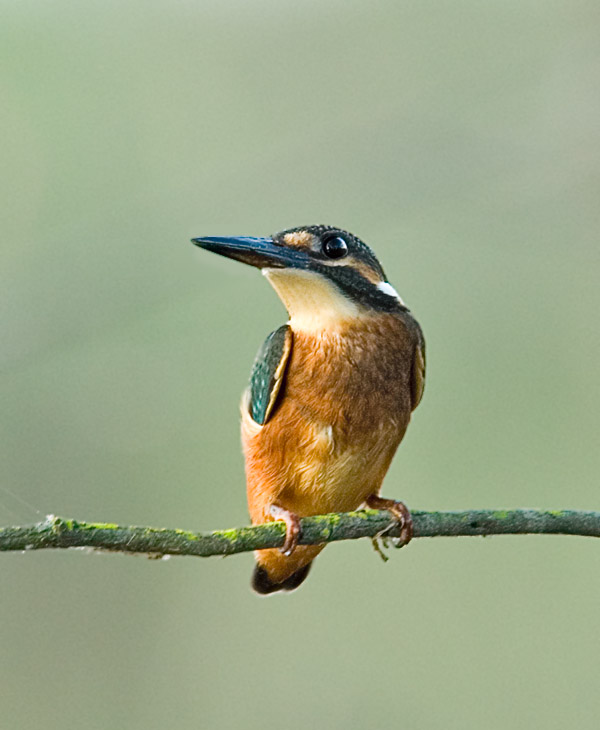
The Common Kinfisher is part of the Alcedinidae – Kingfishers Family, now divided into the River Kingfishers or Alcedinidae group. Personally, Kingfishers are a favorite of mine and I enjoy the neat design, attitude and challenge to photograph the Lord gave them.

The Common Kingfisher (Alcedo atthis) also known as Eurasian Kingfisher or River Kingfisher, is a small kingfisher with seven subspecies recognized within its wide distribution across Eurasia and North Africa. It is resident in much of its range, but migrates from areas where rivers freeze in winter.

This sparrow-sized bird has the typical short-tailed, large-headed kingfisher profile; it has blue upperparts, orange underparts and a long bill. It feeds mainly on fish, caught by diving, and has special visual adaptions to enable it to see prey under water. The glossy white eggs are laid in a nest at the end of a burrow in a riverbank.

This species has the typical short-tailed, dumpy-bodied large-headed and long-billed kingfisher shape. The adult male of the western European subspecies, A. a. ispida has green-blue upperparts with pale azure-blue back and rump, a rufous patch by the bill base, and a rufous ear-patch. It has a green-blue neck stripe, white neck blaze and throat, rufous underparts, and a black bill with some red at the base. The legs and feet are bright red.[5] It is about 16 centimetres (6.3 in) long with a wingspan of 25 cm (9.8 in), and weighs 34–46 grams (1.2–1.6 oz).

The female is identical in appearance to the male except that her lower mandible is orange-red with a black tip. The juvenile is similar to the adult, but with duller and greener upperparts and paler underparts. Its bill is black, and the legs are also initially black.

The flight of the Kingfisher is fast, direct and usually low over water. The short rounded wings whirr rapidly, and a bird flying away shows an electric-blue “flash” down its back.

In North Africa, Europe and Asia north of the Himalayas this is the only small blue kingfisher. In south and southeast Asia it can be confused with six other small blue-and-rufous kingfishers, but the rufous ear patches distinguish it from all but juvenile Blue-eared Kingfisher; details of the head pattern may be necessary to differentiate the two species where both occur.

The Common Kingfisher has no song. The flight call is a short sharp whistle, chee, repeated two or three times. Anxious birds emit a harsh, shrit-it-it and nestlings call for food with a churring noise

Flight Call from xeno-canto by Marco Dragonetti

Common Kingfisher (Alcedo atthis) by W Kwong

Common Kingfisher (Alcedo atthis) by W Kwong

*

Birds Illustrated by Color Photography – Revisited

The above article is an article in the monthly serial for October 1897 “designed to promote Knowledge of Bird-Live.” These include Color Photography, as they call them, today they are drawings. There are at least three Volumes that have been digitized by Project Gutenberg.

To see the whole series of – Birds Illustrated by Color Photography – Revisited

*

(Information from Wikipedia and other internet sources)

Common Kingfisher (Alcedo atthis) by Ian

Common Kingfisher (Alcedo atthis) by Ian

Next Article – The Vermilion Fly-Catcher

The Previous Article – The Yellow-billed Tropic Bird

ABC’s of the Gospel

Links:

Common Kingfisher – Wikipedia

Common Kingfisher – xeno-canto

Alcedinidae – Kingfishers Family

*

Vol, 2, # 5 – The Yellow-Billed Tropic Bird

The Yellow-billed Tropicbird

The Yellow-billed Tropic Bird, 1897

THE YELLOW-BILLED TROPIC BIRD.

imgi

N appearance this bird resembles a large Tern (See The Black Tern), and its habits are similar to those of the Terns. Inter-tropical, it is of a wandering disposition, breeding on the islands of mid-ocean thousands of miles apart. It is noted for its elegant, airy, and long-protracted flight. Davie says that on Bourbon, Mauritius and other islands east and south of Madagascar it breeds in the crevices of the rocks of inaccessible cliffs, and in hollow trees. In the Bermuda Islands it nests about the first of May in holes in high rocky places along the shores. Here its favorite resorts are the small islands of Great Sound, Castle Harbor, and Harrington Sound. The Phaeton, as it is felicitously called, nests in the Bahamas in holes in the perpendicular faces of cliffs and on the flat surfaces of rocks. A single egg is laid, which has a ground-color of purplish brownish white, covered in some specimens almost over the entire surface with fine reddish chocolate-colored spots.

These species compose the small but distinct family of tropic birds and are found throughout the tropical and sub-tropical regions of the world. Long journeys are made by them across the open sea, their flight when emigrating being strong, rapid, and direct, and immense distances are covered by them as they course undismayed by wind or storm. In feeding, Chapman says, they course over the water, beating back and forth at a height of about forty feet, and their long willowy tail-feathers add greatly to the grace and beauty of their appearance when on the wing. They are of rare and probably accidental occurrence on our coasts.

The Songs of Nature never cease,
Her players sue not for release
In nearer fields, on hills afar,
Attendant her musicians are:
From water brook or forest tree,
For aye comes gentle melody,
The very air is music blent—
An universal instrument.
—John Vance Cheney.

***

THE YELLOW-BILLED TROPIC BIRD.

The people who make a study of birds say that I look like a large Tern, and that my habits are like his.

I don’t know whether that is so, I am sure, for I have no acquaintance with that bird, but you little folks can turn to your The Black Tern and see for yourselves if it is true.

For my part, I think I am the prettier of the two on account of my long, willowy tail-feathers. They add greatly, it is said, to the grace and beauty of my appearance when on the wing. Then, the color of my coat is much more beautiful than his, I think, don’t you think so, too?

We are not so common as the Terns, either, for they are very numerous. There are only three species of our family, so we consider ourselves quite distinct.

What are we noted for?

Well, principally for our long distance flights across the sea, elegant and airy, as the writers say of us. Maybe that is the reason they call us the Phaeton sometimes.

Do we go north in the summer as so many other birds do?

Ugh! You make me shudder. No, indeed! We never go farther north than Florida. Our home, or where we build our nests, is in the tropical and sub-tropical regions, where the weather is very warm, you know.

We are great wanderers and build our nests on islands, way out in the ocean many thousands of miles apart.

In trees?

Oh, no, but in any hole we see in the face of a great rock or cliff, and sometimes right on the top of a rock.

How many eggs?

Only one. That is the reason, you see, that our family remains small.

Sing?

Oh, my, no! We are not singing birds. We have a call-note, though harsh and guttural, which sounds like tip, tip, tip.

Summary:

YELLOW-BILLED TROPIC BIRD.Phaethon flavirostris. Other names: “Phaeton.” (Now ~ White-tailed Tropicbird (Phaethon lepturus)

Range.—Tropical coasts; Atlantic coasts of tropical America, West Indies, Bahamas, Bermudas; casual in Florida and accidental in Western New York and Nova Scotia. (Chapman.)

Nest—In holes in the perpendicular faces of cliffs, also on the flat surfaces of rocks.

Eggs—One, ground color of purplish brownish white, covered with fine reddish chocolate-colored spots. (Davie.)


White-tailed Tropicbird (Phaethon lepturus) by Ian

White-tailed Tropicbird (Phaethon lepturus) by Ian

Lee’s Addition:

So it shall be, while My glory passes by, that I will put you in the cleft of the rock, and will cover you with My hand while I pass by. (Exodus 33:22 NKJV)

Our Yellow-billed Tropic Bird is now the White-tailed Tropicbird (Phaethon lepturus). It’s name has gone through several changes according to Avibase. What a lovely bird the Lord created with this family of birds. They are members of the Phaethontidae – Tropicbird Family which only has three species; the Yellow-billed, Red-tailed and Red-billed.

The White-tailed Tropicbird Phaethon lepturus, is a tropicbird, smallest of three closely related seabirds of the tropical oceans and smallest member of the order Phaethontiformes. It occurs in the tropical Atlantic, western Pacific and Indian Oceans. It also breeds on some Caribbean islands, and a few pairs have started nesting recently on Little Tobago, joining the Red-billed Tropicbird colony. In addition to the tropical Atlantic, it nests as far north as Bermuda, where it is locally called a “Longtail”.

White-tailed Tropicbird (Phaethon lepturus) ©WikiC

White-tailed Tropicbird (Phaethon lepturus) ©WikiC

The White-tailed Tropicbird breeds on tropical islands laying a single egg directly onto the ground or a cliff ledge. It disperses widely across the oceans when not breeding, and sometimes wanders far. It feeds on fish and squid, caught by surface plunging, but this species is a poor swimmer. The call is a high screamed keee-keee-krrrt-krrt-krrt.

The adult White-tailed Tropicbird is a slender, mainly white bird, 71–80 cm long including the very long central tail feathers, which double its total length. The wingspan is 89–96 cm, and there is a black band on the inner wing There is black through the eye and the bill is orange-yellow to orange red. The bill colour, pure white back and black wing bar distinguish this species from Red-billed.

Sexes are similar, although males average longer tailed, but juveniles lack the tail streamers, have a green-yellow bill, and a finely barred back.

*

Birds Illustrated by Color Photography – Revisited

The above article is an article in the monthly serial for October 1897 “designed to promote Knowledge of Bird-Live.” These include Color Photography, as they call them, today they are drawings. There are at least three Volumes that have been digitized by Project Gutenberg.

To see the whole series of – Birds Illustrated by Color Photography – Revisited

*

(Information from Wikipedia and other internet sources)

Next Article – The European Kingfisher

The Previous Article – The Cerulean Warbler

Wordless Birds

Links:

*

Vol, 2, # 5 – The Cerulean Warbler

Cerulean Warbler (Setophaga cerulea)

Cerulean Warbler (Setophaga cerulea) – Birds Illustrated by Color Photography

THE CERULEAN WARBLER.

imgt

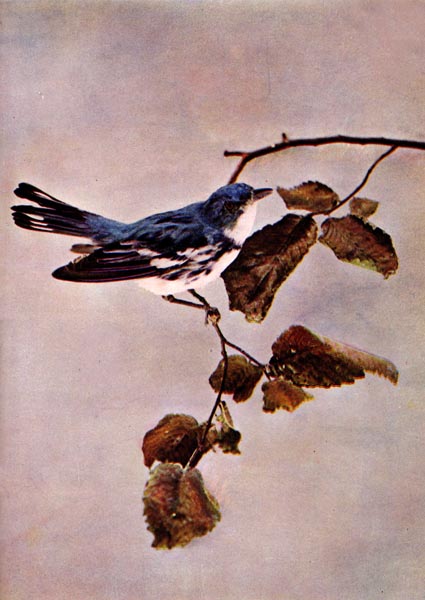
HIS beautiful little sky-blue feathered creature is well named Azure Warbler, or again White-throated Blue Warbler, and is the most abundant of the genus here.

It is a bird of the wood, everywhere associated with the beautiful tall forests of the more northern counties of western New York, sometimes found in the open woods of pasture-lands, and quite partial to hardwood trees. In its flitting motion in search of insect-prey, and in the jerking curves of its more prolonged flight, as also in its structure, it is a genuine Wood Warbler and keeps for the most part to what Thoreau calls the “upper story” of its sylvan domain.

All Warblers, it has been said, depend upon their markings rather than song for their identity, which renders the majority of the tribe of greater interest to the scientist than to the novice. Until you have named four or five of the commonest species as landmarks, you will be considerably confused.

Audubon described the song of the Cerulean Warbler as “extremely sweet and mellow,” whereas it is a modest little strain, says Chapman, or trill, divided into syllables like zee, zee, zee, ze-ee-ee-eep, or according to another observer, rheet, rheet, rheet, rheet, ridi, idi, e-e-e-e-ee; beginning with several soft warbling notes and ending in a rather prolonged but quite musical squeak. The latter and more rapid part of the strain, which is given in the upward slide, approaches an insect quality of tone which is more or less peculiar to all true Warblers, a song so common as to be a universal characteristic of our tall forests.

It is not strange that the nest of this species has been so seldom discovered, even where the bird is very abundant during the breeding season. It is built in the higher horizontal branches of forest trees, always out some distance from the trunk, and ranging from twenty to fifty feet above the ground. One described by Dr. Brewer, found in Ontario, near Niagara Falls, was built in a large oak tree at the height of fifty or more feet from the ground. It was placed horizontally on the upper surface of a slender limb between two small twigs; and the branch on which it was thus saddled was only an inch and a half in thickness, being nine feet from the trunk of the tree. The abandoned home was secured with great difficulty.

The nest is a rather slender fabric, somewhat similar to the nest of the Redstart, and quite small for the bird, consisting chiefly of a strong rim firmly woven of strips of fine bark, stems of grasses, and pine needles, bound round with flaxen fibres of plants and wool. Around the base a few bits of hornets’ nests, mosses, and lichens are loosely fastened. The nest within is furnished with fine stems and needles, the flooring very thin and slight.

The bird is shy when started from the nest, and has a sharp chipping alarm-note common to the family.

The Cerulean Warbler is found in the Eastern States, but is more numerous west of the Allegheny mountains, and throughout the heavily wooded districts of the Mississippi valley. In winter it migrates to Central America and Cuba. The Warblers are of unfailing interest to the lover of bird life. Apart from the beauty of the birds themselves, with their perpetually contrasting colors among the green leaves, their pretty ways furnish to the silent watcher an ever changing spectacle of the innocent life in the tree-tops.

Summary:

CERULEAN WARBLERDendræca caerulea. Other names: “Azure Warbler;” “White-throated Blue Warbler.”

Range—Mississippi valley as far north as Minnesota, and eastward as far as Lockport, N. Y. (Davison.) Winters in the tropics.

Nest—Of fine grasses bound with spider’s silk, lined with strips of bark and with a few lichens attached to its upper surface, in a tree, twenty-five to fifty feet from the ground. (Chapman.)

Eggs—Four, creamy-white, thickly covered with rather heavy blotches of reddish brown.


Cerulean Warbler (Dendroica cerulea) ©WikC

Cerulean Warbler (Dendroica cerulea) ©WikC

Lee’s Addition:

The birds of heaven dwell by them; they give forth their voice from among the branches. (Psalms 104:12 Darby)

The Lord has given us another neat little bird to observe. The color reminds us of the blue sky above. The Cerulean Warblers are part of the Parulidae – New World Warblers Family.

“Adult males have pale cerulean blue upperparts and white underparts with a black necklace across the breast; they also have black streaks on the back and flanks. Females and immature birds have greyer or greenish upperparts, a pale stripe over the eye, and no streaking on the back and no necklace. All of these birds, regardless of their age, have wing bars and a thin pointed bill. A small wood warbler of about 4 inches (11.5 cm) in length, with long pointed wings, short tail, and long under tail coverts. Males have blue upper parts and white below with black streaking on back and upper tail coverts. Females are bluish-green to olive-green above with white under parts and a white or yellowish eyebrow stripe. Both sexes have 2 white wing bars and white tail spots. Juveniles are similar to female with brownish/gray upper parts, white under parts and a pale crown stripe. The cerulean warbler is often found high in the canopy of mature forests.

Their breeding habitats are mature deciduous forests in eastern North America. They migrate to spend the boreal winter in forested mountain areas in South America. The cerulean warbler is an early migrant and arrives on breeding grounds up to 2 weeks before other wood warbler migrants. Males arrive one week before females and pairs form as soon as females arrive. Age of first breeding is one year. Both sexes participate in nest site selection but construction is carried out by the female who may take up to a week to construct the nest.

They forage actively high in trees, sometimes catching insects in flight. These birds mainly eat insects. Their nests are cup-shaped, and are placed on a horizontal branch high in a hardwood tree. The song is a buzzed zray zray zray zray zeeee. The call is a slurred chip.

Song by Tayler Brooks – xeno-canto.org

The Cerulean Warbler is the fastest declining neotropical migrant songbird. Among the many threats they face, their wintering habitat in the northern Andes is dwindling rapidly. Cerulean Warblers depend on shade coffee plantations during the winter. In fragmented forest areas, this bird is vulnerable to nest parasitism by the Brown-headed Cowbird. This bird’s numbers are declining faster than any other warbler species in the USA; its population in 2006 was less than one-fifth of what it was 40 years before.

The Cerulean Warbler has been recorded as a vagrant to Iceland.” (Wikipedia and NY DEC with editing)

Cerulean Warbler (Dendroica cerulea) at nest ©L Walkinshaw

Cerulean Warbler (Dendroica cerulea) at nest ©L Walkinshaw

*

Birds Illustrated by Color Photography – Revisited

The above article is an article in the monthly serial for October 1897 “designed to promote Knowledge of Bird-Live.” These include Color Photography, as they call them, today they are drawings. There are at least three Volumes that have been digitized by Project Gutenberg.

To see the whole series of – Birds Illustrated by Color Photography – Revisited

*

(Information from Wikipedia and other internet sources)

Next Article – The Yellow-billed Tropic Bird

The Previous Article – The Wild Turkey

*

Wordless Birds

Links:

*

Vol. 2, No. 5 – The Wild Turkey

THE WILD TURKEY

The Wild Turkey
From Col. Fred. Kaempfer.
Copyrighted by Nature Study Pub. Co., 1897, Chicago.

THE WILD TURKEY.

imgi

T has been observed that when the Turkey makes its appearance on table all conversation should for the moment be suspended. That it is eaten in silence on some occasions may be inferred from the following anecdote: A certain judge of Avignon, famous for his love of the glorious bird, which the American people have wisely selected for the celebration of Thanksgiving Day, said to a friend: “We have just been dining on a superb Turkey. It was excellent. Stuffed with truffles to the very throat—tender, delicate, filled with perfume! We left nothing but the bones!” “How many were there of you?” asked his friend. “Two,” replied the judge, “the Turkey—and myself!” The reason, no doubt, why this brilliant bird, which so much resembles the domestic Turkey, is now almost extinct. It was formerly a resident of New England, and is still found to some extent as far north-west as the Missouri River and south-west as Texas. In Ohio it was formerly an abundant resident. Dr. Kirtland (1850) mentions the time when Wild Turkeys were more common than tame ones are now.

The nests of this bird are very difficult to discover, as they are made on the ground, midst tall, thick weeds or tangled briars. The female will not leave the nest until almost trodden upon. It is stated that when the eggs are once touched, she will abandon her nest.

The Turkey became known to Europeans almost immediately upon the discovery of America by the Spaniards in 1518, and it is probable that it is distinctively an American bird. In its wild state, its plumage, as in the case of the Honduras Turkey, grows more lustrous and magnificent as the family extends southward.

The “Gobblers,” as the males are called, associate in parties of ten to one hundred, seeking their food apart from the females, which wander singly with their young or in troops with other hens and their families, sometimes to the number of seventy or eighty. They travel on foot, unless disturbed by the hunter or a river compels them to take wing. It is said that when about to cross a river, they select a high eminence from which to start, that their flight may be more sure, and in such a position they sometimes remain for a day or more, as if in consultation. On such occasions the males gobble vociferously, strutting about pompously as if to animate their companions. At the signal note of their leader, they wing their way to the opposite shore.

The Wild Turkey feeds on many kinds of berries, fruits, and grasses. Beetles, tadpoles, young frogs, and lizards are sometimes found in its crop. When the Turkeys reach their destination, they disperse in flocks, devouring the mast as they proceed.

Pairing time begins in March. The sexes roost apart, but at no great distance, so that when the female utters a call, every male within hearing responds, rolling note after note in rapid succession, in a voice resembling that of the tame Turkey when he hears any unusual noise. Where the Turkeys are numerous, the woods from one end to the other, sometimes for many miles, resound with these voices of wooing.

The specimen of the Wild Turkey presented in this number of Birds is of extraordinary size and beauty, and has been much admired. The day is not far distant when a living specimen of this noble bird will be sought for in vain in the United States.


WILD TURKEYMeleagris gallopava.

Range—Eastern United States from Pennsylvania southward to Florida, west to Wisconsin, the Indian Territory and Texas.

Nest—On the ground, at the base of a bush or tree.

Eggs—Ten to fourteen, pale cream buff, finely and evenly speckled with grayish brown.


Wild Turkey (Meleagris gallopavo) by Lee at LPZoo

Wild Turkey (Meleagris gallopavo) by Lee at LPZoo

Lee’s Addition:

Of all clean birds you may eat. (Deuteronomy 14:11 AMP)

The Wild Turkey (Meleagris gallopavo) is native to North America and is the heaviest member of the diverse Galliformes and are in the Phasianidae – Pheasants, Fowl & Allies Family. It is the same species as the domestic turkey, which was originally derived from a southern Mexican subspecies of Wild Turkey (not the related Ocellated Turkey). Although native to North America, the Wild Turkey got its name due to the trade routes in place. During the 16th Century, the major trade route from the Americas and Asia required the goods to go to Constantinople in Turkey before being sent to Britain. The British at the time therefore, associated the Wild Turkey with the country Turkey and the name stuck.

Adult wild turkeys have long reddish-yellow to grayish-green legs. The body feathers are generally blackish and dark brown overall with a coppery sheen that becomes more complex in adult males. Adult males, called toms or gobblers, have a large, featherless, reddish head, red throat, and red wattles on the throat and neck. The head has fleshy growths called caruncles. Juvenile males are called jakes, the difference between an adult male and a juvenile is that the jake has a very short beard and his tail fan has longer feathers in the middle. The adult male’s tail fan will be all the same length. When males are excited, a fleshy flap on the bill expands, and this, the wattles and the bare skin of the head and neck all become engorged with blood, almost concealing the eyes and bill. The long fleshy object over a male’s beak is called a snood. When a male turkey is excited, its head turns blue; when ready to fight, it turns red. Each foot has three toes in front, with a shorter, rear-facing toe in back; males have a spur behind each of their lower legs.

Male turkeys have a long, dark, fan-shaped tail and glossy bronze wings. The male is substantially larger than the female, and his feathers have areas of red, purple, green, copper, bronze, and gold iridescence. Females, called hens, have feathers that are duller overall, in shades of brown and gray. The primary wing feathers have white bars. Turkeys have 5000 to 6000 feathers. Tail feathers are of the same length in adults, different lengths in juveniles.

Males typically have a “beard”, a tuft of coarse hair (modified feathers) growing from the center of the breast. Beards average 230 mm (9.1 in) in length. In some populations, females have a beard, usually shorter and thinner than that of the male. The adult male (or “tom”) normally weighs from 5 to 11 kg (11 to 24 lb) and measures 100–125 cm (39–49 in) in length. The adult female (or “hen”) is typically much smaller at 2.5–5.4 kg (5.5–12 lb) and is 76 to 95 cm (30 to 37 in) long. The wings are relatively small, as is typical of the galliform order, and the wingspan ranges from 1.25 to 1.44 m (4 ft 1 in to 4 ft 9 in). The bill is also relatively small. The tarsus of the Wild Turkey is quite long and sturdy. The tail is also relatively long The record-sized adult male Wild Turkey, … weighed 16.85 kg (37.1 lb). While it is usually rather lighter than the waterfowl, after the Trumpeter Swan, the turkey has the second heaviest maximum weight of any North American bird. Going on average mass, several other birds on the continent, including the American White Pelican and the very rare California Condor and Whooping Crane surpass the mean weight of turkeys.

Turkeys have many vocalizations: “gobbles,” “clucks,” “putts,” “purrs,” “yelps,” “cutts,” “whines,” “cackles,” and “kee-kees.” In early spring, male turkeys, also called gobblers or toms, gobble to announce their presence to females and competing males. The gobble can carry for up to a mile. Males also emit a low-pitched “drumming” sound; produced by the movement of air in the air sack in the chest, similar to the booming of a prairie chicken. In addition they produce a sound known as the “spit” which is a sharp expulsion of air from this air sack. Hens “yelp” to let gobblers know their location. Gobblers often yelp in the manner of females, and hens can gobble, though they rarely do so. Immature males, called jakes, often yelp.

(Audio from xeno.canto.org)

Males Displaying:

Female Calling:

Alarm Call by several birds.

Wild turkeys prefer hardwood and mixed conifer-hardwood forests with scattered openings such as pastures, fields, orchards and seasonal marshes. Open, mature forest with a variety of interspersion of tree species appear to be preferred. In the Northeast of North America, turkeys are most profuse in hardwood timber of oak-hickory and forests of red oak, beech, cherry and white ash. Best ranges for turkeys in the Coastal Plain and Piedmont sections have an interspersion of clearings, farms, and plantations with preferred habitat along principal rivers and in cypress and tupelo swamps. Appalachian and Cumberland plateaus, birds occupy mixed forest of oaks and pines on southern and western slopes, also hickory with diverse understories. Bald cypress and sweet gum swamps of s. Florida; also hardwood of Cliftonia in north-central Florida. Lykes Fisheating Creek area of s. Florida has hardwood hammocks, glades of short grasses with isolated live oak; nesting in neighboring prairies. Original habitat here was mainly longleaf pine with turkey oak and slash pine “flatwoods,” now mainly replaced by slash pine plantations.

Wild turkeys are omnivorous, foraging on the ground or climbing shrubs and small trees to feed. They prefer eating hard mast such as acorns, nuts, and various trees, including hazel, chestnut, hickory, and pinyon pine as well as various seeds, berries such as juniper and bearberry, roots and insects. Turkeys also occasionally consume amphibians and small reptiles such as lizards and snakes. Poults have been observed eating insects, berries, and seeds. Wild turkeys often feed in cow pastures, sometimes visit back yard bird feeders, and favor croplands after harvest to scavenge seed on the ground. Turkeys are also known to eat a wide variety of grasses.

Males are polygamous, mating with as many hens as they can. Male wild turkeys display for females by puffing out their feathers, spreading out their tails and dragging their wings. This behavior is most commonly referred to as strutting. Their heads and necks are colored brilliantly with red, blue and white. The color can change with the turkey’s mood, with a solid white head and neck being the most excited. They use gobbling, drumming/booming and spitting as signs of social dominance, and to attract females. Courtship begins during the months of March and April, which is when turkeys are still flocked together in winter areas. (Wikipedia with editing)

This was taken on the Roaring Fork Drive in Gatlinburg, TN last October.

*

Birds Illustrated by Color Photography – Revisited

The above article is an article in the monthly serial for October 1897 “designed to promote Knowledge of Bird-Live.” These include Color Photography, as they call them, today they are drawings. There are at least three Volumes that have been digitized by Project Gutenberg.

To see the whole series of – Birds Illustrated by Color Photography – Revisited

*

(Information from Wikipedia and other internet sources)

Next Article – The Cerulean Warbler

The Previous Article – The Piping Belted Plover

*

Sharing The Gospel

Links:

*

The Belted Piping Plover – Vol II # 5

The Belted Piping Plover

The Belted Piping Plover

From col. F. M. Woodruff. Copyrighted by Nature Study Pub. Co., 1897, Chicago.

THE BELTED PIPING PLOVER.

imgi

N the Missouri river region and in contiguous parts of the interior of the United States, the Belted Piping Plover is a common summer resident, and is found along the shores of the great lakes, breeding on the flat, pebbly beach between the sand dunes and shore. It is the second of the ring-necked Plovers, and arrives in April in scattering flocks, which separate into pairs a month later. It strays at times into the interior, and has been known to breed on the borders of ponds many miles from the coast. In New England, however, it seldom wanders far from the shore, and prefers sand islands near the main land for its nesting haunts. Nelson says, that some thirty pairs, which were breeding along the beach at Waukegan, within a space of two miles, successfully concealed their nests, for which he made diligent search, although the birds were continually circling about or standing at a short distance, uttering an occasional note of alarm.

These birds have a soft, low, piping note, which they utter not only upon the wing, but occasionally as they run about upon the ground, and, during the early nesting season, a peculiar, loud, prolonged, musical call, that readily attracts attention. In other respects, their habits are not noticeably differed from the Semi-palmated. (See July Birds)

Their nests are without lining, a mere depression in the sand. The eggs are usually four, light gray to creamy buff, finely and rather sparsely speckled or dotted with blackish brown and purplish gray.

The female Belted Piping Plover is similar to the male, but with the dark colors lighter and less in extent. The young have no black band in front, while the collar around the neck is ashy brown.

These interesting and valuable game birds are found associated with various beach birds and Sandpipers, and they become exceedingly fat during the latter part of the summer.

All the Plovers have a singular habit when alighting on the ground in the nesting time; they drop their wings, stand with their legs half bent, and tremble as if unable to support their bodies. In this absurd position they will stand, according to a well-known observer, for several minutes, uttering a curious sound, and then seem to balance themselves with great difficulty. This singular manœuvre is no doubt intended to produce a belief that they may be easily caught, and thus turn the attention of the egg-gatherer from the pursuit of the eggs to themselves, their eggs being recognized the world over, as a great delicacy.


The Plover utters a piping sound

While on the wing or on the ground;

All a tremble it drops its wings,

And, with legs half bent, it sings:

“My nest is near, come take the eggs,

And take me too,—I’m off my legs.”

In vain men search with eager eyes,

No nest is found, the Plover flies!

—C. C. M


Summary:

THE BELTED PIPING PLOVER.Aegialitis meloda circumcincta.

Range—Missouri river region; occasionally eastward to the Atlantic coast.

Nest—Depression in the sand without lining.

Eggs—Four, light gray to creamy buff, finely speckled with blackish brown and purplish gray.


Piping Plover (Charadrius melodus) by J Fenton

Piping Plover (Charadrius melodus) by J Fenton

Lee’s Addition:

Keep me as the apple of the eye, hide me under the shadow of thy wings, (Psalms 17:8 KJV)

Even though these birds make nest right out in the open, the Lord has given them the instincts and knowledge to protect themselves and their young. He does not leave them defenseless. Jim Fenton did a great job capturing these little birds. I especially like the one below. That little one is under not only the shadow of both wings, but the whole body. Aren’t we like that sometimes? We feel like we need lots of protection and love from our Savior.

Today this bird is known only as a Piping Plover and is in the Charadriidae Family of Plovers, Dotterels and Lapwings. Currently there are 67 species assigned to the family. According to What Bird, “Piping plovers will sometimes extend one foot out into wet sand and vibrate it to scare up food items, a foraging technique known as foot-trembling.” That may explain the trembling mentioned above. They also use the “feigned broken wing” like Killdeers to lure predators away from their nests.

You can listen to their call here: Piping Plover.

Wikipedia says, “The Piping Plover (Charadrius melodus) is a small sand-colored, sparrow-sized shorebird that nests and feeds along coastal sand and gravel beaches in North America. The adult has yellow-orange legs, a black band across the forehead from eye to eye, and a black ring around the neck. This chest band is usually thicker in males during the breeding season, and it’s the only reliable way to tell the sexes apart. It is difficult to see when standing still as it blends well with open, sandy beach habitats. It typically runs in short and stops.

There are 2 subspecies of Piping Plovers: the eastern population is known as Charadrius melodus melodus and the mid-west population is known as Charadrius melodus circumcinctus. The bird’s name is derived from its plaintive bell-like whistles which are often heard before the bird is visible. On average, circumcinctus is darker overall with more contrastingly dark cheeks and lores. Breeding male circumcinctus shows more extensive black on forehead and bill-base and more often shows complete breast-bands. Some overlap exists.

Their breeding habitat includes beaches or sand flats on the Atlantic coast, the shores of the Great Lakes, and in the mid-west of Canada and the United States. They nest on sandy or gravel beaches or shoals. These shorebirds forage for food on beaches, usually by sight, moving across the beaches in short bursts. Generally, Piping Plovers will forage for food around the high tide wrack zone and along the waters edge. They mainly eat insects, marine worms, and crustaceans.

Piping Plover (Charadrius melodus) by J Fenton

Piping Plover (Charadrius melodus) by J Fenton

Piping Plovers migrate north in the summer and winters to the south on the Gulf of Mexico, the southern Atlantic coast of the United States and the Caribbean. They begin migrating north beginning in mid-March. Their breeding grounds extend from southern Newfoundland south to the northern parts of South Carolina. They begin mating and nesting on the beach in mid-April.

After a chick hatches it is able to feed within hours. The adults’ role is then to protect them from the elements by brooding them. They also alert them to any danger. Like many other species of plovers, adult Piping Plovers will often feign a “broken wing display”, drawing attention to themselves and away from the chicks when a predator may be threatening the chicks’ safety. The “broken wing display” is also used during the nesting period to distract predators from the nest.[3] A major defense mechanism in the chicks is their ability to blend in with the sand. It takes about 30 days before a chick achieves flight capability. They must be able to fly at least 50 yards before they can be considered as fledglings.

(Wikipedia with editing)

*

Birds Illustrated by Color Photography – Revisited

The above article is an article in the monthly serial for October 1897 “designed to promote Knowledge of Bird-Live.” These include Color Photography, as they call them, today they are drawings. There are at least three Volumes that have been digitized by Project Gutenberg.

To see the whole series of – Birds Illustrated by Color Photography – Revisited

*

(Information from Wikipedia and other internet sources)

Next Article – The Wild Turkey

The Previous Article – The Turnstone


Gospel Presentation

Links:

Piping Plover – What Bird

Piping Plover – xeno-canto

Piping Plover – Wikipedia

Charadriidae Family of Plovers, Dotterels and Lapwings

*

Vol. 2, No. 5 – The Turnstone

The Turnstone - Birds Illustrated by Color Photography

The Turnstone

THE TURNSTONE.

imgt

HIS small plover-like bird is found on the sea-coasts of nearly all countries; in America, from Greenland and Alaska to Chili and Brazil; more or less common in the interior along the shores of the Great Lakes and larger rivers.

It is generally found in company with flocks of the smaller species of Sandpipers, its boldly marked plumage contrasting with surroundings, while the Sandpipers mingle with the sands and unless revealed by some abrupt movement can hardly be seen at a little distance.

The name Turnstone has been applied to this bird on account of its curious habit of dexterously inserting its bill beneath stones and pebbles along the shore in quest of food, overturning them in search of the insects or prey of any kind which may be lurking beneath. It is found on smooth, sandy beaches, though more commonly about the base of rocky cliffs and cones. The eggs of horseshoe crabs are its particular delight.

In the nesting season the Turnstone is widely distributed throughout the northern portions of both continents, and wanders southward along the sea-coasts of all countries. In America it breeds commonly in the Barren Lands of the Arctic coasts and the Anderson River districts, on the Islands of Franklin and Liverpool bays, nesting in July. In the Hudson’s Bay country the eggs are laid in June. The nest is a hollow scratched in the earth, and is lined with bits of grass.

The Turnstone is known by various names: “Brant Bird,” “Bead-bird,” “Horse-foot-Snipe,” “Sand-runner,” “Calico-back,” “Chicaric” and “Chickling.” The two latter names have reference to its rasping notes, “Calico-back,” to the variegated plumage of the upper parts.

In summer the adults are oddly pied above with black, white, brown, and chestnut-red, but the red is totally wanting in winter. They differ from the true Plovers in the well developed hind-toe, and the strong claws, but chiefly in the more robust feet, without trace of web between the toes.

The eggs are greenish-drab in color, spotted, blotched, and dotted irregularly and thickly with yellowish and umber brown. The eggs are two or four, abruptly pyriform in shape.

Summary:

TURNSTONE.Arenaria interpres. Other names: “Brant Bird,” “Calico-back,” “Bead-bird,” “Sand-runner,” “Chickling,” “Horse-foot Snipe.”

Range—Nearly cosmopolitan; nests in the Arctic regions, and in America migrates southward to Patagonia. (Chapman.)

Nest—A slight depression on the ground.

Eggs—Two or four, greenish-drab, spotted all over with brown.


Ruddy Turnstone - MacDill

Ruddy Turnstone – MacDill by Lee

Lee’s Addition:

A gift is as a precious stone in the eyes of him that hath it: whithersoever it turneth, it prospereth. (Proverbs 17:8 KJV)

Amazing! Today, Dan and I went over to Tampa and we carried our cameras along. We went to the shore and were taking photos of the birds that were having a field day just off shore. Brown Pelicans, Cormorants, and lots of Laughing Gulls and terns were diving for the fish that must have been clustered right there. Later we walked down to where the terns and gulls were landed to take more photos. While I was standing there, this one odd bird landed by me and then stayed for about a minute and was gone. Guess he couldn’t find any of his kind. At the time, I thanked the Lord for letting me see it and did not know then that it was the next bird in this series.

I didn’t recognize it until this evening while going through my photos. It was a Ruddy Turnstone! I have never seen one in breeding plumage before and thought I had gotten me a new bird, but no, seen them before.

I am thankful that the photos turned out so good. Dan showed me how to adjust my viewfinder setting properly. I have just looked through it and tried to make things out clear. I was taught to put some lines or text up in the viewfinder and adjust it so that is clear. Then the pictures will be clear when I use my program mode. Worked pretty good.

I haven’t said much lately about my eye, but it has recently gotten worse. (My camera eye) When I went to the eye doctor this week, I was told the vision has gone from 20/50 to 20/80 since my last checkup 6 weeks ago. That is one reason I haven’t been doing as many blogs as usual.

Long story short, my cataract has increased and will need to have an implant, but they can’t do it until my 6 months check up for my retina surgery. That is in June. Then if all is well, the cataract will be taken care of. In the mean time, my vision is blurry and will most likely get worse before it can be taken care of. Your prayers are appreciated that I don’t get discouraged and that I’ll get a good report in June. So far, I am thankful for what I can see. Today was an experiment for me to see if I could still get a good photo and to just enjoy watching the Lord’s amazing creations flying and having a good time “fishing.”

Ruddy Turnstone and Forster's Tern 5-10-13

Ruddy Turnstone and Forster’s Tern

The Ruddy Turnstone (Arenaria interpres) is a small wading bird, one of two species of turnstone in the genus Arenaria. It is now classified in the sandpiper family Scolopacidae but was formerly sometimes placed in the plover family Charadriidae. It is a highly migratory bird, breeding in northern parts of Eurasia and North America and flying south to winter on coastlines almost worldwide. It is the only species of turnstone in much of its range and is often known simply as Turnstone. (Wikipedia)

*

Birds Illustrated by Color Photography – Revisited

The above article is an article in the monthly serial for October 1897 “designed to promote Knowledge of Bird-Live.” These include Color Photography, as they call them, today they are drawings. There are at least three Volumes that have been digitized by Project Gutenberg.

To see the whole series of – Birds Illustrated by Color Photography – Revisited

*

(Information from Wikipedia and other internet sources)

Next Article – Belted Piping Plover

The Previous Article – The American White-Fronted Goose


ABC’s of the Gospel

Links:

Ruddy Turnstone – Wikipedia

Charadriidae – Plovers Family

*

Vol. 2, No. 5 – The American White-fronted Goose

Greater White-fronted Goose (Anser albifrons) by Nikhil Devasar

Greater White-fronted Goose (Anser albifrons) by Nikhil Devasar

From col. Chi. Acad. Sciences. Copyrighted by
Nature Study Pub. Co., 1897, Chicago.

THE AMERICAN WHITE-FRONTED GOOSE.

“As stupid as a Goose!”

Yes, I know that is the way our family is usually spoken of. But then I’m not a tame Goose, you know. We wild fellows think we know a little more than the one which waddles about the duck-pond in your back yard.

He sticks to one old place all the time. Waddles and talks and looks the same year after year. We migratory birds, on the other hand, fly from place to place. Our summers are passed here, our winters there; so that we pick up a thing or two the common Goose never dreams of.

“The laughing Goose!”

Yes, some people call me that. I don’t know why, unless my Honk, honk, honk! sounds like a laugh. Perhaps, though, it is because the look about my mouth is so pleasant.

Did you ever see a flock of us in motion, in October or November, going to our winter home?

Ah, that is a sight! When the time comes for us to start, we form ourselves into a figure like this >· a big gander taking the lead where the dot is. Such a honk, honk, honking you never heard. People who have heard us, and seen us, say it sounds like a great army overhead.

Where do we live in summer, and what do we eat?

You will find us throughout the whole of North America, but in greater numbers on the Pacific coast. The fresh-water lakes are our favorite resorts. We visit the wheat fields and corn fields, nibbling the young, tender blades and feeding on the scattered grain. The farmers don’t like it a bit, but we don’t care. That is the reason our flesh tastes so sweet.

And tough!

My, how you talk! It is only we old fellows that are tough, we fellows over a year old. But of course a great many people don’t know that, or don’t care.

Why, I once heard of a gander that had waddled around a barnyard for five long years. Thanksgiving Day arrived, and they roasted him for dinner.

Think of eating an old, old friend like that!

Where do we build our nests?

Away up north, in Alaska, and on the islands of the Arctic Sea. We make them of hay, feathers, and down, building them in hollow places on the ground.

How many eggs?

Six. I am very good to my mate, and an affectionate father.

Summary:

AMERICAN WHITE-FRONTED GOOSEAnser albifrons gambeli. Other names: “Laughing Goose,” “Speckle Belly.”

Range—North America, breeding far northward; in winter south to Mexico and Cuba, rare on the Atlantic coast.

Nest—On the ground, of grasses lined with down.

Eggs—Six or seven, dull greenish-yellow with obscure darker tints.


Greater White-fronted Goose (Anser albifrons) by Nikhil Devasar

Greater White-fronted Goose (Anser albifrons) by Nikhil Devasar

Lee’s Addition:

Blessed are ye that hunger now: for ye shall be filled. Blessed are ye that weep now: for ye shall laugh. (Luke 6:21 KJV)

Greater White-fronted Goose by Ashley Fisher (xeno-canto) recorded in U.K.

Flock flying over by Jonathon Jongsma (xeno-canto) recorded in U.S.

The Greater White-fronted Goose (Anser albifrons) is a species of goose. The Greater White-fronted Goose is more closely related to the smaller Lesser White-fronted Goose (A. erythropus). In Europe it has been known as simply “White-fronted Goose”; in North America it is known as the Greater White-fronted Goose (or “Greater Whitefront”), and this name is also increasingly adopted internationally. It is named for the patch of white feathers bordering the base of its bill. But even more distinctive are the salt-and-pepper markings on the breast of adult birds, which is why the goose is colloquially called the “Specklebelly” in North America.

These Geese belong to the Anatidae – Ducks, Geese & Swans Family.

Greater White-fronted Geese are 25–32 in (64–81 cm) in length, have a 51–65 in (130–165 cm) wingspan and weigh 4.3–7.3 lb (1.93–3.31 kg). They have bright orange legs and mouse-coloured upper wing-coverts. They are smaller than Greylag Geese. As well as being larger than the Lesser White-fronted Goose, the Greater White-fronted Goose lacks the yellow eye-ring of that species, and the white facial blaze does not extend upwards so far as in Lesser.

The male is typical larger in size, both sexes are similar in appearance – greyish brown birds with light grey breasts dappled with dark brown to black blotches and bars. Both males and females also have a pinkish bill and orange legs and feet.

Greater White-fronted Goose (Anser albifrons frontalis) ©WikiC

Greater White-fronted Goose (Anser albifrons frontalis) ©WikiC

The Greater White-fronted Goose is divided into four subspecies. The nominate subspecies A. a. albifrons breeds in the far north of Europe and Asia, and winters further south and west in Europe.
Two other restricted-range races occur in northern North America: A. a. gambeli in interior northwest Canada, and wintering on the coast of the Gulf of Mexico, slightly larger than the nominate form, and Tule Goose, A. a. elgasi, in southwest Alaska, largest and longest-billed of all, wintering in California. All these races are similar in plumage, differing only in size.

Finally, the very distinct Greenland White-fronted Goose, A. a. flavirostris, breeding in western Greenland, is much darker overall, with only a very narrow white tip to the tail (broader on the other races), more black barring on its belly, and usually has an orange (not pink) bill. It winters in Ireland and western Scotland.

Birds breeding in the far east of Siberia east to Arctic Canada, wintering in the United States and Japan, have been described as A. a. frontalis on the basis of their slightly larger size and a marginally longer bill. Another putative East Asian subspecies albicans has also been described. A 2012 study has found that frontalis and albicans do not merit subspecies status, the former being synonymised with gambelli and the latter with the nominate subspecies; this study found that these forms had been named on the wintering grounds from specimens whose breeding grounds were unknown.

Recent ecological studies suggest the Greenland birds should probably be considered a separate species from A. albifrons. Of particular interest is its unusually long period of parental care and association, which may last several years and can include grandparenting, possibly uniquely among the Anseriformes.

Weather conditions are a key factor in the annual breeding success of White-fronted Geese. In the Arctic, the window of opportunity for nesting, incubating eggs, and raising a brood to flight state is open briefly, for about three months. Arriving in late May or early June, White-fronted Geese begin departing for fall staging areas in early September. This means that a delayed snowmelt or late spring storm can significantly reduce the birds’ reproductive success. (Wikipeedia with editing)

*

Birds Illustrated by Color Photography – Revisited

The above article is an article in the monthly serial for October 1897 “designed to promote Knowledge of Bird-Live.” These include Color Photography, as they call them, today they are drawings. There are at least three Volumes that have been digitized by Project Gutenberg.

To see the whole series of – Birds Illustrated by Color Photography – Revisited

*

(Information from Wikipedia and other internet sources)

Next Article – The Turnstone

The Previous Article – The Summer Tanager

Wordless Birds

Links:

Greater White-fronted Goose – All About Birds

Greater White-fronted Goose – Wikipedia

Anatidae – Ducks, Geese & Swans Family

*

Vol. 2, No. 5 – The Summer Tanager

Summer Tanager (Piranga rubra) Male ©WikiC

Summer Tanager (Piranga rubra) Male ©WikiC

From col. F. M. Woodruff. Copyrighted by
Nature Study Pub. Co., 1897, Chicago.

THE SUMMER TANAGER.

imgt

HE TANAGERS are birds of such uncommon beauty that when we have taken the pictures of the entire family the group will be a notable one and will add attractiveness to the portfolio. [See Vol. I, Red-Rumped Tanager and Scarlet Tanager] This specimen is also called the Summer Red-bird or Rose Tanager, and is found pretty generally distributed over the United States during the summer months, wintering in Cuba, Central America, and northern South America. As will be seen, the adult male is a plain vermilion red. The plumage of the female is less attractive. In habits this species resembles the Scarlet Tanager, perhaps the most brilliant of the group, but is not so retiring, frequenting open groves and often visiting towns and cities.

The nesting season of this charming bird extends to the latter part of July, but varies with the latitude and season. Bark strips and leaves interwoven with various vegetable substances compose the nest, which is usually built on a horizontal or drooping branch, near its extremity and situated at the edge of a grove near the roadside. Davie says: “All the nests of this species which I have seen collected in Ohio are very thin and frail structures; so thin that the eggs may often be seen from beneath. A nest sent me from Lee county, Texas, is compactly built of a cottony weed, a few stems of Spanish moss, and lined with fine grass stems.” Mr. L. O. Pindar states that nests found in Kentucky are compactly built, but not very thickly lined. The eggs are beautiful, being a bright, light emerald green, spotted, dotted, and blotched with various shades of lilac, brownish-purple, and dark brown.

Chapman says the Summer Tanager may be easily identified, not alone by its color but by its unique call-note, a clearly enunciated chicky, tucky, tuck. Its song bears a general resemblance to that of the Scarlet, but to some ears is much sweeter, better sustained, and more musical. It equals in strength, according to one authority, that of the Robin, but is uttered more hurriedly, is more “wiry,” and much more continued.

The Summer Tanager is to a greater or less extent known to farmers as the Red Bee-Bird. Its food consists largely of hornets, wasps, and bees.

The male of this species requires several years to attain the full plumage. Immature individuals, it is said, show a mixture of red and yellow in relative proportions according to age. The female has more red than the male, but the tint is peculiar, a dull Chinese orange, instead of a pure rosy vermilion, as in the male.

An interesting study for many of our readers during the summer months when the Tanagers are gay in their full plumage, would be to seek out, with Birds in hand, the most attractive denizens of the groves, identifying and observing them in their haunts until the entire group, of which five species are represented in the United States, is made familiar. When we remember that there are about three hundred and eighty known species of Tanagers in Tropical America, it would seem a light task to acquaint oneself with the small family at home.

Summary:

SUMMER TANAGER.Piranga rubra. Other names: “Summer Red-bird,” “Rose Tanager.”

Range—Eastern United States west to the edge of the Plains; north regularly to about 40°—New Jersey, central Ohio, Illinois, casually north to Connecticut and Ontario, accidentally to Nova Scotia, wintering in Cuba, Central America, and northern South America. (Davie.)

Nest—Of bark strips and leaves interwoven with various vegetable substances, on drooping branch of tree.

Eggs—Three or four, bluish-white or greenish-blue, with cinnamon or olive-brown markings.


Summer Tanager (Piranga rubra) male by Kent Nickell

Summer Tanager (Piranga rubra) male by Kent Nickell

Lee’s Addition:

Now learn a parable of the fig tree; When her branch is yet tender, and putteth forth leaves, ye know that summer is near: (Mark 13:28 KJV)

Thou hast set all the borders of the earth: thou hast made summer and winter. (Psalms 74:17 KJV)

The Summer Tanager (Piranga rubra), is a medium-sized American songbird. Formerly placed in the tanager family (Thraupidae), it and other members of its genus are now classified in the cardinal family (Cardinalidae). The species’s plumage and vocalizations are similar to other members of the cardinal family.

Their breeding habitat is open wooded areas, especially with oaks, across the southern United States, extending as far north as Iowa. These birds migrate to Mexico, Central America and northern South America. This tanager is an extremely rare vagrant to western Europe.

Summer Tanager (Piranga rubra) by Beedie Savage

Summer Tanager (Piranga rubra) by Beedie Savage

Adults have stout pointed bills and measure 17 cm (6.7 in) in length and 29 g (1.0 oz) in weight. Adult males are rose red and similar in appearance to the Hepatic Tanager, although the latter has a dark bill; females are orangish on the underparts and olive on top, with olive-brown wings and tail. As with all other birds, all red and orange colorations are acquired through their diet.

These birds are often out of sight, foraging high in trees, sometimes flying out to catch insects in flight. They mainly eat insects, especially bees and wasps, and berries. Fruit of Cymbopetalum mayanum (Annonaceae) are an especially well-liked food in their winter quarters, and birds will forage in human-altered habitat. Consequently, these trees can be planted to entice them to residential areas, and they may well be attracted to bird feeders. Summer Tanagers build a cup nest on a horizontal tree branch.

The Summer Tanager has an American Robin-like song, similar enough that novices sometimes mistake this bird for that species. The song consists of melodic units, repeated in a constant stream. The Summer Tanager’s song, however, is much more monotonous than that of T. migratorius, often consisting of as few as 3 or 4 distinct units. It is clearer and less nasal than the song of the Scarlet Tanager.

The Summer Tanager also has a sharp, agitated-sounded call pi-tuk or pik-i-tuk-i-tuk.

Call

Song

(From Wikipedia with editing and xeno-canto)

*

Birds Illustrated by Color Photography – Revisited

The above article is an article in the monthly serial for October 1897 “designed to promote Knowledge of Bird-Live.” These include Color Photography, as they call them, today they are drawings. There are at least three Volumes that have been digitized by Project Gutenberg.

To see the whole series of – Birds Illustrated by Color Photography – Revisited

*

(Information from Wikipedia and other internet sources)

Next Article – The American White-Fronted Goose

The Previous Article – John James Audubon

*

ABC’s of the Gospel

Links:

Summer Tanager – Wikipedia

Cardinalidae – Grosbeaks, Saltators & Allies

Thraupidae – Tanagers and Allies

Summer Tanager Sounds – xeno-canto

*