Vol. 2, No. 5 – The American White-fronted Goose

Greater White-fronted Goose (Anser albifrons) by Nikhil Devasar

Greater White-fronted Goose (Anser albifrons) by Nikhil Devasar

From col. Chi. Acad. Sciences. Copyrighted by
Nature Study Pub. Co., 1897, Chicago.

THE AMERICAN WHITE-FRONTED GOOSE.

“As stupid as a Goose!”

Yes, I know that is the way our family is usually spoken of. But then I’m not a tame Goose, you know. We wild fellows think we know a little more than the one which waddles about the duck-pond in your back yard.

He sticks to one old place all the time. Waddles and talks and looks the same year after year. We migratory birds, on the other hand, fly from place to place. Our summers are passed here, our winters there; so that we pick up a thing or two the common Goose never dreams of.

“The laughing Goose!”

Yes, some people call me that. I don’t know why, unless my Honk, honk, honk! sounds like a laugh. Perhaps, though, it is because the look about my mouth is so pleasant.

Did you ever see a flock of us in motion, in October or November, going to our winter home?

Ah, that is a sight! When the time comes for us to start, we form ourselves into a figure like this >· a big gander taking the lead where the dot is. Such a honk, honk, honking you never heard. People who have heard us, and seen us, say it sounds like a great army overhead.

Where do we live in summer, and what do we eat?

You will find us throughout the whole of North America, but in greater numbers on the Pacific coast. The fresh-water lakes are our favorite resorts. We visit the wheat fields and corn fields, nibbling the young, tender blades and feeding on the scattered grain. The farmers don’t like it a bit, but we don’t care. That is the reason our flesh tastes so sweet.

And tough!

My, how you talk! It is only we old fellows that are tough, we fellows over a year old. But of course a great many people don’t know that, or don’t care.

Why, I once heard of a gander that had waddled around a barnyard for five long years. Thanksgiving Day arrived, and they roasted him for dinner.

Think of eating an old, old friend like that!

Where do we build our nests?

Away up north, in Alaska, and on the islands of the Arctic Sea. We make them of hay, feathers, and down, building them in hollow places on the ground.

How many eggs?

Six. I am very good to my mate, and an affectionate father.

Summary:

AMERICAN WHITE-FRONTED GOOSEAnser albifrons gambeli. Other names: “Laughing Goose,” “Speckle Belly.”

Range—North America, breeding far northward; in winter south to Mexico and Cuba, rare on the Atlantic coast.

Nest—On the ground, of grasses lined with down.

Eggs—Six or seven, dull greenish-yellow with obscure darker tints.


Greater White-fronted Goose (Anser albifrons) by Nikhil Devasar

Greater White-fronted Goose (Anser albifrons) by Nikhil Devasar

Lee’s Addition:

Blessed are ye that hunger now: for ye shall be filled. Blessed are ye that weep now: for ye shall laugh. (Luke 6:21 KJV)

Greater White-fronted Goose by Ashley Fisher (xeno-canto) recorded in U.K.

Flock flying over by Jonathon Jongsma (xeno-canto) recorded in U.S.

The Greater White-fronted Goose (Anser albifrons) is a species of goose. The Greater White-fronted Goose is more closely related to the smaller Lesser White-fronted Goose (A. erythropus). In Europe it has been known as simply “White-fronted Goose”; in North America it is known as the Greater White-fronted Goose (or “Greater Whitefront”), and this name is also increasingly adopted internationally. It is named for the patch of white feathers bordering the base of its bill. But even more distinctive are the salt-and-pepper markings on the breast of adult birds, which is why the goose is colloquially called the “Specklebelly” in North America.

These Geese belong to the Anatidae – Ducks, Geese & Swans Family.

Greater White-fronted Geese are 25–32 in (64–81 cm) in length, have a 51–65 in (130–165 cm) wingspan and weigh 4.3–7.3 lb (1.93–3.31 kg). They have bright orange legs and mouse-coloured upper wing-coverts. They are smaller than Greylag Geese. As well as being larger than the Lesser White-fronted Goose, the Greater White-fronted Goose lacks the yellow eye-ring of that species, and the white facial blaze does not extend upwards so far as in Lesser.

The male is typical larger in size, both sexes are similar in appearance – greyish brown birds with light grey breasts dappled with dark brown to black blotches and bars. Both males and females also have a pinkish bill and orange legs and feet.

Greater White-fronted Goose (Anser albifrons frontalis) ©WikiC

Greater White-fronted Goose (Anser albifrons frontalis) ©WikiC

The Greater White-fronted Goose is divided into four subspecies. The nominate subspecies A. a. albifrons breeds in the far north of Europe and Asia, and winters further south and west in Europe.
Two other restricted-range races occur in northern North America: A. a. gambeli in interior northwest Canada, and wintering on the coast of the Gulf of Mexico, slightly larger than the nominate form, and Tule Goose, A. a. elgasi, in southwest Alaska, largest and longest-billed of all, wintering in California. All these races are similar in plumage, differing only in size.

Finally, the very distinct Greenland White-fronted Goose, A. a. flavirostris, breeding in western Greenland, is much darker overall, with only a very narrow white tip to the tail (broader on the other races), more black barring on its belly, and usually has an orange (not pink) bill. It winters in Ireland and western Scotland.

Birds breeding in the far east of Siberia east to Arctic Canada, wintering in the United States and Japan, have been described as A. a. frontalis on the basis of their slightly larger size and a marginally longer bill. Another putative East Asian subspecies albicans has also been described. A 2012 study has found that frontalis and albicans do not merit subspecies status, the former being synonymised with gambelli and the latter with the nominate subspecies; this study found that these forms had been named on the wintering grounds from specimens whose breeding grounds were unknown.

Recent ecological studies suggest the Greenland birds should probably be considered a separate species from A. albifrons. Of particular interest is its unusually long period of parental care and association, which may last several years and can include grandparenting, possibly uniquely among the Anseriformes.

Weather conditions are a key factor in the annual breeding success of White-fronted Geese. In the Arctic, the window of opportunity for nesting, incubating eggs, and raising a brood to flight state is open briefly, for about three months. Arriving in late May or early June, White-fronted Geese begin departing for fall staging areas in early September. This means that a delayed snowmelt or late spring storm can significantly reduce the birds’ reproductive success. (Wikipeedia with editing)

*

Birds Illustrated by Color Photography – Revisited

The above article is an article in the monthly serial for October 1897 “designed to promote Knowledge of Bird-Live.” These include Color Photography, as they call them, today they are drawings. There are at least three Volumes that have been digitized by Project Gutenberg.

To see the whole series of – Birds Illustrated by Color Photography – Revisited

*

(Information from Wikipedia and other internet sources)

Next Article – The Turnstone

The Previous Article – The Summer Tanager

Wordless Birds

Links:

Greater White-fronted Goose – All About Birds

Greater White-fronted Goose – Wikipedia

Anatidae – Ducks, Geese & Swans Family

*

Bible Birds – Mother Birds and Their Young – (Re-post)

My Mom and Me 26

Yesterday’s My Mom And Me – Email blog inspired me to write a new article for the Birds of the Bible For Kids. It is called:”

Bible Birds – Mother Birds and Their Young.

Please check it out. It is geared for a younger audience.

*

Vol. 2, No. 5 – The Summer Tanager

Summer Tanager (Piranga rubra) Male ©WikiC

Summer Tanager (Piranga rubra) Male ©WikiC

From col. F. M. Woodruff. Copyrighted by
Nature Study Pub. Co., 1897, Chicago.

THE SUMMER TANAGER.

imgt

HE TANAGERS are birds of such uncommon beauty that when we have taken the pictures of the entire family the group will be a notable one and will add attractiveness to the portfolio. [See Vol. I, Red-Rumped Tanager and Scarlet Tanager] This specimen is also called the Summer Red-bird or Rose Tanager, and is found pretty generally distributed over the United States during the summer months, wintering in Cuba, Central America, and northern South America. As will be seen, the adult male is a plain vermilion red. The plumage of the female is less attractive. In habits this species resembles the Scarlet Tanager, perhaps the most brilliant of the group, but is not so retiring, frequenting open groves and often visiting towns and cities.

The nesting season of this charming bird extends to the latter part of July, but varies with the latitude and season. Bark strips and leaves interwoven with various vegetable substances compose the nest, which is usually built on a horizontal or drooping branch, near its extremity and situated at the edge of a grove near the roadside. Davie says: “All the nests of this species which I have seen collected in Ohio are very thin and frail structures; so thin that the eggs may often be seen from beneath. A nest sent me from Lee county, Texas, is compactly built of a cottony weed, a few stems of Spanish moss, and lined with fine grass stems.” Mr. L. O. Pindar states that nests found in Kentucky are compactly built, but not very thickly lined. The eggs are beautiful, being a bright, light emerald green, spotted, dotted, and blotched with various shades of lilac, brownish-purple, and dark brown.

Chapman says the Summer Tanager may be easily identified, not alone by its color but by its unique call-note, a clearly enunciated chicky, tucky, tuck. Its song bears a general resemblance to that of the Scarlet, but to some ears is much sweeter, better sustained, and more musical. It equals in strength, according to one authority, that of the Robin, but is uttered more hurriedly, is more “wiry,” and much more continued.

The Summer Tanager is to a greater or less extent known to farmers as the Red Bee-Bird. Its food consists largely of hornets, wasps, and bees.

The male of this species requires several years to attain the full plumage. Immature individuals, it is said, show a mixture of red and yellow in relative proportions according to age. The female has more red than the male, but the tint is peculiar, a dull Chinese orange, instead of a pure rosy vermilion, as in the male.

An interesting study for many of our readers during the summer months when the Tanagers are gay in their full plumage, would be to seek out, with Birds in hand, the most attractive denizens of the groves, identifying and observing them in their haunts until the entire group, of which five species are represented in the United States, is made familiar. When we remember that there are about three hundred and eighty known species of Tanagers in Tropical America, it would seem a light task to acquaint oneself with the small family at home.

Summary:

SUMMER TANAGER.Piranga rubra. Other names: “Summer Red-bird,” “Rose Tanager.”

Range—Eastern United States west to the edge of the Plains; north regularly to about 40°—New Jersey, central Ohio, Illinois, casually north to Connecticut and Ontario, accidentally to Nova Scotia, wintering in Cuba, Central America, and northern South America. (Davie.)

Nest—Of bark strips and leaves interwoven with various vegetable substances, on drooping branch of tree.

Eggs—Three or four, bluish-white or greenish-blue, with cinnamon or olive-brown markings.


Summer Tanager (Piranga rubra) male by Kent Nickell

Summer Tanager (Piranga rubra) male by Kent Nickell

Lee’s Addition:

Now learn a parable of the fig tree; When her branch is yet tender, and putteth forth leaves, ye know that summer is near: (Mark 13:28 KJV)

Thou hast set all the borders of the earth: thou hast made summer and winter. (Psalms 74:17 KJV)

The Summer Tanager (Piranga rubra), is a medium-sized American songbird. Formerly placed in the tanager family (Thraupidae), it and other members of its genus are now classified in the cardinal family (Cardinalidae). The species’s plumage and vocalizations are similar to other members of the cardinal family.

Their breeding habitat is open wooded areas, especially with oaks, across the southern United States, extending as far north as Iowa. These birds migrate to Mexico, Central America and northern South America. This tanager is an extremely rare vagrant to western Europe.

Summer Tanager (Piranga rubra) by Beedie Savage

Summer Tanager (Piranga rubra) by Beedie Savage

Adults have stout pointed bills and measure 17 cm (6.7 in) in length and 29 g (1.0 oz) in weight. Adult males are rose red and similar in appearance to the Hepatic Tanager, although the latter has a dark bill; females are orangish on the underparts and olive on top, with olive-brown wings and tail. As with all other birds, all red and orange colorations are acquired through their diet.

These birds are often out of sight, foraging high in trees, sometimes flying out to catch insects in flight. They mainly eat insects, especially bees and wasps, and berries. Fruit of Cymbopetalum mayanum (Annonaceae) are an especially well-liked food in their winter quarters, and birds will forage in human-altered habitat. Consequently, these trees can be planted to entice them to residential areas, and they may well be attracted to bird feeders. Summer Tanagers build a cup nest on a horizontal tree branch.

The Summer Tanager has an American Robin-like song, similar enough that novices sometimes mistake this bird for that species. The song consists of melodic units, repeated in a constant stream. The Summer Tanager’s song, however, is much more monotonous than that of T. migratorius, often consisting of as few as 3 or 4 distinct units. It is clearer and less nasal than the song of the Scarlet Tanager.

The Summer Tanager also has a sharp, agitated-sounded call pi-tuk or pik-i-tuk-i-tuk.

Call

Song

(From Wikipedia with editing and xeno-canto)

*

Birds Illustrated by Color Photography – Revisited

The above article is an article in the monthly serial for October 1897 “designed to promote Knowledge of Bird-Live.” These include Color Photography, as they call them, today they are drawings. There are at least three Volumes that have been digitized by Project Gutenberg.

To see the whole series of – Birds Illustrated by Color Photography – Revisited

*

(Information from Wikipedia and other internet sources)

Next Article – The American White-Fronted Goose

The Previous Article – John James Audubon

*

ABC’s of the Gospel

Links:

Summer Tanager – Wikipedia

Cardinalidae – Grosbeaks, Saltators & Allies

Thraupidae – Tanagers and Allies

Summer Tanager Sounds – xeno-canto

*

Vol. 2, No. 5 – John James Audubon

John James Audubon - Oil on canvas©WikiC (1826)

John James Audubon – Oil on canvas ©WikiC (1826)

JOHN JAMES AUDUBON

imgj

OHN JAMES AUDUBON has always been a favorite with the writer, for the invincibleness of his love of Nature and of birds is only equalled by the spontaneous freshness of his style, springing from an affectionate and joyous nature. Recently there was found by accident, in an old calf-skin bound volume, an autobiography of the naturalist. It is entitled “Audubon’s Story of his Youth,” and would make a very pretty book. As introductory to the diaries and ornithological biographies of the birds, it would be very useful.

Two or three incidents in the life of this fascinating character are interesting as showing the influence of the accidental in ultimate achievement.

“One incident,” he says, “which is as perfect in my memory as if it had occurred this very day, I have thought thousands of times since, and will now put on paper as one of the curious things which perhaps did lead me in after times to love birds, and to finally study them with pleasure infinite. My mother had several beautiful parrots, and some monkeys; one of the latter was a full-grown male of a very large species. One morning, while the servants were engaged in arranging the room I was in, ‘Pretty Polly’ asking for her breakfast as usual, ‘Du pain au lait pour le perroquet Mignonne,’ (bread and milk for the parrot Mignonne,) the man of the woods probably thought the bird presuming upon his rights in the scale of nature; be this as it may, he certainly showed his supremacy in strength over the denizen of the air, for, walking deliberately and uprightly toward the poor bird, he at once killed it, with unnatural composure. The sensations of my infant heart at this cruel sight were agony to me. I prayed the servant to beat the monkey, but he, who for some reason, preferred the monkey to the parrot, refused. I uttered long and piercing cries, my mother rushed into the room; I was tranquilized; the monkey was forever afterward chained, and Mignonne buried with all the pomp of a cherished lost one. This made, as I have said, a very deep impression on my youthful mind.”

In consequence of the long absences of his father, who was an admiral in the French navy, the young naturalist’s education was neglected, his mother suffering him to do much as he pleased, and it was not to be wondered at, as he says, that instead of applying closely to his studies, he preferred associating with boys of his own age and disposition, who were more fond of going in search of bird’s nests, fishing, or shooting, than of better studies. Thus almost every day, instead of going to school, he usually made for the fields where he spent the day, returning with his little basket filled with what he called curiosities, such as birds’ nests, birds’ eggs, curious lichens, flowers of all sorts, and even pebbles gathered along the shore of some rivulet. Nevertheless, he did study drawing and music, for which he had some talent. His subsequent study of drawing under the celebrated David, richly equipped him for a work which he did not know was ever to be his, and enabled him to commence a series of drawings of birds of France, which he continued until he had upwards of two hundred completed. “All bad enough,” he says, “yet they were representations of birds, and I felt pleased with them.” Before sailing for France, he had begun a series of drawings of the birds of America, and had also begun a study of their habits. His efforts were commended by one of his friends, who assured him the time might come when he should be a great American naturalist, which had such weight with him that he felt a certain degree of pride in the words, even then, when he was about eighteen years of age.

“The store at Louisville went on prosperously, when I attended to it; but birds were birds then as now, and my thoughts were ever and anon turning toward them as the objects of my greatest delight. I shot, I drew, I looked on nature only; my days were happy beyond human conception, and beyond this I really cared not.” [How like Agassiz, who said he had not time to make money.] As he could not bear to give the attention required by his business, his business abandoned him. “Indeed, I never thought of business beyond the ever-engaging journeys which I was in the habit of taking to Philadelphia or New York, to purchase goods; those journeys I greatly enjoyed, as they afforded me ample means to study birds and their habits as I traveled through the beautiful, the darling forests of Ohio, Kentucky, and Pennsylvania.” Poor fellow, how many ups and downs he had! He lost everything and became burdened with debt. But he did not despair for had he not a talent for drawing? He at once undertook to take portraits of the human head divine in black chalk, and thanks to his master, David, succeeded admirably. He established a large drawing school at Cincinnati, and formed an engagement to stuff birds for the museum there at a large salary.

“One of the most extraordinary things among all these adverse circumstances” he adds, “was, that I never for a day give up listening to the songs of our birds, or watching their peculiar habits, or delineating them in the best way I could; nay, during my deepest troubles, I frequently would wrench myself from the persons around me and retire to some secluded part of our noble forests; and many a time, at the sound of the wood-thrushes’ melodies, have I fallen on my knees and there prayed earnestly to our God. This never failed to bring me the most valuable of thoughts, and always comfort, and it was often necessary for me to exert my will and compel myself to return to my fellow-beings.”

Do you not fancy that Audubon was himself a rara avis and worthy of admiration and study?

Such a man, in the language of a contemporary, should have a monument in the old Creole country in which he was born, and whose birds inspired his childish visions. It should be the most beautiful work possible to the sculptor’s art, portraying Audubon in the garb he wore when he was proud and happy to be called the “American Woodman,” and at his feet should stand the Eagle which he named the “Bird of Washington,” and near should perch the Mocking Bird, as once, in his description, it flew and fluttered and sang to the mind’s eye and ear from the pages of the old reading book.

C. C. Marble.

Plate 41 of Birds of America by John James Audubon depicting Ruffed Grouse by John J Audubon ©WikiC.

Plate 41 of Birds of America by John James Audubon depicting Ruffed Grouse by John J Audubon ©WikiC.


Lee’s Addition:

Drawings can help one to:

Remember his marvellous works that he hath done; his wonders, and the judgments of his mouth; (Psalms 105:5 KJV)

John James Audubon (Jean-Jacques Audubon) (April 26, 1785 – January 27, 1851) was a French-American ornithologist, naturalist, and painter. He was notable for his expansive studies to document all types of American birds and for his detailed illustrations that depicted the birds in their natural habitats. His major work, a color-plate book entitled The Birds of America (1827–1839), is considered one of the finest ornithological works ever completed. Audubon identified 25 new species.

Much has been written about John J Audubon, see links below. He is known for his artistic ability and I found this from Wikipedia interesting, though it would have been nice to have not had to kill the birds. Back then, unfortunately, they did not have cameras like we have today with zoom lens and video cameras that could have recorded the details.

Ivory-billed Woodpecker by John J Audubon ©WikiC

Ivory-billed Woodpecker by John J Audubon

“Audubon developed his own methods for drawing birds. First, he killed them using fine shot. He then used wires to prop them into a natural position, unlike the common method of many ornithologists, who prepared and stuffed the specimens into a rigid pose. When working on a major specimen like an eagle, he would spend up to four 15-hour days, preparing, studying, and drawing it. His paintings of birds are set true-to-life in their natural habitat. He often portrayed them as if caught in motion, especially feeding or hunting. This was in stark contrast to the stiff representations of birds by his contemporaries, such as Alexander Wilson. Audubon based his paintings on his extensive field observations.

He worked primarily with watercolor early on. He added colored chalk or pastel to add softness to feathers, especially those of owls and herons. He employed multiple layers of watercoloring, and sometimes used gouache. All species were drawn life-size which accounts for the contorted poses of the larger birds as Audubon strove to fit them within the page size. Smaller species were usually placed on branches with berries, fruit, and flowers. He used several birds in a drawing to present all views of anatomy and wings. Larger birds were often placed in their ground habitat or perching on stumps. At times, as with woodpeckers, he combined several species on one page to offer contrasting features. He frequently depicted the birds’ nests and eggs, and occasionally natural predators, such as snakes. He usually illustrated male and female variations, and sometimes juveniles. In later drawings, Audubon used assistants to render the habitat for him. Going beyond faithful renderings of anatomy, Audubon employed carefully constructed composition, drama, and slightly exaggerated poses to achieve artistic as well as scientific effects.” (Wikipedia)

*

Birds Illustrated by Color Photography – Revisited

The above article is an article in the monthly serial for October 1897 “designed to promote Knowledge of Bird-Live.” These include Color Photography, as they call them, today they are drawings. There are at least three Volumes that have been digitized by Project Gutenberg.

To see the whole series of – Birds Illustrated by Color Photography – Revisited

*

(Information from Wikipedia and other internet sources)

Next Article – The Summer Tanager

The Previous Article – The Kingbird


Wordless Birds

Links:

John James Audubon – Wikipedia

The Birds of America – Wikipedia

*

Birds of the Bible – Details

Mandarin Duck (Aix galericulata) by Dan

Mandarin Duck (Aix galericulata) by Dan

Currently, I am reading through Leviticus. When I cam to the Tabernacle, my first thoughts were, “Here we go again” with all the details about how to make it. The LORD gave Moses the details and then he shared those details with all the workers and skilled craftsmen as to how it was supposed to be prepared. It includes down to the number of rings to hold the curtains, like 50 on this side and 50 on that side, etc. The colors Gold, Blue, Purple and Scarlet are constantly mentioned.

Details, details, details. I stopped grumbling when I thought about how the LORD in His creative acts was so, “detailed.” Much of the Bible gives us details about God, the Lord, and the Holy Spirit.It is one of God’s attributes that He is so omnipotent, omniscient, understanding, etc. because He does know all the “details.”

For since the creation of the world His invisible attributes are clearly seen, being understood by the things that are made, even His eternal power and Godhead, so that they are without excuse, (Romans 1:20 NKJV)

We are told to look around us to observe creation and we can see His attributes. Think of just the birds. Are they not each different and made with so much detail. So, here is my attempt to share with you some of the neatly “detailed” birds in a slideshow. My first thoughts were of the Mandarin Duck with its lines and marks. Looks like a paintbrush was used by the Hand of our Creator. I have been trying to think of a bird that is gold, blue, purple and scarlet, but so far, it allude me. (The Mandarin Duck is close)

This slideshow is only featuring the colors and feather designs, but how about all the bills, feet, and other aspects of the birds? Enjoy these beautiful birds. (Thanks to all those who took the photos also.)

This slideshow requires JavaScript.

*

(I hardly got to the Passerines. Sorry)

See:

Birds of the Bible

Falling Plates

*

Birds of the Bible – Coat of Many Colors II

Sunset Lorikeet (Trichoglossus forsteni) ©WikiC

Sunset Lorikeet (Trichoglossus forsteni) ©WikiC

Now Israel loved Joseph more than all his children, because he was the son of his old age: and he made him a coat of many colours. (Genesis 37:3 KJV)

After I finished the Birds of the World – Kingfishers, Australasian Warblers, White-Eyes and Doves article last week, I decided to finish up the Psittacidae – Parrots Family. I still needed 150 photos or drawings to complete the 363 species needed. Well, last night, it was finished and at 100% for images.

Looking at all those Parrots and others in the family, they definitely have “Coats of Many Colors” also. Just wanted to share their beautifully created plumage also. Most of us are familiar with parrots and parakeets. Many have them as pets or have seen them in the wild. So you are sort of familiar with them, but I am sure as you view the slideshow, you will see many that you haven’t seen before.

I also want to share the only birds I had personally. My preference is that the birds roam free, or are being kept from extinction in zoos or other similar situation. There is nothing wrong with having a pet, but I am just stating my preference. We ended up with two Monk Parakeets when we lived in south Florida. They are wild down there (up here also), but one day the neighbor boys came to my door and told me about an injured Monk Parakeet. A teenager had shot it out of a tree and the smaller boys found it. They said, “You love birds and you will know what to do.” That began the adventure with my bird. I had never kept a bird in my life, but knew that my veterinarian was also a bird vet. Long story short, I ended up with a one-winged bird that could never go back to the wild. My “free bird” ended up costing over $200 for vet bills. (This was over 20 years ago). Dan wanted to call it “One-armed Bandit” because it cost me so much, but I took the “t” off of “Bandit” and it became “Bandi.” I think it was a “she” because she was so sweet.

Well a year later, my friend bought two Monks and told me there was one more, but it had a deformed leg. Another long story short, I bought “Hoppy” for $25 and ended up spending another $200 getting a broken leg repaired. It was an amazing surgery the vet performed. “Hoppy” had to be a male, because he could be mischievous at times, but he learned to talk and was quite enjoyable (most of the time). The picture shows “Hoppy” with the bandage in front and “Bandi” in the background.

Monk Parakeet (Myiopsitta monachus) Hoppy & Bandi

Hoppy in front, Bandi in back – Monk Parakeet (Myiopsitta monachus)

The only two verses in Scripture, that I know of, that would apply to this would be:

For every kind of beasts, and of birds, and of serpents, and of things in the sea, is tamed, and hath been tamed of mankind: (James 3:7 KJV)

As a cage is full of birds, so are their houses full of deceit: therefore they are become great, and waxen rich. (Jeremiah 5:27 KJV)

Back to the Coats of Many Colors, below is a slideshow showing some of our beautiful and personable members of the Psittacidae – Parrots Family.

*

This slideshow requires JavaScript.

See Also:

Psittacidae – Parrots Family

Birds of the Bible – Coat of Many Colors I

Birds of the Bible 

Birds of the World

*

Birds of the World – Doves, White-eyes, Australisian Warblers and Kingfishers

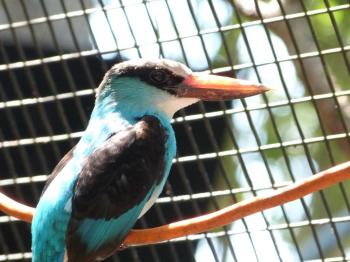
Blue-breasted Kingfisher (Halcyon malimbica) at LPZ by Lee

Blue-breasted Kingfisher (Halcyon malimbica) at LPZ by Lee – taken last week

Many, O LORD my God, are thy wonderful works which thou hast done, and thy thoughts which are to us-ward: they cannot be reckoned up in order unto thee: if I would declare and speak of them, they are more than can be numbered. (Psalms 40:5 KJV)

(Relocated)