Cranes know when it’s time to move south for winter. And robins, warblers, and bluebirds know when it’s time to come back again. But my people? My people know nothing, not the first thing of GOD and his rule. (Jeremiah 8:7 MSG)
How long will the land have grief, and the plants of all the land be dry? because of the sins of the people living in it, destruction has overtaken the beasts and the birds; because they said, God does not see our ways. (Jeremiah 12:4 BBE)
What an amazing animal! God did some very special engineering from the git-go! None of this “grocery store” new and improved nonsense. He got it entirely right the first time.
The Amazing Camel and It’s Creator
(From Moody Press)
If you ever doubted that God exists, Meet the Very Technical, Highly Engineered Dromedary Camel.
When I’m hungry, I’ll eat almost anything-A leather bridle, a piece of rope, my master’s tent, Or a pair of shoes.
My mouth is so tough a thorny cactus doesn’t bother it. I love to chow down grass and other plants That grow here on the Arabian desert.
I’m a dromedary camel, the one-hump kind That lives on hot deserts in the Middle East.
My hump, all eighty pounds of it, Is filled with fat-my body fuel-not water as some people believe. My Mighty Maker gave it to me because He knew I wouldn’t always be able to find food As I travel across the hot sands. When I don’t find any chow, my body automatically Takes fat from the hump, feeds my system, And keeps me going strong. This is my emergency food supply.
If I can’t find any plants to munch, my body uses up my hump. When the hump gets smaller, it starts to tip to one side. But when I get to a nice oasis and begin to eat again, My hump soon builds back to normal.
I’ve been known to drink twenty-seven gallons of water in ten minutes. My Master Designer made me in such a fantastic way that In a matter of minutes all the water I’ve swallowed Travels to the billions of microscopic cells that make up my flesh.
Naturally, the water I swallow first goes into my stomach. There thirsty blood vessels absorb and carry it to every part of my body. Scientists have tested my stomach and found it empty Ten minutes after I’ve drunk twenty gallons.
In an eight hour day I can carry a four hundred pound load A hundred miles across a hot, dry desert And not stop once for a drink or something to eat. In fact, I’ve been known to go eight days without a drink, But then I look a wreck. I lose 227 pounds, my ribs show through my skin, And I look terribly skinny. But I feel great! I look thin because the billions of cells lose their water. They’re no longer fat. They’re flat.
Normally my blood contains 94 percent water, just like yours. But when I can’t find any water to drink, The heat of the sun gradually robs a little water out of my blood. Scientists have found that my blood can lose up to 40 percent of its water, and I’m still healthy.
Doctor’s say human blood has to stay very close to 94 percent water. If you lose 5 percent of it, you can’t see anymore; 10 percent, you can’t Hear and you go insane; 12 percent, your blood is as thick as molasses And your heart can’t pump the thick stuff. It stops, and you’re dead.
But that’s not true with me. Why? Scientists say my blood is different. My red cells are elongated. Yours are round. Maybe that’s what makes the difference.
This proves I’m designed for the desert, Or the desert is designed for me. Did you ever hear of a design without a Designer?
After I find a water hole, I’ll drink for about ten minutes And my skinny body starts to change almost immediately. In that short time my body fills out nicely, I don’t look skinny anymore, And I gain back the 227 pounds I lost.
Even though I lose a lot of water on the desert, My body conserves it too. Way in the beginning when my intelligent Engineer made me, He gave me a specially designed nose that saves water. When I exhale, I don’t lose much. My nose traps that warm, moist air from my lungs And absorbs it in my nasal membranes.
Tiny blood vessels in those membranes take that back into my blood. How’s that for a recycling system? Pretty cool, isn’t it. It works because my nose is cool. My cool nose changes that warm moisture in the air From my lungs into water.
But how does my nose get cool? I breath in hot dry desert air, And it goes through my wet nasal passages. This produces a cooling effect, and my nose stays as much as 18 degrees cooler than the rest of my body.
I love to travel the beautiful sand dunes. It’s really quite easy, because My Creator gave me specially engineered sand shoes for feet. My hooves are wide, and they get even wider when I step on them. Each foot has two long, bony toes with tough, leathery skin between my soles, are a little like webbed feet.
They won’t let me sink into the soft, drifting sand. This is good, because often my master wants me to carry him one hundred miles across the desert in just one day. (I troop about ten miles per hour.)
Sometimes a big windstorm comes out of nowhere, bringing flying sand with it. My Master Designer put special muscles in my nostrils that close the openings, keeping sand out of my nose but still allowing me enough air to breathe.
My eyelashes arch down over my eyes like screens, keeping the sand and sun out but still letting me see clearly. If a grain of sand slips through and gets in my eye, the Creator took care of that too. He gave me an inner eyelid that automatically wipes the sand off my eyeball just like a windshield wiper.
Some people think I’m conceited because I always walk around with my head held high and my nose in the air.
But that’s just because of the way I’m made. My eyebrows are so thick and bushy I have to hold my head high to peek out from underneath them. I’m glad I have them though. They shade my eyes from the bright sun.
Desert people depend on me for many things. Not only am I their best form of transportation, but I’m also their grocery store. Mrs. Camel gives very rich milk that people make into butter and cheese. I shed my thick fur coat once a year, and that can be woven into cloth. A few young camels are used for beef, but I don’t like to talk about that.
For a long time we camels have been called the “ships of the desert” because of the way we sway from side to side when we trot. Some of our riders get seasick.
I sway from side to side because of the way my legs work. Both legs on one side move forward at the same time, elevating that side. My “left, right left, right” motion makes my rider feel like he is in a rocking chair going sideways.
When I was six months old, special knee pads started to grow on my front legs. The intelligent Creator knew I had to have them. They help me lower my 1000 pounds to the ground.
If I didn’t have them, my knees would soon become sore and infected, and I could never lie down. I’d die of exhaustion.
By the way, I don’t get thick knee pads because I fall on my knees. I fall on my knees because I already have these tough pads. Someone very great thought of me and knew I needed them. He designed them into my genes.
It’s real difficult for me to understand how some people say I evolved into what I now am. I’m very technical, highly engineered dromedary camel. Things like me don’t just happen.
They’re planned on a drawing board by Someone very brilliant, Someone very logical.
John 1:1 says,
“In the beginning was the Word.
And the Word was with God,
and the Word was God.”
The Word means “logical, intelligent One.”
(Received in an e-Mail, but found it on the Lakeside Church of Christ website. Not sure who to give the credit to. Could not find it on the Moody site. We do know the ultimate credit goes to – The Creator.)
White-breasted Nuthatch or Birds Illustrated by Color Photography, 1897
From col. F. M. Woodruff.Copyrighted by Nature Study Pub. Co., 1897, Chicago.
THE WHITE-BREASTED NUTHATCH.
EARLY every one readily recognizes this species as it runs up and down and around the branches and trunks of trees in search of insect food, now and then uttering its curious Quauk, quauk, quauk. The White-breasted Nuthatch is often improperly called “Sapsucker,” a name commonly applied to the Downy Woodpecker and others. It is a common breeding bird and usually begins nesting early in April, and two broods are frequently reared in a season. For its nesting place it usually selects the decayed trunk of a tree or stub, ranging all the way from two to sixty feet above the ground. The entrance may be a knot hole, a small opening, or a small round hole with a larger cavity at the end of it. Often the old excavation of the Downy Woodpecker is made use of. Chicken feathers, hair, and a few dry leaves loosely thrown together compose the nest.
This Nuthatch is abundant throughout the State of Illinois, and is a permanent resident everywhere except perhaps of the extreme northern counties. It seems to migrate in spring and return in autumn, but, in reality, as is well known, only retreats to the woodlands to breed, emerging again when the food supply grows scant in the autumn.
The Nuthatches associate familiarly with the Kinglets and Titmice, and often travel with them. Though regarded as shy birds they are not really so. Their habits of restlessness render them difficult of examination. “Tree-mice” is the local name given them by the farmers, and would be very appropriate could they sometimes remain as motionless as that diminutive animal.
Careful observation has disclosed that the Nuthatches do not suck the sap from trees, but that they knock off bits of decayed or loose bark with the beak to obtain the grubs or larvae beneath. They are beneficial to vegetation. Ignorance is responsible for the misapplied names given to many of our well disposed and useful birds, and it would be well if teachers were to discourage the use of inappropriate names and familiarize the children with those recognized by the best authorities.
Referring to the Nuthatches Mr. Baskett says: “They are little bluish gray birds, with white undervests—sometimes a little soiled. Their tails are ridiculously short, and never touch the tree; neither does the body, unless they are suddenly affrighted, when they crouch and look, with their beaks extended, much like a knot with a broken twig on it. I have sometimes put the bird into this attitude by clapping my hands loudly near the window. It is an impulse that seems to come to the bird before flight, especially if the head should be downward. His arrival is sudden, and seems often to be distinguished by turning a somersault before alighting, head downward, on the tree trunk, as if he had changed his mind so suddenly about alighting that it unbalanced him.
“I once saw two Nuthatches at what I then supposed was a new habit. One spring day some gnats were engaged in their little crazy love waltzes in the air, forming small whirling clouds, and the birds left off bark-probing and began capturing insects on the wing. They were awkward about it with their short wings, and had to alight frequently to rest. I went out to them, and so absorbed were they that they allowed me to approach within a yard of a limb that they came to rest upon, where they would sit and pant till they caught their breath, when they went at it again. They seemed fairly to revel in a new diet and a new exercise.”
Summary:
WHITE-BREASTED NUTHATCH.—Sitta carolinensis. Other name: “Sapsucker,” improperly called.
Range—Eastern United States and British Provinces.
Nest—Decayed trunk of tree or stub, from two to six feet from ground, composed of chicken feathers, hair, and dry leaves.
Eggs—Five to eight; white with a roseate tinge, speckled with reddish brown and a slight tinge of purple.
White-breasted Nuthatch (Sitta carolinensis) by Matt Wagner
Lee’s Addition:
If a bird’s nest should chance to be before you in the way, in any tree or on the ground, with young ones or eggs, and the mother bird is sitting on the young or on the eggs, you shall not take the mother bird with the young. (Deuteronomy 22:6 AMP)
This bird belongs to the Sittidae – Nuthatches Family and is a cousin to 27 other Nuthatches around the world.
The White-breasted Nuthatch (Sitta carolinensis) is a small songbird of the nuthatch family which breeds in old-growth woodland across much of temperate North America. It is a stocky bird, with a large head, short tail, powerful bill and strong feet. The upperparts are pale blue-gray, and the face and underparts are white. It has a black cap and a chestnut lower belly. The nine subspecies differ mainly in the color of the body plumage.
Like other nuthatches, the White-breasted Nuthatch forages for insects on trunks and branches, and is able to move head-first down trees. Seeds form a substantial part of its winter diet, as do acorns and hickory nuts that were stored by the bird in the fall. The nest is in a hole in a tree, and the breeding pair may smear insects around the entrance as a deterrent to squirrels. Adults and young may be killed by hawks, owls and snakes, and forest clearance may lead to local habitat loss, but this is a common species with no major conservation concerns over most of its range.
The White-breasted Nuthatch has a large head, short tail, short wings, a powerful bill and strong feet; it is 5–6 in (13–14 cm) long, with a wingspan of 8–11 in (20–27 cm) and a weight of 0.64–1.06 oz (18–30 g).
The adult male of the nominate subspecies, S. c. carolinensis, has pale blue-gray upperparts, a glossy black cap (crown of the head), and a black band on the upper back. The wing coverts and flight feathers are very dark gray with paler fringes, and the closed wing is pale gray and black, with a thin white wing bar. The face and the underparts are white. The outer tail feathers are black with broad diagonal white bands across the outer three feathers, a feature readily visible in flight.
The female has, on average, a narrower black back band, slightly duller upperparts and buffer underparts than the male. Her cap may be gray, but many females have black caps, and cannot be reliably distinguished from the male in the field. In the northeastern United States, at least 10% of females have black caps, but the proportion rises to 40–80% in the Rocky Mountains, Mexico and the southeastern U.S. Juveniles are similar to the adult, but duller plumaged.
Like other nuthatches, this is a noisy species with a range of vocalizations. The male’s mating song is a rapid nasal qui-qui-qui-qui-qui-qui-qui. The contact call between members of a pair, given most frequently in the fall and winter is a thin squeaky nit, uttered up to 30 times a minute. A more distinctive sound is a shrill kri repeated rapidly with mounting anxiety or excitement kri-kri-kri-kri-kri-kri-kri-kri; the Rocky Mountains and Great Basin subspecies have a higher, faster yididitititit call,[2] and Pacific birds a more nasal beeerf.
Three other, significantly smaller, nuthatches have ranges which overlap that of White-breasted, but none has white plumage completely surrounding the eye. Further distinctions are that the Red-breasted Nuthatch has a black eye line and reddish underparts, and the Brown-headed and Pygmy Nuthatches each have a brown cap, and a white patch on the nape of the neck.
The White-breasted Nuthatch is monogamous, and pairs form following a courtship in which the male bows to the female, spreading his tail and drooping his wings while swaying back and forth; he also feeds her morsels of food. The pair establish a territory and then remain together year-round until one partner dies or disappears. The nest cavity is usually a natural hole in a decaying tree, sometimes an old woodpecker nest. The nest hole is usually 10–40 ft (3–12 m) high in a tree and is lined with fur, fine grass, and shredded bark. The clutch is five to nine eggs which are creamy-white, speckled with reddish brown. The eggs are incubated by the female for 13 to 14 days prior to hatching, and the chicks fledge in a further 18 to 26 days. Both adults feed the chicks in the nest and for about two weeks after fledging, and the male also feeds the female while she is incubating. This species of nuthatch roosts in tree holes or behind loose bark when not breeding, and has the unusual habit of removing its faeces from the roost site in the morning. It usually roosts alone except in very cold weather, when up to 29 birds have been recorded together. (From Wikipedia with editing)
The above article is an article in the monthly serial for September 1897 “designed to promote Knowledge of Bird-Live.” These include Color Photography, as they call them, today they are drawings. There are at least three Volumes that have been digitized by Project Gutenberg.
I saw such a sorrowful sight, my dears,
Such a sad and sorrowful sight,
As I lingered under the swaying vines,
In the silvery morning light.
The skies were so blue and the day was so fair
With beautiful things untold,
You would think no sad and sorrowful thing
Could enter its heart of gold.
A fairy-like cage was hanging there,
So gay with turret and dome.
You’d be sure a birdie would gladly make
Such a beautiful place its home.
But a wee little yellow-bird sadly chirped
As it fluttered to and fro;
I know it was longing with all its heart
To its wild-wood home to go.
I heard a whir of swift-rushing wings,
And an answering gladsome note;
As close to its nestlings’ prison bars,
I saw the poor mother bird float.
I saw her flutter and strive in vain
To open the prison door.
Then sadly cling with drooping wing
As if all her hopes were o’er.
But ere I could reach the prison house
And let its sweet captive free,
She was gone like a yellow flash of light,
To her home in a distant tree.
“Poor birdie,” I thought, “you shall surely go,
When mamma comes back again;”
For it hurt me so that so small a thing
Should suffer so much of pain.
And back in a moment she came again
And close to her darling’s side
With a bitter-sweet drop of honey dew,
Which she dropped in its mouth so wide.
Then away, with a strange wild mournful note
Of sorrow, which seemed to say
“Goodbye, my darling, my birdie dear,
Goodbye for many a day.”
A quick wild flutter of tiny wings,
A faint low chirp of pain,
A throb of the little aching heart
And birdie was free again.
Oh sorrowful anguished mother-heart,
’Twas all that she could do,
She had set it free from a captive’s life
In the only way she knew.
Poor little birdie! it never will fly
On tiny and tireless wing.
Through the pearly blue of the summer sky,
Or sing the sweet songs of spring.
And I think, little dears, if you had seen
The same sad sorrowful sight,
You never would cage a free wild bird
To suffer a captive’s plight.
—Mary Morrison.
Red-vented Bulbul (Pycnonotus cafer) at Zoo Miami by Lee
Lee’s Addition:
As a cage is full of birds, so are their houses full of deceit and treachery; therefore they have become great and grown rich, (Jeremiah 5:27 AMP)
It is always sad to see the birds in a cage. Yes, I enjoy seeing birds from foreign lands and also birds that are endangered at the Zoos. Most Zoos have Aviaries which let the birds fly around more freely, but even they “cage” them at times. We were just at the Zoo this past week and they added some new Cockatoos. Unfortunately, they are in cages, large cages, but still cages. One of the few times I have really felt sorry for them. It makes it hard to photograph through those wire also.
Zoo Miami’s Wings of Asia was one of the nicest Aviaries I have been to so far. They have around 54,ooo square feet of space to fly around in and it is very well landscaped. Made me feel like I was outside actually “birdwatching.” You had to really search for many of the birds, not just look in a cage. We go to Lowry Park Zoo in Tampa and they have a several nice sized aviaries for the birds to fly around in and not feel so “couped up.”
This just happened to be the one of the next articles we have been covering in the Birds Illustrated by Color Photography.
The above article is an article in the monthly serial for September 1897 “designed to promote Knowledge of Bird-Live.” These include Color Photography, as they call them, today they are drawings. There are at least three Volumes that have been digitized by Project Gutenberg.
The LORD recompense thy work, and a full reward be given thee of the LORD God of Israel, under whose wings thou art come to trust. (Ruth 2:12 KJV)
While searching for “wing” or “wings” in my e-Sword, I discovered this really great verse. Let’s dig into it.
Searching further using “under” and “wing” here are a few more verses that sort of relate to the verse above:
Keep me as the apple of the eye, hide me under the shadow of thy wings, (Psalms 17:8 KJV)
How excellent is thy lovingkindness, O God! therefore the children of men put their trust under the shadow of thy wings. (Psalms 36:7 KJV)
He shall cover thee with his feathers, and under his wings shalt thou trust: his truth shall be thy shield and buckler. (Psalms 91:4 KJV)
Matthew 23:37 and Luke 13:34 mention being gathered under the wing, but they were not willing. Also, in Birds of the Bible – Under His Wing we covered. no pun intended, how birds protect their young under their wings and how God protects us. But the verse above seem to imply our trust.
What is being trusted? Boaz is implying that Ruth is trusting in the “LORD God of Israel.” She is from another country, another culture and religious way of life, but has turned her trust over to the LORD. That is something I did personally way back in 1960. I put my trust in the Lord to be my personal Savior. It was the best decision of my life.
Storks Shadowing Baby in Lakeland by Dan
In the Psalms verses, we can know that the Lord keeps His Eye on His own and we should desire to be the “apple of the eye.” Notice in the other verses that while we are under the wings we are trusting. Who? The Lord or LORD. Why do we trust? Wow! Look around at all the Lord has done just in creation and care of the birds. How about our care? We know through promises all through the Word of God that He cares for us. We know He doesn’t lie or do things for our harm. We also know that He is just and will give judgment when needed. We could go on and on, but you can also see that the Lord Jesus Christ is “trustworthy.”
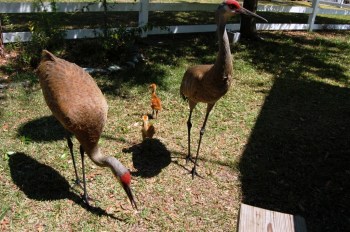
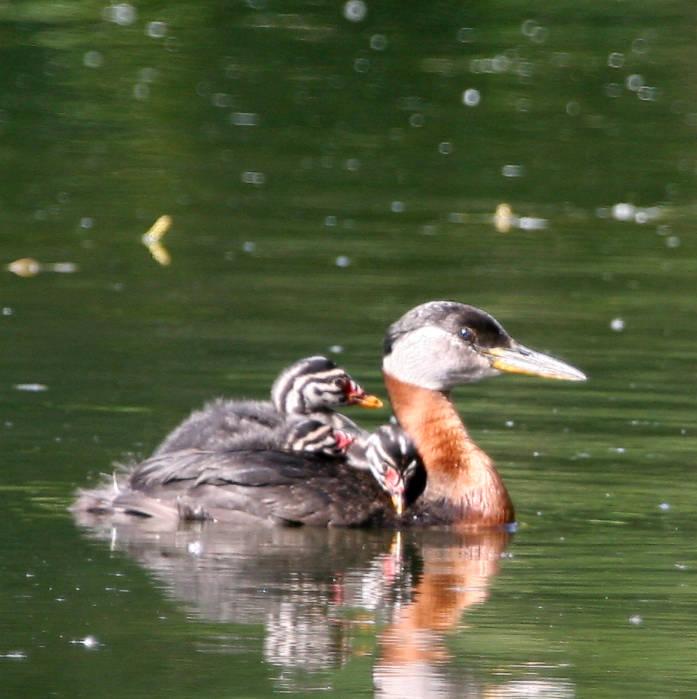
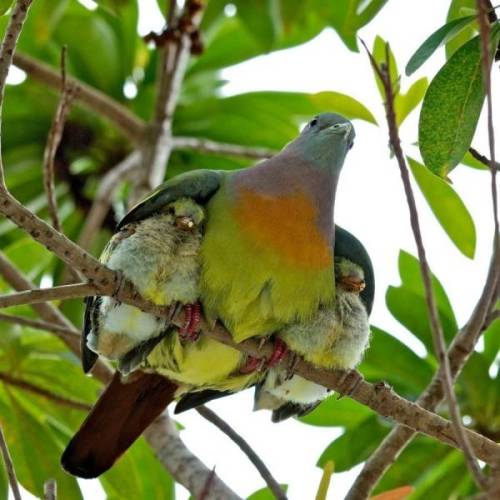
We know the birds trust their parents to protect them while they are under their wings. Should we not trust the Savior while we are under His wings?
Here is a quote from the Believer’s Bible Commentary:
“2:4-12 When Boaz arrived from Bethlehem, he asked the identity of the young woman. Learning that she was Naomi’s daughter-in-law, he cordially invited her to continue gleaning in his fields and to share the water provided for his workers. In praising her for the loyal and selfless step that she had taken, Boaz concluded with a little prayer for her:
The LORD repay your work, and a full reward be given you by the LORD God of Israel, under whose wings you have come for refuge (v. 12).
Leon Morris comments:
In due course, the prayer was answered through him who uttered it. He recognizes the religious aspect of Ruth’s change of country by saying that she has come to trust (AV) under Yahweh’s wings. The imagery is probably that of a tiny bird struggling under the wings of a foster-mother. It gives a vivid picture of trust and security. . . .
From J. Vernon McGee:
“She had come to trust the Lord God. This is the reason she had left the land of Moab and made that radical decision. She had said that the God of Naomi would be her God. She had turned from idolatry to the living and true God. This woman has come to trust God; she was one of His children. Therefore this is the wonderful testimony that she had there in the land of Israel. And Boaz says, “May a full reward be given to you. May you be recompensed for this decision.”
From Matthew Henry:
“(5.) He (Boaz) prayed for her (Ruth_2:12): The Lord recompense thy work. Her strong affection to the commonwealth of Israel, to which she was by birth an alien, was such a work of the divine grace in her as would certainly be crowned with a full reward by him under whose wings she had come to trust. Note, Those that by faith come under the wings of the divine grace, and have a full complacency and confidence in that grace, may be sure of a full recompense of reward for their so doing. From this expression, the Jews describe a proselyte to be one that is gathered under the wings of the divine majesty.”
From John Gill’s Exposition:
“under whose wings thou art come to trust; whom she professed to be her God, and whom she determined to serve and worship; whose grace and favour she expected, and to whose care and protection she committed herself: the allusion is either to fowls, which cover their young with their wings, and thereby keep them warm and comfortable, and shelter and protect them, see Psa_36:7 or to the wings of the cherubim overshadowing the mercy seat, Exo_25:20 and the phrase is now adopted by the Jews to express proselytism; and so the Targum here,”thou art come to be proselyted, and to be hid under the wings of the Shechinah of his glory,”or his glorious Shechinah.”
Marian (Naturalist at Avon Park Range) and Lee 2004
I beseech you therefore, brethren, by the mercies of God, that you present your bodies a living sacrifice, holy, acceptable to God, which is your reasonable service. And do not be conformed to this world, but be transformed by the renewing of your mind, that you may prove what is that good and acceptable and perfect will of God. (Romans 12:1-2 NKJV)
The WordPress.com stats helper monkeys prepared a 2012 annual report for this blog. (Birds of the Bible for Kids)
Here’s an excerpt:
600 people reached the top of Mt. Everest in 2012. This blog got about 3,700 views in 2012. If every person who reached the top of Mt. Everest viewed this blog, it would have taken 6 years to get that many views.







 Birds of the Bible For Kids