Birdwatching Terms – About’s Bird Bill Parts

Bird Bill Parts From About
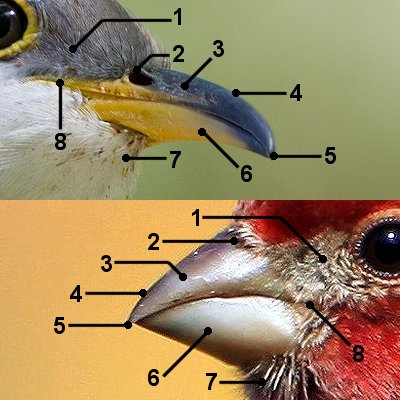
About's Bill-Parts ©Dan Pancamo/nigel

About’s Bill-Parts ©Dan Pancamo/nigel

Bird Bill Parts.  ©Dan Pancamo / nigel

The dove came to him toward evening, and behold, in her beak was a freshly picked olive leaf. So Noah knew that the water was abated from the earth. (Genesis 8:11 NASB)

A bird’s bill, also called a beak, is a critical piece of its anatomy, not only for foraging, defense, singing and other behaviors, but also for birders to make a proper identification. Depending on the bird, a bill can provide clues to far more than species: age, gender, diet and foraging behaviors can all be learned by studying a bill. By knowing the basic parts of a bill and the bird’s face and head immediately adjacent to the bill, birders can be better prepared to look for the subtle clues bills can reveal about every bird.

Overall Bill Features

Some of the most important aspects of a bird’s bill are not specific features, but the general jizz of the bill. When first studying bird bills, look for…

  • Size: How large does the bill appear in proportion to the bird’s head? Check for length as compared to the length of the head as well as the width of the bill and how that width may change along the bill’s length.
  • Shape: Bill shapes vary widely, from delicate triangles or thin, needle-like bills to thick, bulbous bills to sharply curved bills to radical shapes that include spoon-like tips or horny casques. When the shape is very unique, that can be a diagnostic clue for a bird’s identity even if other field marks cannot be seen.
  • Color: The color of a bill can be a clue for species, gender or age. Note the overall color as well as any specific markings, such as a colored tip or base, subterminal band or color differences between the top and bottom of the bill.

Specific Bill Parts

When birders can get a good look at a bill, there are a number of different parts that can yield clues about the bird’s identity, such as…

  1. Lores: While not part of the bill itself, the lores are the space between the base of a bird’s bill and the forward edge of its eyes. This area may be a different color or show a smudge or eye line that can be an identification clue.
  2. Nares: More commonly called the nostrils, the position of the nares as well as their size and shape are important to note for bird’s identities. In some types of birds, such as raptors, the nares are covered by a fleshy cere, while in others, such as many seabirds, elongated tube-like nares help filter seawater.
  3. Maxilla: Also called the upper mandible, the maxilla is the top half of a bird’s bill. Size, length and shape will vary, and some birds have knobs, fleshy wattles or other features that distinguish the maxilla.
  4. Culmen: Difficult to see on many bird species, the culmen is the center line drawn down the length of a bird’s maxilla. In some species, this can be a very distinct peak that divides the sides of the bill, while it may not be noticeable in other species.
  5. Tip: The tip of a bird’s bill may be different shapes, such as blunt or sharply pointed, depending on the bird’s general diet. Hooks are common at the tip of carnivorous birds’ bills, while many waterfowl have small bumps, called nails, on the tip of the maxilla.
  6. Mandible: The lower half of a bird’s bill is called the mandible or lower mandible. The color may vary from the maxilla either along the entire length or just at one end, and can be a great clue for identification. Some birds, such as many gulls, may show spots or other markings just on the mandible.
  7. Chin: Not directly part of the bill, the chin is the area of feathers immediately adjacent to the base of a bird’s mandible. In some species, the color of the chin may vary from the throat or face, providing a valuable identification clue.
  8. Gape: This is a fleshy area at the base of the bill where the upper and lower mandibles meet. In young birds, it is often enlarged or may seem so because the birds have not developed their mature feathers to help conceal it, and it may be brightly colored so their mouths are more noticeable when they beg for food. On some species, such as the bananaquit, the gape remains colorful on adult birds.
Bananaquit (Coereba flaveola) by Raymond Barlow

Bananaquit (Coereba flaveola) by Raymond Barlow

It can be difficult to see many of the subtle details of a bird’s bill, but understanding the different bill parts is a great way for birders to refine their identification skills and learn more about every bird they see.

Photo – Yellow-Billed Cuckoo (Above) © Dan Pancamo
Photo – House Finch (Below) © nigel

*

This is a good introduction to the bird’s bill. Look for more articles on the individual parts of the beak.

From About Birding/Wild Birds – Bird Identification

More Birdwatching Terms 

Birdwatching Tips

*


Child’s Book of Water Birds – Re-visited

Child's Book of Water Birds - Book Cover

The Child’s Book of Water Birds

Revisited

An anonymous writer wrote the Child’s Book of Water Birds in 1855. You can see how Project Gutenberg published it as an e-book. (Public Domain) CLICK HERE

Below are the links to my “Re-visited” versions here. Moved these over from the Birds of the Bible for Kids blog and can be found in the Kid’s Section under Watching Birds.

The six different birds were written to a very young reader. I trust you will enjoy reading them for yourself or to your children or grand-children. They can be used to introduce you/them to birds.

Here are my versions of the Six Birds:

The Swan

Childs Bk of Water Birds swan

The Coot

Childs Bk of Water Birds coot

The Dabchick

Childs Bk of Water Birds dabchick

The Teal

Childs Bk of Water Birds teal

The Goose

Childs Bk of Water Birds goose

The Oystercatcher

Childs Bk of Water Birds oystercatcher

*

The Bible tells us that we are to

Train up a child in the way he should go: and when he is old, he will not depart from it. (Proverbs 22:6 KJV)

Introducing children to the amazing birds the Lord has created is a tiny step to help with that training. Introducing them to the Lord Jesus Christ, is the major step.

Wordless Birds

*

Bible Birds Finally Moved

Snow Bunting (Plectrophenax nivalis) by Ray

Snow Bunting (Plectrophenax nivalis) by Ray

And let the beauty of the LORD our God be upon us: and establish thou the work of our hands upon us; yea, the work of our hands establish thou it. (Psalms 90:17 KJV)

Man goeth forth unto his work and to his labour until the evening. (Psalms 104:23 KJV)

Been working most of the day, moving the Bible Birds pages to Lee’s Birdwatching Adventures. It has been a challenge, but with dust still flying, they are now here.

I posted an article on the Birds of the Bible For Kids blog explaining the move of those articles. You might want to read that article because it affects this blog.

Changes On The Way

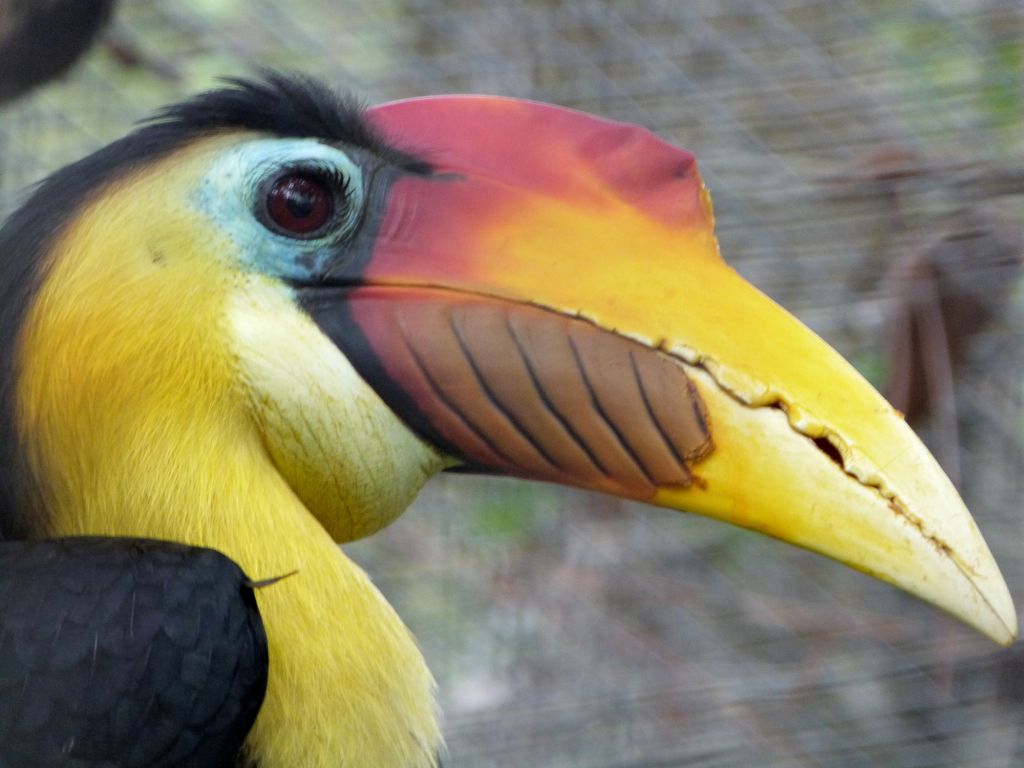
Wrinkled Hornbill (Aceros corrugatus) Brevard Zoo by Lee

Wrinkled Hornbill (Aceros corrugatus) Brevard Zoo by Lee

You can find the Bible Birds listed in the Kid’s Section. The side menu is now working also for that section. (I think it’s correct). Just hover your mouse over the Kid’s Section and you will see the Bible Birds, along with the Watching Birds, Bird Tales and Scripture Alphabet of Animals sections.

Thanks you for being patient while things are being moved around and I trust you will see much improvement soon. As mentioned in the Changes on the Way article, “Our purpose is to Glorify Our Lord and show forth His great creation through His Birds and other Critters.”

There is still lots of work ahead, as other sections are moved to the blog. Just wanted to let you know why things are changing and dust is flying still. I have another big challenge coming next, but that will have to hold for now.

*

Old Mr. Owl Writes A Book

Great Horned Owl (Bubo virginianus) by Bob-Nan

Great Horned Owl (Bubo virginianus) by Bob-Nan

OLD MR. OWL WRITES A BOOK

Daddys Bedtime Story Images

Old Mr. Owl Danced with the Rest

“Old Mr. Owl wanted to write a book and he asked the fairies how to set about doing it,” commenced daddy.

“‘Well,’ said the fairy queen, ‘it makes a good deal of difference, old Mr. Owl, what you want to write about.’

“‘What nonsense!’ he said. ‘It’s just that I want to know how to start off with my book. Just think what a marvelous book it will be—as for as long as folks can remember I’ve been called the Wise Bird—the bird who’s awake at night and whose eyes are so very bright!’

“‘Before I started saying what a fine book it would be, if I were you, I’d write it and give other people the chance to say so,’ said the fairy queen.

“Mr. Owl began to write with his pen, made out of one of Mr. Turkey Gobbler’s best feathers, on a large, flat stone, which he put in the hollow of his tree. Very late in the night, he awakened the fairies who had been sleeping, and told them to listen to his book. Then he called all the owls from the neighborhood with a loud hoot-hoot. But before he began to read, he said:

“‘I’ve not enough light. I will hurt my eyes—my beautiful, wise, big eyes.’

“You see he had made a special arrangement to have his own lights, and when he said that he hadn’t enough, from all over came countless little fireflies. They sparkled and gave the most beautiful light all over the woods, and Mr. Owl put his spectacles on his nose, and said:

“‘Now I see to perfection—which means quite all right.’ And Mr. Owl commenced reading his book.

“It told about the parties, balls, and picnics in fairyland, and of the wild adventures and happenings in the woods. The fairies were absolutely delighted that a book had been written with so much about them in it.

“And the fairy queen was more than happy, for the last chapter was all about her.

“‘Well,’ said Mr. Owl, ‘you made me ashamed of myself for boasting about my book before I had written it, and so the only thing I could do was to write a wise chapter all about you.’

“And the fairy queen smiled with pleasure and also with amusement—for Mr. Owl had certainly thought he could write a wise book—though the next time, perhaps, he wouldn’t say so before he had written it.

“The fireflies had been sparkling and flashing lights all this time, and finally they whispered:

“‘Have a dance, all of you; we’ll give you the light and dance too. It is not well to read books all the time—you must dance.’

“So they all ended off with a fine dance, and old Mr. Owl, with his book under his wing, danced with the rest of the owls and fairies. But before the evening was over he presented to the fairy queen a copy of his book, which said on the cover, ‘A BOOK, by Wise Mr. Owl.'”


Barred Owl by Ray

Barred Owl by Ray


Lee’s Addition:

But I say to every one of you, through the grace given to me, not to have an over-high opinion of himself, but to have wise thoughts, as God has given to every one a measure of faith. (Romans 12:3 BBE)

But he giveth more grace. Wherefore he saith, God resisteth the proud, but giveth grace unto the humble. (James 4:6 KJV)

Figured it was about time the first chapter was added to the Daddy’s Bedtime Bird Stories. We do need to be careful not to think too highly of ourselves. Let other complement what you do.

*

Another Bird Tale From

Daddy’s Bedtime Bird Stories – Gutenberg ebooks

By

Mary Graham Bonner

With four illustrations in color by
Florence Choate and Elizabeth Curtis

Daddys Bedtime Story Images

These stories first appeared in the American Press Association Service and the Western Newspaper Union.


Many of the sketches in this volume are the work of Rebecca McCann, creator of the “Cheerful Cherub,” etc.

Daddys Bedtime Story Images
Daddy’s Bedtime Bird Stories by Mary Graham Bonner – 1917

*

Links:

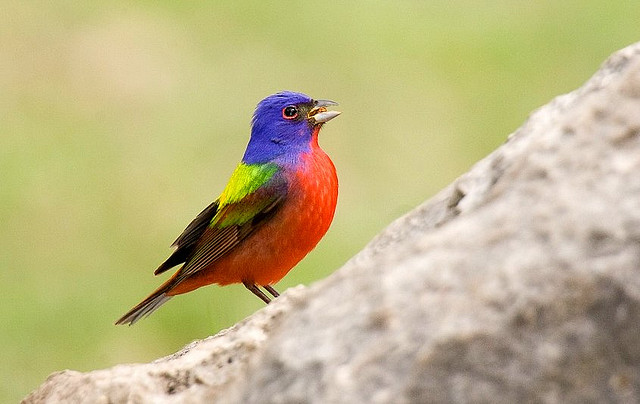
Painted Bunting (Passerina ciris) ©©Flickr

Bird Tales


Daddys Bedtime Story Images


 Daddy’s Bedtime Bird Stories


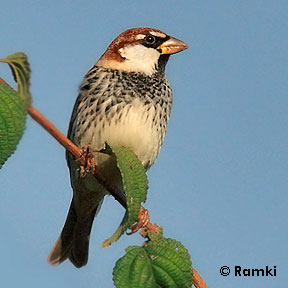
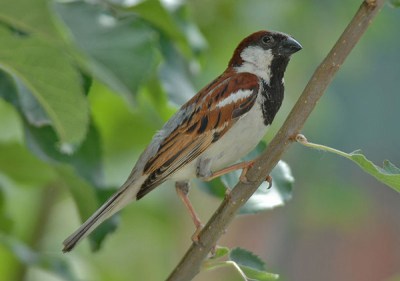
Spanish Sparrow (Passer hispaniolensis) by Nikhil Devasar


 Wordless Birds


Eastern Screech Owl (Megascops asio) baby Reinier Munguia

  Owls


*

Farmer’s Scarecrow Protect A Corn-Field

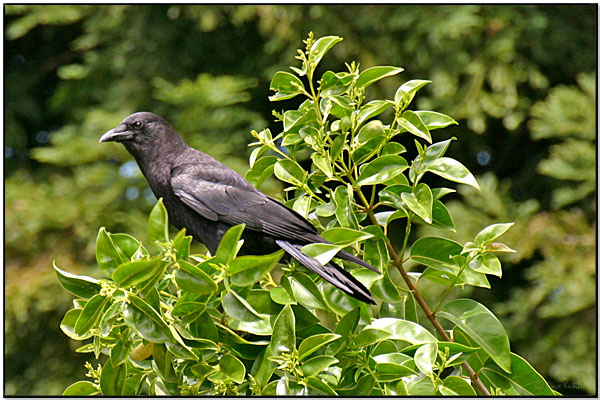
Hawaiian Crow (Corvus hawaiiensis) ©WikiC

Hawaiian Crow (Corvus hawaiiensis) ©WikiC

FARMER’S SCARECROW PROTECTS A CORN-FIELD

"It's a man."

“It’s a man.”

“To-night,” said daddy, “we are going to have the story of the meeting of the brownies, crows, and old Mr. Scarecrow. The crows had been giving feasts in a corn-field almost every morning bright and early before any of the big people who lived in the nearby farm-house were up. Such feasts as they did have! And one day they asked the brownies if they wouldn’t come to their next one.

“‘Caw-caw,’ said the crows together.

“‘Where are we going?’ asked one of the brownies teasingly, for they had been going around and around in circles and hadn’t reached any place.

“‘I don’t quite know,’ said Black Crown Crow, ‘it’s a question which is very hard to decide.’

“‘But we thought you had chosen a special spot,’ said one of the brownies.

“Black Crown Crow looked very sad, and his black wings seemed to droop. ‘It’s that guest I never asked. He’s causing all the trouble. How very rude it is of folks to come to a feast who aren’t invited, and to arrive before us, too. It’s very e-x-a-s-p-e-r-a-t-i-n-g!’

“‘Who is he?’ shouted the brownies, for every little while Black Crown Crow had gone ahead and then had come back. In these little trips he had seen right in the center of the corn-field a man—a real man, he thought, with a hat and a coat and trousers and boots—and carrying something which he couldn’t quite make out. It was either a great huge stick—or worse still—it was a gun. He shivered whenever he thought of that awful word gun.

“‘Caw-caw,’ again shrieked Black Crown Crow, ‘it’s a man and he has a gun—I’m sure it’s a gun. Now the rudeness of him! As if we wanted a man and a gun at our corn feast!’

“‘Oh, it was to have been a corn feast, and now the man has stopped it,’ laughed one of the brownies. ‘Well, such a joke! But to show you how nice we’ll be when we’re here ready for a party which can’t take place, we’ll give a nice party ourselves.’

“And the brownies scampered about a little grove near the corn-field, and there they made a bonfire over which they cooked some corn-meal which they had carried with them in their bags. They knew all along, ever since they’d started, where the crows wanted them to go for the feast, and they also knew that the farmer had made that scarecrow in his corn-field to frighten off Black Crown Crow and his followers.

“The brownies made a fine feast, but how they did chuckle among themselves that the pole dressed up as a man had succeeded in saving the corn for the people of the farm-house.”


American Crow (Corvus brachyrhynchos) by Daves BirdingPix

American Crow (Corvus brachyrhynchos) by Daves BirdingPix

Lee’s Addition:

Come, you children, listen to me; I will teach you the fear of the LORD. (Psalms 34:11 NKJV)

Looks like the Brownies, helped out the “exasperated” Crows and had a good laugh at the same time. The farmer was only trying to protect his crop and the crows were only trying to eat.

What can we learn?

  • The Farmer had a right to protect his food.
  • The Crows were afraid of something that wasn’t really frightening.
  • The Crows were hungry, but maybe they were “over-eating.”
  • The Brownies were helpful and provided food for them.

Consider the ravens, for they neither sow nor reap; they have no storeroom nor barn, and yet God feeds them; how much more valuable you are than the birds! (Luke 12:24 NASB)

This verse tells us that God will provide for the Ravens (and Crows, which are in the same bird family). The Crows may need to go to another field where they can be provided for. Also, are you ever afraid of something, that isn’t really scary?

If the Lord feeds the Crows and other birds, He provides for us and also helps our fears.

From

Daddy’s Bedtime Bird Stories – Gutenberg ebooks

By

Mary Graham Bonner

With four illustrations in color by
Florence Choate and Elizabeth Curtis

Daddys Bedtime Story Images


These stories first appeared in the American Press Association Service and the Western Newspaper Union.


Many of the sketches in this volume are the work of Rebecca McCann, creator of the “Cheerful Cherub,” etc.

Daddy's Bedtime Bird Stories by Mary Graham Bonner - 1917

*
Daddy’s Bedtime Bird Stories by Mary Graham Bonner – 1917

*

Links:

Painted Bunting (Passerina ciris) ©©Flickr


  Bird Tales


  Daddy’s Bedtime Bird Stories


Spanish Sparrow (Passer Hispaniolensis) female ©WikiC


  Wordless Birds


*


Bible Birds – Mighty Hand of God!

Mandarin Duck (Aix galericulata) by Dan at Zoo Miami

Mandarin Duck (Aix galericulata) by Dan at Zoo Miami

O Lord GOD, You have begun to show Your servant Your greatness and Your mighty hand, for what god is there in heaven or on earth who can do anything like Your works and Your mighty deeds? (Deuteronomy 3:24 NKJV)

(Relocated)