
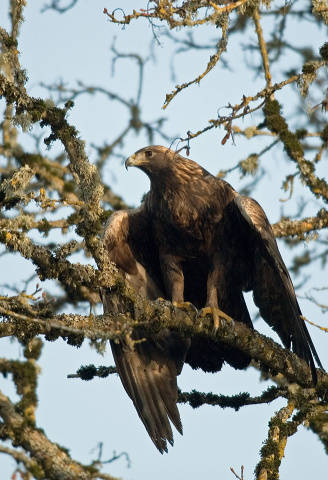
Golden Eagle (Aquila chrysaetos) ©USFWS
Golden Eagle (Aquila chrysaetos) ©USFWS

Griffon Vulture (Gyps fulvus) WikiC
And these you shall regard as an abomination among the birds; they shall not be eaten, they are an abomination: the eagle, the vulture, the buzzard, (Leviticus 11:13 NKJV)
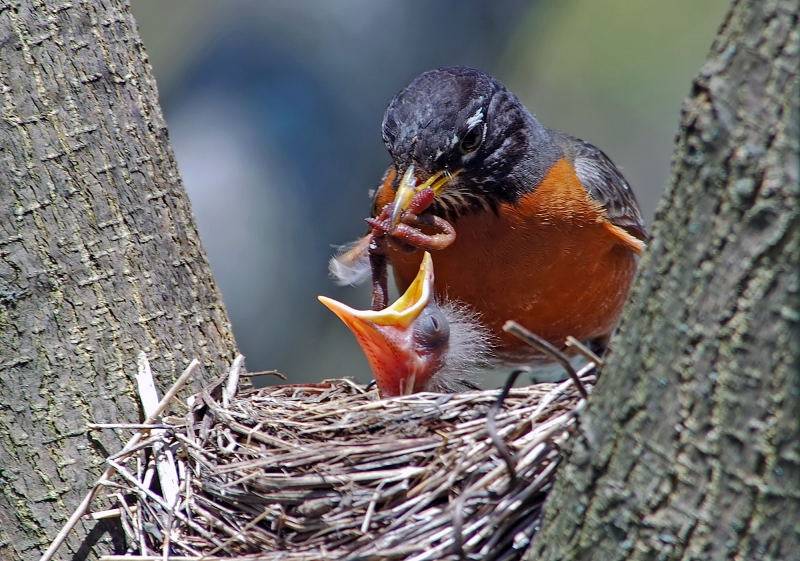
American Robin (Turdus migratorius)with youngsters by Raymond Barlow
This is for every blessed parent who so anxiously works hard in raising their kids in the way of the Lord…
And for the kids being fed by their parents.
Birds emerge from the shell blind and so weak
they can’t even hold their heads up.
Parents must feed babies frequently because
baby birds digest their food quickly.
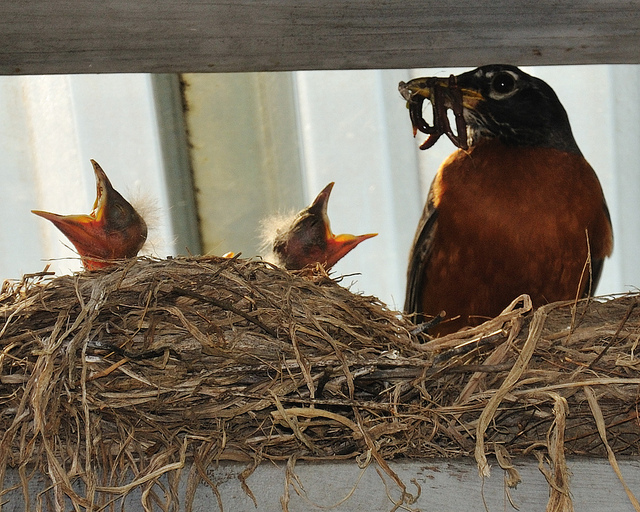
American Robin (Turdus migratorius) with young in nest
Orni-Theology
If birds can feed so much to their chicks every day,
“In the beginning was the Word, and the Word was with God, and the Word was God.” John 1:1/blockquote>
*

Mandarin Duck (Aix galericulata) by Dan
Great are the works of the LORD, studied by all who delight in them. (Psalms 111:2 ESV)
Here is a neat blog worth looking at to see all the beautiful color that God put in Birds.
Enjoy the beauty of these birds.
*
This is by N7QVC’s Christian Blog.
*

Brown Pelican (Pelecanus occidentalis) by Ray
What an interesting video. Just had to share it.
I am like a pelican of the wilderness; I am like an owl of the desert. (Psalms 102:6 NKJV)
They are mentioned 3 times in Scripture. Isaiah 34:11 and Zephaniah 2:14 and the previous verse.
*
*
“Abandoned by his flock, Bigbird the pelican stumbled ashore after a storm and was taken in by the staff of Greystoke Mahale in Tanzania. Watch as Bigbird learns to fly for the first time.”
*
*
(Found on Kid’s blog)
*
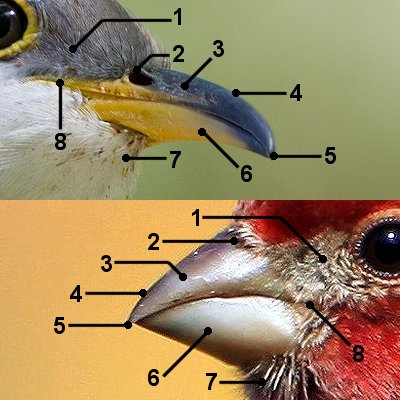
About’s Bill-Parts ©Dan Pancamo/nigel
Bird Bill Parts. ©Dan Pancamo / nigel
The dove came to him toward evening, and behold, in her beak was a freshly picked olive leaf. So Noah knew that the water was abated from the earth. (Genesis 8:11 NASB)
A bird’s bill, also called a beak, is a critical piece of its anatomy, not only for foraging, defense, singing and other behaviors, but also for birders to make a proper identification. Depending on the bird, a bill can provide clues to far more than species: age, gender, diet and foraging behaviors can all be learned by studying a bill. By knowing the basic parts of a bill and the bird’s face and head immediately adjacent to the bill, birders can be better prepared to look for the subtle clues bills can reveal about every bird.
Some of the most important aspects of a bird’s bill are not specific features, but the general jizz of the bill. When first studying bird bills, look for…
When birders can get a good look at a bill, there are a number of different parts that can yield clues about the bird’s identity, such as…

Bananaquit (Coereba flaveola) by Raymond Barlow
It can be difficult to see many of the subtle details of a bird’s bill, but understanding the different bill parts is a great way for birders to refine their identification skills and learn more about every bird they see.
Photo – Yellow-Billed Cuckoo (Above) © Dan Pancamo
Photo – House Finch (Below) © nigel
*
This is a good introduction to the bird’s bill. Look for more articles on the individual parts of the beak.

Green-billed Toucan (Ramphastos dicolorus) ©WikiC
The list of all the Birds of the World are updated about every four months. Which we try to keep up with their (I.O.C.) newest lists.
You are probably wondering why you would need it. Let me share some things about it and then give you some ideas how it my be handy for one of your school projects.
The I.O.C. is actually the International Ornithological Committee. “Ornithological” basically means those who study birds or bird related. They maintain a list of all the birds around the world. They set standards of how to name them, what scientific classification to place the birds in, and divide them into Orders and Families, etc.
They are needed because we may call a bird by one name, yet someone in a different country or area may call it by a different name. They realize that those two names belong to the same bird. It is a very hard task to keep track of all those 10,000 plus birds, but that is what they try to do.
They give every bird an English name as a standard. Then they also want every one to spell the words the same. For instance, some people spell the “Grey” or “Gray” to mean the same color. To keep things simple, all the birds are spelled as “Grey.” That is just one example.
There are committees all over the world working on the birds of the area they live in, then those committees get together to combine all the list to make one big list. That is what was just updated.
On our Birds of the World section, you will find the birds listed by Orders (40 main classifications), then by Families (240 groups of closely related birds). The reason all of that is not duplicated here would be very time-consuming. There are hundreds of pages and thousands of photos on that site.

Wood Duck (Aix sponsa) by Dan
Projects for school or your own information:
You know the name of a bird’s name, but need to find the Species name, Go to the Species Index to find these choices:
If you know that it called Madagascan something, go to the First Name of Bird index and choose the “M” page
If you know it is a Duck, go to the Last Name of Bird index and choose the “D – Last Name” page.
The Families have four indexes to help you find the Families of birds.
When you find your bird in the right family, almost every bird has a link to a photo or video.
I will share more tips on how to use those indexes in another article.
Another reason is because we believe the Lord created all the beautiful birds and He should get all the credit.
In the beginning God created the heavens and the earth. (Genesis 1:1 NKJV)
So God created great sea creatures and every living thing that moves, with which the waters abounded, according to their kind, and every winged bird according to its kind. And God saw that it was good. (Genesis 1:21 NKJV)
*
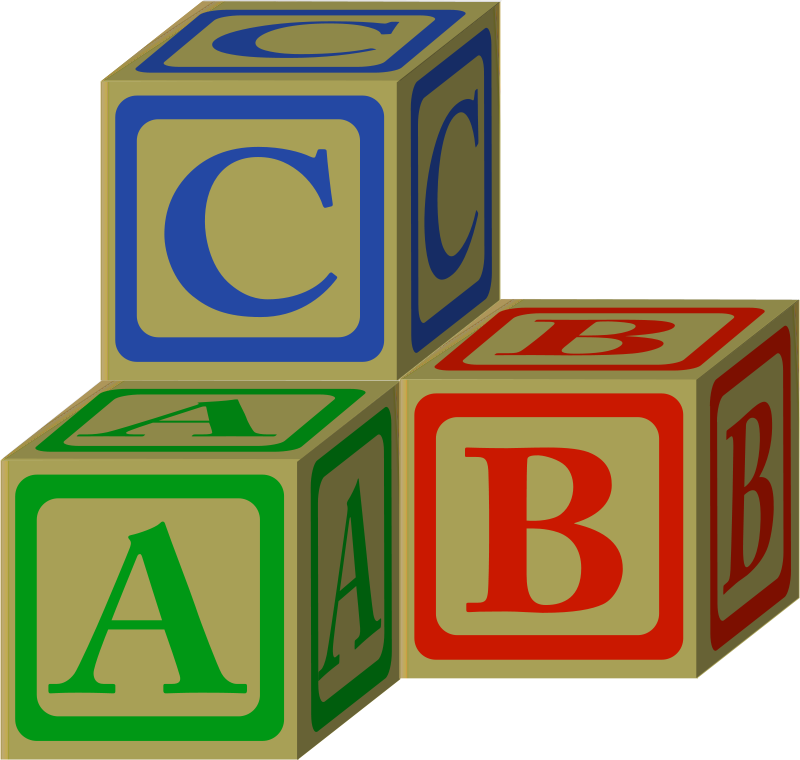
ABC’s of the Gospel
Lead in the sinner’s prayer.
(Adopted from Pastor Jerry Smith’s – Dealing With Children)
Use A Simple Plan – Above
Obtain permission from parents for baptism if they accept the Lord.
*
*

An anonymous writer wrote the Child’s Book of Water Birds in 1855. You can see how Project Gutenberg published it as an e-book. (Public Domain) CLICK HERE
Below are the links to my “Re-visited” versions here. Moved these over from the Birds of the Bible for Kids blog and can be found in the Kid’s Section under Watching Birds.
The six different birds were written to a very young reader. I trust you will enjoy reading them for yourself or to your children or grand-children. They can be used to introduce you/them to birds.
Here are my versions of the Six Birds:


*
The Bible tells us that we are to
Train up a child in the way he should go: and when he is old, he will not depart from it. (Proverbs 22:6 KJV)
Introducing children to the amazing birds the Lord has created is a tiny step to help with that training. Introducing them to the Lord Jesus Christ, is the major step.
*

Great Horned Owl (Bubo virginianus) by Bob-Nan

Old Mr. Owl Danced with the Rest
“Old Mr. Owl wanted to write a book and he asked the fairies how to set about doing it,” commenced daddy.
“‘Well,’ said the fairy queen, ‘it makes a good deal of difference, old Mr. Owl, what you want to write about.’
“‘What nonsense!’ he said. ‘It’s just that I want to know how to start off with my book. Just think what a marvelous book it will be—as for as long as folks can remember I’ve been called the Wise Bird—the bird who’s awake at night and whose eyes are so very bright!’
“‘Before I started saying what a fine book it would be, if I were you, I’d write it and give other people the chance to say so,’ said the fairy queen.
“Mr. Owl began to write with his pen, made out of one of Mr. Turkey Gobbler’s best feathers, on a large, flat stone, which he put in the hollow of his tree. Very late in the night, he awakened the fairies who had been sleeping, and told them to listen to his book. Then he called all the owls from the neighborhood with a loud hoot-hoot. But before he began to read, he said:
“‘I’ve not enough light. I will hurt my eyes—my beautiful, wise, big eyes.’
“You see he had made a special arrangement to have his own lights, and when he said that he hadn’t enough, from all over came countless little fireflies. They sparkled and gave the most beautiful light all over the woods, and Mr. Owl put his spectacles on his nose, and said:
“‘Now I see to perfection—which means quite all right.’ And Mr. Owl commenced reading his book.
“It told about the parties, balls, and picnics in fairyland, and of the wild adventures and happenings in the woods. The fairies were absolutely delighted that a book had been written with so much about them in it.
“And the fairy queen was more than happy, for the last chapter was all about her.
“‘Well,’ said Mr. Owl, ‘you made me ashamed of myself for boasting about my book before I had written it, and so the only thing I could do was to write a wise chapter all about you.’
“And the fairy queen smiled with pleasure and also with amusement—for Mr. Owl had certainly thought he could write a wise book—though the next time, perhaps, he wouldn’t say so before he had written it.
“The fireflies had been sparkling and flashing lights all this time, and finally they whispered:
“‘Have a dance, all of you; we’ll give you the light and dance too. It is not well to read books all the time—you must dance.’
“So they all ended off with a fine dance, and old Mr. Owl, with his book under his wing, danced with the rest of the owls and fairies. But before the evening was over he presented to the fairy queen a copy of his book, which said on the cover, ‘A BOOK, by Wise Mr. Owl.'”

Barred Owl by Ray
Lee’s Addition:
But I say to every one of you, through the grace given to me, not to have an over-high opinion of himself, but to have wise thoughts, as God has given to every one a measure of faith. (Romans 12:3 BBE)
But he giveth more grace. Wherefore he saith, God resisteth the proud, but giveth grace unto the humble. (James 4:6 KJV)
Figured it was about time the first chapter was added to the Daddy’s Bedtime Bird Stories. We do need to be careful not to think too highly of ourselves. Let other complement what you do.
*
Another Bird Tale From
By
Mary Graham Bonner
With four illustrations in color by
Florence Choate and Elizabeth Curtis

These stories first appeared in the American Press Association Service and the Western Newspaper Union.
Many of the sketches in this volume are the work of Rebecca McCann, creator of the “Cheerful Cherub,” etc.

*
Links:

*


 Birds of the Bible For Kids