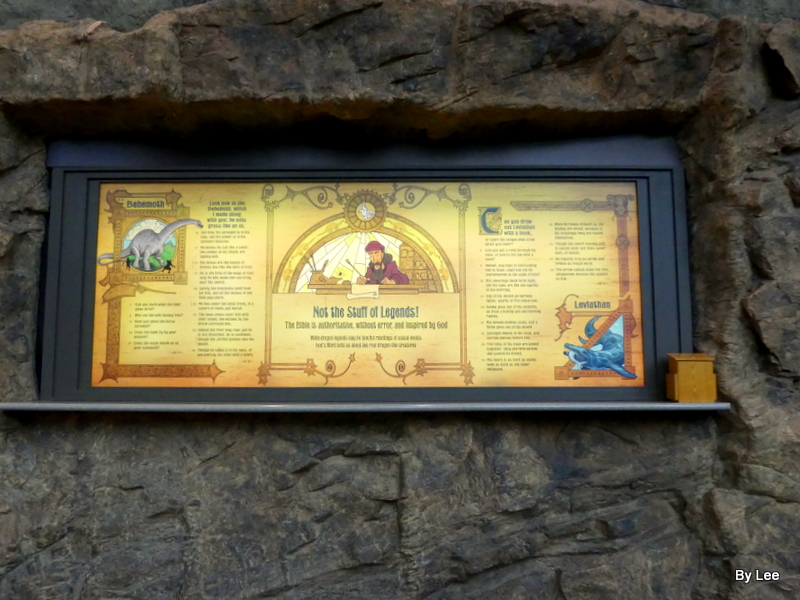
Not The Stuff Of Legends! – Behemoth

Not The Stuff Of Legends – Creation Museum

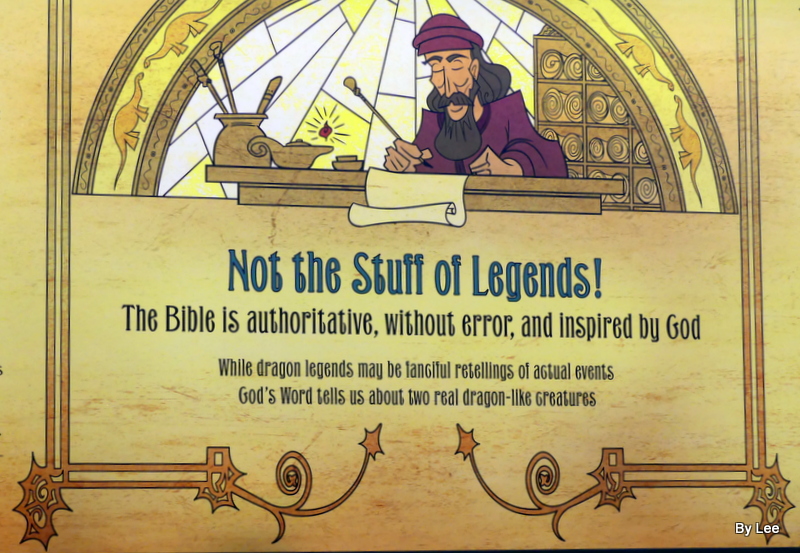
Not the Stuff of Legends!
Not The Stuff Of Legends – Creation Museum

Not The Stuff Of Legends – Creation Museum

In the last article, Creation Museum’s Dragon Legends I, you were introduced to the beginning exhibits at the Creation Museum. The Dragon Legends continued with the next display. There they mention the “two real dragon-like creatures” found in God’s Word.

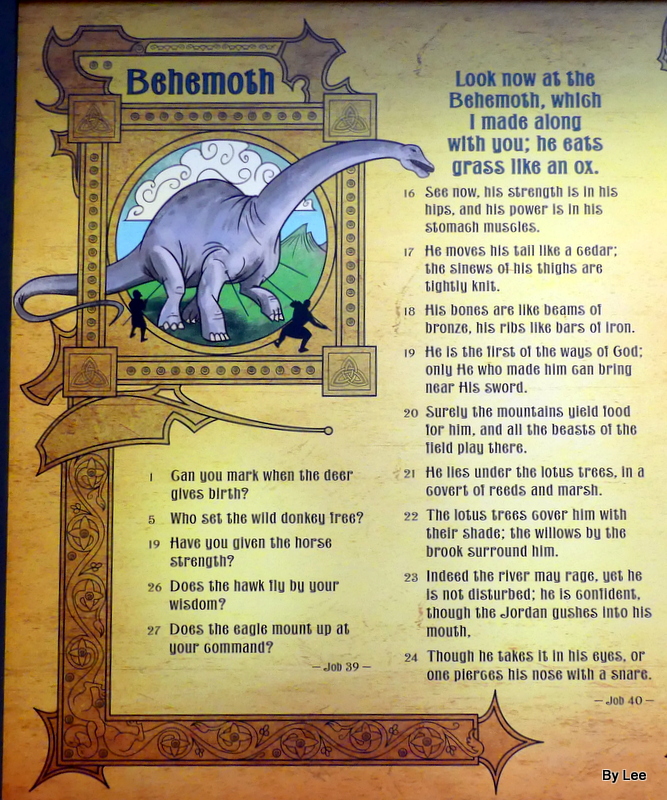
This post mentions the Behemoth mentioned in Job 40:16-24.

Behemoth
Not The Stuff Of Legends – Creation Museum

Job 40:16-24 NKJV

(16) See now, his strength is in his hips, And his power is in his stomach muscles.

(17) He moves his tail like a cedar; The sinews of his thighs are tightly knit.

(18) His bones are like beams of bronze, His ribs like bars of iron.

(19) He is the first of the ways of God; Only He who made him can bring near His sword.

(20) Surely the mountains yield food for him, And all the beasts of the field play there.

(21) He lies under the lotus trees, In a covert of reeds and marsh.

(22) The lotus trees cover him with their shade; The willows by the brook surround him.

(23) Indeed the river may rage, Yet he is not disturbed; He is confident, though the Jordan gushes into his mouth,

(24) Though he takes it in his eyes, Or one pierces his nose with a snare.

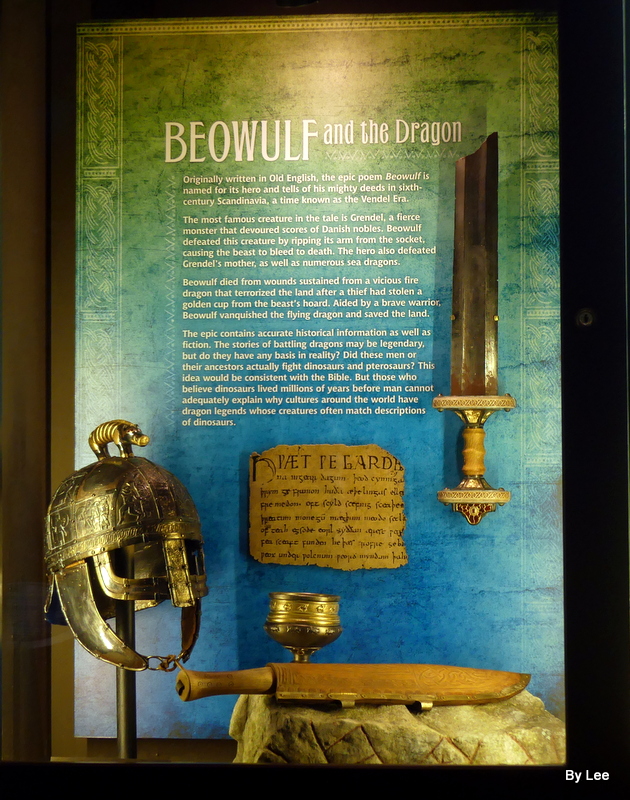
Beowulf and the Dragon was a poem about the battle with a huge dragon. Was it a story, or was it based on a battle with some real live large land animal?
Beowulf & The Dragon – Creation Museum
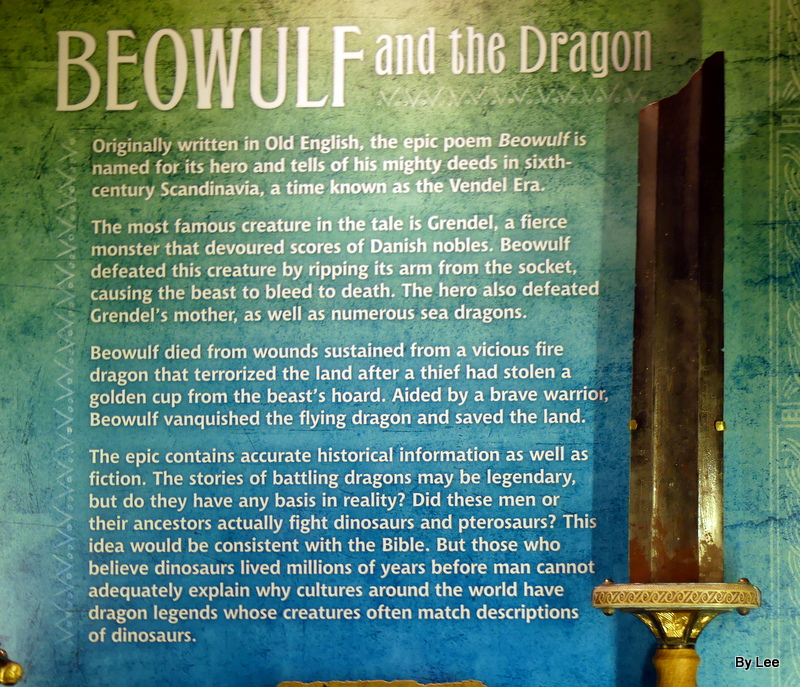
Beowulf & The Dragon – Creation Museum
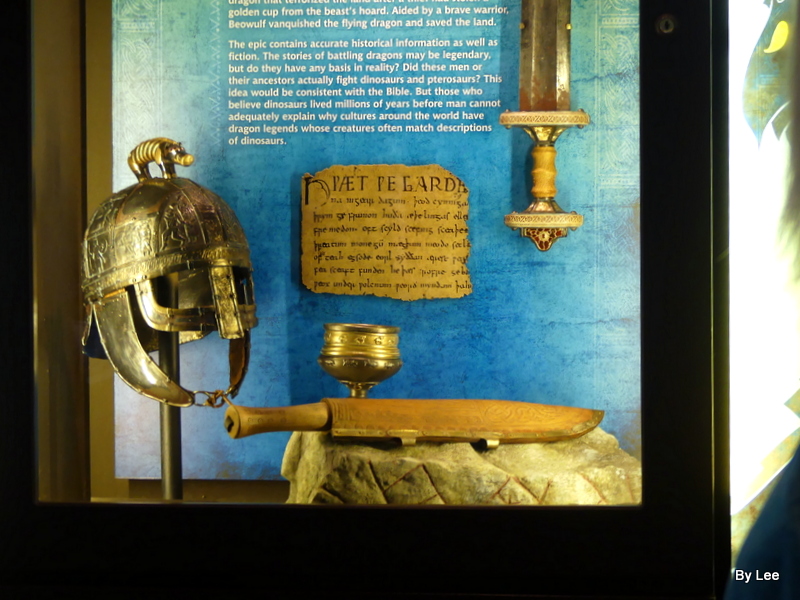
Beowulf & The Dragon – Creation Museum

Previous Articles:
Feedback: Dinosaurs Living with People—The Biblical Worldview – Answers in Genesis

Interesting Things – Dinosaur Blood

From Creation Museum:

Dinosaurs-Dragons-Legends

More From Institute For Creation Research:

Is There Some Truth to Dragon Myths?

Did Medieval Artists See Real Dinosaurs?

Dinosaur Mania and Our Children


Patience Trying To Photograph Yellow-billed Hornbill

Here are some more articles written about our visits to the Cincinnati Zoo: Here is a video by another visitor to the Hornbills:
http://www.youtube.com/watch?v=Btd7BgdBciQ
Trying to get through the fence/cage Southern Yellow-billed Hornbill (Tockus leucomelas) Cincinnati Zoo 2016
If you followed the posts while we were on our trip, you are aware that we skipped going to the Cincinnati Zoo because of weather. Home Again After 2,000 Mile Trip
And not only so, but we glory in tribulations also: knowing that tribulation worketh patience; And patience, experience; and experience, hope: (Romans 5:3-4 KJV)
Since we have been there twice already, I decided to see if there were some birds that were not written about from those trips. Actually, there are quite a few. This Southern Yellow-billed Hornbill’s photo caught my attention. It is so hard to get a photo through the cages of the zoos. This Avian Wonder was just as hard to capture. After several tries, the Hornbill came into focus and I still remember my excitement. Patience is hard at times, but it does pay off.
Yeah! I got through! Southern Yellow-billed Hornbill (Tockus leucomelas) Cincinnati Zoo 2016
“But if we hope for that we see not, then do we with patience wait for it.” (Romans 8:25 KJV)
Here are some more articles written about our visits to the Cincinnati Zoo: Here is a video by another visitor to the Hornbills:
http://www.youtube.com/watch?v=Btd7BgdBciQ

God’s Weaver Birds At Work

Lesser Masked Weaver (Ploceus intermedius) by Bob-Nan

“My days are swifter than a weaver’s shuttle,…” (Job 7:6a KJV)

“Them hath he filled with wisdom of heart, to work all manner of work, of the engraver, and of the cunning workman, and of the embroiderer, in blue, and in purple, in scarlet, and in fine linen, and of the weaver, even of them that do any work, and of those that devise cunning work.” (Exodus 35:35 KJV) [This has to do with the Tabernacle bulders, but the wisdom of heart applies here also.]

A friend shared a video with me of the Weaver Birds on Facebook while we were traveling. I thought I would share some of the fantastic weaving ability given these birds by their Creator.

These are just a few of the videos of Weavers at Work

Here’s another video on YouTube taken at the San Diego Zoo

*

*

*

Previous Articles about the Weaver Birds:

Sunday Inspiration – Weavers and Allies
Wonga Dove and Taveta Weavers at Houston Zoo
Nuggets Plus – The Weaver, The Caller (Ready)
Interesting Things – The Weaver Bird
Baya Weaver – The Model Church

Who Paints The Leaves?

Migration Is Starting And The Birds Are Heading Out

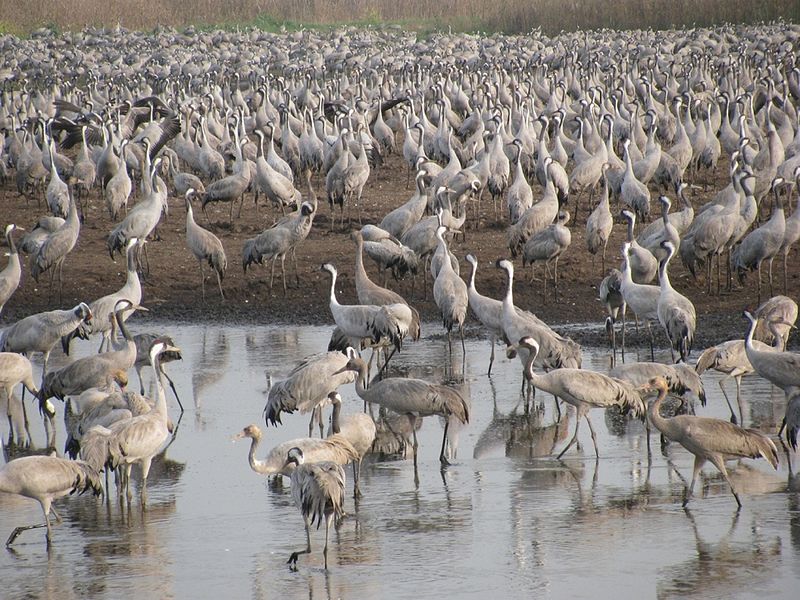
Common Cranes in Israel. Many species of crane gather in large groups during migration and on their wintering grounds

Common Cranes in Israel. Many species of crane gather in large groups during migration and on their wintering grounds

“Even the stork in the sky Knows her seasons; And the turtledove and the swift and the thrush Observe the time of their migration; But My people do not know The ordinance of the LORD.” (Jeremiah 8:7 NASB)

This time of the year, the birds start gathering together to migrate, or move, to their winter place. The birds in Australia, begin flying north to their summer place. But they like to fly in groups. This helps keep them secure and going in the right direction. The cartoon below is cute, but God has built into birds a very accurate way to migrate. A few birds become confused in storms and become “lost.” Even then, many of them still arrive at their destinations.

Migration – Family Circus

The V-formation helps the birds use less energy. This enables the birds to travel the long distances much easier. There are several articles written that you might want to read:

You Comfort Me

Skimmer Baby Leaning against Parents Beak – ©Thomas C – NatlGeog – Pinterest

“If I say, “My foot slips,” Your mercy, O LORD, will hold me up. In the multitude of my anxieties within me, Your comforts delight my soul.” (Psalms 94:18-19 NKJV)

A Black Skimmer chick holding on to it’s parent. Adorable!

What verse(s) would you use for this photo?

*

Gideon

Sorry for the Long Delay

There hasn’t been a blog posted here since Aug 5th. The last few articles were scheduled ahead of time as I had back surgery on Aug 3rd. My overnight stay in the hospital turned out to be 5 days in the hospital. I had side affects like fluid build up in the sac by the lung. Could hardly breathe and that had to drained. And other side issues. Got out on Tuesday, and ended up in the Emergency Room the next day for another side-affect.

“Withhold not thou thy tender mercies from me, O LORD: let thy lovingkindness and thy truth continually preserve me.” (Psalms 40:11 KJV)

But all is not lost. Dr. James J. S. Johnson [Dr. Jim, to me] has kept the main blog active with some very interesting articles. So, if you are not a follower of Lee’s Birdwatching Adventures Plus [the main blog], take a look at the last articles that were posted over there. I trust, with the Lord’s continued healing, that things will get back to normal soon.

Shake a Leg (or 2 or 3 or 4), Crab-Eater! – Aug 7

Crazy as a Coot! – Aug 8

Pinyon Jay, Grand Canyon’s Forester – Aug 9

Killdeer atop Killdeer: Appreciating Help from Others – Aug 10

Loggerhead Shrike: Converting Thorns into Meat-hooks – Aug 11

Oystercatchers Must be Gentiles – Aug 12

Eggs Taste Better if Salted – Aug 13

Penguin Eggs Tragedy – Aug 14

Emma’s Stories Retold – Lizzy and the Penguin Catapult

Emperor Penguin (Aptenodytes forsteri) ©WikiC

Emperor Penguin (Aptenodytes forsteri) ©WikiC

Emma’s Stories Retold – Lizzy and the Penguin Catapult

~ by Emma Foster

Originally Told Here

See All of Emma’s Stories

Some Homes in the Green Forest – Chapter 18

Redtail the Hawk - Burgess Bird Book ©©

Redtail the Hawk – Burgess Bird Book ©©

Some Homes in the Green Forest

The Crow, the Oven Bird and the Red-tailed Hawk.

The Burgess Bird Book For Children moved to:

 Kids Section – Burgess Book

Viera Wetlands – Candy Corn Moorhen

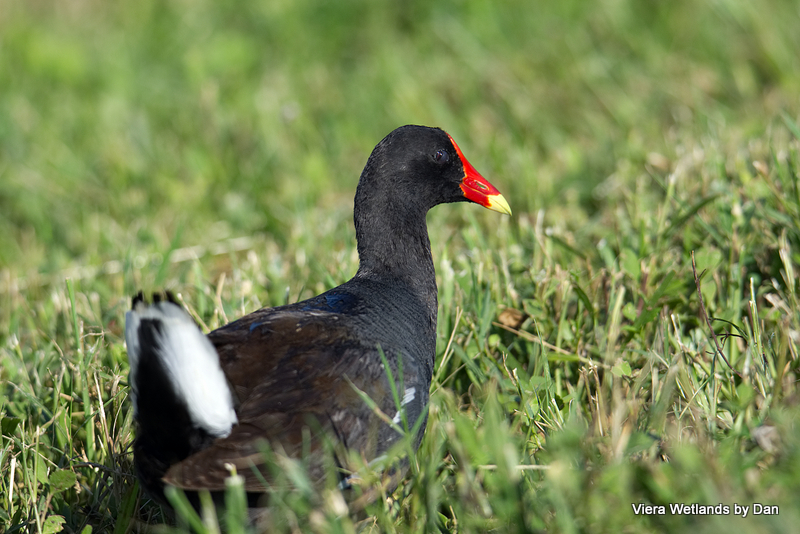
Common Moorhen by Dan at Viera Wetlands

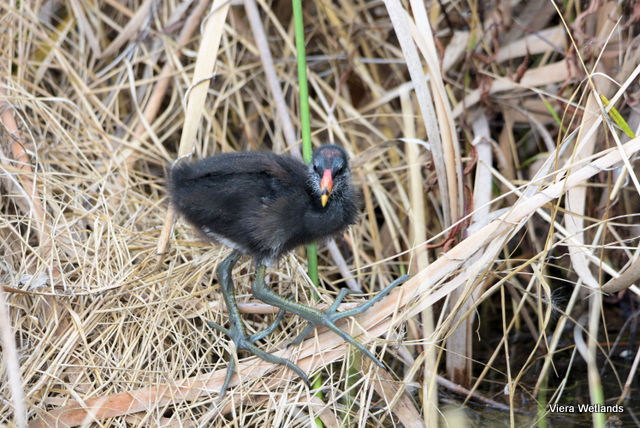
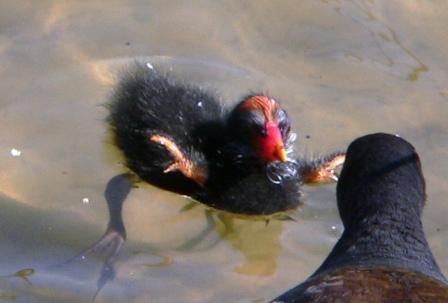
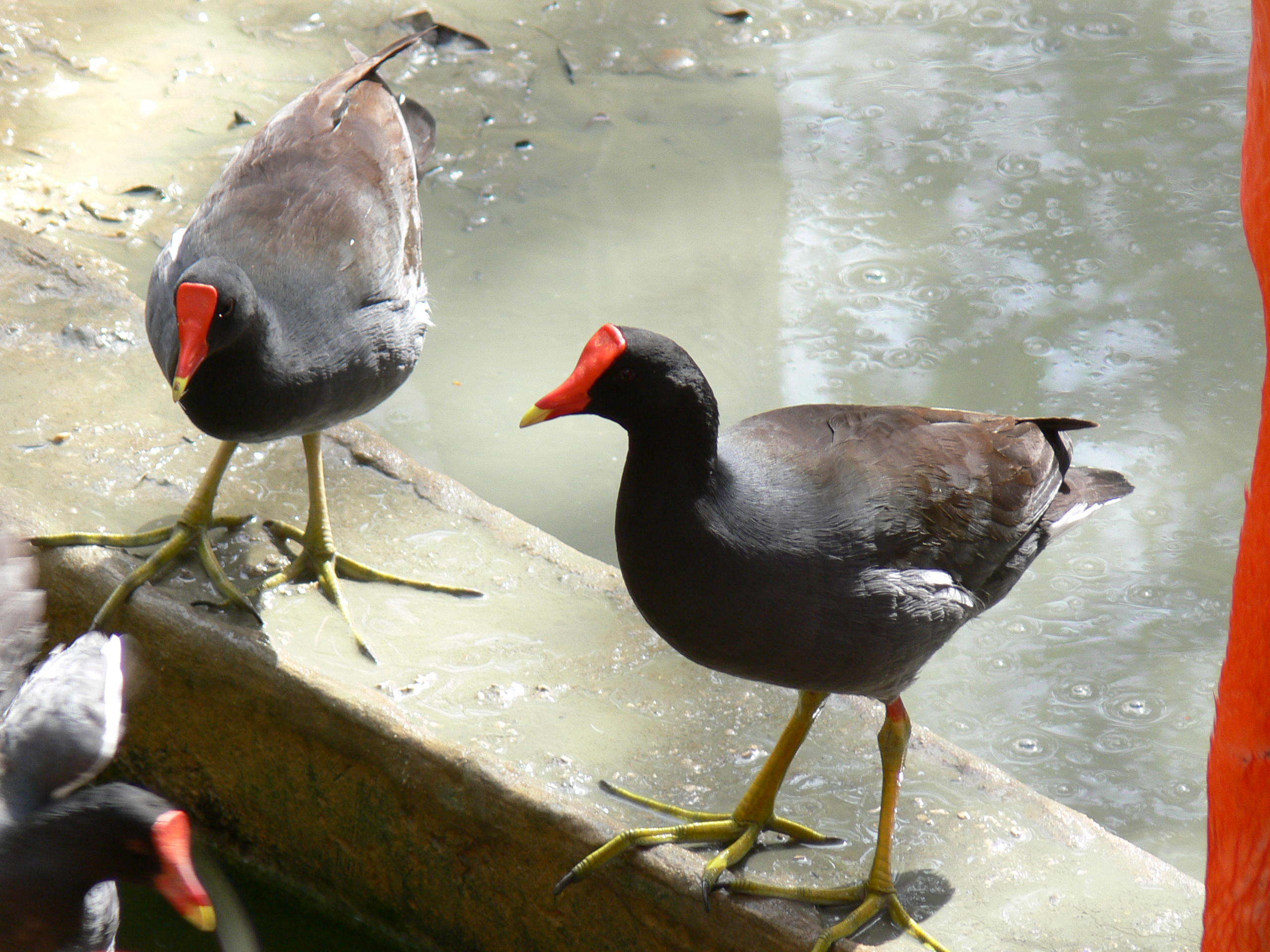
The Common Moorhen (Gallinula chloropus) has a bill that reminds me so much of Candy Corn. On our latest trip to Viera Wetlands, Dan was able to capture this adult with his camera. We showed you the young one with big feet in Big Feet on July 5th.

Young Moorhen at Viera Wetlands

Here are some more photos taken previously:

Common Moorhen Parent and baby Moorhen at Lake Hollingsworth

Another Baby Moorhen at Lake Hollingsworth by Lee

Baby Moorhen – Big feet and undeveloped beak color. Lake Hollingsworth – by Lee

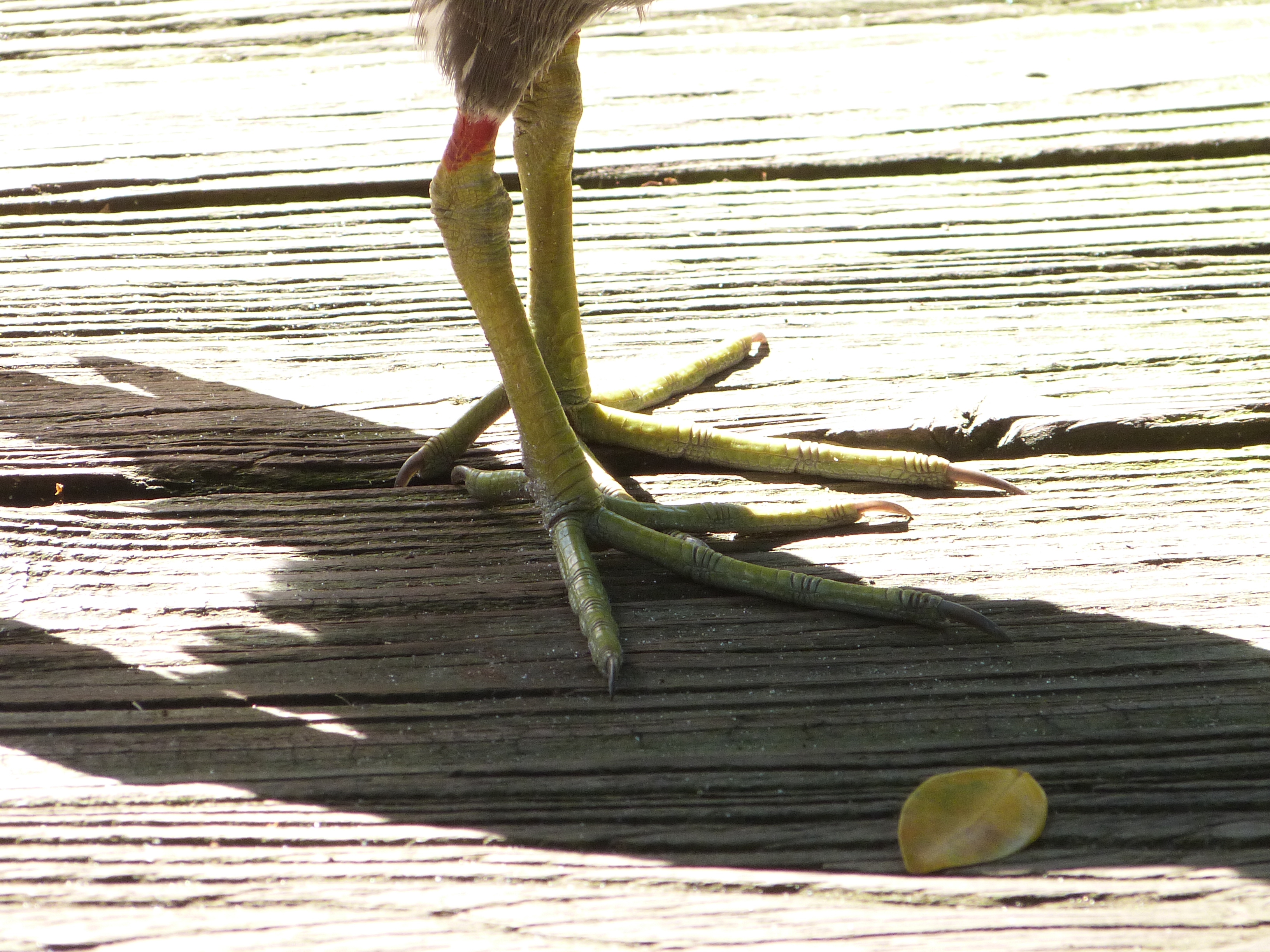
Baby Moorhen with Big Feet above and Adult Common Moorhen below with big feet

Common Moorhen (Gallinula chloropus) PB Zoo by Lee

Then God said, “Let the waters abound with an abundance of living creatures, and let birds fly above the earth across the face of the firmament of the heavens.” (Genesis 1:20 NKJV)

Back to the Candy Corn beak:

Baby Moorhen No Feathers on Wing at Lake Hollingsworth Cropped by Lee

Fact from All About Birds:

  • Newly hatched Common Gallinule chicks have spurs on their wings that help them climb into the nest or grab onto vegetation.

Common Gallinule (Gallinula galeata) Lowry Park Zoo

Common Gallinule (Gallinula galeata) Amazon and Beyond-wild – Zoo Miami – by Lee

Moorhens [Gallinule – They keep changing the names]- All About Birds

Big Feet

Wordless Waterbirds

Secretarybird – The Note Taker

Secretarybird look straight at the lens – ©Pinterest – Rudi Luyten

You would like me to take a note?

Secretarybird -Notice the eyelashes – ©Pinterest

Looking down to start writing! [Notice the eyelashes]

“Let not mercy and truth forsake you; Bind them around your neck, Write them on the tablet of your heart,” (Proverbs 3:3 NKJV)

These Secretarybird photos were on Pinterest and I decided to share them.

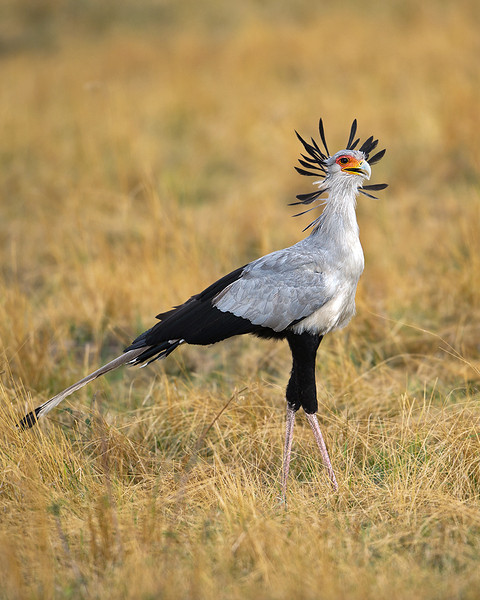
Secretarybird (Sagittarius serpentarius) by Africaddict

Secretarybird (Sagittarius serpentarius) by Africaddict

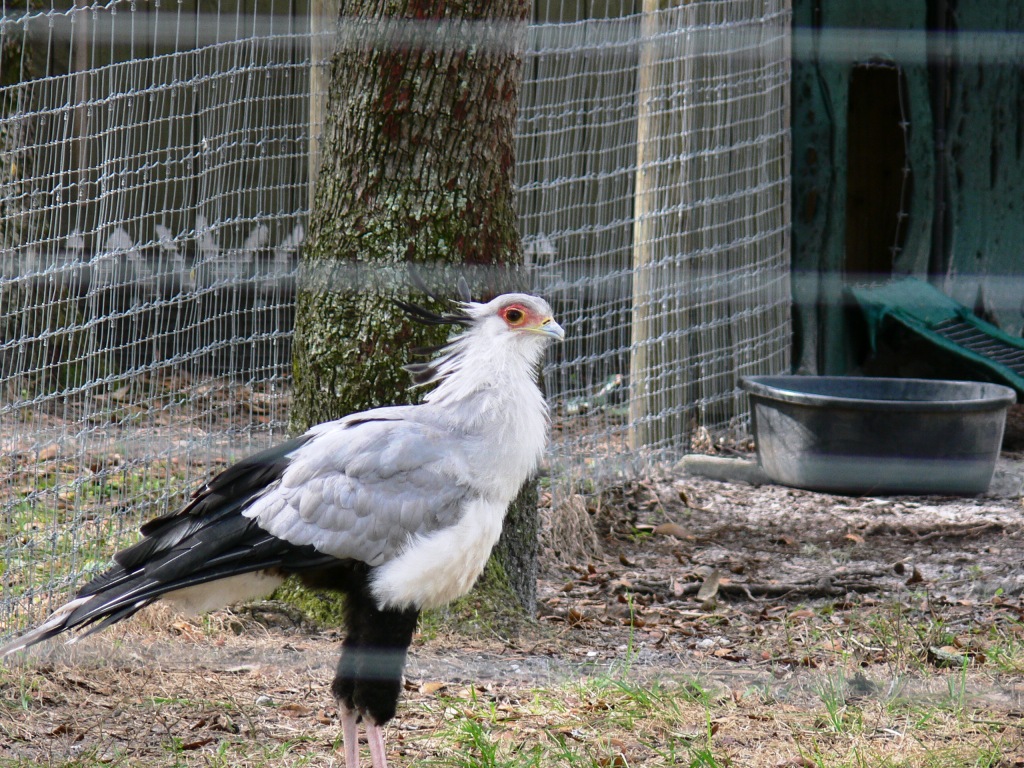
Secretarybirds were named this because: “The secretary bird’s English name was once thought to come from the 1800s, when Europeans first spotted these birds. Back then, male secretaries wore gray tailcoats and dark knee-length pants. They also used goose-quill pens that they carried behind their ears. This long-legged bird shares many of these same physical features: long, dark quills at the back of the head; long, gray wing and tail feathers that resemble a tailcoat; and black feathers that go midway down the legs like short pants. It’s fun to imagine how the two “secretaries” compare!” From San Diego Zoo – Secretary Bird Nice photos in this article to check out!

Secretarybird (Sagittarius serpentarius) by Lee

Secretarybird (Sagittarius serpentarius) by Lee

These are one of my many favorite birds. With over 10,700 birds in the world, it is easy to have many favorites that the Lord, their Creator, has given us to enjoy.

*
Secretary Bird – The Walker

The Wise Owl