Vol. 2, No. 5 – The Turnstone

The Turnstone - Birds Illustrated by Color Photography

The Turnstone

THE TURNSTONE.

imgt

HIS small plover-like bird is found on the sea-coasts of nearly all countries; in America, from Greenland and Alaska to Chili and Brazil; more or less common in the interior along the shores of the Great Lakes and larger rivers.

It is generally found in company with flocks of the smaller species of Sandpipers, its boldly marked plumage contrasting with surroundings, while the Sandpipers mingle with the sands and unless revealed by some abrupt movement can hardly be seen at a little distance.

The name Turnstone has been applied to this bird on account of its curious habit of dexterously inserting its bill beneath stones and pebbles along the shore in quest of food, overturning them in search of the insects or prey of any kind which may be lurking beneath. It is found on smooth, sandy beaches, though more commonly about the base of rocky cliffs and cones. The eggs of horseshoe crabs are its particular delight.

In the nesting season the Turnstone is widely distributed throughout the northern portions of both continents, and wanders southward along the sea-coasts of all countries. In America it breeds commonly in the Barren Lands of the Arctic coasts and the Anderson River districts, on the Islands of Franklin and Liverpool bays, nesting in July. In the Hudson’s Bay country the eggs are laid in June. The nest is a hollow scratched in the earth, and is lined with bits of grass.

The Turnstone is known by various names: “Brant Bird,” “Bead-bird,” “Horse-foot-Snipe,” “Sand-runner,” “Calico-back,” “Chicaric” and “Chickling.” The two latter names have reference to its rasping notes, “Calico-back,” to the variegated plumage of the upper parts.

In summer the adults are oddly pied above with black, white, brown, and chestnut-red, but the red is totally wanting in winter. They differ from the true Plovers in the well developed hind-toe, and the strong claws, but chiefly in the more robust feet, without trace of web between the toes.

The eggs are greenish-drab in color, spotted, blotched, and dotted irregularly and thickly with yellowish and umber brown. The eggs are two or four, abruptly pyriform in shape.

Summary:

TURNSTONE.Arenaria interpres. Other names: “Brant Bird,” “Calico-back,” “Bead-bird,” “Sand-runner,” “Chickling,” “Horse-foot Snipe.”

Range—Nearly cosmopolitan; nests in the Arctic regions, and in America migrates southward to Patagonia. (Chapman.)

Nest—A slight depression on the ground.

Eggs—Two or four, greenish-drab, spotted all over with brown.


Ruddy Turnstone - MacDill

Ruddy Turnstone – MacDill by Lee

Lee’s Addition:

A gift is as a precious stone in the eyes of him that hath it: whithersoever it turneth, it prospereth. (Proverbs 17:8 KJV)

Amazing! Today, Dan and I went over to Tampa and we carried our cameras along. We went to the shore and were taking photos of the birds that were having a field day just off shore. Brown Pelicans, Cormorants, and lots of Laughing Gulls and terns were diving for the fish that must have been clustered right there. Later we walked down to where the terns and gulls were landed to take more photos. While I was standing there, this one odd bird landed by me and then stayed for about a minute and was gone. Guess he couldn’t find any of his kind. At the time, I thanked the Lord for letting me see it and did not know then that it was the next bird in this series.

I didn’t recognize it until this evening while going through my photos. It was a Ruddy Turnstone! I have never seen one in breeding plumage before and thought I had gotten me a new bird, but no, seen them before.

I am thankful that the photos turned out so good. Dan showed me how to adjust my viewfinder setting properly. I have just looked through it and tried to make things out clear. I was taught to put some lines or text up in the viewfinder and adjust it so that is clear. Then the pictures will be clear when I use my program mode. Worked pretty good.

I haven’t said much lately about my eye, but it has recently gotten worse. (My camera eye) When I went to the eye doctor this week, I was told the vision has gone from 20/50 to 20/80 since my last checkup 6 weeks ago. That is one reason I haven’t been doing as many blogs as usual.

Long story short, my cataract has increased and will need to have an implant, but they can’t do it until my 6 months check up for my retina surgery. That is in June. Then if all is well, the cataract will be taken care of. In the mean time, my vision is blurry and will most likely get worse before it can be taken care of. Your prayers are appreciated that I don’t get discouraged and that I’ll get a good report in June. So far, I am thankful for what I can see. Today was an experiment for me to see if I could still get a good photo and to just enjoy watching the Lord’s amazing creations flying and having a good time “fishing.”

Ruddy Turnstone and Forster's Tern 5-10-13

Ruddy Turnstone and Forster’s Tern

The Ruddy Turnstone (Arenaria interpres) is a small wading bird, one of two species of turnstone in the genus Arenaria. It is now classified in the sandpiper family Scolopacidae but was formerly sometimes placed in the plover family Charadriidae. It is a highly migratory bird, breeding in northern parts of Eurasia and North America and flying south to winter on coastlines almost worldwide. It is the only species of turnstone in much of its range and is often known simply as Turnstone. (Wikipedia)

*

Birds Illustrated by Color Photography – Revisited

The above article is an article in the monthly serial for October 1897 “designed to promote Knowledge of Bird-Live.” These include Color Photography, as they call them, today they are drawings. There are at least three Volumes that have been digitized by Project Gutenberg.

To see the whole series of – Birds Illustrated by Color Photography – Revisited

*

(Information from Wikipedia and other internet sources)

Next Article – Belted Piping Plover

The Previous Article – The American White-Fronted Goose


ABC’s of the Gospel

Links:

Ruddy Turnstone – Wikipedia

Charadriidae – Plovers Family

*

Vol. 2, No. 5 – The American White-fronted Goose

Greater White-fronted Goose (Anser albifrons) by Nikhil Devasar

Greater White-fronted Goose (Anser albifrons) by Nikhil Devasar

From col. Chi. Acad. Sciences. Copyrighted by
Nature Study Pub. Co., 1897, Chicago.

THE AMERICAN WHITE-FRONTED GOOSE.

“As stupid as a Goose!”

Yes, I know that is the way our family is usually spoken of. But then I’m not a tame Goose, you know. We wild fellows think we know a little more than the one which waddles about the duck-pond in your back yard.

He sticks to one old place all the time. Waddles and talks and looks the same year after year. We migratory birds, on the other hand, fly from place to place. Our summers are passed here, our winters there; so that we pick up a thing or two the common Goose never dreams of.

“The laughing Goose!”

Yes, some people call me that. I don’t know why, unless my Honk, honk, honk! sounds like a laugh. Perhaps, though, it is because the look about my mouth is so pleasant.

Did you ever see a flock of us in motion, in October or November, going to our winter home?

Ah, that is a sight! When the time comes for us to start, we form ourselves into a figure like this >· a big gander taking the lead where the dot is. Such a honk, honk, honking you never heard. People who have heard us, and seen us, say it sounds like a great army overhead.

Where do we live in summer, and what do we eat?

You will find us throughout the whole of North America, but in greater numbers on the Pacific coast. The fresh-water lakes are our favorite resorts. We visit the wheat fields and corn fields, nibbling the young, tender blades and feeding on the scattered grain. The farmers don’t like it a bit, but we don’t care. That is the reason our flesh tastes so sweet.

And tough!

My, how you talk! It is only we old fellows that are tough, we fellows over a year old. But of course a great many people don’t know that, or don’t care.

Why, I once heard of a gander that had waddled around a barnyard for five long years. Thanksgiving Day arrived, and they roasted him for dinner.

Think of eating an old, old friend like that!

Where do we build our nests?

Away up north, in Alaska, and on the islands of the Arctic Sea. We make them of hay, feathers, and down, building them in hollow places on the ground.

How many eggs?

Six. I am very good to my mate, and an affectionate father.

Summary:

AMERICAN WHITE-FRONTED GOOSEAnser albifrons gambeli. Other names: “Laughing Goose,” “Speckle Belly.”

Range—North America, breeding far northward; in winter south to Mexico and Cuba, rare on the Atlantic coast.

Nest—On the ground, of grasses lined with down.

Eggs—Six or seven, dull greenish-yellow with obscure darker tints.


Greater White-fronted Goose (Anser albifrons) by Nikhil Devasar

Greater White-fronted Goose (Anser albifrons) by Nikhil Devasar

Lee’s Addition:

Blessed are ye that hunger now: for ye shall be filled. Blessed are ye that weep now: for ye shall laugh. (Luke 6:21 KJV)

Greater White-fronted Goose by Ashley Fisher (xeno-canto) recorded in U.K.

Flock flying over by Jonathon Jongsma (xeno-canto) recorded in U.S.

The Greater White-fronted Goose (Anser albifrons) is a species of goose. The Greater White-fronted Goose is more closely related to the smaller Lesser White-fronted Goose (A. erythropus). In Europe it has been known as simply “White-fronted Goose”; in North America it is known as the Greater White-fronted Goose (or “Greater Whitefront”), and this name is also increasingly adopted internationally. It is named for the patch of white feathers bordering the base of its bill. But even more distinctive are the salt-and-pepper markings on the breast of adult birds, which is why the goose is colloquially called the “Specklebelly” in North America.

These Geese belong to the Anatidae – Ducks, Geese & Swans Family.

Greater White-fronted Geese are 25–32 in (64–81 cm) in length, have a 51–65 in (130–165 cm) wingspan and weigh 4.3–7.3 lb (1.93–3.31 kg). They have bright orange legs and mouse-coloured upper wing-coverts. They are smaller than Greylag Geese. As well as being larger than the Lesser White-fronted Goose, the Greater White-fronted Goose lacks the yellow eye-ring of that species, and the white facial blaze does not extend upwards so far as in Lesser.

The male is typical larger in size, both sexes are similar in appearance – greyish brown birds with light grey breasts dappled with dark brown to black blotches and bars. Both males and females also have a pinkish bill and orange legs and feet.

Greater White-fronted Goose (Anser albifrons frontalis) ©WikiC

Greater White-fronted Goose (Anser albifrons frontalis) ©WikiC

The Greater White-fronted Goose is divided into four subspecies. The nominate subspecies A. a. albifrons breeds in the far north of Europe and Asia, and winters further south and west in Europe.
Two other restricted-range races occur in northern North America: A. a. gambeli in interior northwest Canada, and wintering on the coast of the Gulf of Mexico, slightly larger than the nominate form, and Tule Goose, A. a. elgasi, in southwest Alaska, largest and longest-billed of all, wintering in California. All these races are similar in plumage, differing only in size.

Finally, the very distinct Greenland White-fronted Goose, A. a. flavirostris, breeding in western Greenland, is much darker overall, with only a very narrow white tip to the tail (broader on the other races), more black barring on its belly, and usually has an orange (not pink) bill. It winters in Ireland and western Scotland.

Birds breeding in the far east of Siberia east to Arctic Canada, wintering in the United States and Japan, have been described as A. a. frontalis on the basis of their slightly larger size and a marginally longer bill. Another putative East Asian subspecies albicans has also been described. A 2012 study has found that frontalis and albicans do not merit subspecies status, the former being synonymised with gambelli and the latter with the nominate subspecies; this study found that these forms had been named on the wintering grounds from specimens whose breeding grounds were unknown.

Recent ecological studies suggest the Greenland birds should probably be considered a separate species from A. albifrons. Of particular interest is its unusually long period of parental care and association, which may last several years and can include grandparenting, possibly uniquely among the Anseriformes.

Weather conditions are a key factor in the annual breeding success of White-fronted Geese. In the Arctic, the window of opportunity for nesting, incubating eggs, and raising a brood to flight state is open briefly, for about three months. Arriving in late May or early June, White-fronted Geese begin departing for fall staging areas in early September. This means that a delayed snowmelt or late spring storm can significantly reduce the birds’ reproductive success. (Wikipeedia with editing)

*

Birds Illustrated by Color Photography – Revisited

The above article is an article in the monthly serial for October 1897 “designed to promote Knowledge of Bird-Live.” These include Color Photography, as they call them, today they are drawings. There are at least three Volumes that have been digitized by Project Gutenberg.

To see the whole series of – Birds Illustrated by Color Photography – Revisited

*

(Information from Wikipedia and other internet sources)

Next Article – The Turnstone

The Previous Article – The Summer Tanager

Wordless Birds

Links:

Greater White-fronted Goose – All About Birds

Greater White-fronted Goose – Wikipedia

Anatidae – Ducks, Geese & Swans Family

*

Vol. 2, No. 5 – The Summer Tanager

Summer Tanager (Piranga rubra) Male ©WikiC

Summer Tanager (Piranga rubra) Male ©WikiC

From col. F. M. Woodruff. Copyrighted by
Nature Study Pub. Co., 1897, Chicago.

THE SUMMER TANAGER.

imgt

HE TANAGERS are birds of such uncommon beauty that when we have taken the pictures of the entire family the group will be a notable one and will add attractiveness to the portfolio. [See Vol. I, Red-Rumped Tanager and Scarlet Tanager] This specimen is also called the Summer Red-bird or Rose Tanager, and is found pretty generally distributed over the United States during the summer months, wintering in Cuba, Central America, and northern South America. As will be seen, the adult male is a plain vermilion red. The plumage of the female is less attractive. In habits this species resembles the Scarlet Tanager, perhaps the most brilliant of the group, but is not so retiring, frequenting open groves and often visiting towns and cities.

The nesting season of this charming bird extends to the latter part of July, but varies with the latitude and season. Bark strips and leaves interwoven with various vegetable substances compose the nest, which is usually built on a horizontal or drooping branch, near its extremity and situated at the edge of a grove near the roadside. Davie says: “All the nests of this species which I have seen collected in Ohio are very thin and frail structures; so thin that the eggs may often be seen from beneath. A nest sent me from Lee county, Texas, is compactly built of a cottony weed, a few stems of Spanish moss, and lined with fine grass stems.” Mr. L. O. Pindar states that nests found in Kentucky are compactly built, but not very thickly lined. The eggs are beautiful, being a bright, light emerald green, spotted, dotted, and blotched with various shades of lilac, brownish-purple, and dark brown.

Chapman says the Summer Tanager may be easily identified, not alone by its color but by its unique call-note, a clearly enunciated chicky, tucky, tuck. Its song bears a general resemblance to that of the Scarlet, but to some ears is much sweeter, better sustained, and more musical. It equals in strength, according to one authority, that of the Robin, but is uttered more hurriedly, is more “wiry,” and much more continued.

The Summer Tanager is to a greater or less extent known to farmers as the Red Bee-Bird. Its food consists largely of hornets, wasps, and bees.

The male of this species requires several years to attain the full plumage. Immature individuals, it is said, show a mixture of red and yellow in relative proportions according to age. The female has more red than the male, but the tint is peculiar, a dull Chinese orange, instead of a pure rosy vermilion, as in the male.

An interesting study for many of our readers during the summer months when the Tanagers are gay in their full plumage, would be to seek out, with Birds in hand, the most attractive denizens of the groves, identifying and observing them in their haunts until the entire group, of which five species are represented in the United States, is made familiar. When we remember that there are about three hundred and eighty known species of Tanagers in Tropical America, it would seem a light task to acquaint oneself with the small family at home.

Summary:

SUMMER TANAGER.Piranga rubra. Other names: “Summer Red-bird,” “Rose Tanager.”

Range—Eastern United States west to the edge of the Plains; north regularly to about 40°—New Jersey, central Ohio, Illinois, casually north to Connecticut and Ontario, accidentally to Nova Scotia, wintering in Cuba, Central America, and northern South America. (Davie.)

Nest—Of bark strips and leaves interwoven with various vegetable substances, on drooping branch of tree.

Eggs—Three or four, bluish-white or greenish-blue, with cinnamon or olive-brown markings.


Summer Tanager (Piranga rubra) male by Kent Nickell

Summer Tanager (Piranga rubra) male by Kent Nickell

Lee’s Addition:

Now learn a parable of the fig tree; When her branch is yet tender, and putteth forth leaves, ye know that summer is near: (Mark 13:28 KJV)

Thou hast set all the borders of the earth: thou hast made summer and winter. (Psalms 74:17 KJV)

The Summer Tanager (Piranga rubra), is a medium-sized American songbird. Formerly placed in the tanager family (Thraupidae), it and other members of its genus are now classified in the cardinal family (Cardinalidae). The species’s plumage and vocalizations are similar to other members of the cardinal family.

Their breeding habitat is open wooded areas, especially with oaks, across the southern United States, extending as far north as Iowa. These birds migrate to Mexico, Central America and northern South America. This tanager is an extremely rare vagrant to western Europe.

Summer Tanager (Piranga rubra) by Beedie Savage

Summer Tanager (Piranga rubra) by Beedie Savage

Adults have stout pointed bills and measure 17 cm (6.7 in) in length and 29 g (1.0 oz) in weight. Adult males are rose red and similar in appearance to the Hepatic Tanager, although the latter has a dark bill; females are orangish on the underparts and olive on top, with olive-brown wings and tail. As with all other birds, all red and orange colorations are acquired through their diet.

These birds are often out of sight, foraging high in trees, sometimes flying out to catch insects in flight. They mainly eat insects, especially bees and wasps, and berries. Fruit of Cymbopetalum mayanum (Annonaceae) are an especially well-liked food in their winter quarters, and birds will forage in human-altered habitat. Consequently, these trees can be planted to entice them to residential areas, and they may well be attracted to bird feeders. Summer Tanagers build a cup nest on a horizontal tree branch.

The Summer Tanager has an American Robin-like song, similar enough that novices sometimes mistake this bird for that species. The song consists of melodic units, repeated in a constant stream. The Summer Tanager’s song, however, is much more monotonous than that of T. migratorius, often consisting of as few as 3 or 4 distinct units. It is clearer and less nasal than the song of the Scarlet Tanager.

The Summer Tanager also has a sharp, agitated-sounded call pi-tuk or pik-i-tuk-i-tuk.

Call

Song

(From Wikipedia with editing and xeno-canto)

*

Birds Illustrated by Color Photography – Revisited

The above article is an article in the monthly serial for October 1897 “designed to promote Knowledge of Bird-Live.” These include Color Photography, as they call them, today they are drawings. There are at least three Volumes that have been digitized by Project Gutenberg.

To see the whole series of – Birds Illustrated by Color Photography – Revisited

*

(Information from Wikipedia and other internet sources)

Next Article – The American White-Fronted Goose

The Previous Article – John James Audubon

*

ABC’s of the Gospel

Links:

Summer Tanager – Wikipedia

Cardinalidae – Grosbeaks, Saltators & Allies

Thraupidae – Tanagers and Allies

Summer Tanager Sounds – xeno-canto

*

Vol. 2, No. 5 – John James Audubon

John James Audubon - Oil on canvas©WikiC (1826)

John James Audubon – Oil on canvas ©WikiC (1826)

JOHN JAMES AUDUBON

imgj

OHN JAMES AUDUBON has always been a favorite with the writer, for the invincibleness of his love of Nature and of birds is only equalled by the spontaneous freshness of his style, springing from an affectionate and joyous nature. Recently there was found by accident, in an old calf-skin bound volume, an autobiography of the naturalist. It is entitled “Audubon’s Story of his Youth,” and would make a very pretty book. As introductory to the diaries and ornithological biographies of the birds, it would be very useful.

Two or three incidents in the life of this fascinating character are interesting as showing the influence of the accidental in ultimate achievement.

“One incident,” he says, “which is as perfect in my memory as if it had occurred this very day, I have thought thousands of times since, and will now put on paper as one of the curious things which perhaps did lead me in after times to love birds, and to finally study them with pleasure infinite. My mother had several beautiful parrots, and some monkeys; one of the latter was a full-grown male of a very large species. One morning, while the servants were engaged in arranging the room I was in, ‘Pretty Polly’ asking for her breakfast as usual, ‘Du pain au lait pour le perroquet Mignonne,’ (bread and milk for the parrot Mignonne,) the man of the woods probably thought the bird presuming upon his rights in the scale of nature; be this as it may, he certainly showed his supremacy in strength over the denizen of the air, for, walking deliberately and uprightly toward the poor bird, he at once killed it, with unnatural composure. The sensations of my infant heart at this cruel sight were agony to me. I prayed the servant to beat the monkey, but he, who for some reason, preferred the monkey to the parrot, refused. I uttered long and piercing cries, my mother rushed into the room; I was tranquilized; the monkey was forever afterward chained, and Mignonne buried with all the pomp of a cherished lost one. This made, as I have said, a very deep impression on my youthful mind.”

In consequence of the long absences of his father, who was an admiral in the French navy, the young naturalist’s education was neglected, his mother suffering him to do much as he pleased, and it was not to be wondered at, as he says, that instead of applying closely to his studies, he preferred associating with boys of his own age and disposition, who were more fond of going in search of bird’s nests, fishing, or shooting, than of better studies. Thus almost every day, instead of going to school, he usually made for the fields where he spent the day, returning with his little basket filled with what he called curiosities, such as birds’ nests, birds’ eggs, curious lichens, flowers of all sorts, and even pebbles gathered along the shore of some rivulet. Nevertheless, he did study drawing and music, for which he had some talent. His subsequent study of drawing under the celebrated David, richly equipped him for a work which he did not know was ever to be his, and enabled him to commence a series of drawings of birds of France, which he continued until he had upwards of two hundred completed. “All bad enough,” he says, “yet they were representations of birds, and I felt pleased with them.” Before sailing for France, he had begun a series of drawings of the birds of America, and had also begun a study of their habits. His efforts were commended by one of his friends, who assured him the time might come when he should be a great American naturalist, which had such weight with him that he felt a certain degree of pride in the words, even then, when he was about eighteen years of age.

“The store at Louisville went on prosperously, when I attended to it; but birds were birds then as now, and my thoughts were ever and anon turning toward them as the objects of my greatest delight. I shot, I drew, I looked on nature only; my days were happy beyond human conception, and beyond this I really cared not.” [How like Agassiz, who said he had not time to make money.] As he could not bear to give the attention required by his business, his business abandoned him. “Indeed, I never thought of business beyond the ever-engaging journeys which I was in the habit of taking to Philadelphia or New York, to purchase goods; those journeys I greatly enjoyed, as they afforded me ample means to study birds and their habits as I traveled through the beautiful, the darling forests of Ohio, Kentucky, and Pennsylvania.” Poor fellow, how many ups and downs he had! He lost everything and became burdened with debt. But he did not despair for had he not a talent for drawing? He at once undertook to take portraits of the human head divine in black chalk, and thanks to his master, David, succeeded admirably. He established a large drawing school at Cincinnati, and formed an engagement to stuff birds for the museum there at a large salary.

“One of the most extraordinary things among all these adverse circumstances” he adds, “was, that I never for a day give up listening to the songs of our birds, or watching their peculiar habits, or delineating them in the best way I could; nay, during my deepest troubles, I frequently would wrench myself from the persons around me and retire to some secluded part of our noble forests; and many a time, at the sound of the wood-thrushes’ melodies, have I fallen on my knees and there prayed earnestly to our God. This never failed to bring me the most valuable of thoughts, and always comfort, and it was often necessary for me to exert my will and compel myself to return to my fellow-beings.”

Do you not fancy that Audubon was himself a rara avis and worthy of admiration and study?

Such a man, in the language of a contemporary, should have a monument in the old Creole country in which he was born, and whose birds inspired his childish visions. It should be the most beautiful work possible to the sculptor’s art, portraying Audubon in the garb he wore when he was proud and happy to be called the “American Woodman,” and at his feet should stand the Eagle which he named the “Bird of Washington,” and near should perch the Mocking Bird, as once, in his description, it flew and fluttered and sang to the mind’s eye and ear from the pages of the old reading book.

C. C. Marble.

Plate 41 of Birds of America by John James Audubon depicting Ruffed Grouse by John J Audubon ©WikiC.

Plate 41 of Birds of America by John James Audubon depicting Ruffed Grouse by John J Audubon ©WikiC.


Lee’s Addition:

Drawings can help one to:

Remember his marvellous works that he hath done; his wonders, and the judgments of his mouth; (Psalms 105:5 KJV)

John James Audubon (Jean-Jacques Audubon) (April 26, 1785 – January 27, 1851) was a French-American ornithologist, naturalist, and painter. He was notable for his expansive studies to document all types of American birds and for his detailed illustrations that depicted the birds in their natural habitats. His major work, a color-plate book entitled The Birds of America (1827–1839), is considered one of the finest ornithological works ever completed. Audubon identified 25 new species.

Much has been written about John J Audubon, see links below. He is known for his artistic ability and I found this from Wikipedia interesting, though it would have been nice to have not had to kill the birds. Back then, unfortunately, they did not have cameras like we have today with zoom lens and video cameras that could have recorded the details.

Ivory-billed Woodpecker by John J Audubon ©WikiC

Ivory-billed Woodpecker by John J Audubon

“Audubon developed his own methods for drawing birds. First, he killed them using fine shot. He then used wires to prop them into a natural position, unlike the common method of many ornithologists, who prepared and stuffed the specimens into a rigid pose. When working on a major specimen like an eagle, he would spend up to four 15-hour days, preparing, studying, and drawing it. His paintings of birds are set true-to-life in their natural habitat. He often portrayed them as if caught in motion, especially feeding or hunting. This was in stark contrast to the stiff representations of birds by his contemporaries, such as Alexander Wilson. Audubon based his paintings on his extensive field observations.

He worked primarily with watercolor early on. He added colored chalk or pastel to add softness to feathers, especially those of owls and herons. He employed multiple layers of watercoloring, and sometimes used gouache. All species were drawn life-size which accounts for the contorted poses of the larger birds as Audubon strove to fit them within the page size. Smaller species were usually placed on branches with berries, fruit, and flowers. He used several birds in a drawing to present all views of anatomy and wings. Larger birds were often placed in their ground habitat or perching on stumps. At times, as with woodpeckers, he combined several species on one page to offer contrasting features. He frequently depicted the birds’ nests and eggs, and occasionally natural predators, such as snakes. He usually illustrated male and female variations, and sometimes juveniles. In later drawings, Audubon used assistants to render the habitat for him. Going beyond faithful renderings of anatomy, Audubon employed carefully constructed composition, drama, and slightly exaggerated poses to achieve artistic as well as scientific effects.” (Wikipedia)

*

Birds Illustrated by Color Photography – Revisited

The above article is an article in the monthly serial for October 1897 “designed to promote Knowledge of Bird-Live.” These include Color Photography, as they call them, today they are drawings. There are at least three Volumes that have been digitized by Project Gutenberg.

To see the whole series of – Birds Illustrated by Color Photography – Revisited

*

(Information from Wikipedia and other internet sources)

Next Article – The Summer Tanager

The Previous Article – The Kingbird


Wordless Birds

Links:

John James Audubon – Wikipedia

The Birds of America – Wikipedia

*

Vol. 2, No. 4 – The Kingbird

Kingbird of Birds Illustrated by Color Photography, 1897

Kingbird of Birds Illustrated by Color Photography, 1897

From col. F. M. Woodruff. Copyrighted by
Nature Study Pub. Co., 1897, Chicago.

THE KINGBIRD.

imgi

T is somewhat strange that there should be little unity of opinion concerning a bird as well known as is this charming fellow, who has at least one quality which we all admire—courage. We will quote a few of the opinions of well-known observers as to whether his other characteristics are admirable, and let the reader form his own conclusion.

John Burroughs says of him: “The exquisite of the family, and the braggart of the orchard, is the Kingbird, a bully that loves to strip the feathers off its more timid neighbors like the Bluebird, that feeds on the stingless bees of the hive, the drones, and earns the reputation of great boldness by teasing large hawks, while it gives a wide berth to the little ones.” Decidedly, this classifies him with the English Sparrow. But we will hear Dr. Brewer: “The name, Kingbird, is given it on the supposition that it is superior to all other birds in the reckless courage with which it will maintain an unequal warfare. My own observations lead me to the conclusion that writers have somewhat exaggerated the quarrelsome disposition of this bird. I have never, or very rarely, known it to molest or attack any other birds than those which its own instinct prompts it to drive away in self-defense, such as Hawks, Owls, Eagles, Crows, Jays, Cuckoos, and Grackles.” That Dr. Coues is a friend of the Kingbird, his language amply proves: “The Kingbird is not quarrelsome—simply very lively. He is the very picture of dash and daring in defending his home, and when he is teaching his youngsters how to fly. He is one of the best of neighbors, and a brave soldier. An officer of the guild of Sky Sweepers, also a Ground Gleaner and Tree Trapper killing robber-flies, ants, beetles, and rose-bugs. A good friend to horses and cattle, because he kills the terrible gadflies. Eats a little fruit, but chiefly wild varieties, and only now and then a bee.” If you now have any difficulty in making up your verdict, we will present the testimony of one other witness, who is, we think, an original observer, as well as a delightful writer, Bradford Torrey. He was in the country. “Almost, I could have believed myself in Eden,” he says. “But, alas, even the birds themselves were long since shut out of that garden of innocence, and as I started back toward the village a Crow went hurrying past me, with a Kingbird in hot pursuit. The latter was more fortunate than usual, or more plucky, actually alighting on the Crow’s back, and riding for some distance. I could not distinguish his motions—he was too far away for that—but I wished him joy of his victory, and grace to improve it to the full. For it is scandalous that a bird of the Crow’s cloth should be a thief; and so, although I reckon him among my friends—in truth, because I do so—I am always able to take it patiently when I see him chastised for his fault.”

The Kingbird is a common bird in Eastern United States, but is rare west of the Rocky Mountains. It is perhaps better known by the name of Beebird or Bee-martin. The nest is placed in an orchard or garden, or by the roadside, on a horizontal bough or in the fork at a moderate height; sometimes in the top of the tallest trees along streams. It is bulky, ragged, and loose, but well capped and brimmed, consisting of twigs, grasses, rootlets, bits of vegetable down, and wool firmly matted together, and lined with feathers, hair, etc.

Eastern Kingbird (Tyrannus tyrannus) by Margaret Sloan

Eastern Kingbird (Tyrannus tyrannus) by Margaret Sloan


THE KINGBIRD.

You think, my young friends, because I am called Kingbird I should be large and fine looking.

Well, when you come to read about Kings in your history-book you will find that size has nothing to do with Kingliness. I have heard, indeed, that some of them were very puny little fellows, in mind as well as in body.

If it is courage that makes a king then I have the right to be called Kingbird. They say I have a reckless sort of courage, because I attack birds a great deal larger than myself.

I would not call it courage to attack anything smaller than myself, would you? A big man finds it easy to shoot a little bird in the air; and a big boy does not need to be brave to kill or cripple some poor little animal that crosses his path. He only needs to be a coward to do that!

I only attack my enemies,—the Hawks, Owls, Eagles, Crows, Jays, and Cuckoos. They would destroy my young family if I did not drive them away. Mr. Crow especially is a great thief. When my mate is on her nest I keep a sharp lookout, and when one of my enemies approaches I give a shrill cry, rise in the air, and down I pounce on his back; I do this more than once, and how I make the feathers fly!

The little hawks and crows I never attack, and yet they call me a bully. Sometimes I do go for a Song-bird or a Robin, but only when they come too near my nest. People wonder why I never attack the cunning Catbird. I’ll never tell them, you may be sure!

To what family do I belong? To a large family called Flycatchers. Because some Kings are tyrants I suppose, they call me the Tyrant Flycatcher. Look for me next summer on top of a wire fence or dead twig of a tree, and watch me, every few minutes, dash into the air, seize a passing insect, and then fly back to the same perch again.

Any other names? Yes, some folks call me the Bee Bird or Bee Martin. Once in awhile I change my diet and do snap up a bee! but it is always a drone, not a honey-bee. Some ill-natured people say I choose the drones because they can’t sting, and not because they are tramp bees and will not work.

Sing? Yes, when my mate is on her nest I please her with a soft pretty song, at other times my call-note is a piercing Kyrie-K-y-rie! I live with you only in the summer. When September comes I fly away to a warmer climate.

Summary:

KINGBIRD.Tyrannus tyrannus.

Range—North America north to New Brunswick and Manitoba; rare west of the Rocky Mountains; winters in Central and South America.

Nest—Compact and symmetrical, of weed-stocks, grasses, and moss, lined with plant down, fine grasses, and rootlets, generally at the end of a branch fifteen to twenty-five feet from the ground.

Eggs—Three to five, white, spotted with umber.


Eastern Kingbird (Tyrannus tyrannus) by Margaret Sloan Eating

Eastern Kingbird (Tyrannus tyrannus) Eating by Margaret Sloan

Lee’s Addition:

Sing praises to God, sing praises! Sing praises to our King, sing praises! For God is the King of all the earth; Sing praises with understanding. (Psalms 47:6-7 NKJV)

The Eastern Kingbird (Tyrannus tyrannus) is a large tyrant flycatcher native to North America that are part of the Tyrannidae – Tyrant Flycatchers Family. There are 421 species assigned to that family, at present. Eleven of those are Kingbirds.

Adults are grey-black on the upperparts with light underparts; they have a long black tail with a white end and long pointed wings. They have a red patch on their crown, seldom seen. They are of average size for a kingbird, at 7.5–9 in (19–23 cm), 13–15 in (33–38 cm) across the wings and weighing 1.2-1.9 oz (33-55 g).

The call is a high-pitched, buzzing and unmusical chirp, frequently compared to an electric fence.

Eastern Kingbird call from xeno-canto.

An Eastern Kingbird's nest and eggs.

Eastern Kingbird (Tyrannus tyrannus) Nest ©WikiC

Their breeding habitat is open areas across North America. They make a sturdy cup nest in a tree or shrub, sometimes on top of a stump or pole. These birds aggressively defend their territory, even against much larger birds.

These birds migrate in flocks to South America. There is one European record, from Ireland in October 2012.

They wait on an open perch and fly out to catch insects in flight, sometimes hovering to pick food off vegetation. They also eat berries and fruit, mainly in their wintering areas.

Some eastern kingbirds place their nests in the open while others hide nests very well. Eastern kingbirds in Southern British Columbia can nest in open fields; in shrubs over open water; high in tall trees and even in the tops of small stumps. Both male and female participate in nest defense, but females may stay on well-hidden nests longer than females with open nests who may leave nests earlier to chase away predators. Those pairs nesting in the open may be able to see predators coming earlier and rely on aggressive behavior to protect their young.

They can recognize and remove cowbird eggs from their nests. Still, blue jays, American crows, squirrels, and tree-climbing snakes are on occasion nest predators. American kestrels are probable predators of adults.

For the LORD is the great God, And the great King above all gods. In His hand are the deep places of the earth; The heights of the hills are His also. The sea is His, for He made it; And His hands formed the dry land. Oh come, let us worship and bow down; Let us kneel before the LORD our Maker. (Psalms 95:3-6 NKJV)

There are 12 other Kingbirds in the Tyrannus genus.

*

Birds Illustrated by Color Photography – Revisited

The above article is an article in the monthly serial for October 1897 “designed to promote Knowledge of Bird-Live.” These include Color Photography, as they call them, today they are drawings. There are at least three Volumes that have been digitized by Project Gutenberg.

To see the whole series of – Birds Illustrated by Color Photography – Revisited

*

(Information from Wikipedia and other internet sources)

Next Article – John James Audubon

The Previous Article – The Slate-Colored Junco


ABC’s of the Gospel

Links:

Eastern Kingbird – All About Birds

Eastern Kingbird – All About Birds

SIMILAR BIRDS – From All About Birds

Eastern Kingbird – Wikipedia

*

Vol. 2, No. 4 – The Slate-Colored Junco

Slate-colored Red Junco of Birds Illustrated by Color Photography, 1897

Slate-colored Red Junco of Birds Illustrated by Color Photography, 1897

From col. F. M. Woodruff. Copyrighted by
Nature Study Pub. Co., 1897, Chicago.

THE SLATE-COLORED JUNCO.

imgb

LACK SNOWBIRD, in most of the United States and in Ontario, where it is a common resident, and White Bill, are names more often applied to this species of Sparrow than the one of Junco, by which it is known to ornithologists. It nests in the mountains of northern Pennsylvania, New York, and New England, and is a resident throughout the year in northeastern Ohio, and in Michigan. In all probability, the Snowbird does not breed, even occasionally, anywhere within the limits of the state of Illinois, though individuals may in very rare instances be found several weeks after others have departed for the north, these having probably received some injury which prevents their migration. Prof. Forbes refers to such an instance, which came under his own observation. He saw on a tree in the edge of a wood, in the southern part of the state, an adult specimen of the Junco, and only one, which, he says, astonished him.

Mr. William L. Kells states that in Ontario this Junco selects a variety of places for nesting sites, such as the upturned roots of trees, crevices in banks, under the sides of logs and stumps, a cavity under broken sod, or in the shelter of grass or other vegetation. The nest is made of dry grasses, warmly and smoothly lined with hair. The bird generally begins to nest the first week of May, and nests with eggs are found as late as August. A nest of the Junco was found on the rafters of a barn in Connecticut.

Almost any time after the first of October, little excursion parties of Juncos may be looked for, and the custom continues all winter long. When you become acquainted with him, as you surely will, during his visit, you will like him more and more for his cheerful habits. He will come to your back door, and present his little food petition, very merrily indeed. He is very friendly with the Chick-a-dee, and they are often seen together about in the barn-yards, and he even ventures within the barn when seeds are frozen to the ground.

“The Doctor,” in Citizen Bird, tells this pretty story of his winter pets:

“My flock of Juncos were determined to brave all weathers. First they ate the seeds of all the weeds and tall grasses that reached above the snow, then they cleaned the honeysuckles of their watery black berries. When these were nearly gone, I began to feed them every day with crumbs, and they soon grew very tame. At Christmas an ice storm came, and after that the cold was bitter indeed. For two days I did not see my birds; but on the third day, in the afternoon, when I was feeding the hens in the barn-yard, a party of feeble, half-starved Juncos, hardly able to fly, settled down around me and began to pick at the chicken food. I knew at a glance that after a few hours more exposure all the poor little birds would be dead. So I shut up the hens and opened the door of the straw-barn very wide, scattered a quantity of meal and cracked corn in a line on the floor, and crept behind the door to watch. First one bird hopped in and tasted the food; he found it very good and evidently called his brothers, for in a minute they all went in and I closed the door upon them. And I slept better that night, because I knew that my birds were comfortable. The next afternoon they came back again. I kept them at night in this way for several weeks, and one afternoon several Snowflakes came in with them.” (See Snowflakes.)

Dark-eyed Junco (Slate-colored) (Junco hyemalis hyemalis) female WikiC

Dark-eyed Junco (Slate-colored) (Junco hyemalis hyemalis) female WikiC

Summary:

JUNCOJunco hyemalis. Other name: “Snowbird.”

Range—North America; breeds from northern Minnesota to northern New York and southward along the summits of the Alleghenies to Virginia; winters southward to the Gulf States.

Nest—Of grasses, moss, and rootlets, lined with fine grasses and long hairs, on or near the ground.

Eggs—Four or five, white or bluish white, finely or evenly speckled or spotted, sometimes heavily blotched at the larger end with rufous-brown.


Dark-eyed Junco (Junco hyemalis) by Ian

Dark-eyed Junco (Oregon) (Junco hyemalis) by Ian

Lee’s Addition:

And there are also many other things which Jesus did, the which, if they should be written every one, I suppose that even the world itself could not contain the books that should be written. Amen. (John 21:25 KJV)

Dark-eyed Junco (Junco hyemalis dorsalis) WikiC

Dark-eyed Junco (Grey-headed) (Junco hyemalis dorsalis) WikiC

What a neat story about helping the Juncos out of the cold. The Junco the writer is referring to a subspecies  the Dark-eyed Junco. The Slate-colored Junco has 3 subspecies of the Dark-eyed, the hyemalis, carolinensis, and the cismontanus. The photo at top is more of the Dark-eyed dominate species. There are over 15 subspecies of Dark-eyed Juncos.

The Dark-eyed Junco (Junco hyemalis) is the best-known species of the juncos, a genus of small grayish American sparrows. This bird is common across much of temperate North America and in summer ranges far into the Arctic. With shorter wings, they are more prone to stay during the winters and not migrate. If so, it would only be short distances. They are members of the Emberizidae – Buntings, New World Sparrows & Allies Family

Adults generally have gray heads, necks, and breasts, gray or brown backs and wings, and a white belly, but show a confusing amount of variation in plumage details. The white outer tail feathers flash distinctively in flight and while hopping on the ground. The bill is usually pale pinkish.

Males tend to have darker, more conspicuous markings than the females. The Dark-eyed Junco is 5.1 to 6.9 in (13 to 17.5 cm) long and has a wingspan of 7.1 to 9.8 in (18 to 25 cm). Juveniles often have pale streaks and may even be mistaken for Vesper Sparrows (Pooecetes gramineus) until they acquire adult plumage at 2 to 3 months. But junco fledglings’ heads are generally quite uniform in color already, and initially their bills still have conspicuous yellowish edges to the gape, remains of the fleshy wattles that guide the parents when they feed the nestlings.

The song is a trill similar to the Chipping Sparrow’s (Spizella passerina), except that the Red-backed Junco’s song is more complex, similar to that of the Yellow-eyed Junco (Junco phaeonotus). The call also resembles that of the Black-throated blue warblers, which is a member of the New World Warbler family. Calls include tick sounds and very high-pitched tinkling chips.

All sounds provided by xeno-canto.org.

Junco hyemalis hyemalis – Call

Junco hyemalis hyemalis – Song

Dark-eyed Junco Junco (hyemalis carolinensis) ©Flickr Don Faulkner

Dark-eyed Junco Junco (hyemalis carolinensis) ©Flickr Don Faulkner

Dark-eyed Junco Junco (hyemalis carolinensis) by Don Faulkner

Junco hyemalis carolinensis – Call

Junco hyemalis carolinensis – Song

*

Birds Illustrated by Color Photography – Revisited

The above article is an article in the monthly serial for October 1897 “designed to promote Knowledge of Bird-Live.” These include Color Photography, as they call them, today they are drawings. There are at least three Volumes that have been digitized by Project Gutenberg.

To see the whole series of – Birds Illustrated by Color Photography – Revisited

*

(Information from Wikipedia and other internet sources)

Next Article – The Kingbird

The Previous Article – The Snowflake


Wordless Birds

Links:

*

Vol. 2, No. 4 – The Snowflake

Snow Bunting of Birds Illustrated by Color Photography, 1897

Snow Bunting of Birds Illustrated by Color Photography, 1897

From col. F. M. Woodruff. Copyrighted by
Nature Study Pub. Co., 1897, Chicago.

THE SNOWFLAKE

Bobbie didn’t want to go to school that morning, and he looked very cheerfully out upon the cloudy sky and falling flakes of snow, pretending to shiver a little when the angry gusts of wind blew the snow sharply into people’s faces.

“I guess it’s better for little boys like me to stay at home in such weather as this, mamma,” said he, all the while hoping the snow would soon be deep enough for him to ride down the hill on his sled.

Before his mamma could reply Bobbie gave a cry of delight which drew her at once to the window.

As from the snow clouds, on bold and rapid wing, came whirling down an immense flock of birds, white, streaked with gray and brown, chirping, calling to one another, the whole flock settling upon the open places in a field in front of Bobbie’s house.

“Oh, the dear little things,” said Bobbie, “they looked like little white angels dropping out of the clouds.”

“Those are our winter neighbors,” said his mamma, “the Snow Buntings or Snowflakes—they visit us only in winter, their summer homes being away up North near the Arctic Circle in the region of perpetual snow.”

“Do they build their nests in trees?” asked Bobbie, who never tired hearing about the birds.

“There are no trees in that bleak region, only scrubby bushes,” was the answer. “They build a thick, deep grassy nest, well lined with rabbit fur, or Snow Owl feathers, which they tuck under a ledge of rock or bunch of grass.”

“They chirrup just like sparrows,” reflected Bobbie, “can they sing?”

“They only sing when up in their Northern home. There a male Snowflake will sing as merrily as his cousin the Goldfinch.”

“They look like Sparrows, too,” said Bobbie, “only whiter and softer, I think.”

“In the summer they are nearly all white, the brown edges having worn away, leaving them pure black and white. They are very shy and suspicious, and at the least sound you will see them all whirl aloft braving the blasts of winter like little heroes.”

“Well,” said Bobbie, after a while, “if those little soft white birds can go about in such weather, I guess I can too,” and in a few minutes with high rubber boots, and a fur cap drawn over his ears, off trudged Bobbie like another little hero to school.


THE SNOWFLAKE.

imgt

HIS charming bird comes to us at a time when his presence may be truly welcomed and appreciated, nearly all our summer companions of the feathered tribe having departed. He might not inappropriately be named the great Snowflake, though in winter he wears a warm brown cloak, with black stripes, brown collar, and a brown and white vest. In summer, however, he is snow white, with black on the back, wings, and tail. He lives all over northern North America, and in the United States as far south as Georgia.

About the first of November, flocks of Snowflakes may be seen arriving, the males chanting a very low and somewhat broken, but very pleasant song. Some call him White Snowbird, and Snow Bunting, according to locality. The birds breed throughout the Arctic regions of both continents, the National Museum at Washington possessing nests from the most northern points of Alaska, (Point Barrow), and from Labrador, as well as from various intermediate localities.

These birds are famous seed eaters, and are rarely found in trees. They should be looked for on the ground, in the air, for they are constantly seeking new feeding grounds, in the barn-yard, or about the hay stack, where seeds are plentiful. They also nest on the ground, building a deep, grassy nest, lined with rabbit fur or feathers, under a projecting ledge of rock or thick bunch of grass. It seems curious that few persons readily distinguish them from their sparrow cousins, as they have much more white about them than any other color. Last November multitudes of them invaded Washington Park, settling on the ground to feed, and flying up and scurrying away to successive pastures of promise. With their soft musical voices and gentle manners, they were a pleasing feature of the late Autumn landscape. “Chill November’s surly blast” making “field and forest bare,” had no terrors for them, but rather spread before them a feast of scattered seeds, winnowed by it from nature’s ripened abundance.

The Snowflakes disappear with the melting of their namesake, the snow. They are especially numerous in snowy seasons, when flocks of sometimes a thousand are seen in the old fields and meadows. It is unusual, though it has been known to breed in the Northern States. In July, 1831, Audubon found it nesting in the White Mountains, and Dr. J. A. Allen notes a pair as breeding near Springfield, Mass. The Arctic regions are its nesting place however, and these birds were probably belated on their return migration. The Snowflake and Shorelark are so much alike in habits, that the two species occasionally associate. Ernest E. Thompson says: “Apparently the Snowflakes get but little to eat, but in reality they always find enough to keep them in health and spirits, and are as fat as butter balls. In the mid-winter, in the far north, when the thermometer showed thirty degrees below zero, and the chill blizzard was blowing on the plains, I have seen this brave little bird gleefully chasing his fellows, and pouring out, as he flew, his sweet voluble song with as much spirit as ever Skylark has in the sunniest days of June.”

Summary:

SNOWFLAKE.Plectrophenax nivalis. Other name: “Snow Bunting.”

Range—Northern parts of northern hemisphere, breeding in the arctic regions; in North America, south in Winter into the northern United States, irregularly to Georgia, southern Illinois, and Kansas.

Nest—Of grasses, rootlets, and moss, lined with finer grasses and feathers, on the ground.

Eggs—Four to seven, pale bluish white, thinly marked with umber or heavily spotted or washed with rufous-brown.


Snow Bunting (Plectrophenax nivalis) by Ray

Snow Bunting (Plectrophenax nivalis) by Ray

Like the cold of snow in time of harvest Is a faithful messenger to those who send him, For he refreshes the soul of his masters. (Proverbs 25:13 NKJV)

Lee’s Addition:

The Snow Bunting is another of the Lord’s creation given the ability to live up in one of the coldest parts of this world.

The Snow Bunting (Plectrophenax nivalis), sometimes colloquially called a snowflake, is a passerine bird in the longspur family Calcariidae – Longspurs, Snow Buntings. It is an arctic specialist, with a circumpolar Arctic breeding range throughout the northern hemisphere. There are small isolated populations on a few high mountain tops south of the Arctic region, including the Cairngorms in central Scotland and the Saint Elias Mountains on the southern Alaska-Yukon border, and also Cape Breton Highlands.

It is fairly large and long-winged for a bunting, 15–18 cm long and with a wingspan of 32–38 cm, and weighing 26–50 g. In flight, it is easily identified by its large white wing patches. The breeding male is unmistakable, with all white plumage and a black back; the breeding female is grey-black where the male is solid black. In winter plumage, both sexes are mottled pale ginger, blackish and white above, and pale ginger and white below, with the males having more white than the females. The bill is yellow with a black tip, all black in summer males. Unlike most passerines, it has feathered tarsi, an adaptation to its harsh environment. No other passerine can winter as far north as this species apart from the Common Raven.

The call is a distinctive rippling whistle, “per,r,r,rit” and the typical Plectrophenax warble “hudidi feet feet feew hudidi”.

Snow Bunting Song by Ryan P O’Donnell – (xeno-canto).


It builds its bulky nest in rock crevices. The eggs are blue-green, spotted brown, and hatch in 12–13 days, and the young are already ready to fly after a further 12–14 days.
(Wikipedia with editing)

Snow Bunting (Plectrophenax nivalis) by Daves BirdingPix

Snow Bunting (Plectrophenax nivalis) by Daves BirdingPix

Come now, and let us reason together, saith the LORD: though your sins be as scarlet, they shall be as white as snow; though they be red like crimson, they shall be as wool. (Isaiah 1:18 KJV)

*

Birds Illustrated by Color Photography – Revisited

The above article is an article in the monthly serial for October 1897 “designed to promote Knowledge of Bird-Live.” These include Color Photography, as they call them, today they are drawings. There are at least three Volumes that have been digitized by Project Gutenberg.

To see the whole series of – Birds Illustrated by Color Photography – Revisited

*

(Information from Wikipedia and other internet sources)

Next Article – The Slate-Colored Junco

The Previous Article – The Wood Pewee


ABC’s of the Gospel

Links:

*

Vol. 2, No. 4 – The Wood Pewee

Wood Pewee of Birds Illustrated by Color Photography, 1897

Wood Pewee of Birds Illustrated by Color Photography, 1897

Eastern Pewee’s Twilight Song (Though this bird sings throughout the day, listen for its ballads before dawn’s light and well after sunset when this activity peaks. WhatBird) by Todd Wilson – xeno-canto

From col. Chi. Acad. Sciences. Copyrighted by
Nature Study Pub. Co., 1897, Chicago.

THE WOOD PEWEE.

The listening Dryads hushed the woods;
The boughs were thick, and thin and few
The golden ribbons fluttering through;
Their sun-embroidered leafy hoods
The lindens lifted to the blue;
Only a little forest-brook
The farthest hem of silence shook;
When in the hollow shades I heard—
Was it a spirit or a bird?
Or, strayed from Eden, desolate,
Some Peri calling to her mate,
Whom nevermore her mate would cheer?
“Pe-ri! Pe-ri! Peer!”


To trace it in its green retreat
I sought among the boughs in vain;
And followed still the wandering strain
So melancholy and so sweet,
The dim-eyed violets yearned with pain.


Long drawn and clear its closes were—
As if the hand of Music through
The sombre robe of Silence drew
A thread of golden gossamer;
So pure a flute the fairy blue.
Like beggared princes of the wood,
In silver rags the birches stood;
The hemlocks, lordly counselors,
Were dumb; the sturdy servitors,
In beechen jackets patched and gray,
Seemed waiting spellbound all the day
That low, entrancing note to hear—
“Pe-wee! Pe-wee! Peer!”


“Dear bird,” I said, “what is thy name?”
And thrice the mournful answer came,
So faint and far, and yet so near,
“Pe-wee! Pe-wee! Peer!”
—J. T. Trowbridge.

Eastern Wood Pewee (Contopus virens) by Raymond Barlow

Eastern Wood Pewee (Contopus virens) by Raymond Barlow

THE WOOD PEWEE.

I am called the Wood Pewee, but I don’t always stay in the woods. If you have an orchard or a nice garden, you will hear me singing there in June.

People think I am not a happy bird, because my song seems so sad. They are very much mistaken. I am just as happy as any other little fellow dressed in feathers, and can flirt and flutter with the best of them.

Pewee! Pewee! Peer!

That is my song, and my mate thinks it is beautiful. She is never far away, and always comes at my call.

Always, did I say?

No; one day, when we were busy building our nest—which is very pretty, almost as dainty as that of our neighbor the Humming Bird—she flew away to quite a distance to find some soft lining-stuff on which to lay her eggs. I had been fetching and carrying all day the lichens to put round the nest, which was hidden among the thick leaves on the bough of a tree, and was resting by the side of it.

Pewee! Pewee! Peer!

“She will hear that,” thought I, and again I sang it as loud as I could.

“I’ll bring that fellow down, too,” said a boy, who surely had never heard anything about our happy, innocent lives, and as I peered down at him, he flung a large stone, which struck the bough on which I sat. Oh, how frightened I was, and how quickly I flew away!

“He has killed my little mate,” I thought. Still, I called in my plaintive way, Pewee! Pewee! Peer!

A faint, low cry led me to the foot of a large tree, and there on the ground lay my mate, struggling to rise and fly to me.

“I think my wing is broken,” she sobbed. “Oh, that wicked, wicked boy!”

I petted her with my broad, flat beak, and after a while she was able to fly with me to our nest; but it was days and days before she was out of pain. I am sure if that boy sees my story in Birds, he will never give such an innocentlittle creature misery again.

I dress plainly, in a coat of olive and brown, and they do say my manners are stiff and abrupt.

But my voice is very sweet, and there is something about it which makes people say: “Dear little bird, sad little bird! what may your name be?”

Then I answer:

Pewee! Pewee! Peer!


THE WOOD PEWEE.

LTHOUGH one of the most abundant species, common all over the United States, the retiring habits, plainness of dress, and quiet manners of this little bird have caused it to be comparatively little known. Dr. Brewer says that if noticed at all, it is generally confounded with the common Pewee, or Phoebe bird, though a little observation is sufficient to show how very distinct they are. The Wood Pewee will sit almost motionless for many minutes in an erect position, on some dead twig or other prominent perch, patiently watching for its insect prey. While its position is apparently so fixed, however, its eyes are constantly on the alert, and close watching will show that the bird now and then turns its head as its glance follows the course of some distant insect, while anon the feathers of the crown are raised, so as to form a sort of blunt pyramidal crest. This sentinel-like attitude of the Wood Pewee is in marked contrast to the restless motion of the Phoebe, who, even if perched, keeps its tail constantly in motion, while the bird itself seldom remains long in a fixed position. The notes of the two species (see August Birds) are as different as their habits, those of the Wood Pewee being peculiarly plaintive—a sort of wailing pe-e-e-e-i, wee, the first syllable emphasized and long drawn out, and the tone, a clear, plaintive, wiry whistle, strikingly different from the cheerful, emphatic notes of the true Pewee.

The Wood Pewee, like all of its family, is an expert catcher of insects, even the most minute, and has a remarkably quick perception of their near presence, even when the light of day has nearly gone and in the deep gloom of the thick woods. Dr. Brewer describes it as taking its station at the end of a low dead limb, from which it darts out in quest of insects, sometimes for a single individual, which it seizes with a sharp snap of its bill; and, frequently meeting insect after insect, it keeps up a constant snapping sound as it passes on, and finally returns to its post to resume its watch. While watching it occasionally twitters, with a quivering movement of the head and tail, uttering a feeble call-note, sounding like pee-e.

The nest of the Wood Pewee, which is always “saddled” and securely attached to a rather stout branch, usually lichen-covered, is said to be one of the most elegant examples of bird architecture. From beneath it so much resembles a natural portion of the limb, but for its betrayal by the owner, it would seldom be discovered. It is saucer-shaped, with thick walls, and the whole exterior is a beautiful “mosaic” of green, gray, and glaucous lichen. The eggs are a rich delicate cream color, ornamented by a “wreath” round the larger end of madder-brown, purple, and lilac spots.

The Wood Pewee has many admirers, a more interesting creature to watch while feeding being hard to imagine. Often you will find him in the parks. Sitting in some quiet, shady spot, if you wait, he will soon show himself as he darts from the fence post not far away, to return to it time after time with, possibly, the very insect that has been buzzing about your face and made you miserable. His movements are so quick that even the fly cannot elude him.

And to some he is pleasant as a companion. One who loves birds once saw this Flycatcher flying in a circle and repeating breathlessly his emphatic chebec. “He sang on the wing, and I have never heard notes which seemed more expressive of happiness.”

Summary:

WOOD PEWEE.Contopus Virens.

Range—Eastern North America; breeds from Florida to Newfoundland; winters in Central America.

Nest—Compact and symmetrical, of fine grasses, rootlets and moss, thickly covered with lichens, saddled on a limb, twenty to forty feet up.

Eggs—Three or four, white, with a wreath of distinct and obscure markings about the larger end.


Western Wood Pewee (Contopus sordidulus) by Michael Woodruff

Western Wood Pewee (Contopus sordidulus) by Michael Woodruff

Western Wood Pewee by Scott Olmstead – xeno-canto

Lee’s Addition:

He who heeds the word wisely will find good, And whoever trusts in the LORD, happy is he. (Proverbs 16:20 NKJV)

Both the Eastern and Western Wood Pewee belong to the Tyrannidae – Tyrant Flycatchers Family. There are only 2 Wood Pewees and 12 Pewees in the family. If you click through their photos, you will see that they are just plain little birds, but mighty important to the Lord. Whether a Pewee or a Sparrow:

Are not two sparrows sold for a copper coin? And not one of them falls to the ground apart from your Father’s will. (Matthew 10:29 NKJV)

The Eastern Wood Pewee (Contopus virens) is a small tyrant flycatcher from North America. This bird and the Western Wood Pewee (C. sordidulus) were formerly considered to be a single species. The two species are virtually identical in appearance, and can be distinguished most easily by their calls.

The Western Wood Pewee (Contopus sordidulus) is a small tyrant flycatcher. Adults are gray-olive on the upperparts with light underparts, washed with olive on the breast. They have two wing bars and a dark bill with yellow at the base of the lower mandible. This bird is very similar in appearance to the Eastern Wood Pewee; the two birds were formerly considered to be one species. The call of C. sordidulus is a loud buzzy peeer; the song consists of three rapid descending tsees ending with a descending peeer. (Wikipedia with editing)
*

Birds Illustrated by Color Photography – Revisited

The above article is an article in the monthly serial for October 1897 “designed to promote Knowledge of Bird-Live.” These include Color Photography, as they call them, today they are drawings. There are at least three Volumes that have been digitized by Project Gutenberg.

To see the whole series of – Birds Illustrated by Color Photography – Revisited

*

(Information from Wikipedia and other internet sources)

Next Article – The Snowflake

The Previous Article – The Warbling Vireo


Wordless Birds

Links:

Bible Birds – Thrush Introduction

Bible Birds – Thrush Introduction

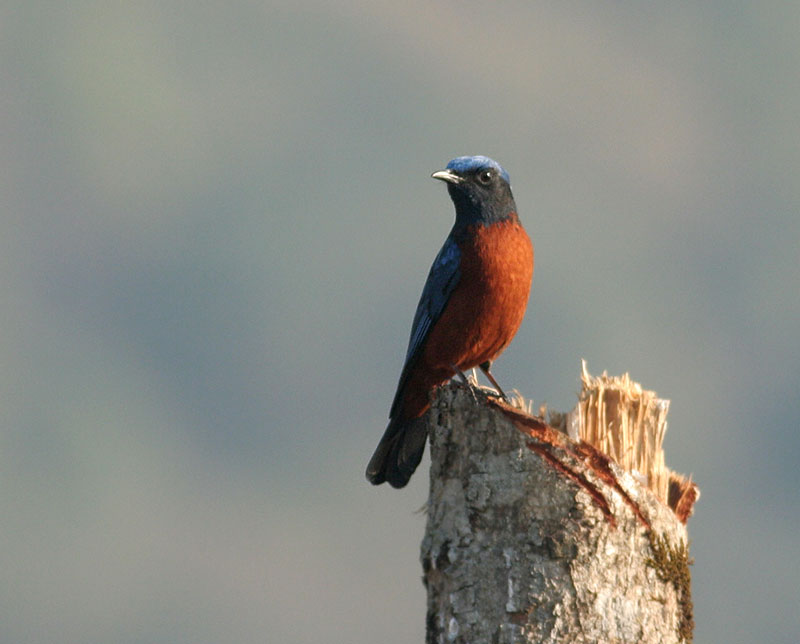
Chestnut-bellied Rock Thrush by Peter Ericsson

Chestnut-bellied Rock Thrush by Peter Ericsson

Even the stork in the sky Knows her seasons; And the turtledove and the swift and the thrush Observe the time of their migration; But My people do not know The ordinance of the LORD. (Jeremiah 8:7 NASB)

(Relocated)


*

Vol. 2, No. 4 – The Warbling Vireo

Warbling Vireo of Birds Illustrated by Color Photography, 1897

Warbling Vireo of Birds Illustrated by Color Photography, 1897

THE WARBLING VIREO.

imgt

HE Vireos are a family of singers and are more often heard than seen, but the Warbler has a much more musical voice, and of greater compass than any other member of the family. The song ripples like a brook, floating down from the leafiest tree-tops. It is not much to look at, being quite plainly dressed in contrast with the red-eyed cousin, the largest of the Vireos. In nesting time it prefers seclusion, though in the spring and mid-summer, when the little ones have flown, and nesting cares have ceased, it frequents the garden, singing in the elms and birches, and other tall trees. It rambles as well through the foliage of trees in open woodland, in parks, and in those along the banks of streams, where it diligently searches the under side of leaves and branches for insect life, “in that near-sighted way peculiar to the tribe.” It is a very stoic among birds, and seems never surprised at anything, “even at the loud report of a gun, with the shot rattling about it in the branches, and, if uninjured, it will stand for a moment unconcerned, or move along, peering on every side amongst the foliage, warbling its tender, liquid strains.”

The nest of this species is like that of the Red-eyed Vireo—a strong, durable, basket-like fabric, made of bark strips, lined with fine grasses. It is suspended by the brim in slender, horizontal forks of branches, at a great height from the ground.

The Vireo is especially numerous among the elms of Boston Common, where at almost any hour of the day, from early in the month of May, until long after summer has gone, may be heard the prolonged notes of the Warbling species, which was an especial favorite of Dr. Thomas M. Brewer, author of “History of North American Birds.” Its voice is not powerful, but its melody, it is said, is flute-like and tender, and its song is perhaps characterized more by its air of happy contentment, than by any other special quality. No writer on birds has grown enthusiastic on the subject, and Bradford Torrey alone among them does it scant justice, when he says this Vireo “is admirably named; there is no one of our birds that can more properly be said to warble. He keeps further from the ground than the others, and shows a strong preference for the elms of village streets, out of which his delicious music drops upon the ears of all passers underneath. How many of them hear it and thank the singer, is unhappily another question.”

Summary:

WARBLING VIREO.Vireo gilvus. Other name: “Yellow-throated Vireo.”

Range—North America; breeds as far north as the Hudson Bay region; winters in the tropics.

Nest—Pensile, of grasses and plant fibres, firmly and smoothly interwoven, lined with fine grasses, suspended from a forked branch eight to forty feet up.

Eggs—Three or four, white, with a few specks or spots of black umber, or rufous-brown, chiefly about the larger end.


Warbling Vireo (Vireo gilvus) by Raymond Barlow

Warbling Vireo (Vireo gilvus) by Raymond Barlow

Lee’s Addition:

A merry heart doeth good like a medicine: but a broken spirit drieth the bones. (Proverbs 17:22 KJV)

A rejoicing heart doth good to the body, And a smitten spirit drieth the bone. (Proverbs 17:22 YLT)

The birds of heaven dwell by them; they give forth their voice from among the branches. (Psalms 104:12 Darby)

Another one of the Lord’s little beauties that loves to sing. The Vireos are in the Vireonidae – Vireos, Greenlets Family.

The Warbling Vireo (Vireo gilvus) is a small North American songbird. Adults are 4.7 in (12 cm) long and weigh 0.4 oz (12 g). They are mainly olive-grey on the head and upperparts with white underparts; they have brown eyes and the front of the face is light. There is a white supercilium. They have thick blue-grey legs and a stout bill. Western birds are generally smaller and have darker grey crowns.

Its breeding habitat is open deciduous and mixed woods from Alaska to Mexico and the Florida Panhandle. It often nests along streams. It migrates to Mexico and Central America. The female quivers wings, oft in response to courtship song of the male, who likes to strut around the female with wings and tail spread.

Warbling Vireo (Vireo gilvus swainsoni) by Ian

Warbling Vireo (Vireo gilvus swainsoni) by Ian

They forage for insects in trees, hopping along branches and sometimes hovering. They also eat berries, especially before migration and in winter quarters, where they are – like other vireos – apparently quite fond of Gumbo-limbo seeds, though they will not venture into human-modified habitat to get them.

They make a deep cup nest (photo) suspended from a tree branch or shrub, placed relatively high in the east and lower in the west. The male helps with incubation and may sing from the nest.

**[Music to be added. Was Hacked of my sight]**

Their song is a cheerful warble, similar to that of the Painted Bunting. There are subtle differences in song between eastern and western birds, at least where the ranges meet in Alberta. Some authorities split the eastern and western races of this species into separate species:

The Western Warbling Vireo, V. swainsoni, includes V. g. swainsoni, which breeds from southeastern Alaska and southwestern Northwest Territories to the Sierra San Pedro Mártir, Baja California, and V. g. brewsteri, which breeds from southern Idaho, Wyoming, and Montana to south-central Oaxaca. These two subspecies winter in Mexico. The swainsoni group also includes V. g. victoriae, an isolated population breeding in the Sierra de la Laguna, Baja California Sur, and migrating to unknown wintering grounds.

The Eastern Warbling Vireo, V. gilvus, breeds from central Alberta and northern Montana east and south through most of the United States and parts of southern Canada, outside the range of the previous group. It winters south of the Isthmus of Tehuantepec from south-central Chiapas to Nicaragua. It completes its autumn molt on the breeding grounds, while the swainsonii group completes it after leaving.

The Brown-capped Vireo (Vireo leucophrys), resident in Central America and northern South America, is sometimes considered conspecific with the Warbling Vireo.

(Wikipedia and other internet sources)
*

Birds Illustrated by Color Photography – Revisited

The above article is an article in the monthly serial for October 1897 “designed to promote Knowledge of Bird-Live.” These include Color Photography, as they call them, today they are drawings. There are at least three Volumes that have been digitized by Project Gutenberg.

To see the whole series of – Birds Illustrated by Color Photography – Revisited

*

(Information from Wikipedia and other internet sources)

Next Article – The Wood Pewee

The Previous Article – The Yellow-Bellied Sapsucker

 ABC’s of the Gospel

Links:

*

Vol. 2, No. 4 – The Yellow-Bellied Sapsucker

Yellow-bellied Sapsucker of Birds Illustrated by Color Photography, 1897

Yellow-bellied Sapsucker of Birds Illustrated by Color Photography, 1897

THE YELLOW-BELLIED SAPSUCKER.

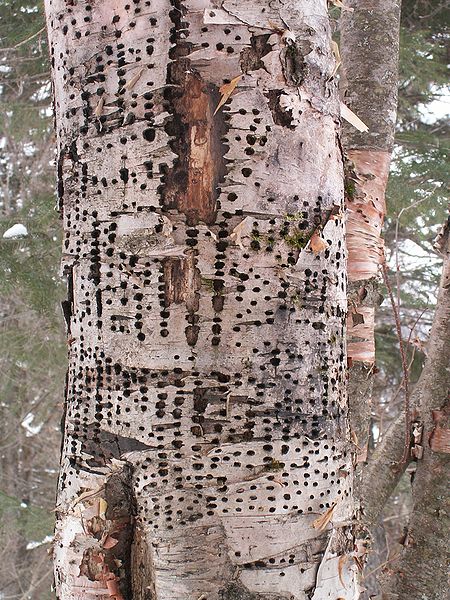
When the veins of the birch overflow in the spring,

Then I sharpen my bill and make the woods ring,

Till forth gushes—rewarding my tap, tap, tap!

The food of us Suckers—the rich, juicy sap.

—C. C. M.

imgm

ANY wild birds run up and down trees, and it seems to make little difference which end up they are temporarily, skirmishing ever to the right and left, whacking the bark with their bills, then quiet a brief moment, and again skirmishing around the tree. Sometimes an apple tree, says a recent writer, will have a perfect circle, not seldom several rings or holes round the tree—holes as large as a buck shot. The little skirmisher makes these holes, and the farmer calls it a Sapsucker. And such it is. Dr. Coues, however, says it is not a bird, handsome as it is, that you would care to have come in great numbers to your garden or orchard, for he eats the sap that leaks out through the holes he makes in the trees. When a great many holes have been bored near together, the bark loosens and peels off, so that the tree is likely to die. The Sapsucker also eats the soft inner bark which is between the rough outside bark and the hard heart-wood of the tree, which is very harmful. Nevertheless the bird does much good in destroying insects which gather to feed on the oozing sap. It sweeps them up in its tongue, which is not barbed, like that of other woodpeckers, but has a little brush on the end of it. It lacks the long, extensile tongue which enables the other species to probe the winding galleries of wood-eating larvæ.

Mr. William Brewster states that throughout the White Mountains of New Hampshire, and in most sections of Northern Maine, the Yellow-Bellied Woodpeckers outnumber all the other species in the summer season. Their favorite nesting sites are large dead birches, and a decided preference is manifested for the vicinity of water, though some nests occur in the interior of woods. The average height of the nesting hole from the ground is about forty feet. Many of the nests are gourd-like in shape, with the ends very smoothly and evenly chiseled, the average depth being about fourteen inches. The labors of excavating the nest and those of rearing the young are shared by both sexes. While this Sapsucker is a winter resident in most portions of Illinois, and may breed sparingly in the extreme northern portion, no record of it has been found.

A walk in one of our extensive parks is nearly always rewarded by the sight of one or more of these interesting and attractive birds. They are usually so industriously engaged that they seem to give little attention to your presence, and hunt away, tapping the bole of the tree, until called elsewhere by some more promising field of operations. Before taking flight from one tree to another, they stop the insect search and gaze inquisitively toward their destination. If two of them meet, there is often a sudden stopping in the air, a twisting upward and downward, followed by a lively chase across the open to the top of a dead tree, and then a sly peeping round or over a limb, after the manner of all Woodpeckers. A rapid drumming with the bill on the tree, branch or trunk, it is said, serves for a love-song, and it has a screaming call note.

**

My Dear Young Friends:

During the long summer days, when you were enjoying golden vacation hours, I often took a peep at you from some dead tree limb or the side of a hemlock or beech. You saw me, perhaps, and were surprised at my courage; for other small birds whose voices you heard, but whose tiny bodies escaped your young eyes, appeared very timid in comparison.

But I am not so brave, after all, and know full well when my red hat is in danger. I am a good flyer, too, and can soon put a wide space between myself and certain wicked boys, who, I hope, by next vacation time will have learned so much about us that they will love every little feathered creature, and not seek to do them any harm.

Can you guess why I have such a queer name? I really ought to be popular in Illinois, for they tell me it is called the Sucker State, and that the people are proud of it. Well, I am called Sapsucker because much, if not most, of my food consists of the secret juices which flow through the entire body of the tree which you probably saw me running up and down and around. But you saw me, you say, very often on dead branches of trees, and surely they had no sap in them? No, but if you will look closely into my actions, you will see that I destroy many insects which drill their way into the wood and deposit their eggs. In my opinion, I do far more good than harm, though you will find some people who think otherwise.

Then, again, if there is utility in beauty, surely I am a benefit to every one. One day I heard a lady say that she never saw my head pop up from behind an old stump without bursting into laughter, I looked so funny. Now I took that as a compliment; for to give pleasure to those around us, I have heard, is one of our highest duties.

Next summer when you seek the pleasant places where I dwell,—in the old deadening where the trees wear girdles around them; in the open groves, where I flit from tree to tree; in the deep wooded districts, whence one hears the tinkling ripple of running waters, you may, if good and gentle, see pop up behind a stump the red hat of Sapsucker.

Summary:

SAPSUCKER, YELLOW-BELLIED.Sphyrapicus varius.

Range—Eastern North America; breeds from Massachusetts northward, and winters from Virginia to Central America.

Nest—About forty feet from the ground.

Eggs—Five to seven.


Yellow-bellied Sapsucker Daves BirdingPix

Yellow-bellied Sapsucker (Sphyrapicus varius) by Daves BirdingPix

Lee’s Addition:

The trees of the LORD are full of sap, The cedars of Lebanon which He planted, Where the birds make their nests; The stork has her home in the fir trees. (Psalms 104:16-17 NKJV)

This article is from Birds Illustrated by Color Photography, 1897. We have been revisiting the birds and giving more current information about them.

The Yellow-bellied Sapsucker is one of 232 species in the Picidae – Woodpeckers Family. The yellow-bellied sapsucker is a mid-sized woodpecker, measuring 7.1–8.7 in (18–22 cm) in length, 13–16 in (34–40 cm) in wingspan and weighing from 1.4–2.2 oz (40–63 g).  Adults are black on the back and wings with white bars; they have a black head with white lines down the side and a red forehead and crown, a yellow breast and upper belly, a white lower belly and rump and a black tail with a white central bar. Adult males have a red throat; females have a white throat.

They drum and give a cat-like call in spring to declare ownership of territory.

The red-naped sapsucker is distinguished by having a red nape (back of the head). The hairy woodpecker has no red on the crown (front of the head) or throat and has blacker back. The downy woodpecker has same markings as the hairy woodpecker but is significantly smaller.

Like other sapsuckers, these birds drill holes in trees and eat the sap and insects drawn to it. They may also pick insects from tree trunks or catch them in flight. They also eat fruit and berries.

Yellow-bellied Sapsucker (Sphyrapicus varius) Holes in tree ©WikiC

Yellow-bellied Sapsucker (Sphyrapicus varius) Holes in tree ©WikiC

Because yellow-bellied sapsuckers feed on up to two hundred fifty species of living trees and woody plants, they are sometimes considered to be a pest. The birds can cause serious damage to trees, and intensive feeding has been documented as a source of tree mortality. Sapsucker feeding can kill a tree by girdling, which occurs when a ring of bark around the trunk is severely injured. Certain tree species are particularly susceptible to dying after being damaged by yellow-bellied sapsuckers. (Wikipedia with editing)

*

Birds Illustrated by Color Photography – Revisited

The above article is an article in the monthly serial for October 1897 “designed to promote Knowledge of Bird-Live.” These include Color Photography, as they call them, today they are drawings. There are at least three Volumes that have been digitized by Project Gutenberg.

To see the whole series of – Birds Illustrated by Color Photography – Revisited

*

(Information from Wikipedia and other internet sources)

Next Article – The Warbling Vireo

The Previous Article – Shore Lark  

Wordless Birds

Links:


Vol. 2, No. 4 – Shore Lark

Horned Lark of Birds Illustrated by Color Photography, 1897

Horned Lark of Birds Illustrated by Color Photography, 1897

From col. F. M. Woodruff. Copyrighted by
Nature Study Pub. Co., 1897, Chicago.

THE LARK.

Up with me! up with me into the clouds!
For thy song, Lark, is strong;
Up with me! Up with me into the clouds!
Singing, singing,
With clouds and sky about thee ringing.
Lift me, guide me till I find
That spot which seems so to thy mind.

I have walked through wildernesses dreary,
And to-day my heart is weary;
Had I now the wings of a Fairy
Up to thee would I fly.
There is madness about thee, and joy divine
In that song of thine;
Lift me, guide me high and high
To thy banqueting place in the sky.
—Wordsworth.


SHORE LARK

I

F the variety of names by which this Lark is known is any indication of its popularity, its friends must be indeed numerous. Snow Lark, Snowbird, Prairie Lark, Sky Lark, American Sky Lark, Horned Lark, are a few of them. There is only one American Species, so far as known. It breeds in northeastern North America and Greenland, wintering in the United States. It also inhabits northern portions of the old world. The common name is derived from the tufts of black feathers over each ear, which the birds have the power of erecting at will like the so-called horns of some owls.

In the Eastern States, during the winter months, flocks of Horned Larks, varying in size from a dozen to those of a hundred or more, may be seen frequenting open plains, old fields, dry shores of bays, and the banks of rivers. According to Davie, as there are a number of geographical varieties of the Horned Lark, the greatest uncertainty has always attended their identification even by experts, and the breeding and winter ranges of the various subspecies do not yet seem to be clearly defined.

Audubon found this species on the low, mossy and sheltered hills along the dreary coast of Labrador. In the midst of the mosses and lichens that covered the rocks the bird imbedded its nest, composed of fine grasses, arranged in a circular form and lined with the feathers of grouse and other birds.

Chapman says these Larks take wing with a sharp, whistled note, and seek fresh fields or, hesitating, finally swing about and return to near the spot from which they were flushed. They are sometimes found associated with Snowflakes. The pinkish grey coloring is very beautiful, but in the Middle and Eastern States this bird is rarely seen in his spring garb, says an observer, and his winter plumage lacks the vivid contrasts and prime color.

As a singer the Shore Lark is not to be despised, especially in his nesting haunts. He has a habit of singing as he soars in the air, after the manner of the European Skylark.

Summary:

HORNED LARK.Otocoris alpestris. Other name: “Shore Lark.”

Range—Breeds in northern Europe, Greenland, Newfoundland, Labrador, and Hudson Bay region; southward in winter into eastern United States to about latitude 35°.

Nest—Of grasses, on the ground.

Eggs—Three or four, pale bluish or greenish white, minutely and evenly speckled with pale grayish brown.


Horned Lark (Eremophila alpestris) by Nikhil Devasar

Horned Lark (Eremophila alpestris) by Nikhil Devasar

Lee’s Addition:

Beside them the birds of the heavens dwell; they sing among the branches. (Psalms 104:12 ESV)

The Horned Lark (Eremophila alpestris) is a member of the Alaudidae – Larks Family. There are 98 members presently in that family. In Europe they are called the Shore Lark, same as the title. Here we call it today the Horned Lark.

Unlike most other larks, this is a distinctive-looking species on the ground, mainly brown-grey above and pale below, with a striking black and yellow face pattern. The summer male has black “horns”, which give this species its American name. America has a number of races distinguished by the face pattern and back color of males, especially in summer. The southern European mountain race Eremophila alpestris penicillata is greyer above, and the yellow of the face pattern is replaced with white.

The Horned Lark breeds across much of North America from the high Arctic south to the Isthmus of Tehuantepec, northernmost Europe and Asia and in the mountains of southeast Europe. There is also an isolated population on a plateau in Colombia. It is mainly resident in the south of its range, but northern populations of this passerine bird are migratory, moving further south in winter.

Horned Lark (Eremophila alpestris) nest w eggs by Nikhil Devasar

Horned Lark (Eremophila alpestris) nest w eggs by Nikhil Devasar

This is a bird of open ground. In Eurasia it breeds above the tree line in mountains and the far north. In most of Europe, it is most often seen on seashore flats in winter, leading to the European name. In the UK it can be found as a winter stopover along the coasts and in eastern England although a mated pair have been recently spotted in Windmill End nature reserve in the West Midlands. In America, where there are no other larks to compete with, it’s also found on farmland, on prairies, in deserts, on golf courses and airports, and the like.

The nest is on the ground, with 2-5 eggs being laid. Food is seeds supplemented with insects in the breeding season. The nest may be near corn or soybeans for a source of food, and the female chooses the site.

Vocalizations are high-pitched, lisping or tinkling, and weak. The song, given in flight as is common among larks, consists of a few chips followed by a warbling, ascending trill.

Here is a Horned Lark Video Portrait from  TheMusicOfNature

*

Birds Illustrated by Color Photography – Revisited

The above article is an article in the monthly serial for October 1897 “designed to promote Knowledge of Bird-Live.” These include Color Photography, as they call them, today they are drawings. There are at least three Volumes that have been digitized by Project Gutenberg.

To see the whole series of – Birds Illustrated by Color Photography – Revisited

*

(Information from Wikipedia and other internet sources)

Next Article – The Yellow-Bellied Sapsucker

The Previous Article – The Chimney Swift

*

ABC’s of the Gospel

Links:

Horned Lark – All About Birds

Horned Lark – Wikipedia

Horned Lark Identifications – Petersons

Horned Lark – About.com

Alaudidae – Larks Family

*