

Yesterday’s My Mom And Me – Email blog inspired me to write a new article for the Birds of the Bible For Kids. It is called:”
Bible Birds – Mother Birds and Their Young.
Please check it out. It is geared for a younger audience.
*
Yesterday’s My Mom And Me – Email blog inspired me to write a new article for the Birds of the Bible For Kids. It is called:”
Bible Birds – Mother Birds and Their Young.
Please check it out. It is geared for a younger audience.
*

Summer Tanager (Piranga rubra) Male ©WikiC
From col. F. M. Woodruff. Copyrighted by
Nature Study Pub. Co., 1897, Chicago.

HE TANAGERS are birds of such uncommon beauty that when we have taken the pictures of the entire family the group will be a notable one and will add attractiveness to the portfolio. [See Vol. I, Red-Rumped Tanager and Scarlet Tanager] This specimen is also called the Summer Red-bird or Rose Tanager, and is found pretty generally distributed over the United States during the summer months, wintering in Cuba, Central America, and northern South America. As will be seen, the adult male is a plain vermilion red. The plumage of the female is less attractive. In habits this species resembles the Scarlet Tanager, perhaps the most brilliant of the group, but is not so retiring, frequenting open groves and often visiting towns and cities.
The nesting season of this charming bird extends to the latter part of July, but varies with the latitude and season. Bark strips and leaves interwoven with various vegetable substances compose the nest, which is usually built on a horizontal or drooping branch, near its extremity and situated at the edge of a grove near the roadside. Davie says: “All the nests of this species which I have seen collected in Ohio are very thin and frail structures; so thin that the eggs may often be seen from beneath. A nest sent me from Lee county, Texas, is compactly built of a cottony weed, a few stems of Spanish moss, and lined with fine grass stems.” Mr. L. O. Pindar states that nests found in Kentucky are compactly built, but not very thickly lined. The eggs are beautiful, being a bright, light emerald green, spotted, dotted, and blotched with various shades of lilac, brownish-purple, and dark brown.
Chapman says the Summer Tanager may be easily identified, not alone by its color but by its unique call-note, a clearly enunciated chicky, tucky, tuck. Its song bears a general resemblance to that of the Scarlet, but to some ears is much sweeter, better sustained, and more musical. It equals in strength, according to one authority, that of the Robin, but is uttered more hurriedly, is more “wiry,” and much more continued.
The Summer Tanager is to a greater or less extent known to farmers as the Red Bee-Bird. Its food consists largely of hornets, wasps, and bees.
The male of this species requires several years to attain the full plumage. Immature individuals, it is said, show a mixture of red and yellow in relative proportions according to age. The female has more red than the male, but the tint is peculiar, a dull Chinese orange, instead of a pure rosy vermilion, as in the male.
An interesting study for many of our readers during the summer months when the Tanagers are gay in their full plumage, would be to seek out, with Birds in hand, the most attractive denizens of the groves, identifying and observing them in their haunts until the entire group, of which five species are represented in the United States, is made familiar. When we remember that there are about three hundred and eighty known species of Tanagers in Tropical America, it would seem a light task to acquaint oneself with the small family at home.
Summary:
SUMMER TANAGER.—Piranga rubra. Other names: “Summer Red-bird,” “Rose Tanager.”
Range—Eastern United States west to the edge of the Plains; north regularly to about 40°—New Jersey, central Ohio, Illinois, casually north to Connecticut and Ontario, accidentally to Nova Scotia, wintering in Cuba, Central America, and northern South America. (Davie.)
Nest—Of bark strips and leaves interwoven with various vegetable substances, on drooping branch of tree.
Eggs—Three or four, bluish-white or greenish-blue, with cinnamon or olive-brown markings.

Summer Tanager (Piranga rubra) male by Kent Nickell
Lee’s Addition:
Now learn a parable of the fig tree; When her branch is yet tender, and putteth forth leaves, ye know that summer is near: (Mark 13:28 KJV)
Thou hast set all the borders of the earth: thou hast made summer and winter. (Psalms 74:17 KJV)
The Summer Tanager (Piranga rubra), is a medium-sized American songbird. Formerly placed in the tanager family (Thraupidae), it and other members of its genus are now classified in the cardinal family (Cardinalidae). The species’s plumage and vocalizations are similar to other members of the cardinal family.
Their breeding habitat is open wooded areas, especially with oaks, across the southern United States, extending as far north as Iowa. These birds migrate to Mexico, Central America and northern South America. This tanager is an extremely rare vagrant to western Europe.

Summer Tanager (Piranga rubra) by Beedie Savage
Adults have stout pointed bills and measure 17 cm (6.7 in) in length and 29 g (1.0 oz) in weight. Adult males are rose red and similar in appearance to the Hepatic Tanager, although the latter has a dark bill; females are orangish on the underparts and olive on top, with olive-brown wings and tail. As with all other birds, all red and orange colorations are acquired through their diet.
These birds are often out of sight, foraging high in trees, sometimes flying out to catch insects in flight. They mainly eat insects, especially bees and wasps, and berries. Fruit of Cymbopetalum mayanum (Annonaceae) are an especially well-liked food in their winter quarters, and birds will forage in human-altered habitat. Consequently, these trees can be planted to entice them to residential areas, and they may well be attracted to bird feeders. Summer Tanagers build a cup nest on a horizontal tree branch.
The Summer Tanager has an American Robin-like song, similar enough that novices sometimes mistake this bird for that species. The song consists of melodic units, repeated in a constant stream. The Summer Tanager’s song, however, is much more monotonous than that of T. migratorius, often consisting of as few as 3 or 4 distinct units. It is clearer and less nasal than the song of the Scarlet Tanager.
The Summer Tanager also has a sharp, agitated-sounded call pi-tuk or pik-i-tuk-i-tuk.
Call
Song
(From Wikipedia with editing and xeno-canto)
*
Birds Illustrated by Color Photography – Revisited
The above article is an article in the monthly serial for October 1897 “designed to promote Knowledge of Bird-Live.” These include Color Photography, as they call them, today they are drawings. There are at least three Volumes that have been digitized by Project Gutenberg.
To see the whole series of – Birds Illustrated by Color Photography – Revisited
*
(Information from Wikipedia and other internet sources)
Next Article – The American White-Fronted Goose
The Previous Article – John James Audubon
*
Links:
Summer Tanager – Wikipedia
Cardinalidae – Grosbeaks, Saltators & Allies
Thraupidae – Tanagers and Allies
Summer Tanager Sounds – xeno-canto
*

John James Audubon – Oil on canvas ©WikiC (1826)

OHN JAMES AUDUBON has always been a favorite with the writer, for the invincibleness of his love of Nature and of birds is only equalled by the spontaneous freshness of his style, springing from an affectionate and joyous nature. Recently there was found by accident, in an old calf-skin bound volume, an autobiography of the naturalist. It is entitled “Audubon’s Story of his Youth,” and would make a very pretty book. As introductory to the diaries and ornithological biographies of the birds, it would be very useful.
Two or three incidents in the life of this fascinating character are interesting as showing the influence of the accidental in ultimate achievement.
“One incident,” he says, “which is as perfect in my memory as if it had occurred this very day, I have thought thousands of times since, and will now put on paper as one of the curious things which perhaps did lead me in after times to love birds, and to finally study them with pleasure infinite. My mother had several beautiful parrots, and some monkeys; one of the latter was a full-grown male of a very large species. One morning, while the servants were engaged in arranging the room I was in, ‘Pretty Polly’ asking for her breakfast as usual, ‘Du pain au lait pour le perroquet Mignonne,’ (bread and milk for the parrot Mignonne,) the man of the woods probably thought the bird presuming upon his rights in the scale of nature; be this as it may, he certainly showed his supremacy in strength over the denizen of the air, for, walking deliberately and uprightly toward the poor bird, he at once killed it, with unnatural composure. The sensations of my infant heart at this cruel sight were agony to me. I prayed the servant to beat the monkey, but he, who for some reason, preferred the monkey to the parrot, refused. I uttered long and piercing cries, my mother rushed into the room; I was tranquilized; the monkey was forever afterward chained, and Mignonne buried with all the pomp of a cherished lost one. This made, as I have said, a very deep impression on my youthful mind.”
In consequence of the long absences of his father, who was an admiral in the French navy, the young naturalist’s education was neglected, his mother suffering him to do much as he pleased, and it was not to be wondered at, as he says, that instead of applying closely to his studies, he preferred associating with boys of his own age and disposition, who were more fond of going in search of bird’s nests, fishing, or shooting, than of better studies. Thus almost every day, instead of going to school, he usually made for the fields where he spent the day, returning with his little basket filled with what he called curiosities, such as birds’ nests, birds’ eggs, curious lichens, flowers of all sorts, and even pebbles gathered along the shore of some rivulet. Nevertheless, he did study drawing and music, for which he had some talent. His subsequent study of drawing under the celebrated David, richly equipped him for a work which he did not know was ever to be his, and enabled him to commence a series of drawings of birds of France, which he continued until he had upwards of two hundred completed. “All bad enough,” he says, “yet they were representations of birds, and I felt pleased with them.” Before sailing for France, he had begun a series of drawings of the birds of America, and had also begun a study of their habits. His efforts were commended by one of his friends, who assured him the time might come when he should be a great American naturalist, which had such weight with him that he felt a certain degree of pride in the words, even then, when he was about eighteen years of age.
“The store at Louisville went on prosperously, when I attended to it; but birds were birds then as now, and my thoughts were ever and anon turning toward them as the objects of my greatest delight. I shot, I drew, I looked on nature only; my days were happy beyond human conception, and beyond this I really cared not.” [How like Agassiz, who said he had not time to make money.] As he could not bear to give the attention required by his business, his business abandoned him. “Indeed, I never thought of business beyond the ever-engaging journeys which I was in the habit of taking to Philadelphia or New York, to purchase goods; those journeys I greatly enjoyed, as they afforded me ample means to study birds and their habits as I traveled through the beautiful, the darling forests of Ohio, Kentucky, and Pennsylvania.” Poor fellow, how many ups and downs he had! He lost everything and became burdened with debt. But he did not despair for had he not a talent for drawing? He at once undertook to take portraits of the human head divine in black chalk, and thanks to his master, David, succeeded admirably. He established a large drawing school at Cincinnati, and formed an engagement to stuff birds for the museum there at a large salary.
“One of the most extraordinary things among all these adverse circumstances” he adds, “was, that I never for a day give up listening to the songs of our birds, or watching their peculiar habits, or delineating them in the best way I could; nay, during my deepest troubles, I frequently would wrench myself from the persons around me and retire to some secluded part of our noble forests; and many a time, at the sound of the wood-thrushes’ melodies, have I fallen on my knees and there prayed earnestly to our God. This never failed to bring me the most valuable of thoughts, and always comfort, and it was often necessary for me to exert my will and compel myself to return to my fellow-beings.”
Do you not fancy that Audubon was himself a rara avis and worthy of admiration and study?
Such a man, in the language of a contemporary, should have a monument in the old Creole country in which he was born, and whose birds inspired his childish visions. It should be the most beautiful work possible to the sculptor’s art, portraying Audubon in the garb he wore when he was proud and happy to be called the “American Woodman,” and at his feet should stand the Eagle which he named the “Bird of Washington,” and near should perch the Mocking Bird, as once, in his description, it flew and fluttered and sang to the mind’s eye and ear from the pages of the old reading book.
C. C. Marble.

Plate 41 of Birds of America by John James Audubon depicting Ruffed Grouse by John J Audubon ©WikiC.
Lee’s Addition:
Drawings can help one to:
Remember his marvellous works that he hath done; his wonders, and the judgments of his mouth; (Psalms 105:5 KJV)
John James Audubon (Jean-Jacques Audubon) (April 26, 1785 – January 27, 1851) was a French-American ornithologist, naturalist, and painter. He was notable for his expansive studies to document all types of American birds and for his detailed illustrations that depicted the birds in their natural habitats. His major work, a color-plate book entitled The Birds of America (1827–1839), is considered one of the finest ornithological works ever completed. Audubon identified 25 new species.
Much has been written about John J Audubon, see links below. He is known for his artistic ability and I found this from Wikipedia interesting, though it would have been nice to have not had to kill the birds. Back then, unfortunately, they did not have cameras like we have today with zoom lens and video cameras that could have recorded the details.

Ivory-billed Woodpecker by John J Audubon
“Audubon developed his own methods for drawing birds. First, he killed them using fine shot. He then used wires to prop them into a natural position, unlike the common method of many ornithologists, who prepared and stuffed the specimens into a rigid pose. When working on a major specimen like an eagle, he would spend up to four 15-hour days, preparing, studying, and drawing it. His paintings of birds are set true-to-life in their natural habitat. He often portrayed them as if caught in motion, especially feeding or hunting. This was in stark contrast to the stiff representations of birds by his contemporaries, such as Alexander Wilson. Audubon based his paintings on his extensive field observations.
He worked primarily with watercolor early on. He added colored chalk or pastel to add softness to feathers, especially those of owls and herons. He employed multiple layers of watercoloring, and sometimes used gouache. All species were drawn life-size which accounts for the contorted poses of the larger birds as Audubon strove to fit them within the page size. Smaller species were usually placed on branches with berries, fruit, and flowers. He used several birds in a drawing to present all views of anatomy and wings. Larger birds were often placed in their ground habitat or perching on stumps. At times, as with woodpeckers, he combined several species on one page to offer contrasting features. He frequently depicted the birds’ nests and eggs, and occasionally natural predators, such as snakes. He usually illustrated male and female variations, and sometimes juveniles. In later drawings, Audubon used assistants to render the habitat for him. Going beyond faithful renderings of anatomy, Audubon employed carefully constructed composition, drama, and slightly exaggerated poses to achieve artistic as well as scientific effects.” (Wikipedia)
*
Birds Illustrated by Color Photography – Revisited
The above article is an article in the monthly serial for October 1897 “designed to promote Knowledge of Bird-Live.” These include Color Photography, as they call them, today they are drawings. There are at least three Volumes that have been digitized by Project Gutenberg.
To see the whole series of – Birds Illustrated by Color Photography – Revisited
*
(Information from Wikipedia and other internet sources)
Next Article – The Summer Tanager
The Previous Article – The Kingbird
Links:
John James Audubon – Wikipedia
The Birds of America – Wikipedia
*

Sunset Lorikeet (Trichoglossus forsteni) ©WikiC
Now Israel loved Joseph more than all his children, because he was the son of his old age: and he made him a coat of many colours. (Genesis 37:3 KJV)
After I finished the Birds of the World – Kingfishers, Australasian Warblers, White-Eyes and Doves article last week, I decided to finish up the Psittacidae – Parrots Family. I still needed 150 photos or drawings to complete the 363 species needed. Well, last night, it was finished and at 100% for images.
Looking at all those Parrots and others in the family, they definitely have “Coats of Many Colors” also. Just wanted to share their beautifully created plumage also. Most of us are familiar with parrots and parakeets. Many have them as pets or have seen them in the wild. So you are sort of familiar with them, but I am sure as you view the slideshow, you will see many that you haven’t seen before.
I also want to share the only birds I had personally. My preference is that the birds roam free, or are being kept from extinction in zoos or other similar situation. There is nothing wrong with having a pet, but I am just stating my preference. We ended up with two Monk Parakeets when we lived in south Florida. They are wild down there (up here also), but one day the neighbor boys came to my door and told me about an injured Monk Parakeet. A teenager had shot it out of a tree and the smaller boys found it. They said, “You love birds and you will know what to do.” That began the adventure with my bird. I had never kept a bird in my life, but knew that my veterinarian was also a bird vet. Long story short, I ended up with a one-winged bird that could never go back to the wild. My “free bird” ended up costing over $200 for vet bills. (This was over 20 years ago). Dan wanted to call it “One-armed Bandit” because it cost me so much, but I took the “t” off of “Bandit” and it became “Bandi.” I think it was a “she” because she was so sweet.
Well a year later, my friend bought two Monks and told me there was one more, but it had a deformed leg. Another long story short, I bought “Hoppy” for $25 and ended up spending another $200 getting a broken leg repaired. It was an amazing surgery the vet performed. “Hoppy” had to be a male, because he could be mischievous at times, but he learned to talk and was quite enjoyable (most of the time). The picture shows “Hoppy” with the bandage in front and “Bandi” in the background.

Hoppy in front, Bandi in back – Monk Parakeet (Myiopsitta monachus)
The only two verses in Scripture, that I know of, that would apply to this would be:
For every kind of beasts, and of birds, and of serpents, and of things in the sea, is tamed, and hath been tamed of mankind: (James 3:7 KJV)
As a cage is full of birds, so are their houses full of deceit: therefore they are become great, and waxen rich. (Jeremiah 5:27 KJV)
Back to the Coats of Many Colors, below is a slideshow showing some of our beautiful and personable members of the Psittacidae – Parrots Family.
*
See Also:
Psittacidae – Parrots Family
Birds of the Bible – Coat of Many Colors I
*
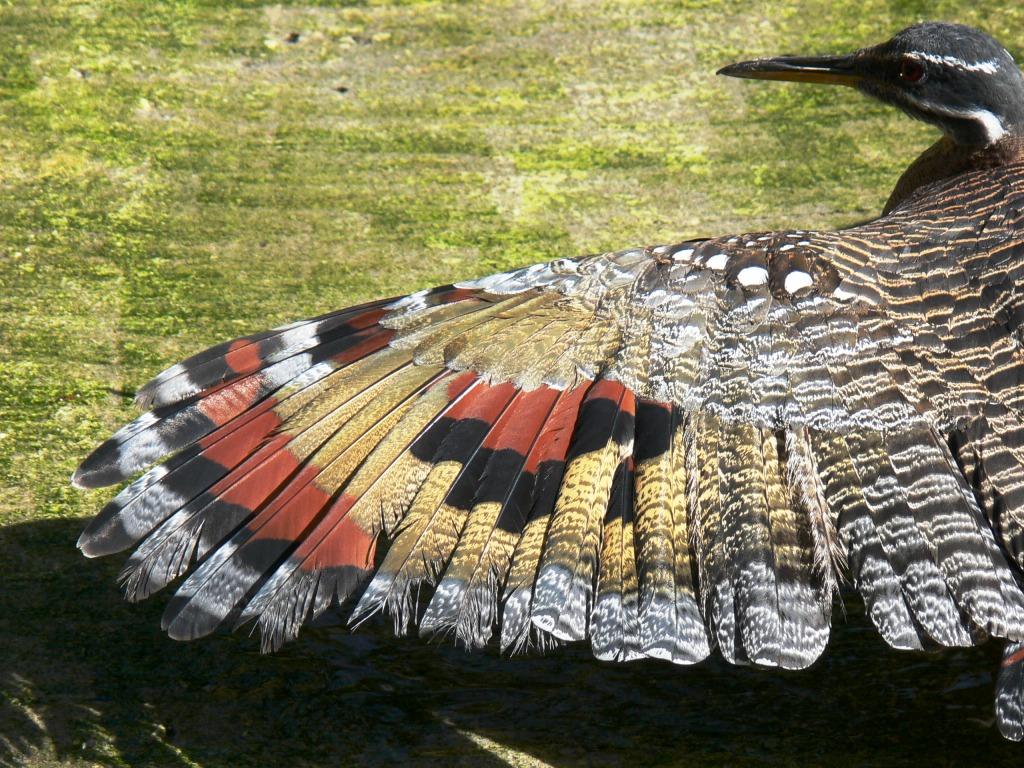
Sunbittern (Eurypyga helias) Left Wing by Lee at Lowry Park Zoo
While reading in Exodus 25 this week, I noticed that the plan for the Ark is written out in quite specific details. The plans for the mercy seat was to be covered by the outstretched wings of the cherubims of gold.
And the cherubims shall stretch forth their wings on high, covering the mercy seat with their wings, and their faces shall look one to another; toward the mercy seat shall the faces of the cherubims be. (Exodus 25:20 KJV)
I wondered if I had written much about “wings”, so I checked and found only three articles, so far:
I am curious about what can be found, so, let’s see what we can find. Of course my e-Sword is fired up and ready for the searching. Searching first with just “wing”, only 6 verses show up. I Kings 6:24, 6:27; 2 Chronicles 3:11-2 all refer to the wing of the cherub. Isaiah 10:14 actually mentions a bird having its eggs taken and not moving its wing, opening its mouth or peeping. It is used as an illustration.
And my hand hath found as a nest the riches of the people: and as one gathereth eggs that are left, have I gathered all the earth; and there was none that moved the wing, or opened the mouth, or peeped. (Isaiah 10:14 KJV)
Ezekiel 17:23 is the verse used in Fowl (Birds) of Every Wing.
Searching again with “wings” this time shows 64 verses (KJV). Again the cherubims are mentioned in Exodus 25:20, 37:9; I Kings 6:26, 8:6, 8:7; 1 Chronicles 28:18; 2 Chronicles 3:11, 3:13, 5:7-8. Cherubim and serephim wings are again mentioned later in the prophecies of Isaiah (Isa 6:2, 8:8, 18:1, and 40:31), Ezekiel (Exe 1:6-11, 1:23-25, 3:13, 10:5-21, 11:22) and Daniel. Ezekiel 17:3 & 7 mention “A great eagle with great wings, longwinged, full of feathers” and “another great eagle with great wings and many feathers” Daniel 7:4 and 6 mention “eagle’s wings” and “wings of a fowl”

Wedge-tailed Eagle (Aquila audax) ©WikiC
Eagles’ wings are mentioned several more times:
Ye have seen what I did unto the Egyptians, and how I bare you on eagles‘ wings, and brought you unto myself. (Exodus 19:4 KJV)
As an eagle stirreth up her nest, fluttereth over her young, spreadeth abroad her wings, taketh them, beareth them on her wings: (Deuteronomy 32:11 KJV)
Wilt thou set thine eyes upon that which is not? for riches certainly make themselves wings; they fly away as an eagle toward heaven. (Proverbs 23:5 KJV)
But they that wait upon the LORD shall renew their strength; they shall mount up with wings as eagles; they shall run, and not be weary; and they shall walk, and not faint. (Isaiah 40:31 KJV)
For thus saith the LORD; Behold, he shall fly as an eagle, and shall spread his wings over Moab. (Jeremiah 48:40 KJV)
Behold, he shall come up and fly as the eagle, and spread his wings over Bozrah: and at that day shall the heart of the mighty men of Edom be as the heart of a woman in her pangs. (Jeremiah 49:22 KJV)

Indian Peafowl (Pavo cristatus) by Nikhil Devasar
Of course other birds are named such as:
Gavest thou the goodly wings unto the peacocks? or wings and feathers unto the ostrich? (Job 39:13 KJV)
Doth the hawk fly by thy wisdom, and stretch her wings toward the south? (Job 39:26 KJV)
And I said, Oh that I had wings like a dove! for then would I fly away, and be at rest. (Psalms 55:6 KJV)
Though ye have lien among the pots, yet shall ye be as the wings of a dove covered with silver, and her feathers with yellow gold. (Psalms 68:13 KJV)
Then lifted I up mine eyes, and looked, and, behold, there came out two women, and the wind was in their wings; for they had wings like the wings of a stork: and they lifted up the ephah between the earth and the heaven. (Zechariah 5:9 KJV)
O Jerusalem, Jerusalem, thou that killest the prophets, and stonest them which are sent unto thee, how often would I have gathered thy children together, even as a hen gathereth her chickens under her wings, and ye would not! (Matthew 23:37 KJV)
O Jerusalem, Jerusalem, which killest the prophets, and stonest them that are sent unto thee; how often would I have gathered thy children together, as a hen doth gather her brood under her wings, and ye would not! (Luke 13:34 KJV)

Baby Chick Peeping Out From Under His Mom’s Wing – ©©
Other references to wings:
That is an interesting survey of the verses with wing or wings in them. Now I will have to get busy and use this information in some future articles. There are definitely some trends that can be seen. Do you see them? Shadow, wind, healing and trust, just to name a few.
*
*

Laughing Gull landing on Brown Pelican
I am like a pelican of the wilderness; I am like an owl of the desert. (Psalms 102:6 NKJV)

Warbling Vireo of Birds Illustrated by Color Photography, 1897
HE Vireos are a family of singers and are more often heard than seen, but the Warbler has a much more musical voice, and of greater compass than any other member of the family. The song ripples like a brook, floating down from the leafiest tree-tops. It is not much to look at, being quite plainly dressed in contrast with the red-eyed cousin, the largest of the Vireos. In nesting time it prefers seclusion, though in the spring and mid-summer, when the little ones have flown, and nesting cares have ceased, it frequents the garden, singing in the elms and birches, and other tall trees. It rambles as well through the foliage of trees in open woodland, in parks, and in those along the banks of streams, where it diligently searches the under side of leaves and branches for insect life, “in that near-sighted way peculiar to the tribe.” It is a very stoic among birds, and seems never surprised at anything, “even at the loud report of a gun, with the shot rattling about it in the branches, and, if uninjured, it will stand for a moment unconcerned, or move along, peering on every side amongst the foliage, warbling its tender, liquid strains.”
The nest of this species is like that of the Red-eyed Vireo—a strong, durable, basket-like fabric, made of bark strips, lined with fine grasses. It is suspended by the brim in slender, horizontal forks of branches, at a great height from the ground.
The Vireo is especially numerous among the elms of Boston Common, where at almost any hour of the day, from early in the month of May, until long after summer has gone, may be heard the prolonged notes of the Warbling species, which was an especial favorite of Dr. Thomas M. Brewer, author of “History of North American Birds.” Its voice is not powerful, but its melody, it is said, is flute-like and tender, and its song is perhaps characterized more by its air of happy contentment, than by any other special quality. No writer on birds has grown enthusiastic on the subject, and Bradford Torrey alone among them does it scant justice, when he says this Vireo “is admirably named; there is no one of our birds that can more properly be said to warble. He keeps further from the ground than the others, and shows a strong preference for the elms of village streets, out of which his delicious music drops upon the ears of all passers underneath. How many of them hear it and thank the singer, is unhappily another question.”
Summary:
WARBLING VIREO.—Vireo gilvus. Other name: “Yellow-throated Vireo.”
Range—North America; breeds as far north as the Hudson Bay region; winters in the tropics.
Nest—Pensile, of grasses and plant fibres, firmly and smoothly interwoven, lined with fine grasses, suspended from a forked branch eight to forty feet up.
Eggs—Three or four, white, with a few specks or spots of black umber, or rufous-brown, chiefly about the larger end.

Warbling Vireo (Vireo gilvus) by Raymond Barlow
Lee’s Addition:
A merry heart doeth good like a medicine: but a broken spirit drieth the bones. (Proverbs 17:22 KJV)
A rejoicing heart doth good to the body, And a smitten spirit drieth the bone. (Proverbs 17:22 YLT)
The birds of heaven dwell by them; they give forth their voice from among the branches. (Psalms 104:12 Darby)
Another one of the Lord’s little beauties that loves to sing. The Vireos are in the Vireonidae – Vireos, Greenlets Family.
The Warbling Vireo (Vireo gilvus) is a small North American songbird. Adults are 4.7 in (12 cm) long and weigh 0.4 oz (12 g). They are mainly olive-grey on the head and upperparts with white underparts; they have brown eyes and the front of the face is light. There is a white supercilium. They have thick blue-grey legs and a stout bill. Western birds are generally smaller and have darker grey crowns.
Its breeding habitat is open deciduous and mixed woods from Alaska to Mexico and the Florida Panhandle. It often nests along streams. It migrates to Mexico and Central America. The female quivers wings, oft in response to courtship song of the male, who likes to strut around the female with wings and tail spread.

Warbling Vireo (Vireo gilvus swainsoni) by Ian
They forage for insects in trees, hopping along branches and sometimes hovering. They also eat berries, especially before migration and in winter quarters, where they are – like other vireos – apparently quite fond of Gumbo-limbo seeds, though they will not venture into human-modified habitat to get them.
They make a deep cup nest (photo) suspended from a tree branch or shrub, placed relatively high in the east and lower in the west. The male helps with incubation and may sing from the nest.
**[Music to be added. Was Hacked of my sight]**
Their song is a cheerful warble, similar to that of the Painted Bunting. There are subtle differences in song between eastern and western birds, at least where the ranges meet in Alberta. Some authorities split the eastern and western races of this species into separate species:
The Western Warbling Vireo, V. swainsoni, includes V. g. swainsoni, which breeds from southeastern Alaska and southwestern Northwest Territories to the Sierra San Pedro Mártir, Baja California, and V. g. brewsteri, which breeds from southern Idaho, Wyoming, and Montana to south-central Oaxaca. These two subspecies winter in Mexico. The swainsoni group also includes V. g. victoriae, an isolated population breeding in the Sierra de la Laguna, Baja California Sur, and migrating to unknown wintering grounds.
The Eastern Warbling Vireo, V. gilvus, breeds from central Alberta and northern Montana east and south through most of the United States and parts of southern Canada, outside the range of the previous group. It winters south of the Isthmus of Tehuantepec from south-central Chiapas to Nicaragua. It completes its autumn molt on the breeding grounds, while the swainsonii group completes it after leaving.
The Brown-capped Vireo (Vireo leucophrys), resident in Central America and northern South America, is sometimes considered conspecific with the Warbling Vireo.
(Wikipedia and other internet sources)
*
Birds Illustrated by Color Photography – Revisited
The above article is an article in the monthly serial for October 1897 “designed to promote Knowledge of Bird-Live.” These include Color Photography, as they call them, today they are drawings. There are at least three Volumes that have been digitized by Project Gutenberg.
To see the whole series of – Birds Illustrated by Color Photography – Revisited
*
(Information from Wikipedia and other internet sources)
Next Article – The Wood Pewee
The Previous Article – The Yellow-Bellied Sapsucker
Links:
*

Yellow-bellied Sapsucker of Birds Illustrated by Color Photography, 1897
When the veins of the birch overflow in the spring,
Then I sharpen my bill and make the woods ring,
Till forth gushes—rewarding my tap, tap, tap!
The food of us Suckers—the rich, juicy sap.
—C. C. M.

ANY wild birds run up and down trees, and it seems to make little difference which end up they are temporarily, skirmishing ever to the right and left, whacking the bark with their bills, then quiet a brief moment, and again skirmishing around the tree. Sometimes an apple tree, says a recent writer, will have a perfect circle, not seldom several rings or holes round the tree—holes as large as a buck shot. The little skirmisher makes these holes, and the farmer calls it a Sapsucker. And such it is. Dr. Coues, however, says it is not a bird, handsome as it is, that you would care to have come in great numbers to your garden or orchard, for he eats the sap that leaks out through the holes he makes in the trees. When a great many holes have been bored near together, the bark loosens and peels off, so that the tree is likely to die. The Sapsucker also eats the soft inner bark which is between the rough outside bark and the hard heart-wood of the tree, which is very harmful. Nevertheless the bird does much good in destroying insects which gather to feed on the oozing sap. It sweeps them up in its tongue, which is not barbed, like that of other woodpeckers, but has a little brush on the end of it. It lacks the long, extensile tongue which enables the other species to probe the winding galleries of wood-eating larvæ.
Mr. William Brewster states that throughout the White Mountains of New Hampshire, and in most sections of Northern Maine, the Yellow-Bellied Woodpeckers outnumber all the other species in the summer season. Their favorite nesting sites are large dead birches, and a decided preference is manifested for the vicinity of water, though some nests occur in the interior of woods. The average height of the nesting hole from the ground is about forty feet. Many of the nests are gourd-like in shape, with the ends very smoothly and evenly chiseled, the average depth being about fourteen inches. The labors of excavating the nest and those of rearing the young are shared by both sexes. While this Sapsucker is a winter resident in most portions of Illinois, and may breed sparingly in the extreme northern portion, no record of it has been found.
A walk in one of our extensive parks is nearly always rewarded by the sight of one or more of these interesting and attractive birds. They are usually so industriously engaged that they seem to give little attention to your presence, and hunt away, tapping the bole of the tree, until called elsewhere by some more promising field of operations. Before taking flight from one tree to another, they stop the insect search and gaze inquisitively toward their destination. If two of them meet, there is often a sudden stopping in the air, a twisting upward and downward, followed by a lively chase across the open to the top of a dead tree, and then a sly peeping round or over a limb, after the manner of all Woodpeckers. A rapid drumming with the bill on the tree, branch or trunk, it is said, serves for a love-song, and it has a screaming call note.
**
My Dear Young Friends:
During the long summer days, when you were enjoying golden vacation hours, I often took a peep at you from some dead tree limb or the side of a hemlock or beech. You saw me, perhaps, and were surprised at my courage; for other small birds whose voices you heard, but whose tiny bodies escaped your young eyes, appeared very timid in comparison.
But I am not so brave, after all, and know full well when my red hat is in danger. I am a good flyer, too, and can soon put a wide space between myself and certain wicked boys, who, I hope, by next vacation time will have learned so much about us that they will love every little feathered creature, and not seek to do them any harm.
Can you guess why I have such a queer name? I really ought to be popular in Illinois, for they tell me it is called the Sucker State, and that the people are proud of it. Well, I am called Sapsucker because much, if not most, of my food consists of the secret juices which flow through the entire body of the tree which you probably saw me running up and down and around. But you saw me, you say, very often on dead branches of trees, and surely they had no sap in them? No, but if you will look closely into my actions, you will see that I destroy many insects which drill their way into the wood and deposit their eggs. In my opinion, I do far more good than harm, though you will find some people who think otherwise.
Then, again, if there is utility in beauty, surely I am a benefit to every one. One day I heard a lady say that she never saw my head pop up from behind an old stump without bursting into laughter, I looked so funny. Now I took that as a compliment; for to give pleasure to those around us, I have heard, is one of our highest duties.
Next summer when you seek the pleasant places where I dwell,—in the old deadening where the trees wear girdles around them; in the open groves, where I flit from tree to tree; in the deep wooded districts, whence one hears the tinkling ripple of running waters, you may, if good and gentle, see pop up behind a stump the red hat of Sapsucker.
Summary:
SAPSUCKER, YELLOW-BELLIED.—Sphyrapicus varius.
Range—Eastern North America; breeds from Massachusetts northward, and winters from Virginia to Central America.
Nest—About forty feet from the ground.
Eggs—Five to seven.

Yellow-bellied Sapsucker (Sphyrapicus varius) by Daves BirdingPix
Lee’s Addition:
The trees of the LORD are full of sap, The cedars of Lebanon which He planted, Where the birds make their nests; The stork has her home in the fir trees. (Psalms 104:16-17 NKJV)
This article is from Birds Illustrated by Color Photography, 1897. We have been revisiting the birds and giving more current information about them.
The Yellow-bellied Sapsucker is one of 232 species in the Picidae – Woodpeckers Family. The yellow-bellied sapsucker is a mid-sized woodpecker, measuring 7.1–8.7 in (18–22 cm) in length, 13–16 in (34–40 cm) in wingspan and weighing from 1.4–2.2 oz (40–63 g). Adults are black on the back and wings with white bars; they have a black head with white lines down the side and a red forehead and crown, a yellow breast and upper belly, a white lower belly and rump and a black tail with a white central bar. Adult males have a red throat; females have a white throat.
They drum and give a cat-like call in spring to declare ownership of territory.
The red-naped sapsucker is distinguished by having a red nape (back of the head). The hairy woodpecker has no red on the crown (front of the head) or throat and has blacker back. The downy woodpecker has same markings as the hairy woodpecker but is significantly smaller.
Like other sapsuckers, these birds drill holes in trees and eat the sap and insects drawn to it. They may also pick insects from tree trunks or catch them in flight. They also eat fruit and berries.
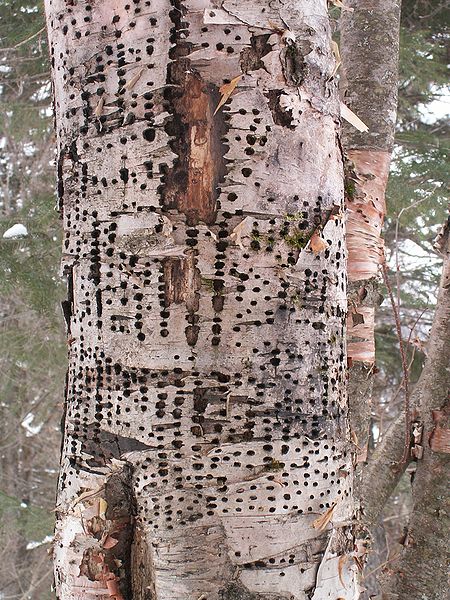
Yellow-bellied Sapsucker (Sphyrapicus varius) Holes in tree ©WikiC
Because yellow-bellied sapsuckers feed on up to two hundred fifty species of living trees and woody plants, they are sometimes considered to be a pest. The birds can cause serious damage to trees, and intensive feeding has been documented as a source of tree mortality. Sapsucker feeding can kill a tree by girdling, which occurs when a ring of bark around the trunk is severely injured. Certain tree species are particularly susceptible to dying after being damaged by yellow-bellied sapsuckers. (Wikipedia with editing)
*
Birds Illustrated by Color Photography – Revisited
The above article is an article in the monthly serial for October 1897 “designed to promote Knowledge of Bird-Live.” These include Color Photography, as they call them, today they are drawings. There are at least three Volumes that have been digitized by Project Gutenberg.
To see the whole series of – Birds Illustrated by Color Photography – Revisited
*
(Information from Wikipedia and other internet sources)
Next Article – The Warbling Vireo
The Previous Article – Shore Lark
Links:

Horned Lark of Birds Illustrated by Color Photography, 1897
From col. F. M. Woodruff. Copyrighted by
Nature Study Pub. Co., 1897, Chicago.
Up with me! up with me into the clouds!
For thy song, Lark, is strong;
Up with me! Up with me into the clouds!
Singing, singing,
With clouds and sky about thee ringing.
Lift me, guide me till I find
That spot which seems so to thy mind.
I have walked through wildernesses dreary,
And to-day my heart is weary;
Had I now the wings of a Fairy
Up to thee would I fly.
There is madness about thee, and joy divine
In that song of thine;
Lift me, guide me high and high
To thy banqueting place in the sky.
—Wordsworth.

F the variety of names by which this Lark is known is any indication of its popularity, its friends must be indeed numerous. Snow Lark, Snowbird, Prairie Lark, Sky Lark, American Sky Lark, Horned Lark, are a few of them. There is only one American Species, so far as known. It breeds in northeastern North America and Greenland, wintering in the United States. It also inhabits northern portions of the old world. The common name is derived from the tufts of black feathers over each ear, which the birds have the power of erecting at will like the so-called horns of some owls.
In the Eastern States, during the winter months, flocks of Horned Larks, varying in size from a dozen to those of a hundred or more, may be seen frequenting open plains, old fields, dry shores of bays, and the banks of rivers. According to Davie, as there are a number of geographical varieties of the Horned Lark, the greatest uncertainty has always attended their identification even by experts, and the breeding and winter ranges of the various subspecies do not yet seem to be clearly defined.
Audubon found this species on the low, mossy and sheltered hills along the dreary coast of Labrador. In the midst of the mosses and lichens that covered the rocks the bird imbedded its nest, composed of fine grasses, arranged in a circular form and lined with the feathers of grouse and other birds.
Chapman says these Larks take wing with a sharp, whistled note, and seek fresh fields or, hesitating, finally swing about and return to near the spot from which they were flushed. They are sometimes found associated with Snowflakes. The pinkish grey coloring is very beautiful, but in the Middle and Eastern States this bird is rarely seen in his spring garb, says an observer, and his winter plumage lacks the vivid contrasts and prime color.
As a singer the Shore Lark is not to be despised, especially in his nesting haunts. He has a habit of singing as he soars in the air, after the manner of the European Skylark.
Summary:
HORNED LARK.—Otocoris alpestris. Other name: “Shore Lark.”
Range—Breeds in northern Europe, Greenland, Newfoundland, Labrador, and Hudson Bay region; southward in winter into eastern United States to about latitude 35°.
Nest—Of grasses, on the ground.
Eggs—Three or four, pale bluish or greenish white, minutely and evenly speckled with pale grayish brown.

Horned Lark (Eremophila alpestris) by Nikhil Devasar
Lee’s Addition:
Beside them the birds of the heavens dwell; they sing among the branches. (Psalms 104:12 ESV)
The Horned Lark (Eremophila alpestris) is a member of the Alaudidae – Larks Family. There are 98 members presently in that family. In Europe they are called the Shore Lark, same as the title. Here we call it today the Horned Lark.
Unlike most other larks, this is a distinctive-looking species on the ground, mainly brown-grey above and pale below, with a striking black and yellow face pattern. The summer male has black “horns”, which give this species its American name. America has a number of races distinguished by the face pattern and back color of males, especially in summer. The southern European mountain race Eremophila alpestris penicillata is greyer above, and the yellow of the face pattern is replaced with white.
The Horned Lark breeds across much of North America from the high Arctic south to the Isthmus of Tehuantepec, northernmost Europe and Asia and in the mountains of southeast Europe. There is also an isolated population on a plateau in Colombia. It is mainly resident in the south of its range, but northern populations of this passerine bird are migratory, moving further south in winter.

Horned Lark (Eremophila alpestris) nest w eggs by Nikhil Devasar
This is a bird of open ground. In Eurasia it breeds above the tree line in mountains and the far north. In most of Europe, it is most often seen on seashore flats in winter, leading to the European name. In the UK it can be found as a winter stopover along the coasts and in eastern England although a mated pair have been recently spotted in Windmill End nature reserve in the West Midlands. In America, where there are no other larks to compete with, it’s also found on farmland, on prairies, in deserts, on golf courses and airports, and the like.
The nest is on the ground, with 2-5 eggs being laid. Food is seeds supplemented with insects in the breeding season. The nest may be near corn or soybeans for a source of food, and the female chooses the site.
Vocalizations are high-pitched, lisping or tinkling, and weak. The song, given in flight as is common among larks, consists of a few chips followed by a warbling, ascending trill.
Here is a Horned Lark Video Portrait from TheMusicOfNature
*
Birds Illustrated by Color Photography – Revisited
The above article is an article in the monthly serial for October 1897 “designed to promote Knowledge of Bird-Live.” These include Color Photography, as they call them, today they are drawings. There are at least three Volumes that have been digitized by Project Gutenberg.
To see the whole series of – Birds Illustrated by Color Photography – Revisited
*
(Information from Wikipedia and other internet sources)
Next Article – The Yellow-Bellied Sapsucker
The Previous Article – The Chimney Swift
*
Links:
Horned Lark – All About Birds
Horned Lark – Wikipedia
Horned Lark Identifications – Petersons
Horned Lark – About.com
Alaudidae – Larks Family
*

Chimney Swift of Birds Illustrated by Color Photography, 1897
From col. Eugene Bliss. Copyrighted by
Nature Study Pub. Co., 1897, Chicago.

HIEF POKAGON, of the Pottawattamie Indians, in an article in The Osprey, writes delightfully of the Chimney Swift, and we quote a portion of it describing a peculiar habit of the bird. The chief was a youth when he made the observation, and he writes in the second person:
“As you look, you see the head of the young chief is turning slowly around, watching something high in air above the stream; you now begin to look in the same direction, catching glimpses every now and then, of the segment of a wild revolving ring of small unnumbered birds circling high above the trees. Their twittering notes and whizzing wings create a musical, but wild, continued roar. You now begin to realize he is determined to understand all about the feathered bees, as large as little birds, the village boy had seen. The circle continues to decrease in size, but increases the revolution until all the living, breathing ring swings over the stream in the field of your vision, and you begin to enquire what means all this mighty ingathering of such multitude of birds. The young chief in admiration claps his hands, leaping towards the stream. The twittering, whizzing roar continues to increase; the revolving circle fast assumes a funnel shape, moving downward until the point reaches the hollow in the stub, pouring its living mass therein until the last bird dropped out of sight. Rejoicing in wonder and admiration, the youth walks round the base of the stub, listening to the rumbling roar of fluttering wings within. Night comes on, he wraps his blanket closer about him, and lies down to rest until the coming day, that he may witness the swarming multitudes pass out in early morning. But not until the hour of midnight does he fall asleep, nor does he wake until the dawn of day, when, rising to his feet, he looks upward to the skies. One by one the stars disappear. The moon grows pale. He listens. Last night’s familiar roar rings in his ears. He now beholds swarming from out the stub the living, breathing mass, forming in funnel shape, revolving like a top, rising high in air, then sweeping outward into a wide expanding ring, until the myriads of birds are scattered wide, like leaves before the whirlwind.”
And then what do they do? Open the mouth of a swallow that has been flying, and turn out the mass of small flies and other insects that have been collected there. The number packed into its mouth is almost incredible, for when relieved from the constant pressure to which it is subjected, the black heap begins to swell and enlarge, until it attains nearly double its former size.
Chimney Swallow is the name usually applied to this Swift. The habit of frequenting chimneys is a recent one, and the substitution of this modern artificial home for hollow trees illustrates the readiness with which it adapts itself to a change in surroundings. In perching, they cling to the side of the chimney, using the spine-pointed tails for a support. They are most active early in the morning and late in the afternoon, when one may hear their rolling twitter as they course about overhead.
The question whether Chimney Swifts break off twigs for their nests with their feet is now being discussed by ornithologists. Many curious and interesting observations have been made, and the momentous question will no doubt in time be placed beyond peradventure.
Summary:
CHIMNEY SWIFT.—Chætura pelagica. Other name: “Chimney Swallow.”
Range—Eastern North America; breeds from Florida to Labrador; winters in Central America.
Nest—A bracket-like basket of dead twigs glued together with saliva, attached to the wall of a chimney, generally about ten feet from the top, by the gummy secretions of the bird’s salivary glands.
Eggs—Four to six, white.

Chimney Swift (Chaetura pelagica) ©WikiC
Lee’s Addition:
“Even the stork in the heavens Knows her appointed times; And the turtledove, the swift, and the swallow Observe the time of their coming. But My people do not know the judgment of the LORD. (Jer 8:7 NKJV)
The Chimney Swift (Chaetura pelagica) is a bird belonging to the swift family. It commonly nests in chimneys in eastern North America, and migrates in large flocks to northwestern South America for the winter. It is also one of the Bible Birds. They belong to the Apodidae – Swifts Family which has 105 species. The Apodidae is part of the APODIFORMES Order.
This is a medium-sized swift, measuring from 4.7 to 5.9 in (12 to 15 cm) in length, with a wingspan of 11 to 12 in (27 to 30 cm) and a weight ranging from 0.60 to 1.1 oz (17 to 30 g).[15] The sexes are identical in plumage, though males average slightly heavier than females. The adult’s plumage is a dark sooty olive above and grayish brown below, with a slightly paler rump and uppertail covert feathers, and a significantly paler throat. Its upperparts are the most uniformly colored of all the Chaetura swifts, showing little contrast between back and rump. Its beak is black, as are its feet and legs. Its iris is dark brown.
The Chimney Swift’s wings are slender, curved and long, extending beyond the bird’s tail when folded. Its wingtips are pointed, which helps to decrease air turbulence (and therefore drag) during flight. In flight, it holds its wings stiffly, alternating between rapid, quivering flaps and longer glides. Its flight profile is widely described as a “cigar with wings”—a description first used by Roger Tory Peterson. Although the bird often appears to beat its wings asynchronously during flight, photographic and stroboscopic studies have shown that it beats them in unison. The illusion that it does otherwise is heightened by its very fast and highly erratic flight, with many rapid changes of direction.
The legs of the Chimney Swift, like those of all swifts, are very short. Its feet are small but strong, with very short toes that are tipped with sharp, curved claws. The toes are anisodactyl—three forward, one back—like those of most birds, but the Chimney Swift can swivel its back toe (its hallux) forward to help it get a better grip. Unlike the legs and feet of most birds, those of the Chimney Swift have no scales; instead, they are covered with smooth skin.
Its tail is short and square. All ten of its tail feathers have shafts ending in sharp, stiff points. These help the bird to prop itself against vertical surfaces.
The Chimney Swift has large, deep set eyes. These are protected by small patches of coarse, black, bristly feathers, which are located in front of each eye. The swift can change the angle of these feathers, which may help to reduce glare. It is far-sighted and, like some birds of prey, has two fovea that help to make its vision especially acute. Like most vertebrates, it is able to focus both eyes at once; however, it is also able to focus a single eye independently.
Its bill is very small, and its gape is huge, extending back below its eyes, and allowing the bird to open its mouth very widely. Unlike many insectivorous birds, it lacks rictal bristles at the base of the beak.

Chimney Swift (Chaetura pelagica) at nest ©WikiC
The Chimney Swift is a gregarious species, and is seldom seen alone. It generally hunts in groups of two or three, migrates in loose flocks of 6–20, and (once the breeding season is over) sleeps in huge communal roosts of hundreds or thousands of birds. Like all swifts, it is a superb aerialist, and only rarely seen at rest. It drinks on the wing, skimming the surface of the water with its beak. It also bathes on the wing, gliding above the surface of a body of water, briefly smacking its breast into the water, then flying off again, shaking its feathers as it goes. It is incapable of perching; instead, it clings to vertical surfaces. If it is disturbed while at rest, the Chimney Swift will clap its wings loudly once or twice against its body; it does this either in place, or while dropping down several feet to a lower location. This behavior can result in a loud “thundering” sound if large roosts of the birds are disturbed. The sound is thought to be the bird’s way of scaring away potential predators. (Wikipedia with editing)
*
Birds Illustrated by Color Photography – Revisited
The above article is an article in the monthly serial for October 1897 “designed to promote Knowledge of Bird-Live.” These include Color Photography, as they call them, today they are drawings. There are at least three Volumes that have been digitized by Project Gutenberg.
To see the whole series of – Birds Illustrated by Color Photography – Revisited
*
(Information from Wikipedia and other internet sources)
Next Article – Shore Lark
The Previous Article – American Goldfinch
Links:
*

American Goldfinch of Birds Illustrated by Color Photography, 1897
“Look, Mamma, look!” cried a little boy, as one day late in June my mate and I alighted on a thistle already going to seed. “Such a lovely bird! How jolly he looks, with that black velvet hat drawn over his eyes!”
“That’s a Goldfinch,” replied his mamma; “sometimes called the Jolly Bird, the Thistle Bird, the Wild Canary, and the Yellow Bird. He belongs to the family of Weed Warriors, and is very useful.”
“He sings like a Canary,” said Bobbie. “Just hear him talking to that little brown bird alongside of him.”
That was my mate, you see, who is rather plain looking, so to please him I sang my best song, “Per-chic-o-ree, per-chic-o-ree.”
“That sounds a great deal better,” said Bobbie; “because it’s not sung by a little prisoner behind cage bars, I guess.”
“It certainly is wilder and more joyous,” said his mamma. “He is very happy just now, for he and his mate are preparing for housekeeping. Later on, he will shed his lemon-yellow coat, and then you won’t be able to tell him from his mate and little ones.”
“How they are gobbling up that thistle-down,” cried Bobbie. “Just look!”
“Yes,” said his mamma, “the fluff carries the seed, like a sail to which the seed is fastened. By eating the seed, which otherwise would be carried by the wind all over the place, these birds do a great amount of good. The down they will use to line their nests.”
“How I should like to peep into their nest,” said Bobbie; “just to peep, you know; not to rob it of its eggs, as boys do who are not well brought up.”
My mate and I were so pleased at that, we flew off a little way, chirping and chattering as we went.
“Up and down, up and down,” said Bobbie; “how prettily they fly.”
“Yes,” said his mamma; “that is the way you can always tell a Goldfinch when in the air. A dip and a jerk, singing as he flies.”
“What other seeds do they eat, mamma?” presently asked Bobbie.
“The seeds of the dandelion, the sunflower, and wild grasses generally. In the winter, when these are not to be had, the poor little fellows have a very hard time. People with kind hearts, scatter canary seed over their lawns to the merry birds for their summer songs, and for keeping down the weeds.”

CCORDING to one intelligent observer, the Finches are, in Nature’s economy, entrusted with the task of keeping the weeds in subjection, and the gay and elegant little Goldfinch is probably one of the most useful, for its food is found to consist, for the greater part, of seeds most hurtful to the works of man. “The charlock that so often chokes his cereal crops is partly kept in bounds by his vigilance, and the dock, whose rank vegetation would, if allowed to cast all its seeds, spread barrenness around, is also one of his store houses, and the rank grasses, at their seeding time, are his chief support.” Another writer, whose study of this bird has been made with care, calls our American Goldfinch one of the loveliest of birds. With his elegant plumage, his rhythmical, undulatory flight, his beautiful song, and his more beautiful soul, he ought to be one of the best beloved, if not one of the most famous; but he has never yet had half his deserts. He is like the Chickadee, and yet different. He is not so extremely confiding, nor should I call him merry. But he is always cheerful, in spite of his so-called plaintive note, from which he gets one of his names, and always amiable. So far as I know, he never utters a harsh sound; even the young ones asking for food, use only smooth, musical tones. During the pairing season, his delight often becomes rapturous. To see him then, hovering and singing,—or, better still, to see the devoted pair hovering together, billing and singing,—is enough to do even a cynic good. The happy lovers! They have never read it in a book, but it is written on their hearts:
“The gentle law that each should be
The other’s heaven and harmony.”
In building his nest, the Goldfinch uses much ingenuity, lichens and moss being woven so deeply into the walls that the whole surface is quite smooth. Instead of choosing the forks of a bough, this Finch likes to make its nest near the end of a horizontal branch, so that it moves about and dances up and down as the branch is swayed by the wind. It might be thought that the eggs would be shaken out by a tolerably sharp breeze, and such would indeed be the case, were they not kept in their place by the form of the nest. On examination, it will be seen to have the edge thickened and slightly turned inward, so that when the nest is tilted on one side by the swaying of the bough, the eggs are still retained within. It is lined with vegetable down, and on this soft bed repose five pretty eggs, white, tinged with blue, and diversified with small grayish purple spots.
A curious story is told of a caged Goldfinch, which in pleasant weather always hung in a window. One day, hearing strange bird voices, the owner looked up from her seat and saw a Catbird trying to induce the Finch to eat a worm it had brought for it. By dint of coaxing and feeding the wild bird, she finally induced it to come often to the window, and one day, as she sat on the porch, the Catbird brought a berry and tried to put it into her mouth. We have often seen sparrows come to the window of rooms where canaries were imprisoned, but it has uniformly been to get food and not to administer it. The Catbird certainly thus expressed its gratitude.
Summary:
AMERICAN GOLDFINCH.—Spinus tristis. Other names: “Yellow-bird,” “Thistle-bird.”
Range—Eastern North America; breeds from South Carolina to southern Labrador; winters from the northern United States to the Gulf.
Nest—Externally, of fine grasses, strips of bark and moss, thickly lined with thistle down; in trees or bushes, five to thirty feet up.
Eggs—Three to six, pale bluish white.
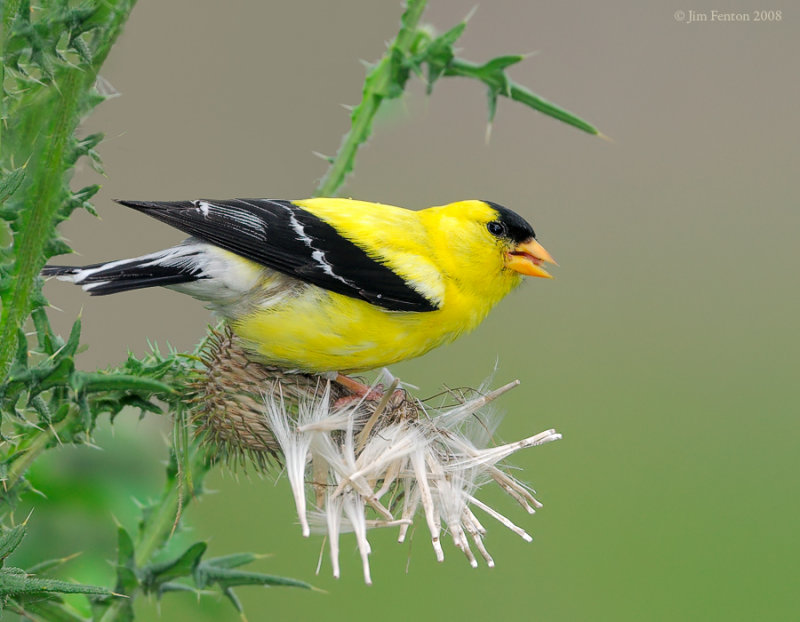
American Goldfinch (Carduelis tristis) on Thistle by Fenton
Lee’s Addition:
Therefore I love Your commandments Above gold, yes, above fine gold. (Psalms 119:127 NASB)
The American Goldfinch is a member of the Fringillidae – Finches Family. It is alway a joy to see them come to my feeders.
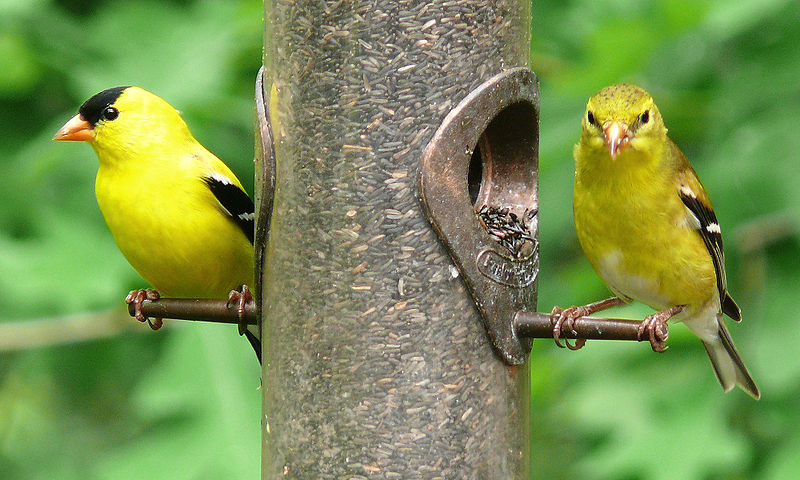
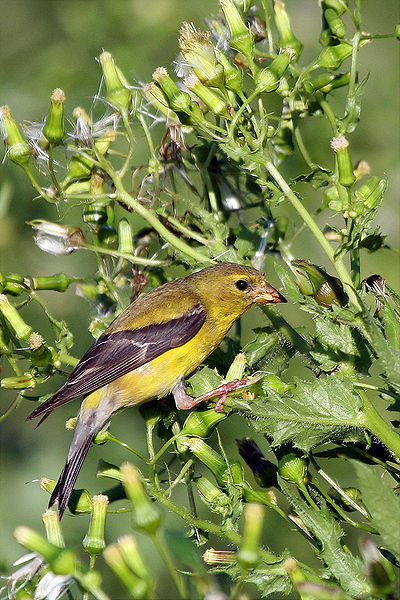
American Goldfinch (Carduelis tristis) Male and Female ©WikiC
The American Goldfinch (Carduelis tristis), also known as the Eastern Goldfinch and Wild Canary, is a small North American bird in the finch family. It is migratory, ranging from mid-Alberta to North Carolina during the breeding season, and from just south of the Canadian border to Mexico during the winter.
The American Goldfinch male is a vibrant yellow in the summer and an olive color during the winter months, while the female is a dull yellow-brown shade which brightens only slightly during the summer. The male displays brightly colored plumage during the breeding season to attract a mate.
The American Goldfinch is a granivore and created for the consumption of seedheads, with a conical beak to remove the seeds and agile feet to grip the stems of seedheads while feeding. It is a social bird, and will gather in large flocks while feeding and migrating. It may behave territorially during nest construction, but this aggression is short-lived. Its breeding season is tied to the peak of food supply, beginning in late July, which is relatively late in the year for a finch. This species is generally monogamous, and produces one brood each year.
American Goldfinch (Carduelis tristis) Female ©WikiC
The American Goldfinch is a small finch, 4.3–5.5 in (11–14 centimeters) long, with a wingspan of 7.5–8.7 in (19–22 centimeters). The beak is small, conical, and pink for most of the year, but turns bright orange with the spring molt in both sexes.[19] The shape and size of the beak aid in the extraction of seeds from the seed heads of thistles, sunflowers, and other plants.
The American Goldfinch undergoes a molt in the spring and autumn, which it undergoes twice a year. During the winter molt it sheds all its feathers; in the spring, it sheds all but the wing and tail feathers, which are dark brown in the female and black in the male. The markings on these feathers remain through each molt, with bars on the wings and white under and at the edges of the short, notched tail. The plumage coloration is especially pronounced after the spring molt, when the bright color of the male’s summer plumage is needed to attract a mate.
Once the spring molt is complete, the body of the male is a brilliant lemon yellow with a striking jet black cap and white rump that is visible during flight.] The female is mostly brown, lighter on the underside with a yellow bib. After the autumn molt, the bright summer feathers are replaced by duller plumage, becoming buff below and olive-brown above, with a pale yellow face and bib. The autumn plumage is almost identical in both sexes, but the male has yellow shoulder patches. In some winter ranges, the goldfinches lose all traces of yellow, becoming a predominantly medium tan-gray color with an olive tinge evident only on close viewing.
The immature American Goldfinch has a dull brown back, and the underside is pale yellow. The shoulders and tail are dull black with buff-colored, rather than white, markings on wings and rump. This coloration is the same in both genders.
The song of the American Goldfinch is a series of musical warbles and twitters, often with a long note. A tsee-tsi-tsi-tsit call is often given in flight; it may also be described as per-chic-o-ree. While the female incubates the eggs, she calls to her returning mate with a soft continuous teeteeteeteete sound. The young begin to use a call of chick-kee or chick-wee shortly before fledging, which they use until they have left the nest entirely. There are two defense calls made by adults during nesting; a sweeet call made to rally other goldfinches to the nest and distract predators, and a bearbee used to signal to the nestlings to quiet them and get them to crouch down in the nest to become less conspicuous.
(Wikipedia with editing)
American Goldfinch song from xeno-canto by Andrew Spencer
*
Birds Illustrated by Color Photography – Revisited
The above article is an article in the monthly serial for October 1897 “designed to promote Knowledge of Bird-Live.” These include Color Photography, as they call them, today they are drawings. There are at least three Volumes that have been digitized by Project Gutenberg.
To see the whole series of – Birds Illustrated by Color Photography – Revisited
*
(Information from Wikipedia and other internet sources)
Next Article – The Chimney Swift
The Previous Article – The Lost Mate
Links:
Fringillidae – Finches Family
American Goldfinch – All About Birds
American Goldfinch – WhatBird
American Goldfinch – National Geographic
American Goldfinch – Wikipedia
*

THE LOST MATE.
Shine! Shine! Shine!
Pour down your warmth, great Sun!
While we bask—we two together.
Two together!
Winds blow south, or winds blow north,
Day come white, or night come black,
Home, or rivers and mountains from home,
Singing all time, minding no time,
If we two but keep together.
Till of a sudden,
May be killed, unknown to her mate,
One forenoon the she-bird crouched not on the nest,
Nor returned that afternoon, nor the next,
Nor ever appeared again.
And thence forward, all summer, in the sound of the sea,
And at night, under the full of moon, in calmer weather,
Over the hoarse surging of the sea,
Or flitting from briar to briar by day,
I saw, I heard at intervals, the remaining one.
Blow! blow! blow!
Blow up, sea-winds, along Paumanok’s shore!
I wait and I wait, till you blow my mate to me.
—Walt Whitman.
Lee’s Addition:
My heart is severely pained within me, And the terrors of death have fallen upon me. (Psalms 55:4 NKJV)
This is a sad one, but it is part of the series. The above photo is from an email about the mate being hit by a car and the other showing its emotions and trying to encourage it to get up.
Here is a YouTube I found about that email.
Fortunately we, as humans have a soul, and as Christians we have hope about our future. Even when we lose a loved one.
But I do not want you to be ignorant, brethren, concerning those who have fallen asleep, lest you sorrow as others who have no hope. For if we believe that Jesus died and rose again, even so God will bring with Him those who sleep in Jesus. For this we say to you by the word of the Lord, that we who are alive and remain until the coming of the Lord will by no means precede those who are asleep. For the Lord Himself will descend from heaven with a shout, with the voice of an archangel, and with the trumpet of God. And the dead in Christ will rise first. Then we who are alive and remain shall be caught up together with them in the clouds to meet the Lord in the air. And thus we shall always be with the Lord. Therefore comfort one another with these words. (1 Thessalonians 4:13-18 NKJV)
*
Birds Illustrated by Color Photography – Revisited
The above article is an article in the monthly serial for October 1897 “designed to promote Knowledge of Bird-Live.” These include Color Photography, as they call them, today they are drawings. There are at least three Volumes that have been digitized by Project Gutenberg.
To see the whole series of – Birds Illustrated by Color Photography – Revisited
*
(Information from Wikipedia and other internet sources)
Next Article – The American Goldfinch
The Previous Article – Blackburnian Warbler
*


 Birds of the Bible For Kids