And she gave birth to her firstborn son and wrapped him in swaddling cloths and laid him in a manger, because there was no place for them in the inn. (Luke 2:7)
John Jacob Niles, 1933 – Collector of the music
Music – I Wonder as I Wander, Appalachian carol by Carl Rütti (1949 – )
I Wonder As I Wander
I wonder as I wander out under the sky,
How Jesus the Savior did come for to die.
For poor on’ry people like you and like I…
I wonder as I wander out under the sky.
When Mary birthed Jesus ’twas in a cow’s stall,
With wise men and farmers and shepherds and all.
But high from God’s heaven a star’s light did fall,
And the promise of ages it then did recall.
If Jesus had wanted for any wee thing,
A star in the sky, or a bird on the wing,
Or all of God’s angels in heav’n for to sing,
He surely could have it, ’cause he was the King.
Mallards flying off by Ian
John Jacob Niles (Dates B-D) Collected by John Jacob Niles in Murphy, NC in July 1933 from a young traveling evangelist Annie Morgan. According to Niles, he asked her to sing the song repeatedly until he had memorized it. It was published in his 1934 Songs of the Hill-Folk. Written in a minor key, it’s qualities of pensiveness make it one of today’s most popular carols.
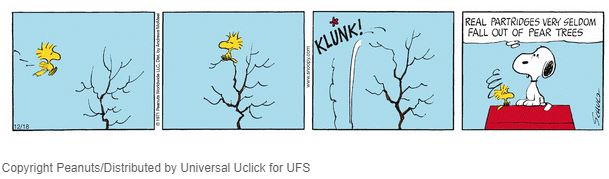
Woodstock really has his issues with trying to be a bird. Then again, Snoopy’s analysis of the adventures of Woodstock can be rather entertaining. Here is the latest from the two.
Mountain Bamboo Partridge (Bambusicola fytchii) by Lee Zoo Miami
As the partridge sitteth on eggs, and hatcheth them not; so he that getteth riches, and not by right, shall leave them in the midst of his days, and at his end shall be a fool. (Jeremiah 17:11 KJV)
Partridges are medium-sized non-migratory gamebirds, with a wide native distribution throughout the Old World, including Europe, Asia, and parts of Africa. They are sometimes grouped in the Perdicinae subfamily of the Phasianidae (pheasants, quail, etc.). However, molecular research suggests that partridges are not a distinct taxon within the family Phasianidae, but that some species are closer to the pheasants, while others are closer to the junglefowl. Partridges are also one of our Birds of the Bible. See the Bible Birds – Partridge.
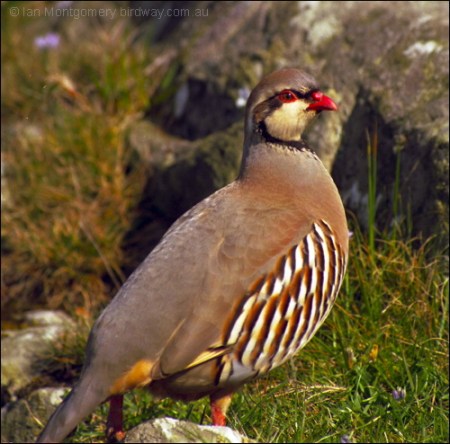
Chukar Partridge (Alectoris chukar) by Ian
These are medium-sized birds, intermediate between the larger pheasants and the smaller quail. Partridges are native to the grassy steppes of Europe, Asia, Africa and the Middle East. Nowadays they are often found nesting on agricultural land. They nest on the ground and have a diet consisting of seeds, grapes and insects. Species such as the grey partridge and the red-legged partridge are popular as game birds, and are often reared in captivity and released for the purpose of hunting. For the same reason, they have been introduced into large areas of North America.
A famous reference to the partridge is in the Christmas carol, “The Twelve Days of Christmas”. The first gift listed is “a partridge in a pear tree”, and these words end each verse. Since partridges are unlikely to be seen in pear-trees (they are ground-nesting birds) it has been suggested that the text “a pear tree” is a corruption of the French “une perdrix” [a partridge]. [Wikipedia with editing]
Rock Partridge (Alectoris graeca) WikiC
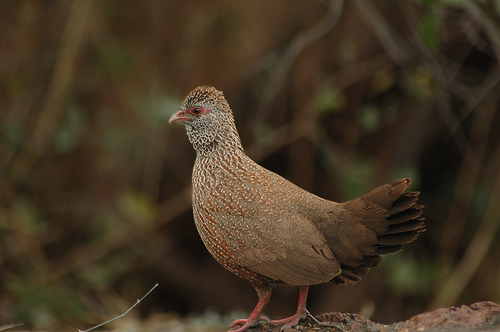
Here are some of the many Partridges from around the world. Our Creator has provided many partridges around the world for us to enjoy.
A Psalm for Solomon. Give the king thy judgments, O God, and thy righteousness unto the king’s son. He shall judge thy people with righteousness, and thy poor with judgment. (Psalms 72:1-2 KJV)
Words by James Montgomery (1771-1854), 1821
[This hymn] is a metrical version of the Seventy-second Psalm. It was written as a Christmas hymn and was first sung on Christmas Day, 1821, at a great convocation of the Moravians in their settlement at Fulneck. At a Wesleyan missionary meeting, held in Liverpool on April 14 of the following year, 1822, when Doctor Adam Clarke presided, Montgomery made an address and closed it by the recital of this hymn with all of its verses…Doctor Clarke later used it in his famous Commentary in connection with his discussion of the Seventy-second Psalm.
Music: Ellacombe, Gesangbuch der Herzogl. Wirtembergischen Katholischen Hofkapelle (Württemberg, Germany: 1784); adapted & harmonized by William H. Monk in the 1868 appendix to Hymns Ancient and Modern, number 366
Birds in Christmas Hymns
Hail to the Lord’s Anointed
Hail to the Lord’s anointed, great David’s greater Son!
Hail in the time appointed, His reign on earth begun!
He comes to break oppression, to set the captive free;
To take away transgression and rule in equity.
He comes in succor speedy to those who suffer wrong;
To help the poor and needy, and bid the weak be strong;
To give them songs for sighing, their darkness turn to light,
Whose souls, condemned and dying, were precious in His sight.
By such shall He be fearèd while sun and moon endure;
Beloved, obeyed, reverèd; for He shall judge the poor
Through changing generations, with justice, mercy, truth,
While stars maintain their stations, or moons renew their youth.
He shall come down like showers upon the fruitful earth;
Love, joy, and hope, like flowers, spring in His path to birth.
Before Him, on the mountains, shall peace, the herald, go,
And righteousness, in fountains, from hill to valley flow.
Arabia’s desert ranger to Him shall bow the knee;
The Ethiopian stranger His glory come to see;
With offerings of devotion ships from the isles shall meet,
To pour the wealth of oceans in tribute at His feet.
Kings shall fall down before Him, and gold and incense bring;
All nations shall adore Him, His praise all people sing;
For He shall have dominion o’er river, sea and shore, Far as the eagle’s pinion or dove’s light wing can soar.
For Him shall prayer unceasing and daily vows ascend;
His kingdom still increasing, a kingdom without end:
The mountain dews shall nourish a seed in weakness sown,
Whose fruit shall spread and flourish and shake like Lebanon.
O’er every foe victorious, He on His throne shall rest;
From age to age more glorious, all blessing and all blest.
The tide of time shall never His covenant remove;
His name shall stand forever, His name to us is Love.
American Yellow Warbler (Dendroica aestiva) singing by J Fenton
And the angel said unto them, Fear not: for, behold, I bring you good tidings of great joy, which shall be to all people. For unto you is born this day in the city of David a Saviour, which is Christ the Lord. (Luke 2:10-11)
Written as – El Cant Dels Ocells – Traditional Catalonian Carol
Translator Unknown
Carol of the Birds
1. Upon this holy night,
When God’s great star appears,
And floods the earth with brightness Birds’ voices rise in song
And warbling all night long
Express their glad heart’s lightness Birds’ voices rise in song
And warbling all night long
Express their glad heart’s lightness
Black-headed Nightingale-Thrush (Catharus mexicanus) by Michael Woodruff
2. The Nightingale is first
To bring his song of cheer,
And tell us of His glad – ness:
Jesus, our Lord, is born
To free us from all sin
And banish ev’ry sadness!
Jesus, our Lord is born
To free us from all sin
And banish ev’ry sadness!
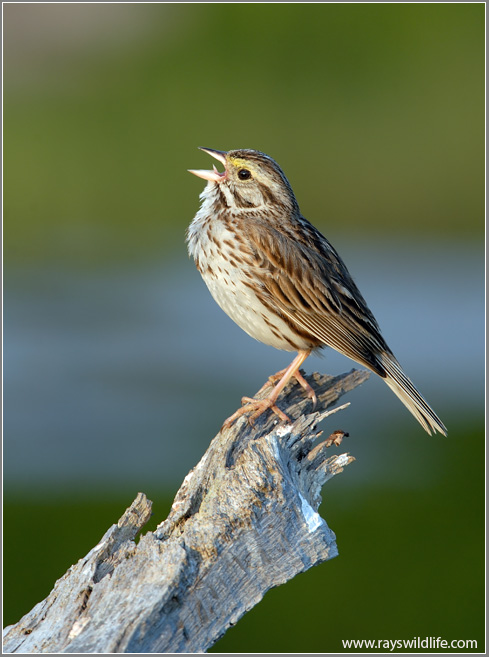
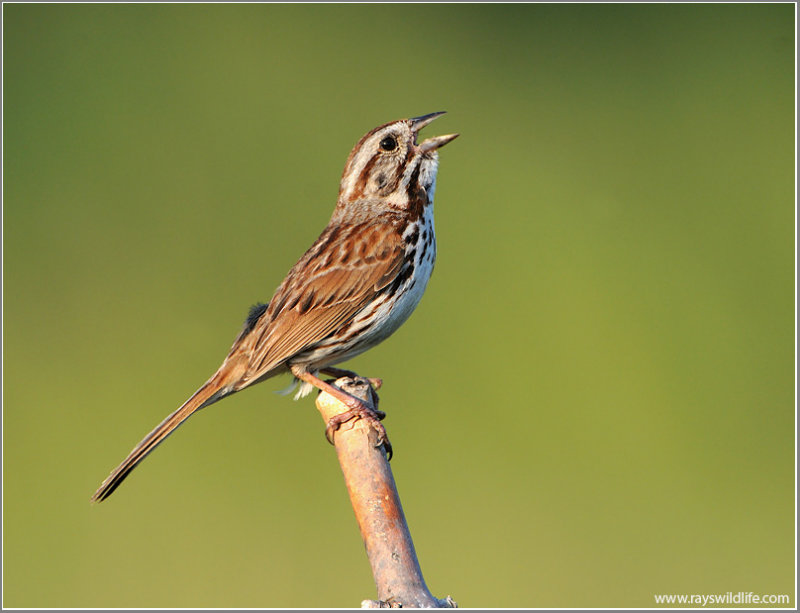
Savannah Sparrow singing by Ray
3. The answ’ring Sparrow cries:
“God comes to earth this day
Amid the angels flying.”
Trilling in sweetest tones,
The Finch his Lord now owns:
“To Him be all thanksgiving.”
Trilling in sweetest tones,
The Finch his Lord now owns:
“To Him be all thanksgiving.”
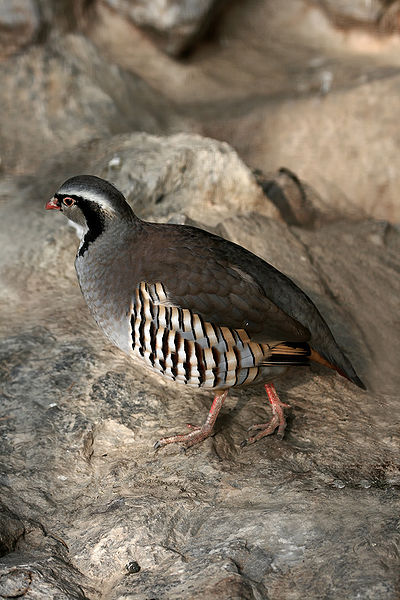
Barbary Partridge (Alectoris barbara koenigi) Pixdaus
4. The Partridge adds his note:
“To Bethlehem I’ll fly,
Where in the stall He’s lying.
There, near the manger blest,
I’ll build myself a nest,
And sing my love undying.
There, near the manger blest,
I’ll build myself a nest,
And sing my love undying.
Photo
*
Found another version of the Carol of the Birds and it appears to be Australian Birds.
The Carol of the Birds
(Wheeler/James)
Brolga (Grus rubicunda) by Ian
Out on the plains the brolgas are dancing
Lifting their feet like warhorses prancing
Up to the sun the woodlarks go winging
Faint in the dawn light echoes their singing
Crana! Orana! Orana to Christmas Day.
Crested Bellbird (Oreoica gutturalis) by Ian
Down where the tree ferns grow by the river
There where the waters sparkle and quiver
Deep in the gullies bell-birds are chiming
Softly and sweetly their lyric notes rhyming
Orana! Orana! Orana to Christmas Day.
Silver-crowned Friarbird (Philemon argenticeps) by Ian
Friar birds sip the nectar of flowers Currawongs chant in wattle tree bowers
In the blue ranges lorikeets calling
Carols of bush birds rising and falling
Orana! Orana! Orana to Christmas Day.
*
I always enjoy the reactions between these two. But, OH! the ruffled feathers that we have seen on birds. Maybe they should stop by Snoopy for some help.
“Everyone helped his neighbor, And said to his brother, “Be of good courage!” (Isaiah 41:6 NKJV)
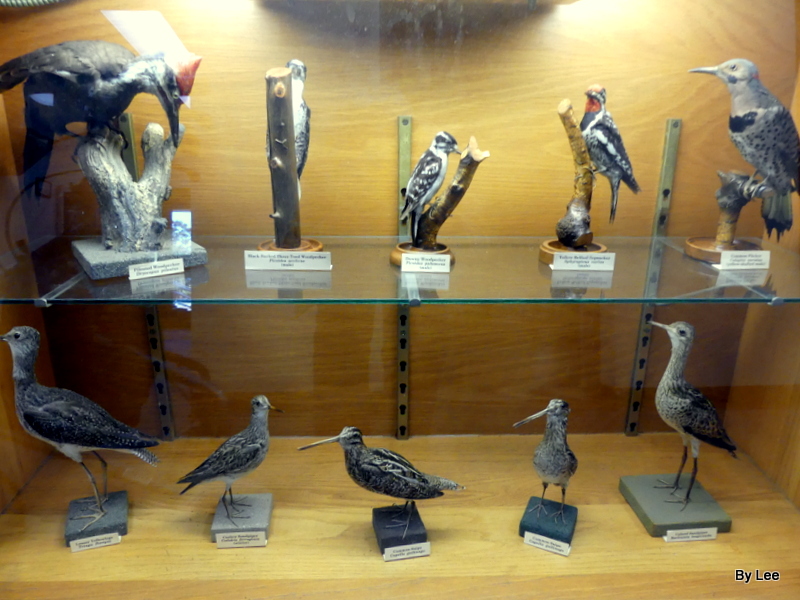
BJU Bird Collection 2018-Display Case 3 – Woodpeckers and Shorebirds
“If a bird’s nest happens to be before you along the way, in any tree or on the ground, with young ones or eggs, with the mother sitting on the young or on the eggs, you shall not take the mother with the young;” (Deuteronomy 22:6 NKJV)
The next Display case of the Waterman Bird Collection contains Woodpeckers from thePicidae family and some shorebirds from the Scolopacidae Family. [Next post]
BJU Bird Collection 2018 – Woodpeckers
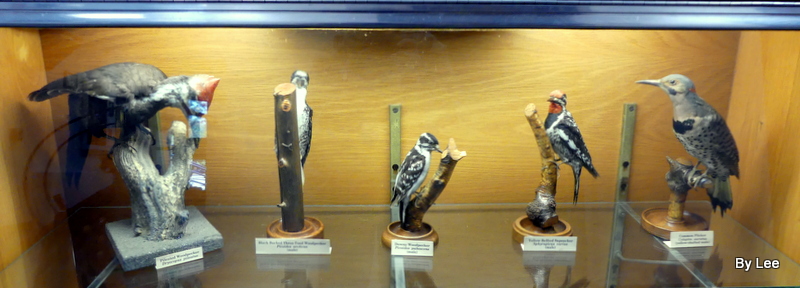
This post is about the five Woodpeckers; Pileated Woodpecker (Dryocopus pileatus), Black-backed Three-toed Woodpecker [now the Black-backed Woodpecker (Picoides arcticus)], Downy Woodpecker (Dryobates pubescens), Yellow-bellied Sapsucker (Sphyrapicus varius) and a Common Flicker [now the Northern Flicker (Colaptes auratus).
Pileated Woodpecker (Dryocopus pileatus) “The Pileated Woodpecker is one of the biggest, most striking forest birds on the continent. It’s nearly the size of a crow, black with bold white stripes down the neck and a flaming-red crest. Look (and listen) for Pileated Woodpeckers whacking at dead trees and fallen logs in search of their main prey, carpenter ants, leaving unique rectangular holes in the wood. The nest holes these birds make offer crucial shelter to many species including swifts, owls, ducks, bats, and pine martens.” [Pileated Woodpecker – All About Birds]
Downy Woodpecker (Dryobates pubescens) – “The active little Downy Woodpecker is a familiar sight at backyard feeders and in parks and woodlots, where it joins flocks of chickadees and nuthatches, barely outsizing them. An often acrobatic forager, this black-and-white woodpecker is at home on tiny branches or balancing on slender plant galls, sycamore seed balls, and suet feeders. Downies and their larger lookalike, the Hairy Woodpecker, are one of the first identification challenges that beginning bird watchers master.” [Downy Woodpecker – All About Birds]
Yellow-bellied Sapsucker (Sphyrapicus varius) – “On a walk through the forest you might spot rows of shallow holes in tree bark. In the East, this is the work of the Yellow-bellied Sapsucker, an enterprising woodpecker that laps up the leaking sap and any trapped insects with its specialized, brush-tipped tongue. Attired sharply in barred black-and-white, with a red cap and (in males) throat, they sit still on tree trunks for long intervals while feeding. To find one, listen for their loud mewing calls or stuttered drumming.” [Yellow-bellied Sapsucker – All About Birds]
Northern Flicker (Colaptes auratus) – “Northern Flickers are large, brown woodpeckers with a gentle expression and handsome black-scalloped plumage. On walks, don’t be surprised if you scare one up from the ground. It’s not where you’d expect to find a woodpecker, but flickers eat mainly ants and beetles, digging for them with their unusual, slightly curved bill. When they fly you’ll see a flash of color in the wings – yellow if you’re in the East, red if you’re in the West – and a bright white flash on the rump.” [Northern Flicker – All About Birds]















 Birds of the Bible For Kids