Category Archives: Christian
Singing Irish Donkey from Donkey Whisperer
My friend at Donkey Whisperer shared this and thought you also might enjoy it.
“Make a joyful noise unto the LORD, all the earth: make a loud noise, and rejoice, and sing praise. Sing unto the LORD with the harp; with the harp, and the voice of a psalm. With trumpets and sound of cornet make a joyful noise before the LORD, the King. Let the sea roar, and the fulness thereof; the world, and they that dwell therein. Let the floods clap their hands: let the hills be joyful together” (Psalms 98:4-8 KJV)
If the floods can clap, the sea roar, and the hills be joyful. why couldn’t a donkey sing praises to his Creator?
Creation Moment’s – The First Beak
Genesis 1:20
“And God said, Let the waters bring forth abundantly the moving creature that hath life, and fowl that may fly above the earth in the open firmament of heaven.”
Hardly a week goes by without a new news story about the supposed evolution of birds. In the week that I wrote this script, evolutionary paleontologists announced that they had discovered the world’s oldest beak. This beak was attached to a bird called ichthyornis (or fish-bird), and the fossil was actually already in the possession of Yale University. Researchers from that institution examined the fossil, which included a complete skull. One researcher said:
The fossil record provides our only direct evidence of the evolutionary transformations that have given rise to modern forms. This extraordinary new specimen reveals the surprisingly late retention of dinosaur-like features in the skull of Ichthyornis – one of the closest-known relatives of modern birds from the Age of Reptiles.
One has to ask how such a skull constitutes “direct evidence of evolutionary transformations”. We do not see the beak being transformed from a dinosaur skull. Indeed, even in the popular-level articles from which this information was gleaned, we see some startling problems. For example, ichthyornis is thought to have died out 83.5 million years ago. Yet, velociraptors – a potential therapod precursor to birds – was claimed not to have appeared until 75 million years ago, about 8 million years after the creature into which it is supposed to have evolved. Even allowing for these problems with timescales, creationist researchers have noted that the evolutionary distance from ichthyornis to modern birds is less than that alleged to exist between many modern birds. One must conclude that ichthyornis has been assigned the world’s oldest beak merely because of an a priori commitment and bias to evolutionary theory.
Lord God, we see evidence of Your unique designs in all the creatures You have made. Thank You that You have made all things well. Amen.
Ref: Yale University. “Scientists find the first bird beak, right under their noses.” ScienceDaily, 2 May 2018. <www.sciencedaily.com/releases/2018/05/180502131859.htm>. Image: CC BY-SA 4.0.
Creation Moments ©2019, used with permission
Here we go again with the evolutionary theories.
Beautiful Frigatebirds Over the Beach
“The birds of the air, And the fish of the sea That pass through the paths of the seas. O LORD, our Lord, How excellent is Your name in all the earth!” (Psalms 8:8-9 NKJV)
Today while trying to enter Patrick AFB in Florida, we spotted three Magnificent Frigatebirds skimming over the edge of the Atlantic Ocean. Wow!! We very seldom spot these birds. The size of their wingspan is amazing and are a sight to see.
Since this was New Year’s Eve day, we discovered that the A1A entrance was closed. So, we had to turn around and go back to the other gate.
“Dan, wait while I get my camera out of the case. Maybe, we can spot them again, because they were heading south originally while we were going north.” Yeah! We spotted the three and also a fourth one. These photos were taken through the front windshield while Dan was driving. So, they are less than perfect. But, it does prove we saw them.
I have a Dr. appointment over here, so we came a day or so early. We birdwatched a Viera Wetlands a bit on the way into the area. Plan on covering more of the wetlands before heading back home.
Now for some better photos of this magnificent Magnificent Frigatebird.
While checking for information on these birds, I found several interesting articles you might want to check out. The one talks about how they stay at sea for days and weeks on end. They tested their sleeping ability to sleep while aloft. See: Frigatebirds can sleep while flying.
“The 7-foot wingspan of a magnificent frigatebird is unmistakable. They dwarf other birds as they glide on air currents above coastal Florida. Our state hosts the largest frigatebird species and the only nesting colony in the United States, located in the Dry Tortugas. Their summer breeding season brings the open-ocean species in to the shore where males can show off their distinctive red pouch to potential mates.
Frigatebirds rarely land on the ground due to their short legs and wing shape. Their thin “bent elbow” wings are ideal for soaring hundreds of miles without a single wing flap, but can’t generate enough lift to get the large birds off of the ground. They land and nest in high places, free diving off of them before catching the breeze and flying on.
It’s just as uncommon to find a frigatebird on the water. Their feathers lack oil that keep their seafaring neighbors like pelicans and gulls afloat. Water would quickly soak the frigate’s feathers and make it nearly impossible to escape.” This is from Nature’s Academy’s article.
We have had several articles here over the years about the Frigatebirds:
Fregatidae – Frigatebirds Family
Sunday Inspiration – Frigatebirds, Gannets and the Booby
“F” is for Flamingos and Frigatebirds: “F” Birds, Part 1
Ian’s Bird of the Week – Great Frigatebird
Ian’s Bird of the Week – Lesser Frigatebird
Christmas Hymns With Birds – The Friendly Beasts
So it was, that while they were there, the days were completed for her to be delivered. And she brought forth her firstborn Son, and wrapped Him in swaddling cloths, and laid Him in a manger, because there was no room for them in the inn. (Luke 2:6-7 NKJV)
Words: Unknown author, 12th Century; translated from French to English by an anonymous translator.
Music: Orientis Partibus, medieval French melody
The Friendly Beasts
Jesus, our Brother, strong and good,
Was humbly born in a stable rude,
And the friendly beasts around Him stood,
Jesus, our Brother, strong and good.
“I,” said the donkey, shaggy and brown,
“I carried His mother uphill and down,
I carried His mother to Bethlehem town;
I,” said the donkey, shaggy and brown.
“I,” said the cow, all white and red,
“I gave Him my manger for His bed,
I gave Him hay to pillow His head;
I,” said the cow, all white and red.
“I,” said the sheep with curly horn,
“I gave Him my wool for His blanket warm,
He wore my coat on Christmas morn;
I,” said the sheep with curly horn.
“I,” said the dove, from the rafters high,
“I cooed Him to sleep that He should not cry,
We cooed Him to sleep, my mate and I;
I,” said the dove, from the rafters high.
Thus all the beasts, by some good spell,
In the stable dark were glad to tell
Of the gifts they gave Emmanuel,
The gifts they gave Emmanuel.
‘I,’ was glad to tell
Of the gift he gave Emmanuel,
The gift he gave Emmanuel.
Jesus our brother, kind and good.
*
More Birds in Hymns
See ~ Wordless Birds
Most information from The Cyber Hymnal – The Friendly Beasts
*
A Christmas Story: The Man And The Birds
This is the 1965 recording of Paul Harvey’s Christmas story classic titled The Man and the Birds. Christmas Day in 2013 I spent the morning putting it all together with a picture slideshow to illustrate the story. I hope you enjoy it. Please share with others.Merry Christmas to all, and to all a good night!
“In the beginning was the Word, and the Word was with God, and the Word was God. The same was in the beginning with God.” (John 1:1-2 KJV)
ABC’s of the Gospel
The Wordless Book
Christmas Hymns With Birds – Thou Didst Leave Thy Throne
Who, being in the form of God, thought it not robbery to be equal with God: But made himself of no reputation, and took upon him the form of a servant, and was made in the likeness of men: (Philippians 2:6-7 KJV)
Words by Emily E. Elliott, 1864. This hymn was first used at St. Mark’s Church in Brighton, England, where Elliott’s father was rector. In 1870, it was published in the Church Missionary Juvenile Instructor, which Elliott edited.
Music: Margaret, Timothy R. Matthews, 1876
Thou Didst Leave Thy Throne
Thou didst leave Thy throne and Thy kingly crown,
When Thou camest to earth for me;
But in Bethlehem’s home was there found no room
For Thy holy nativity.
Refrain
O come to my heart, Lord Jesus,
There is room in my heart for Thee.
Heaven’s arches rang when the angels sang,
Proclaiming Thy royal degree;
But of lowly birth didst Thou come to earth,
And in great humility.
Refrain
O come to my heart, Lord Jesus,
There is room in my heart for Thee.
The foxes found rest, and the birds their nest
In the shade of the forest tree;
But Thy couch was the sod, O Thou Son of God,
In the deserts of Galilee.
Refrain
O come to my heart, Lord Jesus,
There is room in my heart for Thee.
Thou camest, O Lord, with the living Word,
That should set Thy people free;
But with mocking scorn and with crown of thorn,
They bore Thee to Calvary.
Refrain
O come to my heart, Lord Jesus,
There is room in my heart for Thee.
When the heavens shall ring, and the angels sing,
At Thy coming to victory,
Let Thy voice call me home,
Saying Yet there is room,
There is room at My side for thee.
My heart shall rejoice, Lord Jesus,
When Thou comest and callest for me.
Emily E. Elliott (1836-1897) – Emily’s father was Edward Bishop Elliott, Rector of St. Mark’s Church in Brighton, and her aunt was hymnist Charlotte Elliott. For six years, Emily served as editor of The Church Missionary Juvenile Instructor.
Timothy R. Matthews (1826-1910) – Son of the rector of Colmworth, Matthews attended the Bedford Grammar School and Gonville and Caius College, Cambridge (MusB 1853). Ordained the same year, he became private tutor to the family of Rev. Lord Wriothesley Russell, a canon of St. George’s Chapel, Windsor Castle, where he studied under the organist, George Elvey, subsequently a lifelong friend.
Matthews served as Curate (1853-1859) and Curate-in-Charge (1859-1869) of St. Mary’s Church, Nottingham. During this time he founded Nottingham’s Working Men’s Institute. In 1869, he became Rector at North Coates, Lincolnshire. He retired in 1907 to live with his eldest son at Tetney vicarage.
Matthews edited the North Coates Supplemental Tune Book and The Village Organist. He composed Morning and Evening Services, chants and responses, and earned a reputation for simple but effective hymn tunes, writing over 100. William Howard requested six tunes from him for a children’s hymnal, and Matthews completed them within a day. Matthews also composed a Christmas carol and a few songs. His sons Norton and Arthur Percy were also known as hymn tune composers.
*
More Birds in Hymns
See ~ The Wise Owl
Most information from The Cyber Hymnal – Thou Didst Leave Thy Throne
*
Christmas Hymns With Birds – I Wonder As I Wander
And she gave birth to her firstborn son and wrapped him in swaddling cloths and laid him in a manger, because there was no place for them in the inn. (Luke 2:7)
John Jacob Niles, 1933 – Collector of the music
Music – I Wonder as I Wander, Appalachian carol by Carl Rütti (1949 – )
I Wonder As I Wander
I wonder as I wander out under the sky,
How Jesus the Savior did come for to die.
For poor on’ry people like you and like I…
I wonder as I wander out under the sky.
When Mary birthed Jesus ’twas in a cow’s stall,
With wise men and farmers and shepherds and all.
But high from God’s heaven a star’s light did fall,
And the promise of ages it then did recall.
If Jesus had wanted for any wee thing,
A star in the sky, or a bird on the wing,
Or all of God’s angels in heav’n for to sing,
He surely could have it, ’cause he was the King.
John Jacob Niles (Dates B-D) Collected by John Jacob Niles in Murphy, NC in July 1933 from a young traveling evangelist Annie Morgan. According to Niles, he asked her to sing the song repeatedly until he had memorized it. It was published in his 1934 Songs of the Hill-Folk. Written in a minor key, it’s qualities of pensiveness make it one of today’s most popular carols.
*
*
More Birds in Hymns
See ~ Sharing The Gospel
Most information from The Hymns and Carols of Christmas – I Wonder As I Wander
*
Colorful Gouldian Finches From Australia
“The rainbow shall be in the cloud, and I will look on it to remember the everlasting covenant between God and every living creature of all flesh that is on the earth.” (Genesis 9:16 NKJV)
Recently a friend posted a video of beautifully colored Finches. They didn’t tell what they were and others were writing and asking where they were from. So, after posting it to my page, I thought it would be interesting to find out more about the beautiful creations from our Lord.
Here is the link to that video. Animal & Nature page on Facebook. WordPress can’t insert it.
https://www.facebook.com/watch/?v=609945382771747
The video below is by LesleytheBirdNerd on YouTube and she explains much about the colorful finches:
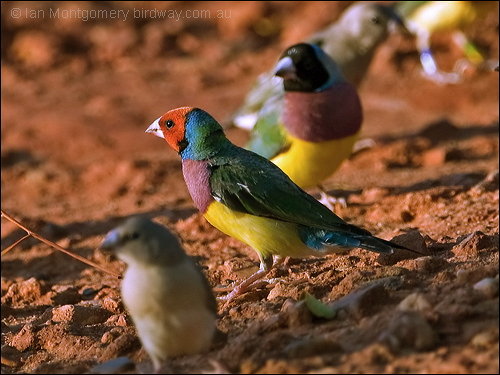
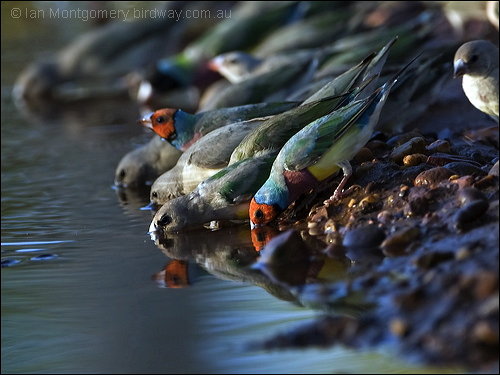
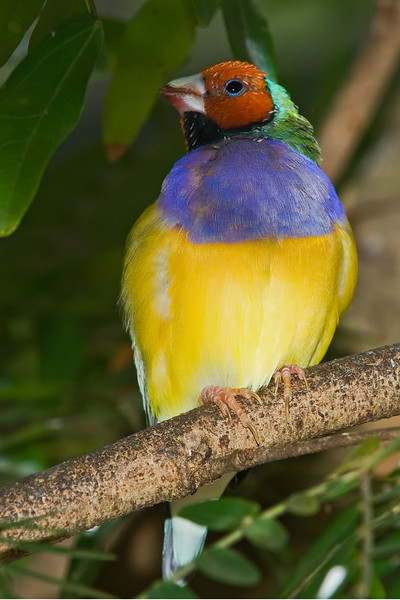
“The Gouldian finch (Erythrura gouldiae), also known as the Lady Gouldian finch, Gould’s finch or the rainbow finch, is a colourful passerine bird which is native to Australia.
Both sexes are brightly coloured with black, green, yellow, and red markings. The females tend to be less brightly coloured. One major difference between the sexes is that the male’s chest is purple, while the female’s is a lighter mauve.
Gouldian finches are about 125–140 mm long. Gouldian finches’ heads may be red, black, or yellow. Formerly considered three different kinds of finches, it is now known that these are colour variants that exist in the wild. Selective breeding has also developed mutations (blue, yellow and silver instead of a green back) in both body and breast colour.
Outside the breeding season, Gouldian finches often join mixed flocks consisting of long-tailed finches and masked finches. Flocks can consist of up to 1,000–2,000 individuals. During the breeding season, they are normally found on rough scree slopes where vegetation is sparse. In the dry season, they are much more nomadic and will move to wherever there food and water can be found.” [Wikipedia with editing]
I wonder if the Lord thought that having “little rainbows” [Gouldian Finches] down here, might help us remember his promise? The rainbow shall be in the cloud, and I will look on it to remember the everlasting covenant between God and every living creature of all flesh that is on the earth.”
(Genesis 9:16 NKJV)
The Gouldian Finch is a member of the Estrildidae – Waxbills, Munias and allies Family.
Christmas Hymns With Birds – Joyful, Joyful, We Adore Thee
My lips shall greatly rejoice when I sing unto thee; and my soul, which thou hast redeemed. (Psalms 71:23 KJV)
Words by Henry J. van Dyke, 1907. Van Dyke wrote this hymn while staying at the home of Harry A. Garfield at Williams College, Massachusetts. It was first published in the Presbyterian Hymnal in 1911. It also appeared in the Poems of Henry van Dyke, 1911. Van Dyke wrote:
“These verses are simple expressions of common Christian feelings and desires in this present time—hymns of today that may be sung together by people who know the thought of the age, and are not afraid that any truth of science will destroy religion, or any revolution on earth overthrow the kingdom of heaven. Therefore this is a hymn of trust and joy and hope.”
Music: Hymn to Joy, from the 9th Symphony of Ludwig van Beethoven; adapted by Edward Hodges, 1824
Joyful, Joyful, We Adore Thee
Joyful, joyful, we adore Thee, God of glory, Lord of love;
Hearts unfold like flowers before Thee, opening to the sun above.
Melt the clouds of sin and sadness; drive the dark of doubt away;
Giver of immortal gladness, fill us with the light of day!
All Thy works with joy surround Thee, earth and heaven reflect Thy rays,
Stars and angels sing around Thee, center of unbroken praise.
Field and forest, vale and mountain, flowery meadow, flashing sea,
Singing bird and flowing fountain call us to rejoice in Thee.
Thou art giving and forgiving, ever blessing, ever blessed,
Wellspring of the joy of living, ocean depth of happy rest!
Thou our Father, Christ our brother, all who live in love are Thine;
Teach us how to love each other, lift us to the joy divine.
Mortals, join the happy chorus, which the morning stars began;
Father love is reigning o’er us, brother love binds man to man.
Ever singing, march we onward, victors in the midst of strife,
Joyful music leads us sunward in the triumph song of life.
*
More Birds in Hymns
See ~ Christmas Gospel Presentation
Most information from The Cyber Hymnal – Joyful, Joyful, We Adore Thee
*
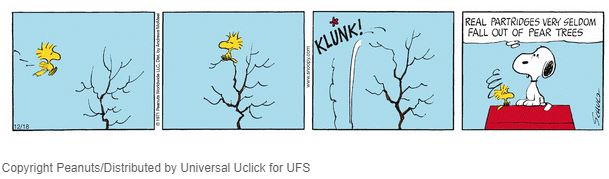
Snoopy’s Partridges In Pear Tree

Woodstock really has his issues with trying to be a bird. Then again, Snoopy’s analysis of the adventures of Woodstock can be rather entertaining. Here is the latest from the two.
As the partridge sitteth on eggs, and hatcheth them not; so he that getteth riches, and not by right, shall leave them in the midst of his days, and at his end shall be a fool. (Jeremiah 17:11 KJV)
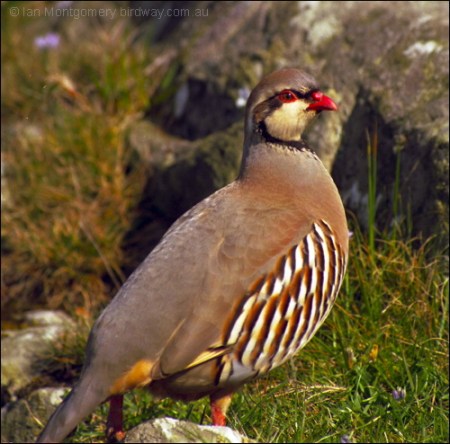
Partridges are medium-sized non-migratory gamebirds, with a wide native distribution throughout the Old World, including Europe, Asia, and parts of Africa. They are sometimes grouped in the Perdicinae subfamily of the Phasianidae (pheasants, quail, etc.). However, molecular research suggests that partridges are not a distinct taxon within the family Phasianidae, but that some species are closer to the pheasants, while others are closer to the junglefowl. Partridges are also one of our Birds of the Bible. See the Bible Birds – Partridge.

Chukar Partridge (Alectoris chukar) by Ian
These are medium-sized birds, intermediate between the larger pheasants and the smaller quail. Partridges are native to the grassy steppes of Europe, Asia, Africa and the Middle East. Nowadays they are often found nesting on agricultural land. They nest on the ground and have a diet consisting of seeds, grapes and insects. Species such as the grey partridge and the red-legged partridge are popular as game birds, and are often reared in captivity and released for the purpose of hunting. For the same reason, they have been introduced into large areas of North America.

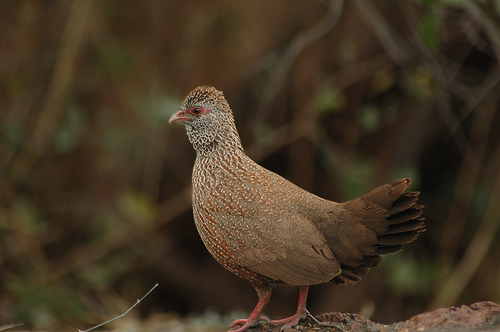
Stone Partridge (Ptilopachus petrosus) ©WikiC
A famous reference to the partridge is in the Christmas carol, “The Twelve Days of Christmas”. The first gift listed is “a partridge in a pear tree”, and these words end each verse. Since partridges are unlikely to be seen in pear-trees (they are ground-nesting birds) it has been suggested that the text “a pear tree” is a corruption of the French “une perdrix” [a partridge]. [Wikipedia with editing]
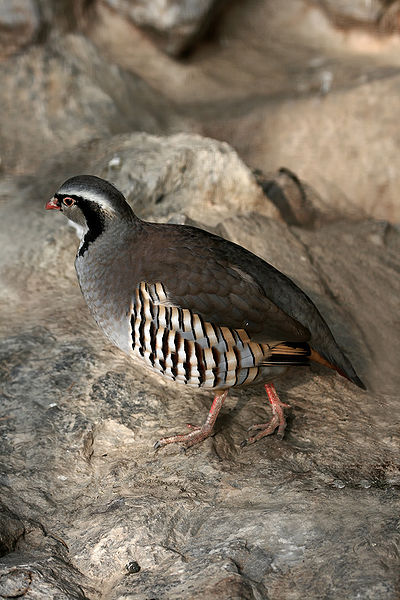
Here are some of the many Partridges from around the world. Our Creator has provided many partridges around the world for us to enjoy.
Christmas Hymns With Birds – Christmas Brings Joy To Every Heart
Rejoice in the Lord always. Again I will say, rejoice! (Philippians 4:4 NKJV)
Words by Bernhardt S. Ingemann (1789-1862), 1840 (Julen har bragt velsignet bud); translated from Danish to English by Cecil Cowdrey.
Music: Christmas Brings Joy, Christoph E. Weyse (1774-1842), 1841
Christmas Brings Joy To Every Heart
Christmas brings joy to every heart,
Sets old and young rejoicing,
What angels sang once to all on earth,
Oh, hear the children voicing.
Bright is the tree with lights aglow,
Like birds that perch together,
The child that holdeth Christmas dear
Shall keep these joys forever.
Joy comes to the all the world today,
To halls and cottage hasting,
Come, sparrow and dove, from roof tree tall,
And share our Christmas feasting.
Dance, little child, on mother’s knee,
The lovely day is dawning,
The road to paradise is found
The blessèd Christmas morning.
Once to this earth our Savior came,
An infant poor and lowly,
To open for us those gardens fair
Where dwell His angels holy.
Christmas joy He bringeth us,
The Christ child King of heaven,
“To every little child,” He saith,
“Shall angel wings be given.”
Most information from The Cyber Hymnal
See ~ Christmas Gospel Presentation
More ~ Birds in Hymns
*