
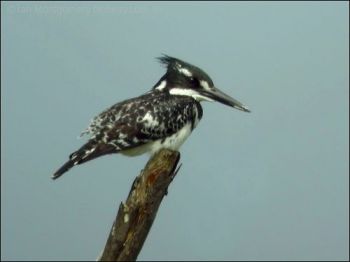
Pied Kingfisher (Ceryle rudis) by Ian
THE FORGETFUL KINGFISHER (Relocated)
*

Yellow-Breasted Chat (Icteria virens) by USGS
*
*
How precious also are Your thoughts to me, O God! How great is the sum of them! (Psalm 139:17 NKJV)
*
Birds Illustrated by Color Photography – Revisited
The above article is an article in the monthly serial for October 1897 “designed to promote Knowledge of Bird-Live.” These include Color Photography, as they call them, today they are drawings. There are at least three Volumes that have been digitized by Project Gutenberg.
To see the whole series of – Birds Illustrated by Color Photography – Revisited
*
Next Article – TBA
The Previous Article – The Yellow-breasted Chat
*

Yellow-breasted Chat (Icteria virens) for Birds Illustrated
From col. F. M. Woodruff. Copyrighted by
chicago colortype co. Nature Study Pub. Co., 1897, Chicago.
I am often heard, but seldom seen. If I were a little boy or a little girl, grown people would tell me I should be seen and not heard. That’s the difference between you and a bird like me, you see.
It would repay you to make my acquaintance. I am such a jolly bird. Sometimes I get all the dogs in my neighborhood howling by whistling just like their masters. Another time I mew like a cat, then again I give some soft sweet notes different from those of any bird you ever heard.
In the spring, when my mate and I begin house-keeping, I do some very funny things, like the clown in a circus. I feel so happy that I go up a tree branch by branch, by short flights and jumps, till I get to the very top. Then I launch myself in the air, as a boy dives when he goes swimming, and you would laugh to see me flirting my tail, and dangling my legs, coming down into the thicket by odd jerks and motions.
It really is so funny that I burst out laughing myself, saying, chatter-chatter, chat-chat-chat-chat! I change my tune sometimes, and it sounds like who who, and tea-boy.
You must be cautious though, if you want to see me go through my performance. Even when I am doing those funny things in the air I have an eye out for my enemies. Should I see you I would hide myself in the bushes and as long as you were in sight I would be angry and say chut, chut! as cross as could be.
Have I any other name?
Yes, I am called the Yellow Mockingbird. But that name belongs to another. His picture was in the June number of Birds, so you know something about him. They say I imitate other birds as he does. But I do more than that. I can throw my voice in one place, while I am in another.
It is a great trick, and I get lots of sport out of it.
Do you know what that trick is called? If not, ask your papa. It is such a long word I am afraid to use it.
About my nest?
Oh, yes, I am coming to that. I arrive in this country about May 1, and leave for the south in the winter. My nest is nothing to boast of; rather big, made of leaves, bark, and dead twigs, and lined with fine grasses and fibrous roots. My mate lays eggs, white in color, and our little ones are, like their papa, very handsome.

Yellow-Breasted Chat (Icteria virens) WikiC

COMMON name for this bird, the largest of the warblers, is the Yellow Mockingbird. It is found in the eastern United States, north to the Connecticut Valley and Great Lakes; west to the border of the Great Plains; and in winter in eastern Mexico and Guatemala. It frequents the borders of thickets, briar patches, or wherever there is a low, dense growth of bushes—the thornier and more impenetrable the better.
“After an acquaintance of many years,” says Frank M. Chapman, “I frankly confess that the character of the Yellow-Crested Chat is a mystery to me. While listening to his strange medley and watching his peculiar actions, we are certainly justified in calling him eccentric, but that there is a method in his madness no one who studies him can doubt.”
By many observers this bird is dubbed clown or harlequin, so peculiar are his antics or somersaults in the air; and by others “mischief maker,” because of his ventriloquistic and imitating powers, and the variety of his notes. In the latter direction he is surpassed only by the Mockingbird.
The mewing of a cat, the barking of a dog, and the whistling sound produced by a Duck’s wings when flying, though much louder, are common imitations with him. The last can be perfectly imitated by a good whistler, bringing the bird instantly to the spot, where he will dodge in and out among the bushes, uttering, if the whistling be repeated, a deep toned emphatic tac, or hollow, resonant meow.
In the mating season he is the noisiest bird in the woods. At this time he may be observed in his wonderful aerial evolutions, dangling his legs and flirting his tail, singing vociferously the while—a sweet song different from all his jests and jeers—and descending by odd jerks to the thicket. After a few weeks he abandons these clown-like maneuvers and becomes a shy, suspicious haunter of the depths of the thicket, contenting himself in taunting, teasing, and misleading, by his variety of calls, any bird, beast, or human creature within hearing.
All these notes are uttered with vehemence, and with such strange and various modulations as to appear near or distant, in the manner of a ventriloquist. In mild weather, during moonlight nights, his notes are heard regularly, as though the performer were disputing with the echoes of his own voice.
“Perhaps I ought to be ashamed to confess it,” says Mr. Bradford Torrey, after a visit to the Senate and House of Representatives at Washington, “but after all, the congressman in feathers interested me most. I thought indeed, that the Chat might well enough have been elected to the lower house. His volubility and waggish manners would have made him quite at home in that assembly, while his orange colored waistcoat would have given him an agreeable conspicuity. But, to be sure, he would have needed to learn the use of tobacco.”
The nest of the Chat is built in a thicket, usually in a thorny bush or thick vine five feet above the ground. It is bulky, composed exteriorly of dry leaves, strips of loose grape vine bark, and similar materials, and lined with fine grasses and fibrous roots. The eggs are three to five in number, glossy white, thickly spotted with various shades of rich, reddish brown and lilac; some specimens however have a greenish tinge, and others a pale pink.
*
Summary:
YELLOW-BREASTED CHAT.—Icteria virens.
Range—Eastern United States to the Great Plains, north to Ontario and southern New England; south in winter through eastern Mexico to Northern Central America.
Nest—In briar thickets from two to five feet up, of withered leaves, dry grasses, strips of bark, lined with finer grasses.
Eggs—Three or four, white, with a glossy surface.

Yellow-breasted Chat (Icteria virens) by Daves BirdingPix
Lee’s Addition:
Like a crane or a swallow, so I chattered; I mourned like a dove; My eyes fail from looking upward. O LORD, I am oppressed; Undertake for me! (Isa 38:14 NKJV)
Oh, sing to the LORD a new song! Sing to the LORD, all the earth. (Psa 96:1 NKJV)
The Yellow-breasted Chat (Icteria virens) is a large songbird in the Muscicapidae – Chats, Old World Flycatchers Family. They are one of 313 members of that family. Another one of the Lord’s beautiful creatures. I haven’t seen that many, but they would sure be a delight to see.
Identification Tips: From USGS
Length: 6.25 inches
The largest warbler
Thick bill
White spectacles
Yellow throat and breast
Whitish belly and undertail coverts
Olive upperparts
Fairly long tail
Dark legs
Females and males similar in plumage
*
Yellow-Breasted Chat (Icteria virens) USGS
The song of this bird is an odd, variable mixture of cackles, clucks, whistles and hoots. Their calls are harsh chak’s. Unlike most warblers, this species has been known to mimic the calls of other birds. Thus, less experienced field birdwatchers sometimes overlook chats after mistaken their song for species such as Gray Catbirds and Brown Thrashers, which share similar habitat preferences and skulking habits, though are generally much more abundant. During the breeding season, Chats are at their most conspicuous as they will usually sing from exposed locations and even fly in the open while gurgling their songs.
*
Birds Illustrated by Color Photography – Revisited
The above article is an article in the monthly serial for October 1897 “designed to promote Knowledge of Bird-Live.” These include Color Photography, as they call them, today they are drawings. There are at least three Volumes that have been digitized by Project Gutenberg.
To see the whole series of – Birds Illustrated by Color Photography – Revisited
*
(Information from Wikipedia and other internet sources, with editing)
Next Article – Volume II. July to December 1897 Index
The Previous Article – More Bird Miscellany
Links:
*

American Robin (Turdus migratorius) in nest ready to eat ©WikiC
Knowledge never learned of schools
Of the wild bee’s morning chase,
Of the wild-flowers’ time and place,
Flight of fowl and habitude
Of the tenants of the wood;
How the tortoise bears his shell;
How the woodchuck digs his cell;
And the ground-mole makes his well;
How the robin feeds her young;
How the oriole’s nest is hung.
—Whittier.

Mangrove Warbler (Dendroica petechia) (aka Yellow) by Anthony747
Consider the marvelous life of a bird and the manner of its whole existence…. Consider the powers of that little mind of which the inner light flashes from the round bright eye; the skill in building its home, in finding its food, in protecting its mate, in serving its offspring, in preserving its own existence, surrounded as it is on all sides by the most rapacious enemies….
When left alone it is such a lovely little life—cradled among the hawthorn buds, searching for aphidæ amongst apple blossoms, drinking dew from the cup of a lily; awake when the gray light breaks in the east, throned on the topmost branch of a tree, swinging with it in the sunshine, flying from it through the air; then the friendly quarrel with a neighbor over a worm or berry; the joy of bearing grass-seed to his mate where she sits low down amongst the docks and daisies; the triumph of singing the praise of sunshine or of moonlight; the merry, busy, useful days; the peaceful sleep, steeped in the scent of the closed flower, with head under one wing and the leaves forming a green roof above.
—Ouida.

Asian Openbill (Anastomus oscitans) on nest by Nikhil
“I once lived in a little house,
And lived there very well;
I thought the world was small and round,
And made of pale blue shell.
I lived next in a little nest,
Nor needed any other;
I thought the world was made of straw,
And brooded by my mother.
One day I fluttered from the nest
To see what I could find.
I said: ‘The world is made of leaves,
I have been very blind.’
At length I flew beyond the tree,
Quite fit for grown-up labors;
I don’t know how the world is made,
And neither do my neighbors.”
Lee’s Addition:
By them the birds of the heavens have their home; They sing among the branches. (Psalm 104:12 NKJV)
These three miscellaneous articles give various lessons. The Bird Miscellany informs us that book learning only goes so far, then you need to go out and observe what is going on around you. Same way with bird watching. You can read all the books, but you won’t become a birdwatcher until you go watch birds.
The second segment talks of a peaceful bird just enjoying its life. Last, the Bird’s Story reminds us of growing up.
Depart from evil and do good; Seek peace and pursue it. (Psalm 34:14 NKJV)
Better is a dry morsel with quietness, Than a house full of feasting with strife. (Proverbs 17:1 NKJV)
If you have an opinion, leave a comment. Always interesting to hear different points of view.
*
Birds Illustrated by Color Photography – Revisited
The above article is an article in the monthly serial for October 1897 “designed to promote Knowledge of Bird-Live.” These include Color Photography, as they call them, today they are drawings. There are at least three Volumes that have been digitized by Project Gutenberg.
To see the whole series of – Birds Illustrated by Color Photography – Revisited
*
(Information from Wikipedia and other internet sources, with editing)
Next Article – The Yellow-breasted Chat
The Previous Article – The Ring-necked Pheasant
*

Green-winged Teal (Anas carolinensis) for Birds Illustrated
Just a common Duck?
No, I’m not. There is only one other Duck handsomer than I am, and he is called the Wood Duck. You have heard something about him before. I am a much smaller Duck, but size doesn’t count much, I find when it comes to getting on in the world—in our world, that is. I have seen a Sparrow worry a bird four times its size, and I expect you have seen a little boy do the same with a big boy many a time.
What is the reason I’m not a common Duck?
Well, in the first place, I don’t waddle. I can walk just as gracefully as I can swim. Your barn-yard Duck can’t do that. I can run, too, without getting all tangled up in the grass, and he can’t do that, either. But sometimes I don’t mind associating with the common Duck. If he lives in a nice big barn-yard, that has a good pond, and is fed with plenty of grain, I visit him quite often.
Where do I generally live?
Well, along the edges of shallow, grassy waters, where I feed upon grass, seeds, acorns, grapes, berries, as well as insects, worms, and small snails. I walk quite a distance from the water to get these things, too.
Can I fly?
Indeed I can, and very swiftly. You can see I am no common Duck when I can swim, and walk, and fly. You can’t do the last, though you can the first two.
Good to eat?
Well, yes, they say when I feed on rice and wild oats I am perfectly delicious. Some birds were, you see, born to sing, and flit about in the trees, and look beautiful, while some were born to have their feathers taken off, and be roasted, and to look fine in a big dish on the table. The Teal Duck is one of those birds. You see we are useful as well as pretty. We don’t mind it much if you eat us and say, “what a fine bird!” but when you call us “tough,” that hurts our feelings.
Good for Christmas?
Oh, yes, or any other time—when you can catch us! We fly so fast that it is not easy to do; and can dive under the water, too, when wounded.
Something about our nests?
Oh, they are built upon the ground, in a dry tuft of grass and weeds and lined with feathers. My mate often plucks the feathers from her own breast to line it. Sometimes she lays ten eggs, indeed once she laid sixteen.
Such a family of Ducklings as we had that year! You should have seen them swimming after their mother, and all crying, Quack, quack, quack! like babies as they were.

Green-winged Teal (Anas carolinensis) by Bob-Nan
HANDSOME little Duck indeed is this, well known to sportsmen, and very abundant throughout North America. It is migratory in its habits, and nests from Minnesota and New Brunswick northward, returning southward in winter to Central America and Cuba.
The green wing is commonly found in small flocks along the edges of shallow, grassy waters, feeding largely upon seeds of grasses, small acorns, fallen grapes or berries, as well as aquatic insects, worms, and small snails. In their search for acorns these ducks are often found quite a distance from the water, in exposed situations feeding largely in the night, resting during the day upon bogs or small bare spots, closely surrounded and hidden by reeds and grasses.
On land this Duck moves with more ease and grace than any other of its species except the Wood Duck, and it can run with considerable speed. In the water also it moves with great ease and rapidity, and on the wing it is one of the swiftest of its tribe. From the water it rises with a single spring and so swiftly that it can be struck only by a very expert marksman; when wounded it dives readily.
As the Teal is more particular in the selection of its food than are most Ducks, its flesh, in consequence, is very delicious. Audubon says that when this bird has fed on wild oats at Green Bay, or soaked rice in the fields of Georgia or Carolina, it is much superior to the Canvas back in tenderness, juiciness, and flavor.
G. Arnold, in the Nidologist, says while traveling through the northwest he was surprised to see the number of Ducks and other wild fowl in close proximity to the railway tracks. He found a number of Teal nests within four feet of the rails of the Canadian Pacific in Manitoba. The warm, sun-exposed banks along the railway tracks, shrouded and covered with thick grass, afford a very fair protection for the nests and eggs from water and marauders of every kind. As the section men seldom disturbed them—not being collectors—the birds soon learned to trust them and would sit on their nests by the hour while the men worked within a few feet of them.
The green-winged Teal is essentially a fresh-water bird, rarely being met with near the sea. Its migrations are over the land and not along the sea shore. It has been seen to associate with the Ducks in a farmer’s yard or pond and to come into the barn-yard with tame fowls and share the corn thrown out for food.
The nests of the Teal are built upon the ground, generally in dry tufts of grass and often quite a distance from the water. They are made of grass, and weeds, etc., and lined with down. In Colorado under a sage brush, a nest was found which had been scooped in the sand and lined warmly with down evidently taken from the bird’s own breast, which was plucked nearly bare. This nest contained ten eggs.
The number of eggs, of a pale buff color, is usually from eight to twelve, though frequently sixteen or eighteen have been found. It is far more prolific than any of the Ducks resorting to Hudson’s Bay, and Mr. Hearn says he has seen the old ones swimming at the head of seventeen young when the latter were not much larger than walnuts.
In autumn the males usually keep in separate flocks from the females and young. Their notes are faint and piping and their wings make a loud whistling during flight.
*
Summary:
GREEN-WINGED TEAL.—Anas carolinensis.
Range—North America, migrating south to Honduras and Cuba.
Nest—On the ground, in a thick growth of grass.
Eggs—Five to eight, greenish-buff, usually oval.

Green-winged Teal (Anas crecca) by Ian
Lee’s Addition:
Of all clean birds ye shall eat. (Deuteronomy 14:11 KJV)
Unfortunately, at least for me, people do eat ducks and teals. I prefer to go birdwatching and only “shoot” the birds with my camera. They just seem too pretty to harm, but I can’t condemn those who eat them. I do have a problem with those who only kill them to hang them on a wall. Anyway.
The Green-winged Teals are in the Anatidae – Ducks, Geese & Swans – Family which has currently 172 species of which 24 are Teals. Are North American ones, according to Sibley’s, are the Green-winged, Blue-winged and the Cinnamon Teals.
The Green-winged Teal (Anas carolinensis) or (Anas crecca carolinensis) is a common and widespread duck that breeds in the northern areas of North America except on the Aleutian Islands. It was considered conspecific with the Common Teal (A. crecca) for some time but the issue is still being reviewed by the American Ornithologists’ Union; based on this the IUCN and BirdLife International do not accept it as a separate species at present. However, nearly all other authorities consider it distinct based on behavioral, morphological, and molecular evidence.
This dabbling duck is strongly migratory and winters far south of its breeding range. It is highly gregarious outside of the breeding season and will form large flocks. In flight, the fast, twisting flocks resemble waders.

Green-winged Teal (Anas carolinensis) by Daves BirdingPix
This is the smallest North American dabbling duck. The breeding male has grey flanks and back, with a yellow rear end and a white-edged green speculum, obvious in flight or at rest. It has a chestnut head with a green eye patch. It is distinguished from drake Common Teals (the Eurasian relative of this bird) by a vertical white stripe on side of breast, the lack of both a horizontal white scapular stripe and the lack of thin buff lines on its head.
The females are light brown, with plumage much like a female Mallard. They can be distinguished from most ducks on size, shape, and the speculum. Separation from female Common Teal is problematic. In non-breeding (eclipse) plumage, the drake looks more like the female.
It is a common duck of sheltered wetlands, and usually feeds by dabbling for plant food or grazing. It nests on the ground, near water and under cover. It is plentiful enough to make it a species of Least Concern if it were; it is far more plentiful than the Common Teal. It can be seen in vast numbers in the Marismas Nacionales of western Mexico, a main wintering area.
This is a noisy species. The male has a clear whistle, whereas the female has a feeble “quack”.
All three Green-winged Teal subspecies occur in the northern hemisphere during summer and in winter extend to northern South America, central Africa, southern India, Burma, and the Philippines. In North America, ssp.carolinensis occurs across the continent and is joined in the Aleutian Islands by ssp. nimia, which remains there throughout the year. Anas crecca breeds in Iceland, Europe, and Asia. It is also seen occasionally during the winter in North America along the Atlantic Coast. The American green-winged teal winters from southern Alaska and southern British Columbia east to New Brunswick and Nova Scotia and south to Central America. It also winters in Hawaii.
The American green-winged teal breeds from the Aleutian Islands, northern Alaska, Mackenzie River delta, northern Saskatchewan, Manitoba, Ontario, Quebec, and Labrador south to central California, central Nebraska, central Kansas, southern Minnesota, Wisconsin, Ontario, Quebec, Newfoundland, and the Maritime Provinces. Nesting chronology varies geographically. In North Dakota, Green-winged Teal generally begin nesting in late April. In the Northwest Territories, Canada, Green-winged Teal begin nesting between late May and early July. At Minto Lakes, Alaska, Green-winged Teal initiate nesting as early as June 1 and as late as July 20.
Green-winged Teal lay 5 to 16 eggs. The incubation period is 21 to 23 days. They often fledge 34 to 35 days after hatching or usually before 6 weeks of age. Young Green-winged Teal have the fastest growth rate of all ducks. Male Green-winged Teal leave females at the start of incubation and congregate on safe waters to molt. Some populations undergo an extensive molt migration while others remain on or near breeding grounds. Females molt on breeding grounds.
Green-winged Teal are among the earliest spring migrants. They arrive on nesting areas almost as soon as the snow melts. In early February, Green-winged Teal begin to depart their winter grounds, and continue through April. In central regions Green-winged Teal begin to arrive early in March with peak numbers in early April.
In northern areas of the United States, Green-winged Teal migrating to wintering grounds appear in early September through mid-December. They begin migrating into most central regions during September and often remain through December. On their more southerly winter areas, Green-winged Teal arrive as early as late September, but most do not appear until late November.
Green-winged Teal inhabit inland lakes, marshes, ponds, pools, and shallow streams with dense emergent and aquatic vegetation. They prefer shallow waters and small ponds and pools during the breeding season. Green-winged Teal are often found resting on mudbanks or stumps, or perching on low limbs of dead trees. These ducks nest in depressions on dry ground located at the base of shrubs, under a log, or in dense grass. The nests are usually 2 to 300 feet (6–91 m) from water. Green-winged teal avoid treeless or brushless habitats. Green-winged teal winter in both freshwater or brackish marshes, ponds, streams, and estuaries. As they are smaller birds, they tend to stay in the calmer water.
Green-winged Teal, more than any other species of duck, prefer to seek food on mud flats. They usually eat vegetative matter consisting of seeds, stems, and leaves of aquatic and emergent vegetation. Green-winged Teal appear to prefer the small seeds of nutgrasses, millets and sedges to larger seeds, but they also consume corn, wheat, barley, and buttonbush seeds. In marshes, sloughs, and ponds, Green-winged Teal select the seeds of bulrushes, pondweeds, and spikerushes. To a lesser extent they feed upon the vegetative parts of muskgrass, pondweeds, widgeongrass and duckweeds. They will occasionally eat insects, mollusks, and crustaceans.[8][10] Occasionally during spring months, Green-winged Teal will gorge on maggots of decaying fish which are found around ponds.
Common predators of Green-winged Teal include humans, skunks, red foxes, raccoons, crows, and magpies.

Green-winged Teal (Anas carolinensis) by Daves BirdingPix
*
Birds Illustrated by Color Photography – Revisited
The above article is an article in the monthly serial for October 1897 “designed to promote Knowledge of Bird-Live.” These include Color Photography, as they call them, today they are drawings. There are at least three Volumes that have been digitized by Project Gutenberg.
To see the whole series of – Birds Illustrated by Color Photography – Revisited
*
(Information from Wikipedia and other internet sources, with editing)
Next Article – The Black Grouse
The Previous Article – The Allen’s Humming Bird
Links:
*

House Sparrow (Passer domesticus) “English Sparrow” for Birds Illustrated
From col. Chi. Acad. Sciences. Copyrighted by
Nature Study Pub. Co., 1897, Chicago.
“Oh, it’s just a common Sparrow,” I hear Bobbie say to his mamma, “why, I see lots of them on the street every day.”
Of course you do, but for all that you know very little about me I guess. Some people call me “Hoodlum,” and “Pest,” and even “Rat of the Air.” I hope you don’t. It is only the folks who don’t like me that call me ugly names.
Why don’t they like me?
Well, in the first place the city people, who like fine feathers, you know, say I am not pretty; then the farmers, who are not grateful for the insects I eat, say I devour the young buds and vines as well as the ripened grain. Then the folks who like birds with fine feathers, and that can sing like angels, such as the Martin and the Bluebird and a host of others, say I drive them away, back to the forests where they came from.
Do I do all these things?
I’m afraid I do. I like to have my own way. Maybe you know something about that yourself, Bobbie. When I choose a particular tree or place for myself and family to live in, I am going to have it if I have to fight for it. I do chase the other birds away then, to be sure.
Oh, no, I don’t always succeed. Once I remember a Robin got the better of me, so did a Catbird, and another time a Baltimore Oriole. When I can’t whip a bird myself I generally give a call and a whole troop of Sparrows will come to my aid. My, how we do enjoy a fuss like that!
A bully? Well, yes, if by that you mean I rule around my own house, then I am a bully. My mate has to do just as I say, and the little Sparrows have to mind their papa, too.
“Don’t hurt the little darlings, papa,” says their mother, when it comes time for them to fly, and I hop about the nest, scolding them at the top of my voice. Then I scold her for daring to talk to me, and sometimes make her fly away while I teach the young ones a thing or two. Once in a while a little fellow among them will “talk back.” I don’t mind that though, if he is a Cock Sparrow and looks like his papa.
No, we do not sing. We leave that for the Song Sparrows. We talk a great deal, though. In the morning when we get up, and at night when we go to bed we chatter a great deal. Indeed there are people shabby enough to say that we are great nuisances about that time.

House Sparrow by Ray’s Wildlife Photography

HE English Sparrow was first introduced into the United States at Brooklyn, New York, in the years 1851 and ’52. The trees in our parks were at that time infested with a canker-worm, which wrought them great injury, and to rid the trees of these worms was the mission of the English Sparrow.
In his native country this bird, though of a seed-eating family (Finch), was a great insect eater. The few which were brought over performed, at first, the duty required of them; they devoured the worms and stayed near the cities. With the change of climate, however, came a change in their taste for insects. They made their home in the country as well as the cities, and became seed and vegetable eaters, devouring the young buds on vines and trees, grass-seed, oats, rye, and other grains.
Their services in insect-killing are still not to be despised. A single pair of these Sparrows, under observation an entire day, were seen to convey to their young no less than forty grubs an hour, an average exceeding three thousand in the course of a week. Moreover, even in the autumn he does not confine himself to grain, but feeds on various seeds, such as the dandelion, the sow-thistle, and the groundsel; all of which plants are classed as weeds. It has been known, also, to chase and devour the common white butterfly, whose caterpillars make havoc among the garden plants.
The good he may accomplish in this direction, however, is nullified to the lovers of the beautiful, by the war he constantly wages upon our song birds, destroying their young, and substituting his unattractive looks and inharmonious chirps for their beautiful plumage and soul-inspiring songs.
Mrs. Olive Thorne Miller in “Bird Ways” gives a fascinating picture of the wooing of a pair of Sparrows in a maple tree, within sight of her city window, their setting up house-keeping, domestic quarrel, separation, and the bringing home, immediately after, of a new bride by the Cock Sparrow.
She knows him to be a domestic tyrant, a bully in fact, self-willed and violent, holding out, whatever the cause of disagreement, till he gets his own will; that the voices of the females are less harsh than the males, the chatter among themselves being quite soft, as is their “baby-talk” to the young brood.
That they delight in a mob we all know; whether a domestic skirmish or danger to a nest, how they will all congregate, chirping, pecking, scolding, and often fighting in a fierce yet amusing way! One cannot read these chapters of Mrs. Miller’s without agreeing with Whittier:
“Then, smiling to myself, I said,—
How like are men and birds!”
Although a hardy bird, braving the snow and frost of winter, it likes a warm bed, to which it may retire after the toils of the day. To this end its resting place, as well as its nest, is always stuffed with downy feathers. Tramp, Hoodlum, Gamin, Rat of the Air! Notwithstanding these more or less deserved names, however, one cannot view a number of homeless Sparrows, presumably the last brood, seeking shelter in any corner or crevice from a winter’s storm, without a feeling of deep compassion. The supports of a porch last winter made but a cold roosting place for three such wanderers within sight of our study window, and never did we behold them, ’mid a storm of sleet and rain, huddle down in their cold, ill-protected beds, without resolving another winter should see a home prepared for them.
Summary:
ENGLISH SPARROW.—Passer domesticus. Other names: “European Sparrow,” “House Sparrow.”
Range—Southern Europe. Introduced into and naturalized in North America, Australia, and other countries.
Nest—Of straw and refuse generally, in holes, boxes, trees, any place that will afford protection.
Eggs—Five to seven.

House Sparrow (Passer domesticus) by Daves BirdingPix
Lee’s Addition:
Are not two sparrows sold for a farthing? and one of them shall not fall on the ground without your Father. But the very hairs of your head are all numbered. Fear ye not therefore, ye are of more value than many sparrows. Whosoever therefore shall confess me before men, him will I confess also before my Father which is in heaven. (Matthew 10:29-32 KJV)
Sparrows are mentioned in four passages in Scripture; the one above, Psalm 84:3, Psalm 102:7 and Luke 12:6,7.
We have written about the Sparrows numerous times in our Bible Birds – Sparrows and Birds of the Bible – Sparrow articles. They belong to the Passeridae – Old World Sparrows, Snowfinches Family. The House Sparrow does not always have the best of reputations, as mentioned above and in some of the articles. Just remember one thing:
Are not five sparrows sold for two pennies? And [yet] not one of them is forgotten or uncared for in the presence of God. But [even] the very hairs of your head are all numbered. Do not be struck with fear or seized with alarm; you are of greater worth than many [flocks] of sparrows. (Luke 12:6-7 AMP)
Think about that! God really cares!
WhatBird has these interesting facts; “These birds return to their birthplace after every migration (a characteristic known as philopatric). Because of this, local populations have adapted to the color of their habitat resulting in 15 distinct subspecies in the West.” It also says, “The Old Testament Bible associates the symbol of the sparrow with loneliness and solitude, while the New Testament views it as a sign of insignificance. Poor House Sparrow.” (WhatBird)
The House Sparrow (Passer domesticus) is a bird of the sparrow family Passeridae, found in most parts of the world. A small bird, it has a typical length of 16 cm (6.3 in) and a weight of 24–39.5 g (0.85–1.39 oz). Females and young birds are coloured pale brown and grey, and males have brighter black, white, and brown markings. One of about 25 species in the genus Passer, the House Sparrow is native to most of Europe, the Mediterranean region, and much of Asia. Its intentional or accidental introductions to many regions, including parts of Australia, Africa, and the Americas, make it the most widely distributed wild bird.
The House Sparrow is strongly associated with human habitations, and can live in urban or rural settings. Though found in widely varied habitats and climates, it typically avoids extensive woodlands, grasslands, and deserts away from human development. It feeds mostly on the seeds of grains and weeds, but it is an opportunistic eater and commonly eats insects and many other foods. Its predators include domestic cats, hawks, owls, and many other predatory birds and mammals.
Because of its numbers, ubiquity and association with human settlements, the sparrow is culturally prominent. It is extensively, and usually unsuccessfully, persecuted as an agricultural pest, but it has also often been kept as a pet as well as being a food item and a symbol of lust and sexual potency, as well as of commonness and vulgarity. Though it is widespread and abundant, its numbers have declined in some areas.
The plumage of the House Sparrow is mostly different shades of grey and brown. The sexes differ: the female is mostly buff, and the male has bolder markings and a reddish back.[8] The male has a dark grey crown from the top of its bill to its back, and chestnut brown on the sides of its head. It has black around its bill, on its throat, and on the spaces between its bill and eyes (lores). It has a small white stripe between the lores and crown and small white spots immediately behind the eyes (postoculars), with black patches below and above them. The underparts are pale grey or white, as are the cheeks, ear coverts, and stripes at the base of the head. The upper back and mantle are a warm brown, with broad black streaks, while the lower back, rump and uppertail coverts are greyish-brown.
The male is duller in fresh non-breeding plumage, with whitish tips on many feathers. Wear and preening expose many of the bright brown and black markings, including most of the black throat and chest patch, called the “bib” or “badge”. The badge is variable in width and general size, and some scientists have suggested that patches signal social status or fitness.
The female has no black markings or grey crown. Its upperparts and head are brown with darker streaks around the mantle and a distinct pale supercilium. Its underparts are pale grey-brown. The juvenile is similar to the female adult but deeper brown below and paler above. Juvenile males tend to have darker throats and white postoculars.

House Sparrow (Passer domesticus) Eggs ©WikiC
The House Sparrow can be confused with a number of other seed-eating birds, especially its relatives in the genus Passer. Many of these relatives are smaller, with an appearance that is neater or “cuter”, as with the Dead Sea Sparrow. The dull-coloured female can often not be distinguished from other females, and is nearly identical to the those of the Spanish and Italian Sparrows. The Eurasian Tree Sparrow is smaller and more slender with a chestnut crown and a black patch on each cheek. The male Spanish Sparrow and Italian Sparrow are distinguished by their chestnut crowns. The Sind Sparrow is very similar but smaller, with less black on the male’s throat and a distinct pale supercilium on the female.
As an adult, the House Sparrow mostly feeds on the seeds of grains and weeds, but it is opportunistic and adaptable, and eats whatever foods are available. It can perform complex and unusual tasks to obtain food, such as opening automatic doors to enter supermarkets, clinging to hotel walls to watch vacationers on their balconies,[109] and nectar robbing kowhai flowers. In common with many other birds, the House Sparrow requires grit to digest the hard seeds it eats. Grit can be either stone, often grains of masonry, or the shells of eggs or snails; oblong and rough grains are preferred.
*
Birds Illustrated by Color Photography – Revisited
The above article is an article in the monthly serial for October 1897 “designed to promote Knowledge of Bird-Live.” These include Color Photography, as they call them, today they are drawings. There are at least three Volumes that have been digitized by Project Gutenberg.
To see the whole series of – Birds Illustrated by Color Photography – Revisited
*
(Information from Wikipedia and other internet sources, with editing)
Next Article – The Allen’s Humming Bird
The Previous Article – The Mountain Bluebird
Links:
*


 Birds of the Bible For Kids