

Child’s Book of Water Birds – Book Cover

Yellow-Breasted Chat (Icteria virens) by USGS
*
*
How precious also are Your thoughts to me, O God! How great is the sum of them! (Psalm 139:17 NKJV)
*
Birds Illustrated by Color Photography – Revisited
The above article is an article in the monthly serial for October 1897 “designed to promote Knowledge of Bird-Live.” These include Color Photography, as they call them, today they are drawings. There are at least three Volumes that have been digitized by Project Gutenberg.
To see the whole series of – Birds Illustrated by Color Photography – Revisited
*
Next Article – TBA
The Previous Article – The Yellow-breasted Chat
*

Yellow-breasted Chat (Icteria virens) for Birds Illustrated
From col. F. M. Woodruff. Copyrighted by
chicago colortype co. Nature Study Pub. Co., 1897, Chicago.
I am often heard, but seldom seen. If I were a little boy or a little girl, grown people would tell me I should be seen and not heard. That’s the difference between you and a bird like me, you see.
It would repay you to make my acquaintance. I am such a jolly bird. Sometimes I get all the dogs in my neighborhood howling by whistling just like their masters. Another time I mew like a cat, then again I give some soft sweet notes different from those of any bird you ever heard.
In the spring, when my mate and I begin house-keeping, I do some very funny things, like the clown in a circus. I feel so happy that I go up a tree branch by branch, by short flights and jumps, till I get to the very top. Then I launch myself in the air, as a boy dives when he goes swimming, and you would laugh to see me flirting my tail, and dangling my legs, coming down into the thicket by odd jerks and motions.
It really is so funny that I burst out laughing myself, saying, chatter-chatter, chat-chat-chat-chat! I change my tune sometimes, and it sounds like who who, and tea-boy.
You must be cautious though, if you want to see me go through my performance. Even when I am doing those funny things in the air I have an eye out for my enemies. Should I see you I would hide myself in the bushes and as long as you were in sight I would be angry and say chut, chut! as cross as could be.
Have I any other name?
Yes, I am called the Yellow Mockingbird. But that name belongs to another. His picture was in the June number of Birds, so you know something about him. They say I imitate other birds as he does. But I do more than that. I can throw my voice in one place, while I am in another.
It is a great trick, and I get lots of sport out of it.
Do you know what that trick is called? If not, ask your papa. It is such a long word I am afraid to use it.
About my nest?
Oh, yes, I am coming to that. I arrive in this country about May 1, and leave for the south in the winter. My nest is nothing to boast of; rather big, made of leaves, bark, and dead twigs, and lined with fine grasses and fibrous roots. My mate lays eggs, white in color, and our little ones are, like their papa, very handsome.

Yellow-Breasted Chat (Icteria virens) WikiC

COMMON name for this bird, the largest of the warblers, is the Yellow Mockingbird. It is found in the eastern United States, north to the Connecticut Valley and Great Lakes; west to the border of the Great Plains; and in winter in eastern Mexico and Guatemala. It frequents the borders of thickets, briar patches, or wherever there is a low, dense growth of bushes—the thornier and more impenetrable the better.
“After an acquaintance of many years,” says Frank M. Chapman, “I frankly confess that the character of the Yellow-Crested Chat is a mystery to me. While listening to his strange medley and watching his peculiar actions, we are certainly justified in calling him eccentric, but that there is a method in his madness no one who studies him can doubt.”
By many observers this bird is dubbed clown or harlequin, so peculiar are his antics or somersaults in the air; and by others “mischief maker,” because of his ventriloquistic and imitating powers, and the variety of his notes. In the latter direction he is surpassed only by the Mockingbird.
The mewing of a cat, the barking of a dog, and the whistling sound produced by a Duck’s wings when flying, though much louder, are common imitations with him. The last can be perfectly imitated by a good whistler, bringing the bird instantly to the spot, where he will dodge in and out among the bushes, uttering, if the whistling be repeated, a deep toned emphatic tac, or hollow, resonant meow.
In the mating season he is the noisiest bird in the woods. At this time he may be observed in his wonderful aerial evolutions, dangling his legs and flirting his tail, singing vociferously the while—a sweet song different from all his jests and jeers—and descending by odd jerks to the thicket. After a few weeks he abandons these clown-like maneuvers and becomes a shy, suspicious haunter of the depths of the thicket, contenting himself in taunting, teasing, and misleading, by his variety of calls, any bird, beast, or human creature within hearing.
All these notes are uttered with vehemence, and with such strange and various modulations as to appear near or distant, in the manner of a ventriloquist. In mild weather, during moonlight nights, his notes are heard regularly, as though the performer were disputing with the echoes of his own voice.
“Perhaps I ought to be ashamed to confess it,” says Mr. Bradford Torrey, after a visit to the Senate and House of Representatives at Washington, “but after all, the congressman in feathers interested me most. I thought indeed, that the Chat might well enough have been elected to the lower house. His volubility and waggish manners would have made him quite at home in that assembly, while his orange colored waistcoat would have given him an agreeable conspicuity. But, to be sure, he would have needed to learn the use of tobacco.”
The nest of the Chat is built in a thicket, usually in a thorny bush or thick vine five feet above the ground. It is bulky, composed exteriorly of dry leaves, strips of loose grape vine bark, and similar materials, and lined with fine grasses and fibrous roots. The eggs are three to five in number, glossy white, thickly spotted with various shades of rich, reddish brown and lilac; some specimens however have a greenish tinge, and others a pale pink.
*
Summary:
YELLOW-BREASTED CHAT.—Icteria virens.
Range—Eastern United States to the Great Plains, north to Ontario and southern New England; south in winter through eastern Mexico to Northern Central America.
Nest—In briar thickets from two to five feet up, of withered leaves, dry grasses, strips of bark, lined with finer grasses.
Eggs—Three or four, white, with a glossy surface.

Yellow-breasted Chat (Icteria virens) by Daves BirdingPix
Lee’s Addition:
Like a crane or a swallow, so I chattered; I mourned like a dove; My eyes fail from looking upward. O LORD, I am oppressed; Undertake for me! (Isa 38:14 NKJV)
Oh, sing to the LORD a new song! Sing to the LORD, all the earth. (Psa 96:1 NKJV)
The Yellow-breasted Chat (Icteria virens) is a large songbird in the Muscicapidae – Chats, Old World Flycatchers Family. They are one of 313 members of that family. Another one of the Lord’s beautiful creatures. I haven’t seen that many, but they would sure be a delight to see.
Identification Tips: From USGS
Length: 6.25 inches
The largest warbler
Thick bill
White spectacles
Yellow throat and breast
Whitish belly and undertail coverts
Olive upperparts
Fairly long tail
Dark legs
Females and males similar in plumage
*
Yellow-Breasted Chat (Icteria virens) USGS
The song of this bird is an odd, variable mixture of cackles, clucks, whistles and hoots. Their calls are harsh chak’s. Unlike most warblers, this species has been known to mimic the calls of other birds. Thus, less experienced field birdwatchers sometimes overlook chats after mistaken their song for species such as Gray Catbirds and Brown Thrashers, which share similar habitat preferences and skulking habits, though are generally much more abundant. During the breeding season, Chats are at their most conspicuous as they will usually sing from exposed locations and even fly in the open while gurgling their songs.
*
Birds Illustrated by Color Photography – Revisited
The above article is an article in the monthly serial for October 1897 “designed to promote Knowledge of Bird-Live.” These include Color Photography, as they call them, today they are drawings. There are at least three Volumes that have been digitized by Project Gutenberg.
To see the whole series of – Birds Illustrated by Color Photography – Revisited
*
(Information from Wikipedia and other internet sources, with editing)
Next Article – Volume II. July to December 1897 Index
The Previous Article – More Bird Miscellany
Links:
*

American Robin (Turdus migratorius) in nest ready to eat ©WikiC
Knowledge never learned of schools
Of the wild bee’s morning chase,
Of the wild-flowers’ time and place,
Flight of fowl and habitude
Of the tenants of the wood;
How the tortoise bears his shell;
How the woodchuck digs his cell;
And the ground-mole makes his well;
How the robin feeds her young;
How the oriole’s nest is hung.
—Whittier.

Mangrove Warbler (Dendroica petechia) (aka Yellow) by Anthony747
Consider the marvelous life of a bird and the manner of its whole existence…. Consider the powers of that little mind of which the inner light flashes from the round bright eye; the skill in building its home, in finding its food, in protecting its mate, in serving its offspring, in preserving its own existence, surrounded as it is on all sides by the most rapacious enemies….
When left alone it is such a lovely little life—cradled among the hawthorn buds, searching for aphidæ amongst apple blossoms, drinking dew from the cup of a lily; awake when the gray light breaks in the east, throned on the topmost branch of a tree, swinging with it in the sunshine, flying from it through the air; then the friendly quarrel with a neighbor over a worm or berry; the joy of bearing grass-seed to his mate where she sits low down amongst the docks and daisies; the triumph of singing the praise of sunshine or of moonlight; the merry, busy, useful days; the peaceful sleep, steeped in the scent of the closed flower, with head under one wing and the leaves forming a green roof above.
—Ouida.

Asian Openbill (Anastomus oscitans) on nest by Nikhil
“I once lived in a little house,
And lived there very well;
I thought the world was small and round,
And made of pale blue shell.
I lived next in a little nest,
Nor needed any other;
I thought the world was made of straw,
And brooded by my mother.
One day I fluttered from the nest
To see what I could find.
I said: ‘The world is made of leaves,
I have been very blind.’
At length I flew beyond the tree,
Quite fit for grown-up labors;
I don’t know how the world is made,
And neither do my neighbors.”
Lee’s Addition:
By them the birds of the heavens have their home; They sing among the branches. (Psalm 104:12 NKJV)
These three miscellaneous articles give various lessons. The Bird Miscellany informs us that book learning only goes so far, then you need to go out and observe what is going on around you. Same way with bird watching. You can read all the books, but you won’t become a birdwatcher until you go watch birds.
The second segment talks of a peaceful bird just enjoying its life. Last, the Bird’s Story reminds us of growing up.
Depart from evil and do good; Seek peace and pursue it. (Psalm 34:14 NKJV)
Better is a dry morsel with quietness, Than a house full of feasting with strife. (Proverbs 17:1 NKJV)
If you have an opinion, leave a comment. Always interesting to hear different points of view.
*
Birds Illustrated by Color Photography – Revisited
The above article is an article in the monthly serial for October 1897 “designed to promote Knowledge of Bird-Live.” These include Color Photography, as they call them, today they are drawings. There are at least three Volumes that have been digitized by Project Gutenberg.
To see the whole series of – Birds Illustrated by Color Photography – Revisited
*
(Information from Wikipedia and other internet sources, with editing)
Next Article – The Yellow-breasted Chat
The Previous Article – The Ring-necked Pheasant
*
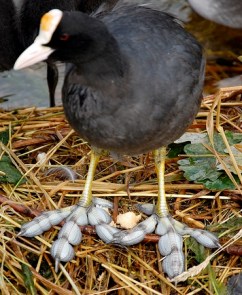
Giant Coot (Fulica gigantea) Loped Feet ©©Flickr
Thou hast enlarged my steps under me, that my feet did not slip. (Psalms 18:36 KJV)

Common Pheasant (Phasianus colchicus) “Ring-necked” for Birds Illustrated
From col. Chi. Acad. Sciences. Copyrighted by
Nature Study Pub. Co., 1897, Chicago.

E are fortunate in being able to present our readers with a genuine specimen of the Ring-Necked species of this remarkable family of birds, as the Ring-Neck has been crossed with the Mongolian to such an extent, especially in many parts of the United States, that they are practically the same bird now. They are gradually taking the place of Prairie Chickens, which are becoming extinct. The hen will hatch but once each year, and then in the late spring. She will hatch a covey of from eighteen to twenty-two young birds from each setting. The bird likes a more open country than the quail, and nests only in the open fields, although it will spend much time roaming through timberland. Their disposition is much like that of the quail, and at the first sign of danger they will rush into hiding. They are handy and swift flyers and runners. In the western states they will take the place of the Prairie Chicken, and in Ohio will succeed the Quail and common Pheasant.
While they are hardy birds, it is said that the raising of Mongolian-English Ring-Necked Pheasants is no easy task. The hens do not make regular nests, but lay their eggs on the ground of the coops, where they are picked up and placed in a patent box, which turns the eggs over daily. After the breeding season the male birds are turned into large parks until February.
The experiment which is now being made in Ohio—if it can be properly so termed, thousands of birds having been liberated and begun to increase—has excited wide-spread interest. A few years ago the Ohio Fish and Game Commission, after hearing of the great success of Judge Denny, of Portland, Oregon, in rearing these birds in that state, decided it would be time and money well spent if they should devote their attention and an “appropriation” to breeding and rearing these attractive game birds. And the citizens of that state are taking proper measures to see that they are protected. Recently more than two thousand Pheasants were shipped to various counties of the state, where the natural conditions are favorable, and where the commission has the assurance that the public will organize for the purpose of protecting the Pheasants. A law has been enacted forbidding the killing of the birds until November 15, 1900. Two hundred pairs liberated last year increased to over two thousand. When not molested the increase is rapid. If the same degree of success is met with between now and 1900, with the strict enforcement of the game laws, Ohio will be well stocked with Pheasants in a few years. They will prove a great benefit to the farmers, and will more than recompense them for the little grain they may take from the fields in destroying bugs and insects that are now agents of destruction to the growing crops.
The first birds were secured by Mr. E. H. Shorb, of Van Wert, Ohio, from Mr. Verner De Guise, of Rahway, N. J. A pair of Mongolian Pheasants, and a pair of English Ring-Necks were secured from the Wyandache Club, Smithtown, L. I. These birds were crossed, thus producing the English Ring-Neck Mongolian Pheasants, which are larger and better birds, and by introducing the old English Ring-Neck blood, a bird was produced that does not wander, as the thoroughbred Mongolian Pheasant does.
Such of our readers as appreciate the beauty and quality of this superb specimen will no doubt wish to have it framed for the embellishment of the dining room.
*
Summary:
RING-NECKED PHEASANT.—Phasianus torquatus. (Common Pheasant (Phasianus colchicus) – Today)
Range—Throughout China; have been introduced into England and the United States.
Nest—On the ground under bushes.
Eggs—Vary, from thirteen to twenty.

Pheasant (Phasianus colchius) by Robert Scanlon
Lee’s Addition:
“As a partridge that broods but does not hatch, So is he who gets riches, but not by right; It will leave him in the midst of his days, And at his end he will be a fool.” (Jer 17:11 NKJV)
What a lovely creation from the Creator. The male is especially beautiful and brightly feathered. The Common Pheasant is in the Phasianidae – Pheasants, Fowl & Allies. Family which currently has 182 species. Partridges are also part of the family and are closely related.
It is native to Asia and has been widely introduced elsewhere as a game bird. In parts of its range, namely in places where none of its relatives occur such as in Europe (where it is naturalized), it is simply known as the “pheasant”. Ring-necked Pheasant is both the name used for the species as a whole in North America and also the collective name for a number of subspecies and their intergrades which have white neck rings.
It is a well-known gamebird, among those of more than regional importance perhaps the most widespread and ancient one in the whole world. The Common Pheasant is one of the world’s most hunted birds; it has been introduced for that purpose to many regions, and is also common on game farms where it is commercially bred. Ring-necked Pheasants in particular are commonly bred and were introduced to many parts of the world; the game farm stock, though no distinct breeds have been developed yet, can be considered semi-domesticated. The Ring-necked Pheasant is the state bird of South Dakota, one of only three U.S. state birds that is not a species native to the United States.
There are many colour forms of the male Common Pheasant, ranging in colour from nearly white to almost black in some melanistic examples. These are due to captive breeding and hybridization between subspecies and with the Green Pheasant, reinforced by continual releases of stock from varying sources to the wild.
The adult male Common Pheasant of the nominate subspecies Phasianus colchicus colchicus is 24–35 in. in length with a long brown streaked black tail, accounting for almost 20 in. of the total length. The body plumage is barred bright gold and brown plumage with green, purple and white markings. The head is bottle green with a small crest and distinctive red wattle. P. c. colchicus and some other races lack a white neck ring.

Common Pheasant (Phasianus colchicus) ©WikiC Female
The female (hen) is much less showy, with a duller mottled brown plumage all over and measuring 20–25 in. long including a tail of around 8 in. Juvenile birds have the appearance of the female with a shorter tail until young males begin to grow characteristic bright feathers on the breast, head and back at about 10 weeks after hatching.
In the USA, Common Pheasants are widely known as “Ring-necked Pheasants“. More colloquial North American names include “chinks” or, in Montana, “phezzens“. In China, meanwhile, the species is properly called zhi ji (雉鸡) – “pheasant-fowl” –, essentially implying the same as the English name “Common Pheasant”. Like elsewhere, P. colchicus is such a familiar bird in China that it is usually just referred to as shan ji (山雞), “mountain chicken”, a Chinese term for pheasants in general.
There are about 30 subspecies in five (sometimes six) groups. These can be identified according to the male plumage, namely presence or absence of a white neck-ring and the color of the uppertail (rump) and wing coverts.
Common Pheasants feed solely on the ground but roost in sheltered trees at night. They eat a wide variety of animal and vegetable type-food, like fruit, seeds and leaves as well as a wide range of invertebrates, with small vertebrates like snakes, lizards, small mammals, and birds occasionally taken.

Common Pheasant (Phasianus colchicus) ©WikiC Egg
The males are often accompanied by a harem of several females. Common Pheasants nest on the ground, producing a clutch of around ten eggs over a two-three week period in April to June. The incubation period is about 23–26 days. The chicks stay near the hen for several weeks after hatching but grow quickly, resembling adults by only 15 weeks of age.

Common Pheasant (Phasianus colchicus) ©WikiC Chick One Hour Old
Two links, one to a photo and the other to information that I do not like, but it happens:
http://en.wikipedia.org/wiki/File:Game_birds_Borough_Market.jpg – Game birds at Borough Market in London.
http://www.featherstore.com/English-Ringneck-Pheasant-Tails-10-12-p/erpt1.htm – Tail feathers for sale.
One remark to these is that Our Heavenly Father knows when they fall.
… And yet not one of them will fall to the ground without your Father’s leave (consent) and notice. (Mat 10:29 AMP)
My other remark is that, like the Partridge, they are “Clean” birds and are allowed to be eaten. I can handle that, but those that only hunt them for a plaque on their wall or feathers for a hat, for me, it is sad.
Now therefore, let not my blood fall to the earth away from the presence of the LORD, for the king of Israel has come out to seek a single flea like one who hunts a partridge in the mountains. (1Sa 26:20 ESV)
*
Birds Illustrated by Color Photography – Revisited
The above article is an article in the monthly serial for October 1897 “designed to promote Knowledge of Bird-Live.” These include Color Photography, as they call them, today they are drawings. There are at least three Volumes that have been digitized by Project Gutenberg.
To see the whole series of – Birds Illustrated by Color Photography – Revisited
*
(Information from Wikipedia and other internet sources, with editing)
Next Article – More Bird Miscellany
The Previous Article – The Bronzed Grackle
Links:
Ring-necked Pheasant – All About Birds
Common Pheasant – Wikipedia
Phasianidae – Pheasants, Fowl & Allies. Family
Birds of the Bible – Partridge
*

Common Grackle (Quiscalus quiscula) “Bronzed Grackle” for Birds Illustrated
From col. Chi. Acad. Sciences. Copyrighted by
Nature Study Pub. Co., 1897, Chicago.
You can call me the Crow Blackbird, little folks, if you want to. People generally call me by that name.
I look something like the Crow in the March number of Birds, don’t I? My dress is handsomer than his, though. Indeed I am said to be a splendid looking bird, my bronze coat showing very finely in the trees.
The Crow said Caw, Caw, Caw! to the little boys and girls. That was his way of talking. My voice is not so harsh as his. I have a note which some people think is quite sweet; then my throat gets rusty and I have some trouble in finishing my tune. I puff out my feathers, spread my wings and tail, then lifting myself on the perch force out the other notes of my song. Maybe you have seen a singer on the stage, instead of a perch, do the same thing. Had to get on his tip-toes to reach a high note, you know.
Like the Crow I visit the cornfields, too. In the spring when the man with the plow turns over the rich earth, I follow after and pick up all the grubs and insects I can find. They would destroy the young corn if I didn’t eat them. Then, when the corn grows up, I, my sisters, and my cousins, and my aunts drop down into the field in great numbers. Such a picnic as we do have! The farmers don’t seem to like it, but certainly they ought to pay us for our work in the spring, don’t you think? Then I think worms as a steady diet are not good for anybody, not even a Crow, do you?
We like nuts, too, and little crayfish which we find on the edges of ponds. No little boy among you can beat us in going a-nutting.
We Grackles are a very sociable family, and like to visit about among our neighbors. Then we hold meetings and all of us try to talk at once. People say we are very noisy at such times, and complain a good deal. They ought to think of their own meetings. They do a great deal of talking at such times, too, and sometimes break up in a fight.
How do I know? Well, a little bird told me so.
Yes, we build our nest as other birds do; ours is not a dainty affair; any sort of trash mixed with mud will do for the outside. The inside we line with fine dry grass. My mate does most of the work, while I do the talking. That is to let the Robin and other birds know I am at home, and they better not come around.
Yours,
Mr. Bronzed Grackle.
First come the Blackbirds clatt’rin in tall trees,
And settlin’ things in windy congresses,
Queer politicians though, for I’ll be skinned
If all on ’em don’t head against the wind.
—Lowell.

Y the more familiar name of Crow Blackbird this fine but unpopular bird is known, unpopular among the farmers for his depredations in their cornfields, though the good he does in ridding the soil, even at the harvest season, of noxious insects and grubs should be set down to his credit.
The Bronzed Grackle or Western Crow Blackbird, is a common species everywhere in its range, from the Alleghenies and New England north to Hudson Bay, and west to the Rocky Mountains. It begins nesting in favorable seasons as early as the middle of March, and by the latter part of April many of the nests are finished. It nests anywhere in trees or bushes or boughs, or in hollow limbs or stumps at any height. A clump of evergreen trees in a lonely spot is a favorite site, in sycamore groves along streams, and in oak woodlands. It is by no means unusual to see in the same tree several nests, some saddled on horizontal branches, others built in large forks, and others again in holes, either natural or those made by the Flicker. A long list of nesting sites might be given, including Martin-houses, the sides of Fish Hawk’s nests, and in church spires, where the Blackbirds’ “clatterin’” is drowned by the tolling bell.
The nest is a coarse, bulky affair, composed of grasses, knotty roots mixed with mud, and lined with fine dry grass, horse hair, or sheep’s wool. The eggs are light greenish or smoky blue, with irregular lines, dots and blotches distributed over the surface. The eggs average four to six, though nests have been found containing seven.
The Bronze Grackle is a bird of many accomplishments. He does not hop like the ordinary bird, but imitates the Crow in his stately walk, says one who has watched him with interest. He can pick beech nuts, catch cray fish without getting nipped, and fish for minnows alongside of any ten-year-old. While he is flying straight ahead you do not notice anything unusual, but as soon as he turns or wants to alight you see his tail change from the horizontal to the vertical—into a rudder. Hence he is called keel-tailed.
The Grackle is as omnivorous as the Crow or Blue Jay, without their sense of humor, and whenever opportunity offers will attack and eat smaller birds, especially the defenseless young. His own meet with the like fate, a fox squirrel having been seen to emerge from a hole in a large dead tree with a young Blackbird in its mouth. The Squirrel was attacked by a number of Blackbirds, who were greatly excited, but it paid no attention to their demonstrations and scampered off into the wood with his prey. Of their quarrels with Robins and other birds much might be written. Those who wish to investigate their remarkable habits will do well to read the acute and elaborate observations of Mr. Lyndes Jones, in a recent Bulletin of Oberlin College. He has studied for several seasons the remarkable Bronze Grackle roost on the college campus at that place, where thousands of these birds congregate from year to year, and, though more or less offensive to some of the inhabitants, add considerably to the attractiveness of the university town.
The breeding habitat is open and semi-open areas across North America east of the Rocky Mountains. The nest is a well-concealed cup in dense trees (particularly pine) or shrubs, usually near water; sometimes, the Common Grackle will nest in cavities or in man-made structures. It often nests in colonies, some being quite large. Bird houses are also a suitable nesting site. There are 4-7 eggs.
This bird is a permanent resident in much of its range. Northern birds migrate in flocks to the southeastern United States.
*

Common Grackle (Quiscalus quiscula) by Raymond Barlow
Summary:
BRONZED GRACKLE.—Quiscalus quiscula æneus. (Now Common Grackle)
Range—Eastern North America from the Alleghenies and New England north to Hudson Bay, west to the Rocky Mountains.
Nest—In sycamore trees and oak woodlands a coarse bulky structure of grasses, knotty roots, mixed with mud, lined with horse hair or wool.
Eggs—Four to six, of a light greenish or smoky-blue, with lines, dots, blotches and scrawls on the surface.

Common Grackle (Quiscalus quiscula) ©©Eric Begin at Flickr
Lee’s Addition:
Look at the birds of the air, for they neither sow nor reap nor gather into barns; yet your heavenly Father feeds them. Are you not of more value than they? (Mat 6:26 NKJV)
The “Bronzed Grackle” is actually a subspecies of the Common Grackle. They are in the Icteridae – Oropendolas, Orioles & Blackbirds Family which has 108 members (IOC 3.4). In that family, there are 11 different Grackles. What a beautiful creation from the Lord. When this bird is out in the sun, it just shines.
The LORD make His face shine upon you, And be gracious to you; (Num 6:25 NKJV)
Make Your face shine upon Your servant, And teach me Your statutes. (Psa 119:135 NKJV)
Adult Common Grackles measure from 28 to 34 cm (11 to 13 in) in length, span 14–18 in (36–46 cm) across the wings and weigh 74–142 g (2.6–5.0 oz).[2] Common grackles are less sexually dimorphic than larger grackle species but the differences between the sexes can still be noticeable. The male, which averages 4.3 oz (122 g), is larger than the female, at an average of 3.3 oz (94 g).
Adults have a long, dark bill, pale yellowish eyes and a long tail; its feathers appear black with purple, green or blue iridescence on the head, and primarily bronze sheen in the body plumage. The adult female, beyond being smaller, is usually less iridescent; her tail in particular is shorter, and unlike the males, does not keel in flight and is brown with no purple or blue gloss. The juvenile is brown with dark brown eyes.

Common Grackle (Quiscalus quiscula) Chick ©WikiC
The common grackle forages on the ground, in shallow water or in shrubs; it will steal food from other birds. It is omnivorous, eating insects, minnows, frogs, eggs, berries, seeds, grain and even small birds and mice. Grackles at outdoor eating areas often wait eagerly until someone drops some food. They will rush forward and try to grab it, often snatching food out of the beak of another bird. Grackles prefer to eat from the ground at birdfeeders, making scattered seed an excellent choice of food for them. In shopping centers, grackles can be regularly seen foraging for bugs, especially after a lawn trimming.
Along with some other species of grackles, the common grackle is known to practice “anting,” rubbing insects on its feathers to apply liquids such as formic acid secreted by the insects. (See Birdwatching – Anting)
This bird’s song is particularly harsh, especially when these birds, in a flock, are calling. Songs vary from, year round “Chewink Chewink” to a more complex breeding season “Ooo whew,whew,whew,whew,whew” call that gets faster and faster and ends with a loud “Crewhewwhew!” It also occasionally sounds like a power line buzzing. The grackle can also mimic the sounds of other birds or even humans, though not as precisely as the mockingbird, which is known to share its habitat in the Southeastern United States.
By Chris Parrish xeno-canto
In the breeding season, males tip their heads back and fluff up feathers to display and keep other males away. This same behavior is used as a defensive posture to attempt to intimidate predators. Male common grackles are less aggressive toward one another, and more cooperative and social, than the larger boat-tailed grackle species.
Grackles tend to congregate in large groups, popularly referred to as a plague. This enables them to detect birds invading their territory, and predators, which are mobbed en masse to deter the intruders.
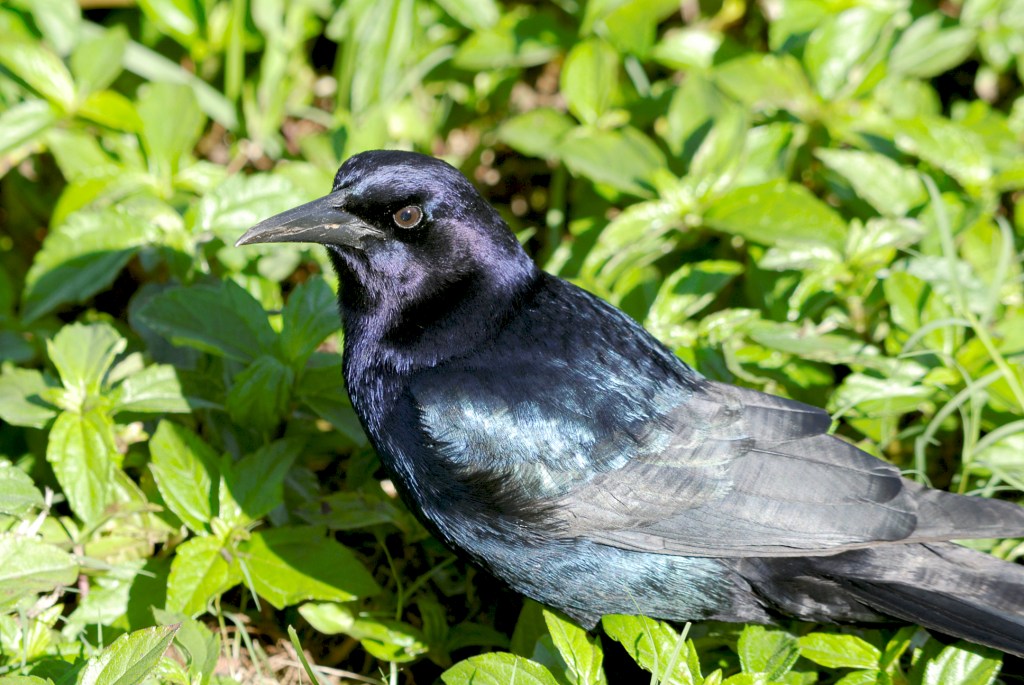
Common Grackle (Quiscalus quiscula quiscula) – Purple Form By Dan’sPix
*
Birds Illustrated by Color Photography – Revisited
The above article is an article in the monthly serial for October 1897 “designed to promote Knowledge of Bird-Live.” These include Color Photography, as they call them, today they are drawings. There are at least three Volumes that have been digitized by Project Gutenberg.
To see the whole series of – Birds Illustrated by Color Photography – Revisited
*
(Information from Wikipedia and other internet sources, with editing)
Next Article – The Ring-necked Pheasant
The Previous Article – The Verdin
Links:
Common Grackle – All About Birds
Common Grackle – Wikipedia
Common Grackle – National Geographic
Common Grackle – IBC Video
Common Grackle – xeno-canto
Icteridae – Oropendolas, Orioles & Blackbirds Family
*


 Birds of the Bible For Kids